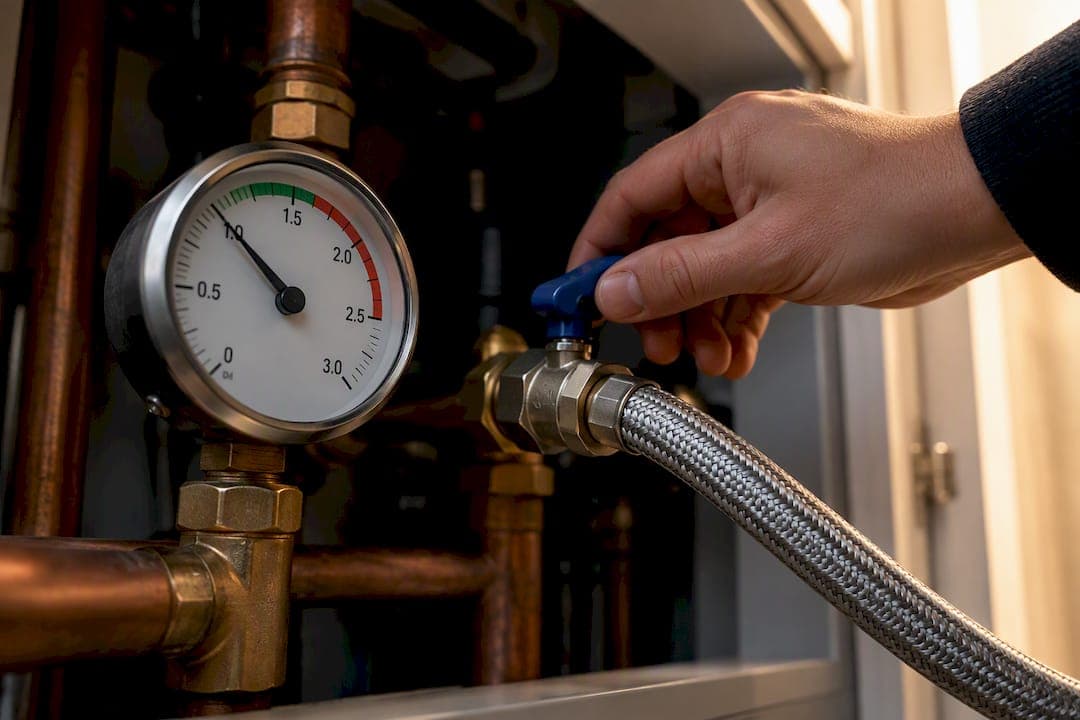
Most boilers losing pressure have either just been bled of a radiator or have a small, slow leak somewhere in the system. Check the gauge now: normal is roughly 1.0 to 1.5 bar. If it's dropping fast, repeatedly, or you can see water anywhere, stop trying to fix it yourself and call a Gas Safe engineer.
TL;DR:
- Most boiler pressure drops are caused by radiator bleeding or minor leaks in pipes, valves, or internal seals, especially if pressure falls below 1 bar.
- Regularly checking the pressure gauge and bleeding radiators promptly can prevent persistent pressure issues, but recurring drops may indicate leaks or faulty components.
- Frequent need for topping up your system over weeks suggests underlying problems like leaks, a failing expansion vessel, or a faulty pressure relief valve, requiring professional inspection.
- Avoid DIY fixes if pressure drops repeatedly within days or if the pressure relief valve discharges water, as these signs point to serious issues needing a Gas Safe engineer.
- Maintaining pressure between 1.0 and 1.5 bar with annual servicing and proper system habits minimizes the risk of leaks, sludge buildup, and damage to the boiler.
Table of Contents
- How to check your boiler's pressure
- What usually causes a boiler to lose pressure?
- Safe checks and fixes you can try tonight
- When should you call a Gas Safe engineer?
- Preventing pressure loss before it starts
- Does water quality affect boiler pressure?
- Finding leaks in places you can't easily see
- How often should you actually need to top up?
- Michael's practical take: common mistakes and quick judgment calls
- How Your-local-plumber can help with a boiler that keeps losing pressure
- Sources
- FAQ
How to check your boiler's pressure
The pressure gauge or digital display usually sits on the front of the boiler, sometimes behind a small flap. Combi boilers show it constantly; some system boilers display it only when you press a button or open the control panel.
Read it with the heating off first, then compare after the system has been running for twenty minutes or so, since pressure naturally rises slightly when the water heats and expands.
- Below 1 bar: system is low, likely needs topping up
- 1.0 to 1.5 bar: normal range for most systems
- Around 2.0 bar or higher: too high, don't top up further
- Needle stuck at 0: could be a gauge fault or a serious pressure loss
Before touching anything, do a quick visual sweep. Check for damp patches near radiators, pipe joints, or under the boiler itself. In cold weather, glance at the condensate pipe outside your house for ice, and make sure both filling loop taps are shut tight, not just resting closed.
What usually causes a boiler to lose pressure?
Bleeding a radiator is the most common trigger. Letting trapped air out releases a small amount of water too, which drops system pressure enough that you'll need to top up afterwards.
Leaks come next on the list, and they're not always obvious. Radiator valves, pipe joints under floorboards, and the boiler's internal seals can all weep slowly enough that you never see a puddle, just a pressure gauge that keeps creeping down.
Which? has documented in its boiler maintenance guidance, where gradual pressure loss without an obvious cause is one of the most reported boiler complaints.
Other frequent culprits include:
- A filling loop left slightly open, letting water drift into the system and unbalance the pressure over days
- A faulty pressure relief valve (PRV), which can leak water outside through the overflow pipe
- A failing expansion vessel, which loses the ability to absorb pressure changes as the water heats and cools
- A frozen condensate pipe in winter, which can cause the boiler to lock out and sometimes drop pressure as a side effect
If your system needs a top-up every few weeks rather than every few months, that pattern itself is a diagnostic clue, not just an inconvenience.
Safe checks and fixes you can try tonight
1. Bleed the radiators. Turn off the heating and let it cool. Using a radiator key, open the valve slightly at the top corner of each radiator until air stops hissing and water starts to trickle out, then close it. Cold spots at the top of a radiator with warmth below are the classic sign of trapped air.
2. Check the pressure again. After bleeding, the gauge will almost always have dropped. This is expected, not a fault.
3. Repressurise using the filling loop. Most combi boilers have a flexible braided hose (internal loop) or a permanent valve setup (external loop) connecting the mains to the heating system. With the boiler off and cool, open both taps slowly and watch the gauge climb. Add water gradually and stop as soon as you hit 1.0 to 1.5 bar, then close both taps fully.
4. Run a heating cycle and recheck. Switch the heating on for fifteen minutes, then check the gauge again once it's settled.
Pro Tip: A shockingly common mistake is closing the filling loop taps only halfway, thinking they're shut because the handle has stopped turning easily. Push the handle fully perpendicular to the pipe. If it's not, water keeps drifting in and your pressure creeps up over days, sometimes triggering the PRV to discharge.
Stop immediately and isolate the system if you see water actively leaking, the PRV is discharging outside, or the gauge won't hold pressure at all after topping up twice.
When should you call a Gas Safe engineer?
Anything involving work on the boiler itself, not just topping up via the filling loop, must legally be carried out by a Gas Safe registered engineer. You can check any engineer's registration number on the Gas Safe Register website before they arrive, and it's worth doing every time, not just for new tradespeople.
Certain signs mean you should stop DIY entirely and book a professional:
- Pressure drops again within days of topping up, more than once
- You spot a leak anywhere on the system, however small
- The PRV is discharging water through its outside pipe
- Error codes appear on the display alongside pressure warnings
- No amount of topping up holds the pressure for more than a day or two
An engineer visit typically involves pressure testing the whole system, inspecting the PRV and expansion vessel, and tracing any leak with dye or a leak detection kit. Non-Gas Safe registered installers can carry out some wet-side plumbing work, but final gas connections and internal boiler checks must be done by someone registered, which is worth remembering if you're ever tempted to let a general handyman loose on the boiler casing.
Preventing pressure loss before it starts
A yearly service catches most pressure faults before they become emergencies, and booking before winter demand peaks means you're not competing for an engineer's time when your heating actually fails.
Beyond the annual service, a few habits keep pressure problems rare rather than routine:
- Glance at the gauge once a month, especially before the heating season starts
- Bleed radiators as soon as you notice cold spots, then recheck pressure straight after
- Lag or insulate the condensate pipe if it runs outside, to stop winter freezing
- Never leave the filling loop connected or the taps ajar after topping up
If you find yourself topping up repeatedly rather than occasionally, that's the signal to book an engineer instead of reaching for the filling loop again.
Does water quality affect boiler pressure?
Hard water and old, unflushed systems both contribute to pressure problems, just less directly than a leak. Limescale builds up inside heat exchangers and pipework in hard water areas, restricting flow and making the whole system work harder, which can accelerate wear on seals and valves that eventually leak.
Sludge is the other culprit, a black, gritty residue made of rust and mineral deposits that accumulates inside radiators and pipework over years. It doesn't cause pressure loss directly, but it corrodes joints and valve seats from the inside, and a corroded joint is exactly where a slow weep starts.
Systems with a magnetic filter fitted near the boiler catch much of this debris before it circulates, and an engineer will usually check and clean this filter during an annual service. Homes without one, or with an older system that's never been chemically flushed, tend to see more frequent minor leaks and more radiators needing regular bleeding, both of which chip away at pressure over time.
If your radiators need bleeding every month rather than every year, sludge build up is a likely reason, not bad luck. A power flush, carried out by a qualified engineer, clears years of accumulated debris and often resolves pressure quirks that DIY topping up never quite fixes. It's not a cheap job, but it's considerably cheaper than replacing a heat exchanger damaged by years of gritty water circulating through it.
Finding leaks in places you can't easily see
Not every leak shows up as a puddle on the carpet. Pipe joints under floorboards, behind stud walls, or feeding underfloor heating loops can weep for months before anyone notices, and by the time a stain appears on a ceiling below, water has often been escaping for weeks.
A useful diagnostic clue: if pressure only drops while the heating is switched off, then seems to recover once it's running, suspect a leak interacting with thermal expansion rather than a straightforward hole in a pipe. Water escaping under pressure sometimes only becomes visible as a damp patch once the system has cooled and contracted.
For underfloor heating specifically, a persistent pressure drop with no visible leak anywhere upstairs is one of the strongest indicators that the loop itself, buried under the screed, has a fault. This is not a DIY diagnosis. Engineers use pressure testing rigs that isolate sections of pipework and thermal imaging cameras that spot the temperature differential a hidden leak creates, sometimes before any damp patch appears at all.

Musty smells in a room with no obvious source, a boiler that needs increasingly frequent top-ups, or skirting boards that feel warm in unexpected places are all worth mentioning to an engineer, even if you can't see anything wrong. Catching a hidden leak early is almost always cheaper than dealing with the damp and flooring damage that follows months of it going unnoticed.
How often should you actually need to top up?
Topping up two or three times a year, usually after bleeding radiators or after the system has sat unused over summer, is entirely normal and nothing to worry about. Which? notes that occasional small top-ups are expected, particularly following maintenance work or a long period without heating running.
What isn't normal is topping up every few weeks, or watching the gauge drift down within days of a top-up. That pattern points to a leak, a faulty component, or a filling loop that isn't sealing properly, not routine system behaviour.
A useful way to think about frequency: occasional loss follows an event, like bleeding a radiator or the heating being off for a fortnight while you're away. Regular loss follows no event at all, the pressure just falls on its own schedule, week after week, regardless of what you've done to the system.

If you're genuinely unsure which category you're in, keep a rough note of the date each time you top up for a couple of months. Two or three entries spread across that time with an obvious cause each time is fine. Weekly entries with no explanation is the point to book someone in.
Michael's practical take: common mistakes and quick judgment calls
The mistake I see repeated most is people leaving a filling loop tap slightly open after topping up, then wondering why the pressure keeps drifting upward for days afterwards. Check the handle sits perpendicular to the pipe, every time.
My rule of thumb: if you've had to top up more than twice in six months with no obvious cause like bleeding radiators, stop DIY-ing it and get an engineer out. Persistent tinkering rarely fixes a genuine fault, it just delays finding it.
— Michael
How Your-local-plumber can help with a boiler that keeps losing pressure
If you've worked through the checks above and the pressure still won't hold, or you've spotted a leak you can't trace, that's when it's worth bringing in someone qualified rather than guessing further.

Your-local-plumber sends Gas Safe registered engineers for exactly this kind of job, whether it's a suspected leak, a faulty PRV, or a boiler that keeps locking out on low pressure. There's no call-out fee, pricing is transparent, and every repair comes with a 12-month warranty, so you're not left wondering what you're paying for before anyone arrives. Heating and boiler repairs are charged at £110 per hour, and if the diagnosis points to something more serious than a repair, you can get a free new boiler quote on the same visit.
For anything urgent, an active leak, a PRV discharging, or a boiler that's lost pressure completely overnight, the emergency plumbing and heating service offers a 60 minute response, 24/7, including holidays. For anything less urgent, book a standard plumbing visit online and get an engineer out at a time that suits you.
Sources
- Boiler services explained - Energy Saving Trust
- What should your boiler pressure be? - Which?
- Gas safety: who can carry out gas work - HSE
FAQ
Can a boiler lose pressure without a leak?
Yes. Bleeding a radiator, a filling loop left slightly open, or a failing expansion vessel can all drop pressure without any water visibly escaping the system.
How often is it normal for a boiler to lose pressure?
Topping up two or three times a year, especially after bleeding radiators or a long period with the heating off, is considered normal. Needing to top up every few weeks points to a leak or a faulty component.
Is losing 0.1 bar a week normal?
A very slow, steady drift of this kind can sometimes be within tolerance, particularly in older systems, but it's worth monitoring rather than ignoring. If it continues for more than a month or two, book a Gas Safe engineer to check for a slow leak.
Is it safe to leave a boiler with low pressure?
Running a boiler well below 1 bar for long periods can cause it to lock out or stop heating properly, and in some cases risks damage to the pump or heat exchanger. Top up to the normal 1.0 to 1.5 bar range as soon as you notice it, and call an engineer if it keeps happening.