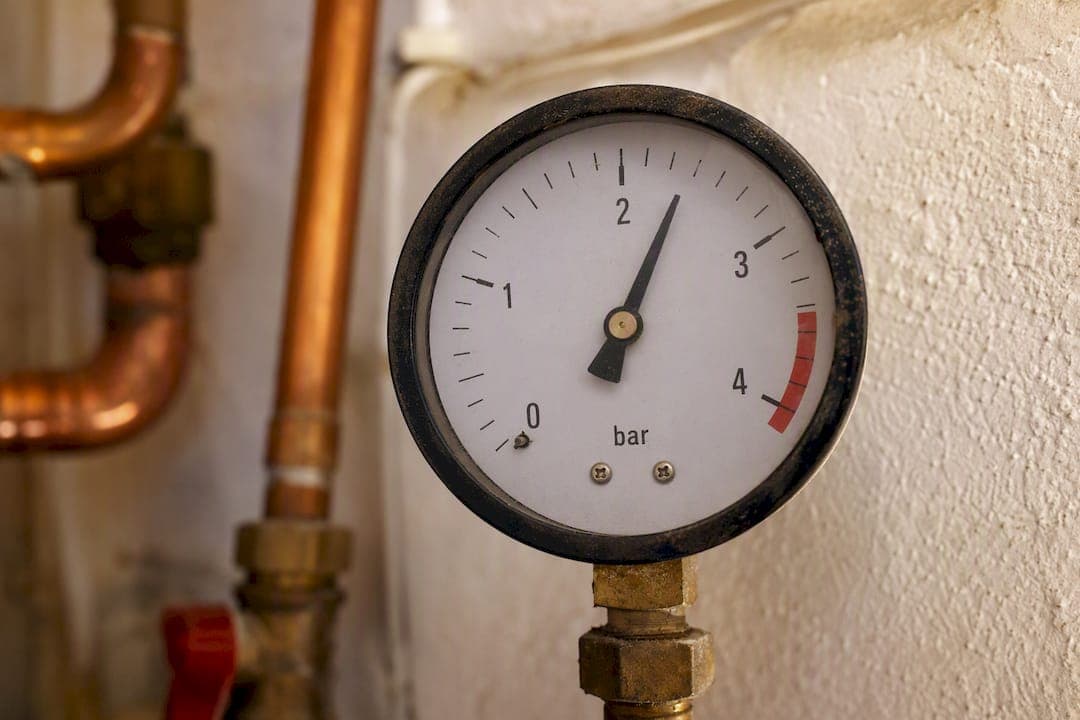
If your gauge sits above 2.5 bar, that's high, but not yet an emergency unless water is discharging from the pressure relief valve or pressure keeps climbing to a dangerously high level. First move: switch the boiler off, let the system cool for 30 to 60 minutes, then recheck the reading. If it's still elevated and you're confident with the process, bleeding a radiator often brings it straight back down. Only call a Gas Safe registered engineer if pressure won't drop, keeps climbing, or you spot a leak.
TL;DR:
- Bleeding a radiator can often reduce high boiler pressure from above 2.5 bar back to safe levels without professional help.
- A cold boiler should read between 1.0 and 1.5 bar, with 1.0 to 2.0 bar being normal when the system is hot.
- Active discharge from the pressure relief valve or pressure readings above 3.0 bar indicate urgent issues requiring immediate shutdown and professional inspection.
- Repeated pressure rises despite bleeding and checking the filling loop usually point to expansion vessel failure or internal pressure system faults.
- DIY fixes are suitable for minor overfills, but persistent high pressure or leaks necessitate booking a Gas Safe engineer for diagnosis and repair.
Table of Contents
- What normal boiler pressure looks like on the gauge
- Warning signs you're dealing with high boiler pressure problems
- Why does high boiler pressure happen in the first place?
- How to reduce boiler pressure yourself: five safe steps
- When high pressure points to a fault only an engineer can fix
- Safety checklist: isolate now or book an engineer?
- Combi boilers vs system boilers: does the fix differ?
- Author perspective: a plumber's quick workflow and expectations on call-outs
- Book an engineer from Your Local Plumber
- Sources
What normal boiler pressure looks like on the gauge
A cold boiler should read somewhere between 1.0 and 1.5 bar. Once the heating fires up and the system warms through, that figure climbs a little, and 1.0 to 2.0 bar while running is entirely normal for most combi boilers. It's the readings that remain consistently above the normal operating pressure, whether cold or hot, that indicate a genuine fault worth investigating.
Finding the gauge is easy once you know where to look. On most combi boilers it's a small analogue dial on the front panel, often with a coloured zone (green for safe, red for too high or too low). Newer models show the figure digitally on the display screen instead, sometimes alongside a fault code.
A small bump in pressure as the water heats is completely expected, since hot water expands and needs somewhere to go. The problem starts when:
- The needle sits in the red zone even when the system is cold.
- Pressure keeps creeping up every time the heating cycles.
- The digital display flashes a pressure warning repeatedly, not just once.
Warning signs you're dealing with high boiler pressure problems
A gauge reading is the clearest signal, but your boiler often tells you something's wrong before you even glance at the dial. Lock-outs and error codes are usually the first clue, followed by odd noises from the pipework as trapped air or excess water pushes through the system under strain.
Watch for:
- The boiler locking out or displaying an error code related to pressure.
- Banging, gurgling, or knocking noises when the heating is running.
- Water dripping or spraying from the pressure relief valve outlet, usually a small pipe near an external wall.
- A gauge reading that won't settle, even after you've bled a radiator.
None of this means your boiler is about to explode. Modern safety valves are designed specifically to release pressure before things reach that point, so an explosion is extremely unlikely. What does happen, though, is component stress, seal failure, and slow leaks that get worse the longer they're ignored. If you see active discharge from the PRV or water pooling near the boiler, that's your cue to isolate the system and get someone qualified to look at it.
Why does high boiler pressure happen in the first place?
Most cases come down to one of four culprits, and three of them are things you can check yourself before assuming the worst.
- Overfilling. Adding too much water through the filling loop, or leaving the loop valve cracked open even slightly, slowly pushes pressure up over hours or days.
- A stuck or misaligned filling loop. Check the handles or lever; if it's not fully closed and aligned, water keeps trickling into the system unnoticed.
- A failing expansion vessel. This internal component absorbs the extra volume created when water heats up. Once its air charge weakens, it can't do that job, and pressure spikes every time the heating runs.
- A faulty pressure relief valve. Sometimes the PRV itself is the problem, either leaking pressure away (giving a falsely low reading) or failing to vent properly when it should.
Spotting which of these applies usually just takes a five minute look at the filling loop and a memory of how the pressure's been behaving over the past few days.
How to reduce boiler pressure yourself: five safe steps
Before touching anything, make sure the boiler is switched off and has had time to cool. Working on a hot system risks scalding and gives you an inaccurate reading anyway.
-
Switch off and wait. Turn the boiler off at the control panel and let it stand for 30 to 60 minutes. This lets the water inside cool and settle, so whatever you read on the gauge afterwards reflects the true baseline rather than a temporary spike.
-
Check and record the cold reading. Note the exact figure. If it's still above 2.5 bar once fully cooled, that's your working number and the one worth writing down for later.
-
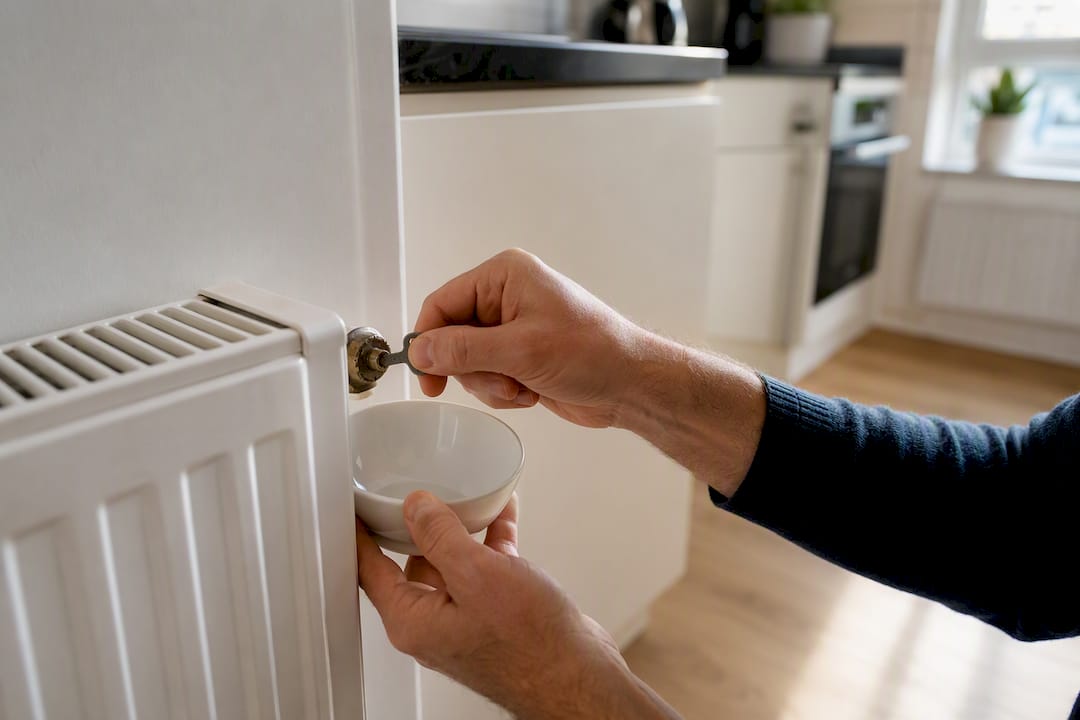
Bleed a radiator. Choose one radiator, ideally on a lower floor, and have a cloth and small container ready. Using a radiator key, turn the bleed valve slowly and anticlockwise until you hear a hiss of air, then feel for water starting to trickle out. Close the valve the moment water appears steadily, rather than air. This releases a small amount of fluid from the sealed system, which is often enough to bring pressure back to 1.0 to 1.5 bar. Our detailed radiator bleeding guide covers tools and technique if this is your first attempt.
-
Try the drain-off valve if bleeding doesn't shift it. Usually located near the boiler or on a downstairs pipe run, the drain-off (or filter) valve lets out more water than a radiator bleed alone. This step carries more risk of a mess or an awkward reassembly, so only attempt it if you're genuinely comfortable, and our guide to draining a boiler system walks through it properly.
-
Confirm the filling loop is fully closed. Both handles or the lever should sit at a right angle to the pipe, fully shut. A loop that's even slightly open is a common reason pressure creeps straight back up within a day or two.
Once you've made an adjustment, switch the heating back on, let it run through a full cycle, and recheck the gauge. Write down each reading with a date and time.
Pro Tip: Keep a simple log of pressure readings on your phone, cold and hot, over a week. A single high reading is usually harmless, but a pattern of rises tells an engineer exactly what's failing before they even arrive.
When high pressure points to a fault only an engineer can fix
If bleeding a radiator and checking the filling loop haven't solved it, or the pressure creeps back up within a day, the problem is probably inside the boiler itself rather than in the visible pipework.
The usual suspect is the expansion vessel, a sealed component that absorbs the extra volume created when water heats and expands. It works because of a pre-charged air cushion inside; when that air charge leaks away over years of use, the vessel can no longer do its job, and pressure spikes every heating cycle. As a rule of thumb, if pressure rises by more than 1 bar between cold and hot, the vessel is a likely cause.
An engineer diagnosing persistent high pressure will typically work through a set order: confirm the cold reading, rule out an open filling loop, test the expansion vessel's pre-charge with a specialist gauge, then check the PRV's integrity and continuity. Steps involving the vessel and valve need proper tools, which is why this stage generally isn't a DIY job.
| What's being checked | Why it matters |
|---|---|
| Expansion vessel pre-charge | Confirms whether the vessel is still absorbing expansion correctly |
| PRV integrity | Checks the valve opens and seals at the right pressure |
| Filling loop seal | Rules out a slow, hidden overfill |
| Internal valves | Identifies less obvious leaks feeding pressure back up |
Before the visit, take photos of the gauge, note down your readings log, and photograph any leaks. It genuinely speeds up diagnosis and can save you a second call-out.
Safety checklist: isolate now or book an engineer?
Some signs mean stop immediately; others mean book soon but you're not in danger tonight.
Isolate and stop using the system now if you see:
- Water actively discharging from the pressure relief valve outlet.
- Any visible leak around the boiler, radiators, or pipework.
- Pressure consistently reading above 3.0 bar and not dropping.
- Damp patches or staining on ceilings below the system.
Book a visit soon if you notice:
- The boiler locking out repeatedly with a pressure-related code.
- The gauge fluctuating noticeably between heating cycles.
- Suspected expansion vessel failure based on the readings you've logged.
Pro Tip: Before booking, ask whether the engineer is registered on the Gas Safe Register and quote your registration check number back to them; you can verify any engineer's ID on the official Gas Safe Register site in under a minute.
Anything involving a leak near the boiler is worth treating as urgent rather than routine.
Combi boilers vs system boilers: does the fix differ?
The core problem, too much water volume for the system to handle safely, is the same in both, but the layout changes where you look first.
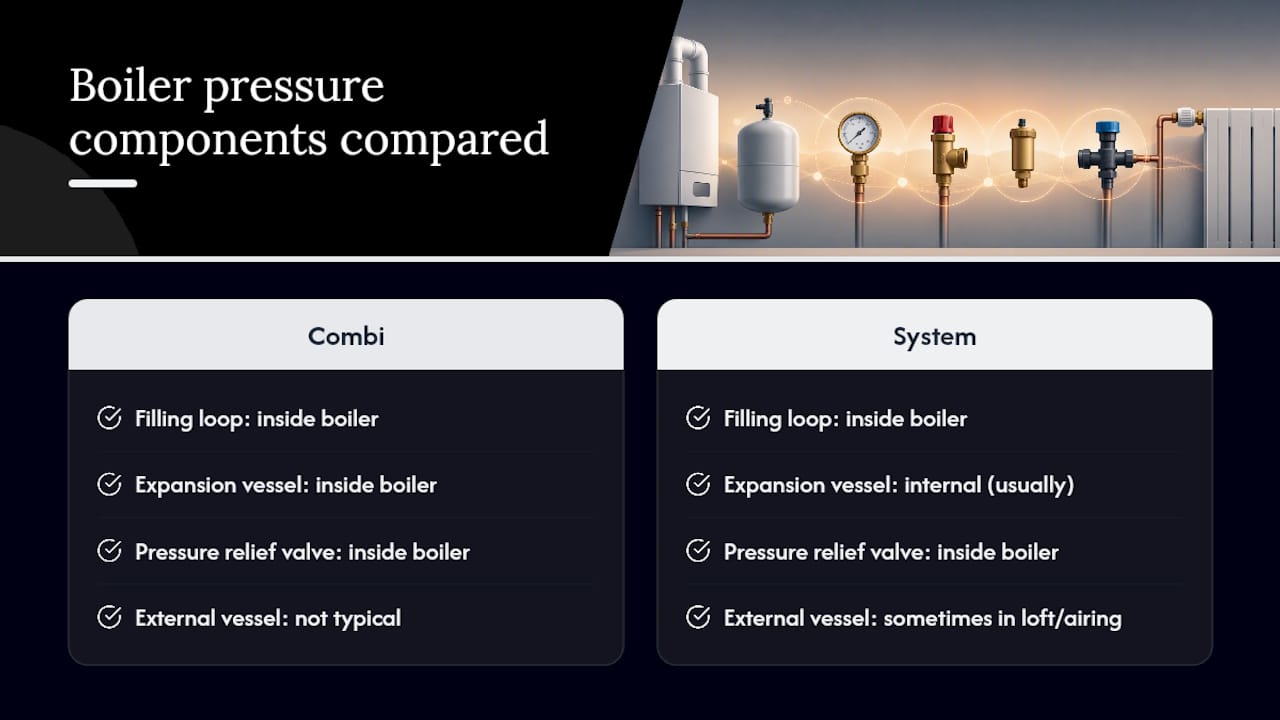
A combi boiler heats water on demand and houses the expansion vessel, filling loop, and PRV all within one compact unit. That makes diagnosis relatively contained: pressure faults nearly always trace back to something inside or immediately connected to the boiler casing itself.
A system boiler works alongside a separate hot water cylinder, and while it still uses a filling loop and internal expansion vessel, some installations include an additional external expansion vessel elsewhere in the system, often in the loft or an airing cupboard. That means a pressure fault on a system boiler can sometimes originate somewhere other than the boiler itself, which makes a DIY radiator bleed less likely to solve it on its own.
Regular (heat-only) boilers paired with an open vented cylinder don't use the same sealed-system pressure gauge at all, so if your setup includes a header tank in the loft rather than a filling loop, high "pressure" symptoms usually mean something different entirely, and comparing notes with a system-boiler troubleshooting guide won't apply.
Author perspective: a plumber's quick workflow and expectations on call-outs
Most call-outs for this follow the same shape. I check the cold reading first, glance at the filling loop, then bleed a radiator on site while I talk through what I'm seeing. That alone resolves a fair number of jobs within the first fifteen minutes.
When it doesn't, the pattern repeats often enough to be predictable: a tired expansion vessel that needs recharging or replacing, or a PRV that's worn past sealing properly. Neither is expensive to diagnose, and having your pressure readings logged beforehand genuinely cuts the visit shorter. Transparent pricing means you know the cost before anything's touched.
— Michael
Book an engineer from Your Local Plumber
Your-local-plumber gets you a Gas Safe registered engineer at your door faster than sourcing quotes yourself and waiting days for a slot. If the steps above haven't brought your pressure down, or you've spotted a PRV leak, don't keep resetting the boiler and hoping it holds.

Your-local-plumber handles emergency call-outs, expansion vessel recharging or replacement, PRV repairs, radiator bleeding, and full system draining, all with transparent fixed pricing agreed before work starts. DIY fixes are fine for a one-off overfill; a booked engineer is the right call once pressure keeps returning or you can see water where it shouldn't be. Book your engineer visit today and get the fault checked properly, not just patched over.
Sources
For consumer guidance on safe pressure ranges, Which? is a solid starting point. For model-specific tolerances and PRV behaviour, check manufacturer pages from Vaillant and Worcester Bosch. For safe radiator bleeding steps, see EDF Energy's guidance.
- What should your boiler pressure be? - Which?
- Boiler pressure: everything you need to know - EDF Energy
- Boiler pressure - Worcester Bosch FAQs