
Most often a boiler that keeps turning off is caused by a frozen condensate pipe, low system pressure, or a faulty thermostat sensor. You can safely check pressure and thaw a frozen pipe yourself, but if you smell gas, hear banging, or the boiler keeps locking out after a reset, stop and call a Gas Safe engineer.
TL;DR:
- Most boiler shutdowns during cold weather are caused by frozen condensate pipes, which can often be thawed safely without professional help.
- Low system pressure, often from leaks or improper topping up, quickly triggers safety shutdowns and requires pressure repair or leak detection.
- Faulty thermostats, sensors, or electrical wiring can send false signals, causing unnecessary lockouts, especially if symptoms appear intermittently.
- Repeatedly resetting a boiler without addressing the underlying fault, such as short-cycling or sensor issues, can cause additional damage and delays.
- Gas supply issues or blocked flues are serious hazards requiring immediate professional inspection from a Gas Safe engineer to prevent dangerous situations.
Table of Contents
- Why does my boiler keep turning off? The common causes explained
- Boiler troubleshooting checklist: what you can safely check now
- When to call a Gas Safe engineer instead of DIY
- Preventing boiler shutdowns: maintenance that actually works
- Boiler fault codes and how to reset properly
- Electrical faults that shut a boiler down
- Gas supply problems that trigger a shutdown
- The safety features designed to switch your boiler off
- Blocked flues and vents: an underrated cause
- Programmer and timer faults worth ruling out
- What actually happens when you book an engineer
- Where to check manufacturer and safety guidance
- Get a Gas Safe engineer out fast with Your-local-plumber
- Sources
Why does my boiler keep turning off? The common causes explained
Boilers rarely shut down for no reason. Every model has built-in safety logic designed to stop the unit rather than risk a fault escalating, so the shutdown itself is a symptom, not the disease. Working out which of these six culprits you're dealing with saves you a wasted call-out and, in some cases, a genuinely dangerous DIY attempt.
Frozen condensate pipe. This is the single most common reason a boiler cuts out in cold weather, and it's almost always the external white plastic pipe that runs from the boiler to an outside drain. Condensing boilers produce acidic waste water that has to go somewhere, and when that pipe sits exposed to frost, it freezes solid and blocks the flow. You'll usually hear gurgling before the shutdown, followed by no hot water or heating the next cold morning. Viessmann's guidance on frozen condensate pipes confirms it as the leading cause of winter lockouts, and the fix is thawing followed by a single reset.
Low system pressure. Most boilers want a typical cold pressure reading within a certain range. Drop below that and the internal pressure switch cuts the boiler off to protect the heat exchanger from running dry. A slow drift downward over weeks is normal and easily topped up. A pressure gauge that empties in a day or two points to a leak somewhere in the system, and repeated topping up without finding that leak only masks the real problem while feeding oxygenated water into the system.
Thermostat or sensor faults. A thermostat with a dead battery, a miscalibrated temperature reading, or a failed sensor probe on the boiler itself can all send the wrong signal and trigger a shutdown that has nothing to do with the boiler's mechanics. This is one of the easiest faults to misdiagnose because the symptoms look identical to a genuine boiler fault.
Airlocks and blocked circulation. Trapped air in radiators, or magnetite sludge building up inside the heat exchanger over years of use, restricts water flow. The boiler senses it's not shifting heat properly and shuts down as a protective measure. Cold patches at the top of radiators are the giveaway for airlocks; a system that's never been flushed is the giveaway for sludge.
Short-cycling and oversizing. If your boiler fires up, runs for a couple of minutes, then cuts out and repeats the pattern, that's short-cycling rather than a single lockout. It's often caused by an oversized boiler that satisfies demand too quickly, a faulty thermostat calling for heat erratically, or low water flow. Left unchecked, it wears out the ignition components and pump far faster than normal use.
Lockout versus short-cycling: know the difference. A lockout is the boiler tripping a safety switch and staying off until reset. Short-cycling is the boiler switching itself on and off repeatedly while still trying to operate. Confusing the two leads to the wrong fix entirely: resetting a boiler that's short-cycling achieves nothing if the underlying flow or sizing issue isn't addressed.
Boiler troubleshooting checklist: what you can safely check now
Work through these steps in order. Each one rules something out before you move to the next, and the checklist tells you exactly where to stop and call for help.
- Read the display and note any fault code before you touch anything. Codes like EA, F28, F29 or L2 point specifically at condensate or ignition faults, and an engineer will want that code even if a reset clears it. Our guide to common boiler fault codes covers what most manufacturer codes actually mean.
- Check the pressure gauge. If it reads below the normal pressure range, use the filling loop to bring it back to the recommended range, then close or disconnect the loop afterwards; leaving it open lets pressure creep too high and creates its own fault. If you need the fuller walkthrough, see our steps on boiler pressure and filling loops.
- Inspect the condensate pipe for ice. Feel along the external pipe for a cold, hard section. Thaw it with warm water poured over a towel wrapped around the pipe, or a hot-water bottle held against it. Never use boiling water; it can crack the plastic and burn you in the process.
- Bleed the radiators. Starting with the coldest one, use a radiator key to release trapped air until water flows steadily, then re-check system pressure since bleeding often drops it slightly.
- Listen to the pump. A humming or grinding sound while the boiler tries to fire suggests restricted flow rather than a straightforward airlock.
- Check the thermostat. Swap the batteries, confirm the set temperature is genuinely above room temperature, and try calling for heat manually. If the boiler fires fine on manual demand but not from the thermostat, the thermostat is your fault, not the boiler.
- Reset once, and only once. If the fault clears and stays clear, that's a legitimate result. If the same lockout returns within 24 hours, manufacturer guidance is clear that repeated resetting isn't a fix and it's time to call a Gas Safe engineer.
Pro Tip: Keep a simple note on your phone of the date, time, fault code, and pressure reading every time the boiler cuts out. A pattern of three lockouts in a week tells an engineer far more than "it keeps switching off," and it often cuts diagnosis time on the visit.
When to call a Gas Safe engineer instead of DIY
Pressure checks and condensate thawing are jobs any homeowner can do safely. Anything involving the burner, gas valve, flue, or heat exchanger is not, and by law it isn't yours to touch anyway.
Under the Gas Safety (Installation and Use) Regulations 1998, any work on gas appliances, flues, or internal gas fittings must be carried out by a Gas Safe registered engineer. That's not a suggestion. Attempting to strip down a gas valve or investigate a flue fault yourself risks carbon monoxide exposure, and it also invalidates your boiler's warranty and, potentially, your home insurance.
Call an engineer immediately if you notice any of the following:
- A smell of gas, however faint
- The same lockout recurring within 24 hours of a reset
- Flame failure after the boiler ignites, rather than before
- Banging, whistling, or delayed ignition noises ("kettling")
- Sudden, large pressure loss with visible water escaping anywhere
- Warning lights indicating overheating
When you call, have the fault code, your latest pressure reading, and a rough timeline of symptoms ready. Telling the engineer whether the boiler locked out (stayed off) or short-cycled (kept restarting) on its own can shave real time off the diagnosis, since it points them straight at either the safety electronics or the flow system rather than making them start from zero.
Preventing boiler shutdowns: maintenance that actually works
Most of the faults above are preventable, and the fixes are cheaper than the repeated call-outs they replace.
Book an annual service. A service checks the burner, flue, condensate trap, and pressure vessel before any of them fail outright, and it's the single biggest lever against unexpected shutdowns. Our boiler servicing guide covers exactly what an engineer checks and why it matters for reliability, not just safety compliance.
Sort out the condensate pipe permanently. If yours runs externally and freezes every winter, ask an engineer about rerouting it internally to a household drain, or having it upsized and insulated. Installer guidance from HHIC specifically recommends larger diameter pipework and insulation on external runs as the standard fix, rather than thawing it every cold snap.
- Use the filling loop only to top up, then close it fully afterwards
- Investigate any pressure drop that repeats within days rather than topping up on autopilot
- Ask about boiler sizing and control upgrades if short-cycling keeps recurring
- Get radiators bled and the system power-flushed if sludge is suspected
Topping up pressure repeatedly without finding the leak introduces fresh, oxygen-rich mains water into a closed system every time. That accelerates internal corrosion and magnetite build-up, which is exactly what causes the airlocks and blocked flow described earlier. It's a loop that gets more expensive the longer it runs.
Boiler fault codes and how to reset properly
Every manufacturer uses its own code system, but the underlying logic is consistent: a code identifies exactly which safety sensor tripped, whether that's an overheat thermostat, a flame detection failure, or low water pressure. Ignoring the code and resetting blind is the single biggest mistake homeowners make, because it throws away the one piece of information most useful to whoever fixes it next.
Write the code down before pressing reset. Most boilers reset with a dedicated button held for a few seconds, though some require turning the power off and back on. A boiler that clears on the first reset and runs normally afterwards has likely resolved a one-off trip, often from a brief pressure dip or a momentary sensor glitch.
A boiler that returns the same code within hours or days is telling you the underlying fault hasn't gone away; the reset only cleared the symptom. At that point, further resets achieve nothing beyond delaying the call you'll need to make anyway. Keep the model number and the exact code to hand when you ring for help, since it lets an engineer bring the right parts on the first visit rather than diagnosing on-site and returning later.
Electrical faults that shut a boiler down
Boilers depend on a steady electrical supply to run their control board, pump, and ignition system, so problems well outside the gas system can still switch it off. A tripped fuse or circuit breaker feeding the boiler is one of the simplest checks worth doing before assuming a bigger fault. Check your consumer unit for a tripped switch, and reset it once if you find one.
Wiring faults between the boiler and room thermostat or programmer are a less obvious cause, particularly in older properties where wiring has degraded or been disturbed by other work. A boiler that runs fine on manual override at the unit itself but won't respond to the thermostat or timer usually points to a wiring or control fault rather than anything inside the boiler's own casing.
Water ingress into the electrical components, sometimes from a nearby leak or condensation dripping onto the control board, causes intermittent shutdowns that can be maddening to diagnose because they don't happen every time. If your boiler cuts out only in damp conditions or after rain, mention that pattern to whoever you call, since it narrows the search considerably. None of this is a DIY electrical job on a gas appliance. Report it and let a Gas Safe engineer, who is also qualified to check the relevant wiring, take it from there.
Gas supply problems that trigger a shutdown
A boiler can be in perfect mechanical health and still refuse to fire if the gas supply feeding it is interrupted or running at the wrong pressure. This is worth ruling out early because the fix, when it's genuinely a supply issue, often doesn't need an engineer at all.
Check whether other gas appliances in the house, a hob or gas fire, are working. If none of them are, the problem sits with the supply itself rather than the boiler, and you should contact your gas network's emergency number rather than a plumber. A prepayment gas meter running low or a supply that's been switched off at the meter, sometimes by a previous occupant or during other works in the property, produces exactly the same symptom as a boiler fault: no ignition, no heat.
Analysis of no-fire callouts shows loss of gas supply as one of the most frequent causes engineers find on arrival, alongside low pressure and ignition electrode failure. If supply and pressure both check out but the boiler still won't fire, the fault has moved into ignition or valve territory, and that's squarely a Gas Safe job. Never attempt to inspect or adjust a gas valve, meter, or supply pipe yourself.
The safety features designed to switch your boiler off
Every shutdown that isn't a mechanical breakdown is, in a real sense, the boiler doing exactly what it was built to do. Modern boilers carry several independent safety sensors, and each one exists to stop a specific failure mode before it becomes dangerous.
An overheat thermostat trips if the water inside the heat exchanger gets hotter than it should, usually because flow has been restricted by an airlock or sludge, and shuts the boiler down before the metal is damaged. A flame failure device checks that ignition has actually happened after gas starts flowing. If it hasn't, within a second or two, the gas valve closes automatically to stop unburnt gas building up. Low water pressure switches and condensate blockage sensors work the same way, cutting power the moment either falls outside safe limits.
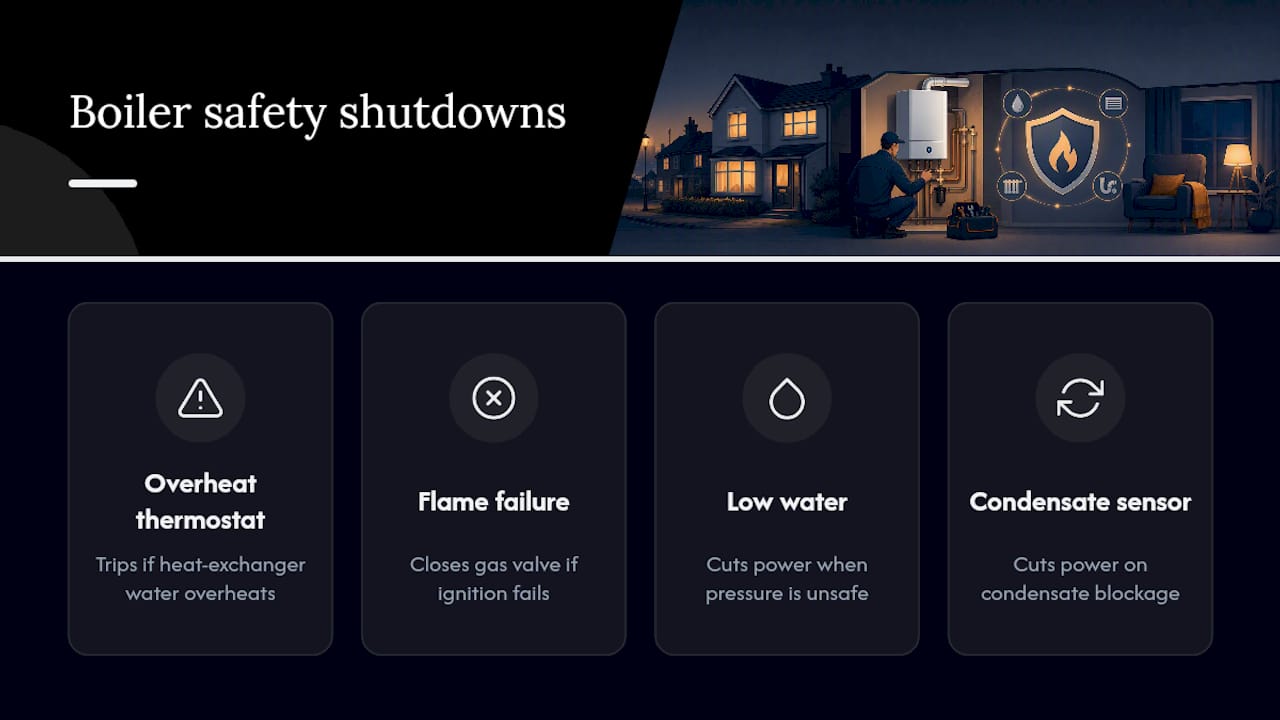
Understanding this reframes the whole problem. A lockout isn't the boiler malfunctioning; it's the boiler catching a fault elsewhere in the system and refusing to keep running until that fault is resolved. That's exactly why a single reset is reasonable once, but a boiler that keeps tripping the same sensor is telling you, quite clearly, that the underlying issue is still there.
Blocked flues and vents: an underrated cause
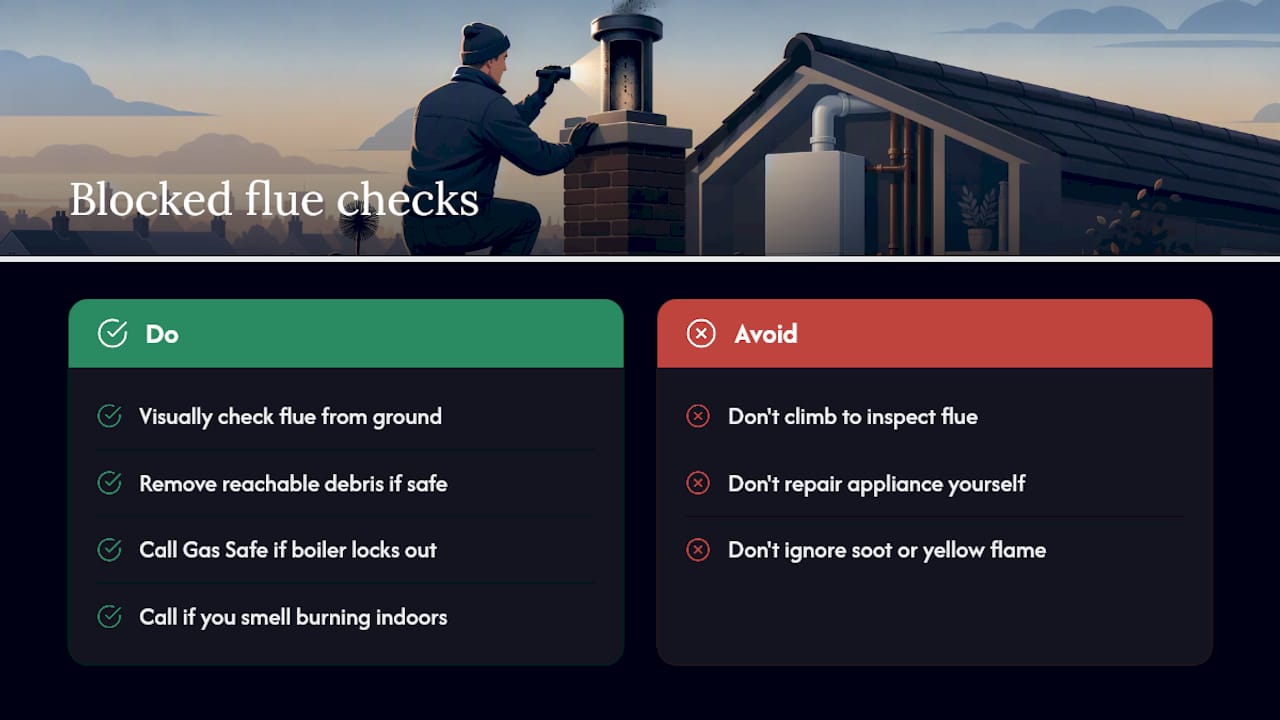
A blocked flue rarely gets mentioned in general troubleshooting lists, yet it's one of the more serious causes on this list because it directly affects how combustion gases escape the property. Bird nests, leaves, ice, or even a badly positioned garden feature near an external flue terminal can restrict or block the outlet entirely.
Boilers fitted with a flue gas sensor will lock out rather than continue running with restricted exhaust, which is the safety system working correctly. Some older or less sophisticated installations may show more subtle symptoms first, such as a burning smell, sooty staining around the flue terminal, or a pilot-light-style flame that looks yellow rather than crisp blue.
Check the external flue terminal visually from the ground; you're looking for obvious obstructions, not inspecting the appliance itself. If you spot debris you can safely remove without a ladder, clear it and see if normal operation resumes. If the terminal looks clear but the boiler still locks out, or if you notice any burning smell indoors, treat it as a combustion fault and call a Gas Safe engineer straight away. Flue faults sit firmly in the category HSE guidance reserves for registered engineers only, given the carbon monoxide risk involved.
Programmer and timer faults worth ruling out
Not every shutdown comes from inside the boiler at all. A faulty central heating programmer or timer can switch the boiler off on a schedule that no longer matches what you actually want, and it's easily mistaken for a boiler fault because the boiler itself is behaving exactly as instructed.
Check the programmer's current time and day settings first; a power cut or battery change often resets these without anyone noticing, so the boiler ends up "off" during hours you expect it to be running. Confirm the programmer is set to the right mode, since some models default to a holiday or frost-protection setting after a power interruption, which deliberately limits heating to minimal levels.
If the clock and settings look correct but the boiler still won't respond to the programmer's calls for heat, the fault likely sits in the wiring or relay connecting programmer to boiler rather than in either unit individually. This is the same territory as the electrical faults covered earlier, and it's another case where the fix is diagnostic rather than something to guess at with a screwdriver. Our guide on central heating problems covers programmer and zone-valve faults in more depth if this is where your troubleshooting has led you.
What actually happens when you book an engineer
Most call-outs for a boiler that keeps turning off follow a similar pattern once an engineer arrives: check the fault code and reset history first, then pressure and condensate, then move to flame sensing and electrical connections if the simple causes don't explain it. A frozen condensate or low pressure fix is often resolved within the hour. Ignition or control board faults usually take longer, sometimes requiring a follow-up visit for parts.
Giving the engineer your fault code, pressure readings, and a timeline of when the shutdowns started genuinely speeds things up. It lets them walk in already narrowing down between a sensor fault, a flow restriction, or an electrical issue rather than starting the diagnosis from scratch on your doorstep.
That's the practical value of the checklist earlier in this piece. It's not about replacing an engineer. It's about arriving at that conversation with the right information already in hand.
— Michael
Where to check manufacturer and safety guidance
For deeper reading, HSE's gas safety guidance covers homeowner legal duties, while HHIC's installer guidance details condensate pipe standards. Check your manufacturer's manual for model-specific fault codes.
Get a Gas Safe engineer out fast with Your-local-plumber
If you've worked through the checks above and the boiler still won't stay on, or you've spotted one of the red flag symptoms, Your-local-plumber sends Gas Safe registered engineers for boiler diagnostics and repairs with fixed, transparent pricing agreed before any work starts, not estimated after the job's half done.

This suits anyone who's just spent an evening thawing a condensate pipe or topping up pressure only to have the fault return within a day. That's precisely the pattern that needs a professional diagnosis rather than another reset, and our engineers carry the diagnostic kit to check flow, pressure, and electrical faults on the same visit rather than guessing from a phone description. Bring the fault code and your pressure log; it genuinely helps them get to the fix faster.
Your-local-plumber covers emergency boiler repairs, annual servicing, and full replacements across multiple UK towns and cities, with 24/7 availability for the faults that can't wait until Monday. If your boiler keeps cutting out and you'd rather not risk another cold night, book a boiler repair and get an engineer scheduled today.
Sources
- How to fix a frozen boiler condensate pipe | Viessmann UK
- Gas safety - Home owners - HSE
- Installer guide: condensate discharge pipe installation (HHIC)
- Boiler won't fire: causes and Gas Safe fixes | squote