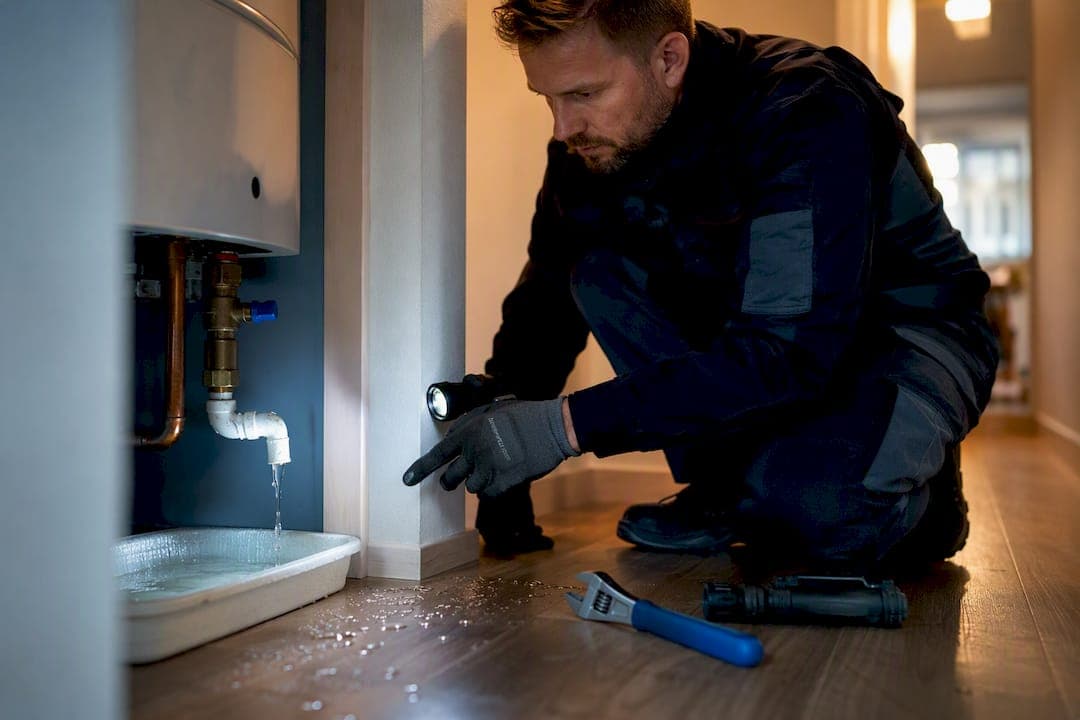
A leaking boiler usually means a failing joint, a pressure-relief discharge or a corroded internal part. Water near electrics, rapidly falling pressure, or a lost heating supply are emergency signs. In every case, contain the water, switch the boiler off at the fused spur if it's safe to touch, and call a Gas Safe registered engineer before attempting anything further.
TL;DR:
- Most boiler leaks originate from damaged joints, failed internal seals, or issues with the pressure relief or condensate pipes.
- The external discharge pipe leaking typically indicates overpressure or expansion vessel problems rather than internal component failure.
- If the pressure gauge rises above 1 bar or keeps climbing after bleeding, it suggests an internal cross-connection requiring professional diagnosis.
- Homeowners can safely check pressure levels and confirm the filling loop is closed but should not open or tamper with internal components.
- Immediate professional help is necessary if water contacts electrics, pressure drops rapidly, or there is any smell of gas, with costs ranging from about £100 to over £800 depending on repairs.
Table of Contents
- What causes a boiler to leak water?
- How do you tell where a boiler is leaking from?
- What should you do immediately if your boiler is leaking?
- Which checks are safe to do yourself, and which aren't?
- When do you need a Gas Safe engineer, and what will it cost?
- How can you stop a boiler leak happening again?
- What happens when Your-Local-Plumber attends a leak call-out?
- Book a Gas Safe engineer for your leaking boiler today
- Sources
What causes a boiler to leak water?
Where the water appears usually tells you what's failed. Pressure problems and worn internal parts behave very differently, and matching the symptom to the fault saves an engineer time, which often saves you money.
- PRV or overflow discharge: water dripping from the external pipe near an outside wall usually points to overpressure or a failed expansion vessel rather than the pressure relief valve itself being the problem.
- Loose or corroded joints: pipework that's vibrated loose over time, or corroded fittings, is one of the most common reasons for water leaking from a boiler underneath the casing.
- Internal seal, pump or heat exchanger failure: worn seals, a leaking pump, or a cracked heat exchanger let mains water escape inside the casing, often showing as staining or drips from the base.
- Condensate pipe issues: on condensing boilers, a blocked or frozen condensate pipe can back up and look exactly like a leak, especially in cold spells.
If pressure keeps climbing even with the filling loop shut, that's a strong sign of an internal cross-connection, such as a leaking tankless coil or a cracked heat exchanger, and it needs a qualified engineer rather than a DIY fix.
How do you tell where a boiler is leaking from?
Working through the signs in order narrows the fault before anyone even picks up a spanner.
- Check underneath and around joints. Look for drips beneath the casing, damp patches on connecting pipework, or water tracking down onto the floor.
- Inspect the external discharge pipe. If it's dripping outside, that's the pressure relief valve doing its job in response to a pressure or expansion vessel fault, not necessarily a leak inside the unit.
- Read the pressure gauge. Cold pressure normally sits around 1 bar. A gauge sitting in the red, or one that keeps climbing after you've bled off the excess, suggests overpressure rather than a simple drip.
- Rule out condensate problems. Water appearing only near external pipework, particularly after a cold night, points to a blocked or frozen condensate line rather than a system leak.
Damp plaster or a ceiling stain below an airing cupboard often means a slow leak has been running for a while, even if the boiler itself looks dry.
What should you do immediately if your boiler is leaking?
Your priority is containment and safety, not diagnosis. Get water away from anything electrical first.
- Switch the boiler off at the wall isolator or fused spur, but only if it's dry and safe to reach.
- Put a bucket and towels under the leak, move anything valuable nearby, and protect flooring or the ceiling below if the leak has been running for a while.
- If you know where the system isolation valve is and feel confident using it, close the boiler's water feed. If you're not sure, leave it and wait for the engineer.
- Note down what you've seen: where the water's coming from, how the pressure gauge is behaving, and whether you've lost heating or hot water. An engineer diagnoses faster with detail than with guesswork.
Pro Tip: Take a photo of the pressure gauge and the leak location on your phone before you mop up. It sounds unnecessary, but an engineer working from a clear photo often diagnoses the fault before they've even walked through the door.
Which checks are safe to do yourself, and which aren't?
A handful of checks are genuinely safe for a homeowner. Everything past the casing is not, and that line matters more than most people realise.
- Log the pressure gauge over a few hours. If it keeps rising after you've topped it up and closed the filling loop, that's a sign of an internal fault, not a simple pressure drop.
- Confirm the filling loop is fully closed. A loop left slightly open is one of the most common causes of pressure creeping up after a top-up.
- Bleed a radiator only if you're confident doing it. This is safe and can relieve minor pressure issues, but it won't fix a leak.
- Never remove the boiler casing or touch internal components. This isn't just risky, it's illegal for anyone who isn't Gas Safe registered, and it can void your warranty and your insurance.
Run the boiler only in short bursts while you're waiting for an engineer if you need some heat, and switch it off again if you see any fresh signs of leaking.
When do you need a Gas Safe engineer, and what will it cost?
Some symptoms mean stop and call now. Water anywhere near electrical components, pressure dropping quickly rather than slowly, a lost heating or hot water supply, or any smell of gas all warrant an immediate call to a qualified engineer rather than a wait-and-see approach.
Once on site, an engineer typically tightens or reseals joints, replaces a failed PRV or expansion vessel, swaps worn seals or a pump, or investigates a suspected heat exchanger fault.
What it actually costs: Checkatrade's cost data puts a loose joint or pipework reseal at roughly £100 to £250, an internal seal or pump repair at £150 to £500, and corrosion or major component work, including heat exchanger issues, at £150 to £800 or more depending on complexity.
Always confirm the engineer is Gas Safe registered, and get a written quote before any parts are replaced. Costs shift with the age of the boiler, how accessible the parts are, and how long the job takes.
How can you stop a boiler leak happening again?
Most leaks that turn into emergency call-outs had warning signs for weeks beforehand. A few habits catch them early.
- Book an annual service and keep it aligned with your manufacturer's warranty terms, since skipped servicing is a common reason warranty claims get rejected.
- Have your engineer check the expansion vessel charge, fit or clean a magnetic filter, and flush the system with an inhibitor to slow corrosion.
- Make sure condensate pipework is insulated or routed to avoid freezing in winter.
- If the same fault keeps recurring, or the heat exchanger has failed, replacement is often better value than repeated repairs on an ageing boiler.
What happens when Your-Local-Plumber attends a leak call-out?
Every call-out starts the same way: safe isolation first, then diagnosis, then containment while we work. You'll get a fixed price or a written quote before anything's replaced, not a surprise bill afterwards.
Our engineers are Gas Safe registered, and we've written up more detailed troubleshooting guides, including what to do if your heating stops working, for readers who want to dig deeper before we arrive. Expect straight answers about what's failed and why, not a sales pitch dressed up as a diagnosis.
— Michael
Book a Gas Safe engineer for your leaking boiler today
Your-Local-Plumber is the practical alternative to waiting on hold with a national call centre. We send local Gas Safe registered engineers with fixed, transparent pricing, and we're available 24/7 for exactly the kind of leak that can't wait until Monday.

When we arrive, the first job is always safety: isolating power near any wet electrics, containing the leak properly, and checking your pressure gauge before touching anything else. You'll know the likely cause and the cost before we start any repair, not after. If your boiler's dripping right now, book a call-out with Your-Local-Plumber and get an engineer on the way.
Sources
- Boiler repair costs | Checkatrade
- Relief valve leak diagnosis & repair | InspectApedia
- Is my boiler leaking water? | Vaillant