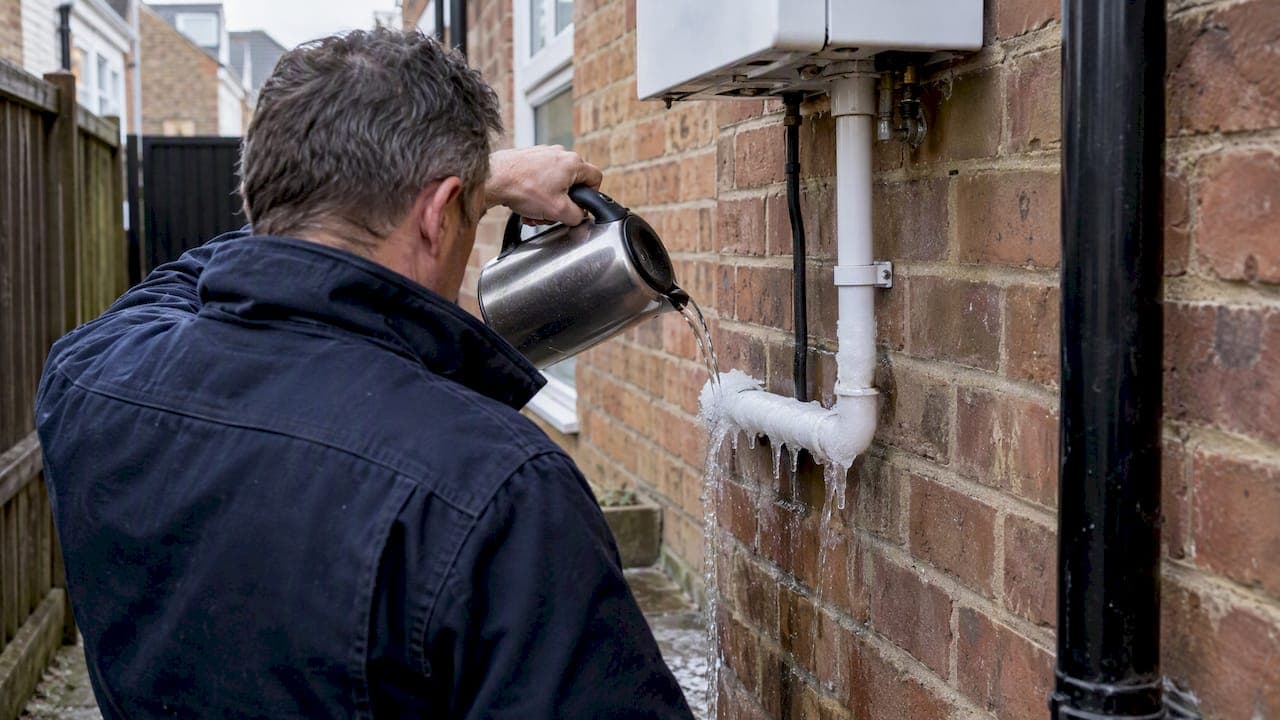
If your central heating pipes are frozen, turn the heating on and open a nearby tap so any trapped water can move. Only try this when the pipe is reachable from ground level and you feel safe doing it; otherwise call an engineer, such as one of ours at Your Local Plumber. Fault codes such as Vaillant F28/F29 or Worcester EA can be clues to a frozen condensate pipe. Check your boiler guidance for model-specific codes.
TL;DR:
- A gurgling boiler, lockout, or Vaillant F28/F29, Worcester EA, or some Ideal L02 codes can indicate frozen condensate, but codes vary by model.
- For an accessible condensate pipe, switch off boiler power and use warm, never boiling, water or a warm cloth; reset it according to the manual.
- For exposed heating pipes, open the nearest radiator valve or tap, then warm from the accessible end; check joints for leaks once water flows.
- Call a Gas Safe engineer for unreachable, overhead, or leaking pipes, or a boiler that stays locked out; never thaw pipes with a flame.
- Insulate exposed pipes, keep the boiler on a timer during cold spells, and do not rely on boiler frost protection to protect external condensate pipes.
Table of Contents
- How can you tell what has frozen?
- How do you thaw a frozen condensate pipe?
- How do you thaw frozen radiator and heating pipes?
- What should you never do when thawing pipes?
- How can you stop your pipes freezing again?
- When should you call a Gas Safe engineer?
- A word from Michael on frozen condensate pipes
- How can we help when your pipes freeze?
- FAQ
- Sources
How can you tell what has frozen?
Start by working out which pipe is the culprit, because a frozen condensate pipe and a frozen heating pipe need different handling. These are the usual clues:
- No heating or hot water, with the boiler locked out.
- A gurgling noise from the boiler, often the first sign of a frozen condensate pipe.
- Visible frost on external pipework, or a pipe that feels rock hard.
- Reduced or no water flow from a tap or radiator.
- Fault codes can be a clue: F28 or F29 on a Vaillant, EA on a Worcester, or L02 on some Ideal models. Check your boiler manual, as codes vary by model.
The condensate pipe is the plastic pipe running from your boiler to a drain or outside gully. It usually freezes at the open end, at bends, or at any dip where water sits. Before you touch anything, check that the frozen section is reachable from the ground, that no electrical fittings are close by, and that the boiler is switched off at the power.
How do you thaw a frozen condensate pipe?
Most homeowners can do this when the pipe is easy to reach. Follow these steps:
- Switch off the boiler's power supply before you start.
- Trace the condensate pipe from the boiler to its outside end, and find where it is frozen.
- Pour warm water, not boiling, along the frozen section from a watering can. Vaillant advises warm water or a hot water bottle because boiling water can damage plastic pipework.
- Alternatively, wrap the pipe in a hot water bottle, microwave heat pack or warm damp cloth, and repeat until you hear water flow.
- Once it runs freely, follow your boiler manual to reset it. Some council guidance suggests holding the reset button for about 10 seconds, but your manual comes first.
- If the boiler does not fire up again, stop and call a Gas Safe engineer.
Pro Tip: Keep a kettle of hot tap water and a spare watering can near the back door in cold snaps. Warm runoff can refreeze, so scatter a little salt on the path afterwards.
How do you thaw frozen radiator and heating pipes?
Exposed runs, such as pipes in a garage, utility room or under a floor, can often be thawed from the ground. Take these steps:
- Open the nearest radiator valve or tap, so pressure is relieved and thawed water has somewhere to go.
- Warm the pipe with a hairdryer on a low setting, a heat wrap or warm towels.
- Start at the warm end, nearest the tap or radiator, and work towards the frozen section.
- Keep the heat moving and never leave a hairdryer pointing at one spot or near pooled water.
- Once water flows, check every joint along the run for drips or damp patches.
- If you spot a leak, isolate the system and call a professional straight away.
Loft and wall-run pipes are different. If reaching them means a ladder or an awkward position, stop and book an engineer. A burst pipe behind a ceiling does far more damage than a cold radiator.
What should you never do when thawing pipes?
A few mistakes cause most injuries and repair bills:
- Never use a blowtorch, charcoal stove, kerosene heater or any naked flame near pipes.
- Never pour boiling water onto plastic condensate pipe.
- Never climb up to thaw a pipe above head height. As we explain in our post on why you shouldn't thaw above head height, leave this work to a professional.
- Watch for runoff freezing on paths and steps, which creates a slip risk.
- Keep water well away from electrical parts around the boiler.
Industry advice on condensate pipe design is to keep runs short, insulated and falling continuously at a minimum of 3º. A poorly fitted pipe freezes again and again, so persistent trouble usually means the installation needs fixing, not just thawing.
How can you stop your pipes freezing again?
These steps can help reduce the risk of frozen pipes:
- Fit foam lagging to exposed and external pipes, and add a weatherproof outer cover on the condensate pipe.
- Keep the boiler on a timer during cold spells rather than switching it off. Manufacturers such as Vaillant say boilers that sit unused, for example over holidays, are more vulnerable.
- Turn the room thermostat down overnight instead of off.
- Ask an engineer to reroute the condensate pipe internally, increase its fall or diameter, or fit trace heating.
- Consider your outbuildings too: this guide to preparing a log cabin for cold weather has ideas that carry over to garage and garden-room pipe runs.
Lagging also pays a little back. The Energy Saving Trust says pipe insulation can save around £10 a year on energy bills while protecting against freezing.
Pro Tip: Do not rely on built-in boiler frost protection alone. Manufacturer guides note it does not guarantee the whole system, and external condensate pipes can still freeze.

When should you call a Gas Safe engineer?
Some situations are not worth the risk. Call a professional when:
- The frozen pipe is out of reach, or above head height.
- The boiler stays locked out after you have thawed the pipe. Which? Trusted Traders advice is to consult a Gas Safe registered engineer if you are unsure or cannot reach the pipe safely.
- You can see leaks or damp after thawing.
An engineer can thaw the pipe safely, repair joints, recommission the boiler and fix the cause with lagging, rerouting or trace heating. To speed things up, have your boiler make and model, any fault code and the pipe location ready, and ask about call-out and labour pricing up front. Our guide to avoiding an unnecessary callout shows what to try first.
A word from Michael on frozen condensate pipes
A boiler that has simply gone quiet may have a frozen condensate pipe. It is common, fixable and rarely a disaster. What worries me is people on ladders with kettles. If it is above your head, leave it to us; a thawed pipe is never worth a fall. We would rather talk you through the safe steps or attend ourselves than see anyone hurt. Our winter plumbing tips cover the rest.
— Michael
How can we help when your pipes freeze?

When you would rather not tackle it yourself, we can step in quickly:
- Our emergency heating engineer service can help when you need assistance.
- Condensate pipe thawing, plus lagging and insulation to stop a repeat.
- Boiler checks and heating repairs, charged at £110 per hour.
- A free quote if the boiler needs replacing, with new boilers supplied and fitted from £1300.
Ask us about our call-out charges, repair terms and warranty. Have your boiler make, any fault code and the pipe location to hand, then book online and we will get you warm again.
FAQ
Can frozen pipes defrost on their own?
Sometimes, when temperatures rise above freezing, but you should not count on it. A frozen condensate pipe can leave your boiler locked out until it thaws, so a gentle warm-water thaw is usually quicker.
What temperature stops pipes from freezing?
Pipes are at risk once temperatures fall to around freezing, especially exposed or poorly lagged ones. Keeping the heating on a timer and insulating pipework reduces the risk.
Why is my boiler making a gurgling noise?
A gurgling sound is a common sign of a frozen condensate pipe. If you can reach the pipe safely, thaw it with warm water, then reset the boiler as your manual describes.
Why are my heat pump pipes freezing up?
For a heat pump that appears to be icing up, check the manufacturer's guidance or contact an engineer.
Sources
- Nrla
- Insulating tanks, pipes and radiators - Energy Saving Trust
- How to thaw a frozen boiler condensate pipe | Vaillant
- Dealing with frozen condensate pipes