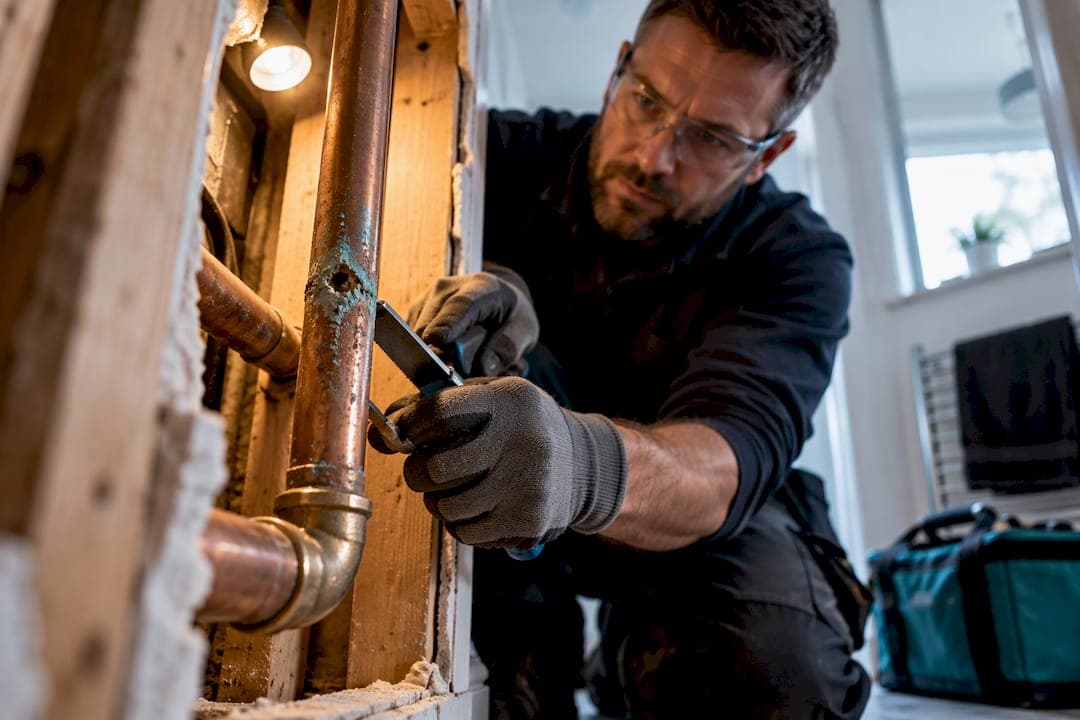
A pinhole leak is a tiny hole in copper pipework, usually caused by corrosive water chemistry, leftover soldering flux, or localised pitting that eats through the pipe wall from the inside. The moment you spot one, shut off the stopcock and isolate the affected section before anything else. Temporary fixes can buy time, but they are not a substitute for a proper repair.
TL;DR:
- Pinhole leaks are usually caused by aggressive water chemistry, leftover flux residue, pitting corrosion, or mechanical stress, often developing over years.
- Immediate actions should include shutting off the stopcock, draining the system, and removing valuables, while avoiding DIY fixes in shared or concealed pipework.
- Temporary repairs like epoxy putty or repair bands are unreliable long-term solutions and should be followed by a proper pipe replacement or soldered repair.
- Confirm a leak by isolating all water, checking the meter, and inspecting with a torch or thermal camera, especially for concealed pipework.
- Costs for professional repairs range from about £150 for accessible fixes to over £1,200 for trace-and-access concealed jobs, with insurance possibly covering some expenses.
Table of Contents
- What to do in the first few minutes
- Why copper pipes develop pinhole leaks in the first place
- How to spot and locate a pinhole leak
- Permanent repair methods that actually last
- DIY repair or call a professional: costs and risk
- Preventing the next pinhole leak
- Field notes: what actually goes wrong on real repairs
- Where homeowners get this wrong
- Getting a permanent fix booked in
- Sources
- FAQ
What to do in the first few minutes
Water finds its way into floors and ceilings faster than most people expect, so speed matters more than precision here.
- Turn off the stopcock (usually under the kitchen sink or near the incoming main) and open the lowest tap in the house to drain the run.
- Switch off any electrics near the leak, especially light fittings below a ceiling stain.
- Mop up standing water and move anything valuable away from the affected area.
- If you cannot isolate the pipe fully, reduce pressure at the nearest valve and place a container or towel to protect the flooring and skirting.
- Photograph the damage for any future insurance claim before you start drying things out.
If the leak is inside a wall, under a concrete floor, or in a flat where pipework is shared with neighbours, stop trying to manage it yourself and call an emergency plumber. Flooding that affects a shared structure often becomes a matter of joint responsibility rather than a simple DIY job, and pipes inside a shared system can fall under different rules than pipework wholly within your own property.
For a genuine stop-gap, a WRAS-approved epoxy putty or a repair bandage wrapped around the hole can hold back a slow weep once the pressure is off, but these products are approved for potable water contact rather than approved as permanent fixes, and most trade guidance treats them as temporary.
Pro Tip: Keep a small epoxy putty repair kit and a torch in the airing cupboard. A pinhole rarely waits for office hours.
Why copper pipes develop pinhole leaks in the first place
Pinhole leaks are almost never random. They tend to trace back to one handful of mechanisms, often working together over years before a hole finally appears.
- Aggressive water chemistry: soft, acidic water dissolves copper from the inside, thinning the pipe wall gradually.
- Flux residue: leftover soldering flux left inside a joint keeps corroding the copper long after installation.
- Pitting corrosion: localised attack from dissolved oxygen, carbon dioxide, or debris in the water eats through one small spot rather than the whole pipe.
- Mechanical stress: vibration, abrasion against joists, or contact with a dissimilar metal can wear a pipe thin at a single point.
Water with a pH below 6.5 and hardness under 60 mg/l CaCO3 is considered highly aggressive to copper, and the Drinking Water Inspectorate links this combination to both general dissolution and pitting corrosion that eventually punches through the pipe wall. Homes on soft-water supplies or private sources are more exposed to this than those on harder mains water.
Flux is a separate and often overlooked culprit. During soldering, flux clears oxidation so solder can bond properly, but any residue left inside the pipe after jointing keeps working on the copper, slowly thinning it from within until a pinhole appears, sometimes years after the original installation. Pitting adds a third layer: aeration, dissolved oxygen, and stray debris create tiny localised cells where corrosion concentrates on one spot rather than spreading evenly, which is why a pipe can look sound everywhere except the one place it finally fails.

How to spot and locate a pinhole leak
Most pinholes announce themselves quietly before they become a genuine problem, if you know where to look.
- A damp patch on a ceiling or wall that reappears after drying, often with a faint tide mark.
- Green or blue-green staining around a joint or on masonry, a telltale sign of copper corrosion products.
- A fine, almost invisible spray or a hissing sound when the system is under pressure.
- Discoloured or metallic-tasting water from a tap that was previously clear.
- An unexplained jump on your water meter overnight, when nothing in the house is running.
A simple isolation test helps confirm a leak before you start opening up walls: turn off every tap and appliance, note the meter reading, wait an hour without using any water, then check it again. Any movement points to a leak somewhere in the system. For leaks you cannot see, a torch inspection in the loft or under floors is the cheapest first step, followed by thermal camera hire or a specialist acoustic detection survey if the pipe run is concealed. Concealed leaks usually mean trace-and-access work, which adds both time and cost compared with a leak you can see and reach directly.
Permanent repair methods that actually last
Temporary fixes exist to buy time, not to solve the problem, so every pinhole eventually needs one of these three approaches.
Cut-and-replace is the most reliable option when the pipe shows more than one weak spot or when the corrosion looks widespread rather than a single isolated pit. The damaged section is cut out entirely and replaced with new pipe and fittings, which resets the clock on that stretch of pipework.
Soldered repairs work well for a single, accessible pinhole, but only when the pipe is completely dry and clean before you start. Soldering onto a damp or still-pressurised pipe rarely holds, and using the wrong flux or failing to flush the joint afterwards leaves the exact residue that caused the original problem, setting up a second leak nearby within a few years.
Mechanical fittings, including compression, push-fit, and press-fit systems, offer a faster, solder-free alternative and are widely used for repairs in tight or awkward spaces. Choosing WRAS-compliant fittings matters here, since anything touching drinking water needs that approval regardless of which joining method you use.
Whichever method you choose, the same sequence applies:
- Depressurise and fully drain the affected section.
- Cut the damaged pipe square, well clear of the corroded area.
- Deburr and clean both pipe ends thoroughly.
- Fit the new section or joint according to the manufacturer's instructions.
- Pressure test the repair before closing up any wall or floor.
Pro Tip: Never close up a wall or ceiling over a fresh repair until it has held pressure for at least a few hours. A slow leak from a rushed joint is far more expensive to find the second time.
DIY repair or call a professional: costs and risk
Fixing a pinhole yourself is realistic if the pipe is fully accessible and you are comfortable soldering or fitting compression joints correctly on pipework carrying drinking water. If either of those is in doubt, the risk of a failed repair, or worse, a non-compliant fitting on a potable supply, usually outweighs the money saved.
- Emergency call-outs for an urgent leak typically run £80 to £200.
- A simple, accessible repair generally costs £150 to £350.
- Concealed repairs involving trace-and-access can add £400 to £1,200 or more, depending on how much opening up is needed.
Home insurance often covers the cost of finding a hidden leak under a trace-and-access clause, but policies vary on whether they also cover replacing the pipework itself once it is found, so it is worth checking your policy wording before assuming full cover. If you live in a flat or a building with shared pipework, get clarity on who is responsible for the repair before work starts, since that can affect both cost and insurance routes.
Preventing the next pinhole leak
Most repeat leaks trace back to the same untreated cause, so prevention is really about addressing water chemistry and installation habits rather than just patching holes as they appear.
- Have your water tested for pH and hardness if you have had more than one pinhole leak, particularly on a private or well-fed supply.
- Insist on water-soluble flux and a full flush-through immediately after any new soldered joint.
- Avoid dead legs and stagnant sections of pipe where water sits unused for long periods.
- Fit isolating fittings where copper meets a dissimilar metal to prevent galvanic reaction.
- Have pipework in older properties inspected every few years, especially in lofts and under floors where a slow leak can go unnoticed.
Pro Tip: If your area is known for soft or acidic water, ask whether a whole-house treatment or filtration system is worth it before you replace pipework a second time.
Field notes: what actually goes wrong on real repairs
Michael's rundown for engineers and confident homeowners: isolate first, confirm the cause before repairing, choose the right joining method for the location, always pressure test, and never close up the wall until the repair has proven itself.

The most common failing on repeat call-outs is flux residue left behind on an earlier repair, quietly corroding the joint from the inside for months before it fails again. Second most common: a temporary epoxy fix left in place indefinitely instead of being followed up with permanent work. Third: skipping the pressure test because the job "looked fine".
Where homeowners get this wrong
The advice you will find most often treats a pinhole leak as a one-off plumbing accident: patch it, move on. That misses the point. A pinhole is usually a symptom of something ongoing, whether that is aggressive water chemistry working through the whole system or flux residue left from an installation years earlier, and treating only the visible hole almost guarantees another one nearby within a year or two.
The other place conventional advice falls short is cost framing. Cheap online guides push epoxy putty as a fix rather than what it actually is: a way to buy time. If you have had more than one pinhole in the same section of pipework, the priority is not a better sealant, it is finding out why the pipe is failing at all, whether that means testing your water or reviewing how the original joints were made.
If you take one thing from this, it is to treat the second leak as more informative than the first. One pinhole can be bad luck. Two in the same run is a pattern worth investigating properly before you spend more money patching symptoms.
— Michael
Getting a permanent fix booked in
A pinhole leak rarely fixes itself, and the longer copper pipework sits under aggressive water or old flux residue, the more likely a second hole appears somewhere nearby. Your Local Plumber offers emergency call-outs with a 60-minute response for active leaks, alongside leak detection and permanent pipe repairs once the water is isolated.

Isolate your stopcock before you call, and have the location and any temporary fix you have applied ready to describe. Jobs come with a guarantee and a warranty on completed work. Book online or call for attendance, including holidays.
Sources
- Pipe and fittings corrosion - Drinking Water Inspectorate
- WRAS approvals directory
- How much does it cost to repair a leaking water pipe? - Checkatrade
- Capillary jointing using solders and fluxes - WaterRegs UK
- SylWrap Standard Pipe Repair Kit - Sylmasta
FAQ
I accidentally nicked a copper pipe but it isn't leaking. What now?
A nick that hasn't broken through the pipe wall can still thin the copper enough to fail later, so it's worth having it checked rather than left. A short repair section fitted now, using a WRAS-compliant mechanical fitting or a soldered joint on a dry pipe, is far cheaper than dealing with a leak once the wall gives way.
What is the best sealant for a copper pipe hole?
Look for a product that is explicitly WRAS-approved for use on pipework carrying drinking water, such as an epoxy putty or repair bandage kit designed for that purpose. Most trade guidance still treats these as emergency or short-term measures rather than a permanent solution.
How do I fix a pinhole leak in copper pipe without soldering?
A WRAS-compliant compression, push-fit, or press-fit coupling can repair a section of copper pipe without any soldering, provided the pipe ends are cut square and properly deburred first. These mechanical fittings are a practical option in tight spaces or where a naked flame isn't safe to use.
What actually causes most copper pipe pinhole leaks?
The main drivers are aggressive water chemistry, particularly soft, acidic water with low hardness, leftover flux residue from soldering, and localised pitting corrosion from dissolved oxygen or debris in the system. Mechanical stress, such as vibration or contact with a dissimilar metal, can also wear a single spot thin over time.