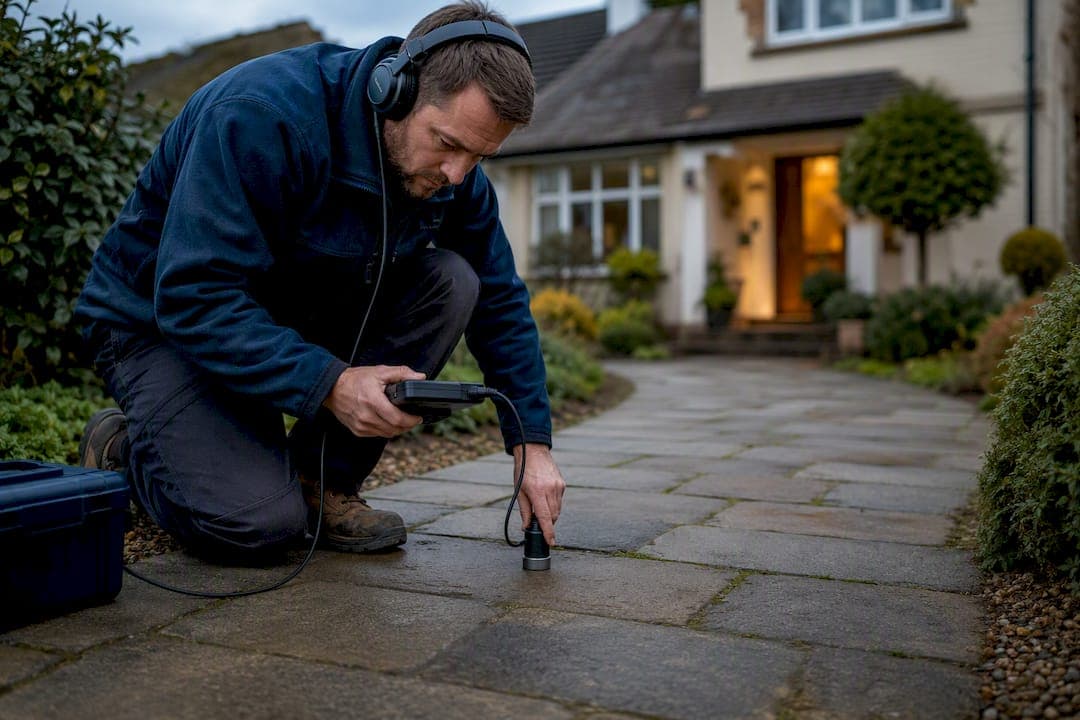
If you've spotted a soggy patch of lawn, a falling water meter reading, or weak pressure at the kitchen tap, there's a good chance you're dealing with an underground water leak in your supply pipe. Turn off every tap and appliance, then check whether your meter is still ticking over. If it is, isolate the internal stopcock and call a professional rather than reaching for a spade. Remember that the pipe running from the boundary into your home is your legal responsibility, and your water company can issue a Private Leakage Notification if it isn't fixed.
TL;DR:
- Most underground leaks are detected through acoustic methods, with about 70% resolved without needing excavation, making early detection cost-effective.
- The water meter is an essential tool; a steady increase in reading over hours indicates a leak, and a simple two-hour test is often enough to confirm it.
- Repair costs vary based on pipe material, depth, and site conditions, with no-dig MDPE pipe replacement being quicker and cheaper for soft ground than open-trench methods.
- Always obtain a detailed, insurer-friendly report with photos and location details before committing to excavation work, and get multiple quotes for reinstatement costs.
- Verify contractor credentials, available detection methods, and clear written quotes to prevent unnecessary digging and ensure proper leak localization and repair.
Table of Contents
- Signs that you have an underground water leak
- How professionals locate underground leaks
- What to expect from a detection visit
- Repair options and typical cost ranges
- How to choose a leak detection and repair service
- What Your-Local-Plumber offers and where to read more
- What actually matters when you're dealing with a hidden leak
- How we can help: book a detection with Your-Local-Plumber
- Sources
Signs that you have an underground water leak
An underground water leak rarely announces itself with a dramatic flood. It creeps in through small, easy-to-miss clues that build over weeks.
- Wet or sunken patches in the lawn or driveway that appear regardless of the weather, or a suspiciously lush green strip during a dry summer.
- Boggy ground with no obvious drainage cause nearby.
- Reduced pressure or flow at cold taps, especially if it's worsened gradually rather than overnight.
- A steadily climbing meter reading month on month, with no change in household habits.
- Localised subsidence, small dips or sinkage in paths and borders above the pipe run.
- A heating system that keeps needing topping up, which can point to a leak feeding the system rather than a boiler fault.
The cheapest diagnostic tool you own is your water meter. Turn off every tap, appliance and outside tap, note the reading, then check again after two hours untouched. Movement confirms a leak somewhere, and Anglian Water's own guidance walks through the same test. Pair that with a quick look at your internal stopcock before booking anyone out.
How professionals locate underground leaks
Most detection engineers work through a hierarchy of methods, starting cheap and non-invasive and only escalating when they need to. Roughly 70% of straightforward buried leaks are resolved with acoustic methods alone, well before anyone reaches for a digger.
- Acoustic listening and correlation. Sensors placed at two points along the pipe pick up the sound of escaping water and calculate distance from the timing difference. This is the standard first-line technique for pipes under lawns and soft ground, and it's cited as the go-to method by WaterSafe.
- Ground microphones and listening sticks. Used to pinpoint the exact spot once correlation narrows the search area, particularly on harder surfaces like paving or tarmac.
- Tracer gas injection. A safe, inert gas mix pumped into an isolated section of pipe rises through the soil and is picked up by a surface detector. Engineers reach for this when acoustic correlation struggles, typically on deep, plastic, or intermittently leaking pipes that don't transmit sound well.
- Thermal imaging. Picks up the temperature difference between escaping water and surrounding soil, useful on shallow leaks but limited by depth and weather conditions.
- Ground-penetrating radar (GPR). Less about finding the leak itself and more about mapping buried services, especially useful when locating non-metallic pipes that acoustic kit can't always distinguish from other services underground.
No method is foolproof. When these techniques narrow things down but can't confirm the exact point, a small targeted trial hole is still sometimes necessary, but that's the exception rather than the starting point.
What to expect from a detection visit
A proper visit follows a logical sequence rather than jumping straight to digging. Expect pre-checks and a conversation about your symptoms, a meter isolation test to confirm there's genuinely a leak, then an acoustic survey of the suspected pipe run. If that's inconclusive, the engineer may move to tracer gas or a small trial hole.
- Most straightforward domestic leaks are found in a single visit lasting a couple of hours.
- More complex jobs, long private supply runs, shared pipes, or work near a public highway can stretch into a multi-day investigation because of access issues or the need for traffic management.
A good written report should tell you exactly where the leak sits, include photos, set out the recommended repair method, and give a firm cost estimate rather than a vague range.
Pro Tip: Ask upfront whether the report is insurer-friendly. Many home insurance policies include trace-and-access cover, and a proper report with photos and a location diagram can be the difference between a smooth insurance claim and a rejected one.
Before agreeing to any work, ask for a written quote, confirmation of how the surface will be reinstated, and a clear answer on what happens if no leak is actually found.
Repair options and typical cost ranges
Once the leak is confirmed, the repair method depends on pipe material, depth, and what's sitting above it. Detection surveys alone typically run £250 to £1,600 depending on access and reporting requirements, with excavation and repair priced separately on top.
- No-dig mole-plough MDPE replacement. A new MDPE pipe is pulled through underground using a mole plough, avoiding a full trench. Quick, minimal reinstatement needed, and usually the cheaper option for lawns and soft ground.
- Open-trench replacement. Necessary where a mole plough can't get through, such as under drives, patios or where other services are in the way. Reinstatement costs rise sharply here because you're relaying block paving, tarmac or concrete afterwards.
- Local patch repairs versus full replacement. A single patch might fix today's leak, but older lead or galvanised pipes tend to fail again nearby soon after. Full replacement with modern 25mm MDPE is generally the better long-term move rather than repeatedly patching a pipe that's reaching the end of its working life.
- Cost drivers to watch for: surface type (block paving costs more to reinstate than turf), pipe length, whether the supply is shared with a neighbour, and any requirement for traffic management if the pipe runs under a public highway.
Some water companies also offer free leak checks or leakage allowances for customers who repair promptly, though the details vary by supplier, so it's worth a call before you commit to anything.
How to choose a leak detection and repair service
The wrong contractor can leave you with a vague diagnosis and a hole in the garden that's someone else's problem to fix properly. A few checks up front save a lot of grief later.
- Verify credentials. Confirm trade accreditation, public liability insurance, and whether they can produce an insurer-friendly report if you need to claim.
- Check technical capability. Ask which detection methods they own outright versus subcontract out, and whether reinstatement (relaying paving, turf, tarmac) is included or a separate job.
- Get commercial clarity in writing. A proper quote should state the price, how they charge if no leak is found, expected timescales, and any warranty on the repair itself.
- Watch for red flags. Be wary of anyone unwilling to issue a written report, pushing you straight to excavation without trying acoustic methods first, or giving a scope of work so vague you can't compare it against another quote.
Pro Tip: Get at least two quotes for anything beyond a simple patch repair. Detection is quick to compare on paper, but reinstatement costs vary wildly between contractors, and that's usually where the real price difference hides.
What Your-Local-Plumber offers and where to read more
Some plumbing services handle the full sequence: acoustic and tracer gas detection, MDPE pipe replacement using no-dig and open-trench methods, and reinstatement of lawns, drives and paving afterwards. Call out and you'll get a straight answer on next steps rather than a hard sell.
For readers who want to prepare before booking, the step-by-step leak detection walkthrough and the hidden leaks checklist cover the groundwork in more detail.

What actually matters when you're dealing with a hidden leak
Most advice on underground leaks focuses on the drama of finding the exact spot, and not enough on the boring bit that actually saves people money: doing the meter test first. It costs nothing, takes two hours, and stops you paying for a callout you didn't need. That's the single biggest gap between how this topic gets written about and how it should be handled.
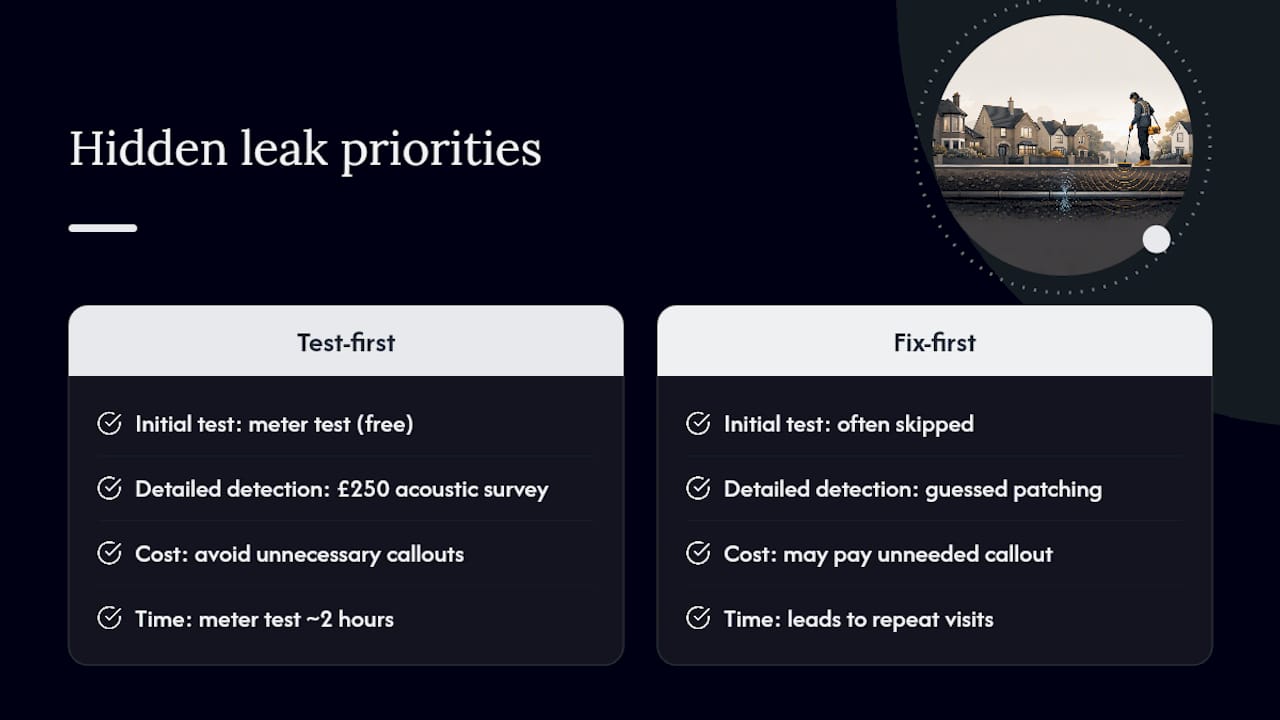
The other thing conventional advice underplays is timing. A leak that's merely inconvenient this month becomes a legal notice next month if your water company steps in, because the responsibility for that pipe sits with you, not them. Treat an early, ambiguous symptom, like a slightly damp patch or a meter that seems to tick faster than it used to, as worth a phone call, not a wait-and-see.
If there's one priority for homeowners, it's this: get the detection done properly before you commit to any repair. A £250 acoustic survey that pinpoints the fault beats a guessed patch job that fails again in six months.
— Michael
How we can help: book a detection with Your-Local-Plumber
Some plumbing services aim to provide a straight diagnosis instead of a guess. Where a general contractor might reach straight for a spade, acoustic detection is often run first, so you're not paying to dig up a drive on a hunch.

Some plumbing teams handle the whole job end to end: leak detection, MDPE pipe replacement using no-dig or open-trench methods depending on what's above the pipe, and reinstatement of your lawn, patio or drive afterwards. On your first call, you'll get a straightforward chat about your symptoms and a clear idea of what a visit involves before anyone sets foot on site.
If you've spotted any of the warning signs above, book a leak detection visit with Your-local-plumber and get a written report you can act on with confidence.
Sources
- Responsibility for pipes and pumping stations - Ofwat
- Checking for leaks - Anglian Water
- How much does water leak detection cost in the UK?
- When is a water leak your responsibility? The rules homeowners should know - BBC