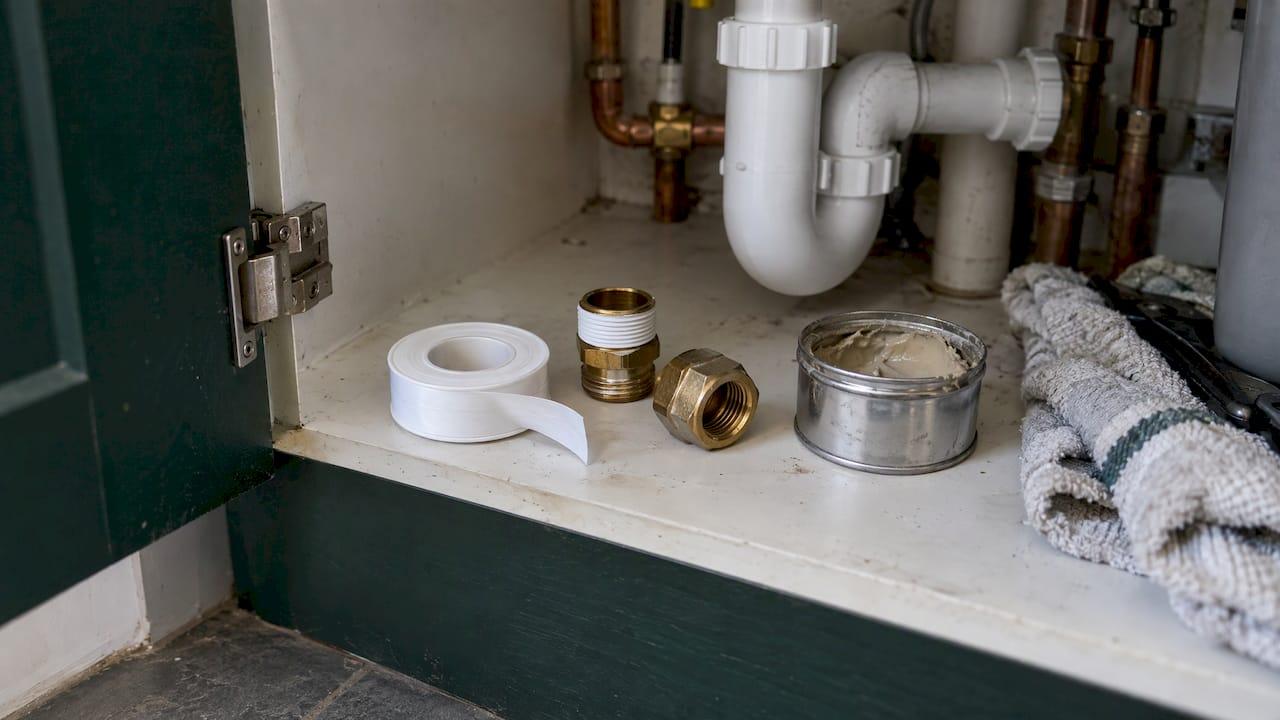
PTFE tape and jointing compound do the same job: they fill the microscopic gaps in a tapered pipe thread so it cannot weep. Tape is a dry film wrapped round the thread, compound is a paste brushed on. For most domestic threads either works, and the real skill is knowing which joints need neither, because many fittings seal on a washer or an olive rather than on the thread. Below you get the rule for each joint, the application routine, and the points where a job is better left to one of our engineers.
TL;DR
- Use PTFE tape or jointing compound only on tapered threads that seal on the thread itself, such as a fitting into a tank, valve or radiator.
- Leave both off joints that seal on a washer, O-ring or olive: tap connectors, flexi hoses, trap nuts, push-fit and compression fittings.
- Tape is clean and quick for standard half-inch and three-quarter-inch connections. Compound suits larger threads, awkward threads and joints you want to take up slightly out of line.
- Gas joints need gas-rated materials and a Gas Safe registered engineer. Drinking-water joints need approved products.
- One well-applied product is normally enough. Doubling up is a specialist call, not a habit.
Table of Contents
- What each product actually does
- First question: does this joint need a sealant at all?
- When tape is the right choice
- When jointing compound is the right choice
- Can you use both together?
- How to apply PTFE tape
- How to apply jointing compound
- Drinking water and hot water: check the approvals
- Gas joints are not a DIY decision
- What about plumber's putty?
- Our view
- When a leak needs an engineer
- FAQ
- Sources
What each product actually does
A tapered (BSP) pipe thread is cut so that it wedges tighter as you screw it in. Even so, no thread is perfectly machined, and a small spiral gap remains. A sealant fills that gap.
PTFE tape is a thin, dry film of polytetrafluoroethylene wrapped clockwise round the male thread. It also lubricates the thread so it goes in smoothly. Toolstation's guide describes it as clean and quick to use.
Jointing compound is a paste, brushed or spread over the threads before assembly. Formulations differ for different fluids, pressures and operating conditions, and the compound has to be suitable for the pipe material and what is flowing through it. That compatibility point matters more than anything else on the label.
In practice the difference comes down to this:
| PTFE tape | Jointing compound | |
|---|---|---|
| Form | Dry film on a roll | Paste (sometimes a cord used with paste) |
| Mess | Very little | Can squeeze out and smear |
| Best for | Standard 1/2" and 3/4" domestic threads | Larger threads, awkward or worn threads, heavy-duty pipework |
| Adjusting a joint | Back off and you may need to rewrap | Non-setting types allow small adjustments |
| Main risk | Too many wraps, wrong direction, shredding | Over-application pushed into pipework |
First question: does this joint need a sealant at all?
This is where most leaks start. Adding tape or paste to a joint that already has its own seal can stop that seal working.
A thread-sealed joint needs tape or compound. A washer-sealed or olive-sealed joint does not. Plumbers University's UK guide says to use tape or paste on tapered threads that seal on the thread, such as a fitting into a tank, valve or radiator, and not on joints that seal with a washer or olive, such as flexi tails, tap connectors and trap nuts.
Joints that usually take tape or compound
- Radiator valve tails into the radiator
- Threaded fittings into a cylinder, tank or valve body
- Outside tap connections where the thread does the sealing
- Threaded boiler and heating fittings, where the product is approved for the system
Joints that usually take neither
- Tap connectors and flexible hoses (they seal on a washer)
- Waste trap nuts
- Push-fit fittings
- Compression fittings
On compression fittings the thread does not make the seal. The ferrule squeezed between pipe and nut does, so tape is unnecessary. Uponor's UK guidance goes further: compound should not go on a compression fitting unless the manufacturer specifies it, and incorrect use can invalidate the warranty and cause the joint to fail. Fitting manufacturers' instructions differ on rare cases such as a slight weep, so follow the instructions for the exact fitting, pipe material and service.
Also worth knowing: UK guidance says compression fittings should not be installed in concealed spots such as under floorboards or inside closed wall cavities, where they cannot be inspected or tightened. If a leaking joint is in such a place, that is an engineer's job rather than a tape job.
If you want a refresher on joint types, our guide to types of plumbing joint fittings shows which seal on the thread and which do not.
When tape is the right choice
For everyday domestic work, tape is the usual pick. Standard half-inch and three-quarter-inch connections on radiator valves, outside taps and cylinder fittings are what it is made for. It is clean, it does not stain a finished room, and it takes seconds.
Tape is not suited to every situation. One UK supplier's guide says tape alone is not suitable for vibrating pipework, pressures above about 10 bar, or large threads above 2" BSP, where compound or a liquid sealant is the better choice. Those conditions are uncommon in a typical home, but they do turn up in plant rooms, pump sets and larger heating installations.

When jointing compound is the right choice
Compound comes into its own on bigger or rougher threads. One UK trade guide notes that hemp and compound are still preferred by experienced plumbers for threads larger than 3/4" BSP and for large galvanised steel pipe, where tape does not reliably fill the deeper thread profile.
Compounds are also not interchangeable. Typical UK categories include:
- A non-setting white paste for water systems (Boss White is one example, suitable to 110°C and not gas-approved)
- A liquid sealant for central heating, sealed systems and unvented cylinders (Fernox LS-X is one, containing a corrosion inhibitor)
- Anaerobic sealants that cure without air and resist vibration (Loctite 577 and 572)
- Gas-approved compounds marked to BS 6891 or IGEM requirements
Those categories are drawn from APM's UK thread-sealant guide. The point is that the tin must match the job. Reading about jointing compound uses and compatibility in home plumbing shows how much the right choice depends on the system.
Can you use both together?
Sometimes, but it is not the default. Plumbers University says some plumbers use both on tricky threads, though one well-applied product is usually enough. A thin smear of compound over tape is sometimes used on critical joints that will be hidden, for example behind tiling or under a screed floor.
There are two cautions. First, some compound manufacturers say not to combine their product with hemp. Boss's universal compound page says hemp is not needed for an effective seal and is illegal on potable water systems. Second, UK government-commissioned research on gas sealants notes that guidance says tape should not be used with jointing compound, though many gas engineers do. The same study found that a support material such as tape, cord or hemp gives a seal strength, while compound reduces small leakage within it. That is why combinations appear on gas work, and why they belong to someone trained and equipped to pressure test.
Over-wrapping is a real problem in its own right. Too much tape reduces the thread's strength and shredded tape can constrict a joint or jam a valve seat.
How to apply PTFE tape
- Clean the male thread. Remove old tape, paste and debris with a wire brush or rag.
- Start one or two threads back from the end. This keeps loose tape out of the pipe.
- Wrap clockwise as you look at the thread end, so tightening the fitting pulls the tape in rather than unwinding it.
- Use the right number of turns. For water, 3 to 4 turns with about 50% overlap is a common UK recommendation. Plumbers University suggests 5 to 10 wraps, depending on tape thickness. Thin tape needs more turns than thick tape, so read the roll.
- Tighten by hand, then finish with a spanner. Do not back off to line up a fitting once it is tight; unwind, rewrap and start again.
- Fill, pressurise and look. Check for weeping at the joint straight away and again after an hour.
The usual failure points: wrapping anticlockwise, covering the very end of the thread, using far too much tape, and taping a joint that seals on a washer.
How to apply jointing compound
- Check the label for the fluid, temperature and pipe material.
- Clean the thread and brush a thin, even coat over the male thread, leaving the first thread bare.
- Assemble and tighten. Wipe off any squeezed-out paste.
- Use as little as will do the job.
That last point is not cosmetic. The Water Hygiene Centre, reported in HPM in January 2026, advises that jointing compound should be avoided wherever possible in systems with thermostatic mixing valves, fine strainers and tap filters or aerators. Over-applied compound can be pushed into the pipework, build up, support biofilm and restrict flow. PTFE tape, cord or pre-formed washers are the alternatives it recommends. That makes tape the sensible first choice around shower valves and thermostatic fittings.
Drinking water and hot water: check the approvals
Anything touching drinking water needs an approved product. In England and Wales, the Water Supply (Water Fittings) Regulations 1999 apply, and sealants for drinking-water pipework should carry WRAS approval or equivalent, as one UK trade guide explains.
There is a recent change worth knowing. The Water Hygiene Centre reports that WRAS has revised its jointing-compound testing temperature from up to 85°C down to 23°C. WRAS approval therefore now confirms safety at room temperature only. For hot water, read the manufacturer's technical data sheet for the temperature rating rather than relying on the badge.
Gas joints are not a DIY decision
Standard white tape is not the right product for gas. UK trade guidance says gas work needs yellow gas-rated tape or an approved gas compound, and that standard tape can shred and migrate into a gas valve seat, causing a slow internal leak. Gas-rated tape must meet BS EN 751-3:2022+A1:2023, the British Standard for unsintered PTFE tape and string on threaded joints in contact with gas and hot water. The colour matters less than the standard and the labelling.
More importantly, the law is simple: anyone doing gas work for pay must be on the Gas Safe Register, and domestic gas work falls under the Gas Safety (Installation and Use) Regulations 1998. If you smell gas, do not touch any joint: open windows, turn off the supply at the meter if it is safe to do so, and call the National Gas Emergency Service on 0800 111 999. Our guide to Gas Safe certification explains what to look for on an engineer's ID card.
What about plumber's putty?
Plumber's putty is not the same thing as jointing compound. Putty is a soft, oil-based material used to seal around sink drains and fill gaps where there is no pressure, while jointing compound goes on pressurised threaded pipe joints. Neither substitutes for the other.
Our view
Most leaking threads we are called to are not a problem of the wrong product. They are the wrong product on the wrong joint, or the right product used in the wrong amount. Tape on a washer-sealed connector, a thick layer of paste near a thermostatic valve, tape wound the wrong way: each one looks like a sealed joint on the day and weeps a week later.
Our approach is to match the sealant to the joint, the fluid and the temperature, and to leave a joint dry when it is designed to seal dry. That is the habit our experienced engineers bring to every job, whether it is a radiator valve, a cylinder immersion heater or a boiler fitting.
When a joint sits behind a wall, under a floor or on a gas supply, the sensible route is to have it made up properly once. That is what our no fix, no fee guarantee and 12-month warranty are there for.
Michael
When a leak needs an engineer
If a thread keeps weeping after you have rewrapped it, or the joint is on boiler, heating or hidden pipework, you can book one of our engineers. We offer plumbing across our towns, with no call-out fee and payment only after successful work. Heating and boiler work is charged at £110 per hour, and new boilers are supplied and fitted from £1,300. For a leak that cannot wait, our 60-minute emergency response is available 24/7, including holidays.

If you are thinking about a new boiler, a free on-site quote is the starting point.
FAQ
Is PTFE tape or jointing compound better?
Neither is better everywhere. Tape is the usual pick for standard domestic tapered threads because it is clean and quick. Compound suits larger, rougher or heavy-duty threads. Check the product is approved for drinking water, hot water or gas, depending on the joint.
Can I use PTFE tape on compression fittings?
Usually no. A compression joint seals on the olive, not the thread, and tape can interfere with that seal. Follow the fitting manufacturer's instructions for the exact fitting, as a few specify exceptions for a slight weep.
Is white PTFE tape safe for gas?
No. White tape is not recommended for gas because it can shred and reach valve seats. Gas joints need gas-rated materials and a Gas Safe registered engineer, and every gas joint should be pressure tested after it is made up.
How many turns of tape should I use?
It depends on the tape thickness and the thread. A typical UK range is 3 to 4 turns for water with about 50% overlap, up to 5 to 10 wraps for thinner tape. Wrap clockwise, start one or two threads back, and stop when the thread profile is still visible through the tape.
Is plumber's putty the same as pipe jointing compound?
No. Putty seals non-pressurised gaps such as sink drain flanges. Jointing compound seals pressurised threaded pipe joints, so the two are not interchangeable.
Sources
- How to Use PTFE Tape, Toolstation
- A Complete Guide to PTFE Tape for water and gas, Vital Parts
- PTFE tape vs jointing paste: when to use each, Plumbers University
- Everything You Need to Know About PTFE Tape, RS
- Compression fitting FAQs, Uponor
- Should you use PTFE tape on compression fittings? BEOWELD
- PTFE Tape, Hemp, and Jointing Compounds: Thread Sealants, APM
- PTFE Tape: How to Wrap It, When to Use It, BuildWiz
- Hydrogen skills and standards for heat: sealant suitability, GOV.UK
- Boss Universal Pipe Jointing Compound 500g
- Thread seal tape, Wikipedia
- Water Hygiene Centre: Plumbing jointing compound and your water system, HPM
- Pipe Joint Compound vs PTFE Tape, Heating and Plumbing World
- BS EN 751-3:2022+A1:2023, BSI Knowledge
- The Difference Between Pipe Joint Compound and Plumber's Putty, Hunker