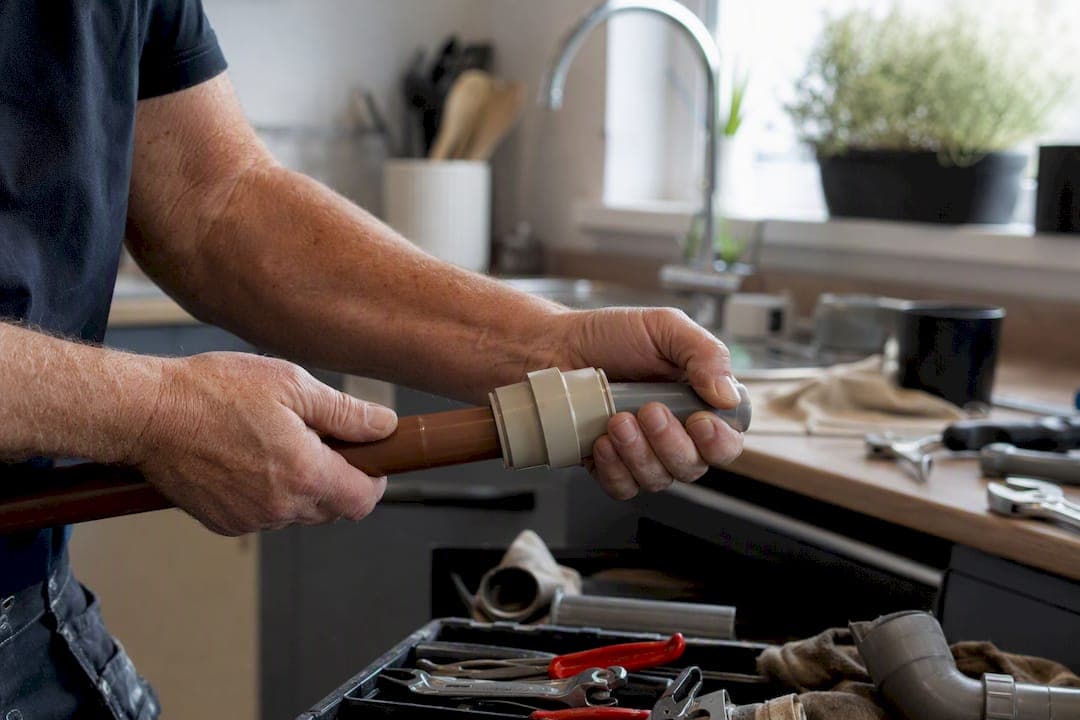
Seven fitting families cover almost every plumbing job you'll face: end-feed and solder-ring (soldered, permanent), compression (mechanical, demountable), push-fit (fast, tool-light), threaded and barbed (screwed and hose connections), solvent-weld (fused plastic drainage) and MDPE/electrofusion (buried mains). Each one answers a different question. Compression suits repairs you can't drain or heat. Push-fit suits mixed materials and tight corners. End-feed suits concealed, permanent copper runs. Solvent-weld belongs on plastic waste pipes. MDPE and electrofusion belong to the mains supply and are rarely suitable for DIY jobs.
Before picking one, ask yourself:
- Can I safely use a naked flame here?
- Can I drain this section of the system?
- Will this joint be hidden behind plaster or floorboards?
- Is this pipework a mains or underground service?
Key Takeaways
Matching the fitting to the job, not just the pipe material, is what determines whether a joint lasts or leaks.
| Point | Details |
|---|---|
| Match joint to job, not just pipe | Consider access, heat risk and whether the pipe can be drained before picking a fitting type. |
| Soldered joints need dry pipes | End-feed and solder-ring fittings require a completely dry system and flame safety precautions. |
| Compression suits repairs | Use compression fittings when you can't drain or heat the pipe, and always fit a new olive on rework. |
| Push-fit needs clean pipe ends | Deburr copper or plastic pipe before inserting to protect the internal O-ring from slow leaks. |
| Call a professional for mains or complex jobs | Your-local-plumber offers fixed-price callouts for leak diagnosis, valve fitting and installations you'd rather not tackle yourself. |
Table of Contents
- What are the different types of plumbing joint fittings?
- End-feed and solder-ring fittings: when permanence matters
- Compression fittings: the demountable option for repairs
- Push-fit fittings: quick joints for tight spaces and mixed pipework
- Where do threaded and barbed fittings fit in?
- Solvent-weld fittings for plastic waste and drainage
- MDPE, electrofusion and press-fit: mains and specialist systems
- What do all the different fitting shapes actually do?
- Permanent versus demountable joints: which should you choose?
- A quick checklist before you pick up a fitting
- If you'd rather leave it to an expert
- Sources
What are the different types of plumbing joint fittings?
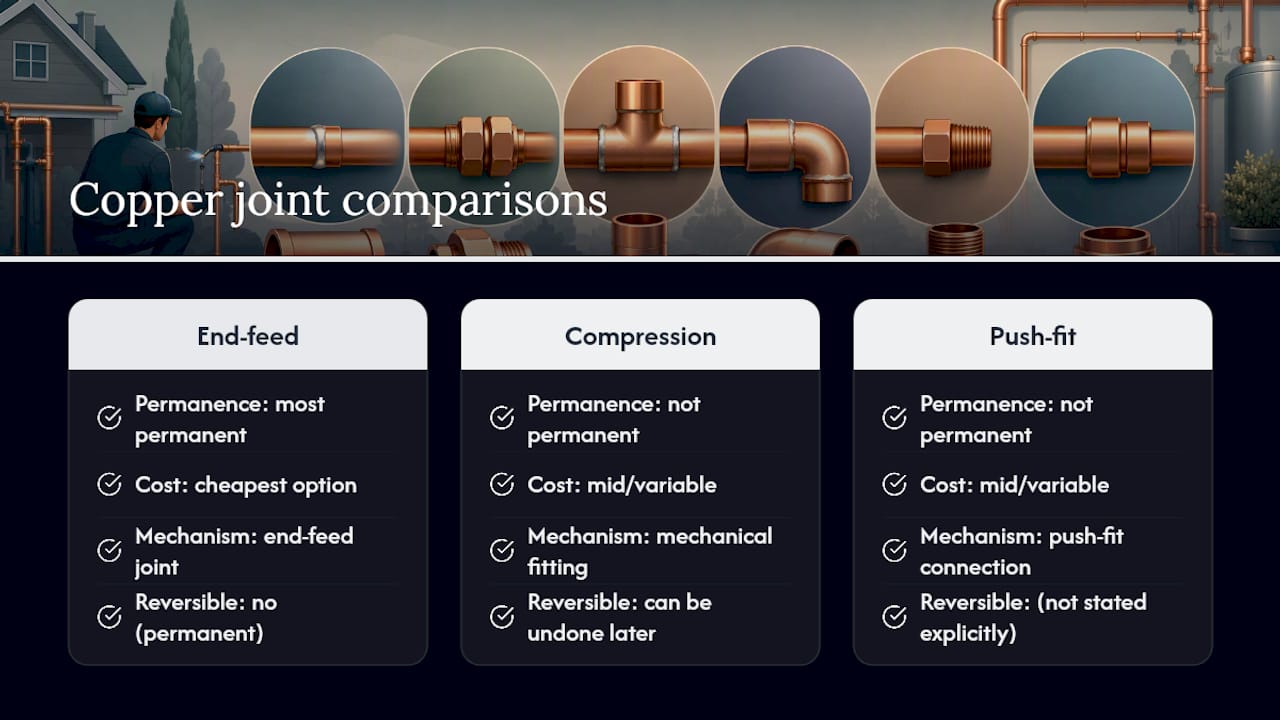
Copper pipework in UK homes is joined three main ways: end-feed, compression or push-fit, and each serves a different operational need. End-feed is the cheapest and most permanent. Compression is mechanical and can be undone later. Push-fit is the quickest and works across mixed pipe materials.
That's the copper side of things. Plastic waste pipes use solvent-weld joints instead, hose connections use barbed fittings, and anything running underground to the mains uses MDPE with specialist inserts. The right choice depends less on personal preference and more on what the job in front of you actually demands: access, heat risk, whether the pipe can be drained, and whether the joint needs to be permanent or reversible.
End-feed and solder-ring fittings: when permanence matters
End-feed fittings are soldered by hand, using a blowtorch to melt wire solder into the joint by capillary action. They're the cheapest copper fitting on the shelf and, once made properly, effectively permanent. Solder-ring (often called Yorkshire) fittings work the same way but come with solder pre-loaded inside the fitting, which is slightly pricier but faster and safer overhead or in awkward corners, since there's no separate solder wire to feed by hand while balancing a torch.
Choose soldered joints for:
- New concealed pipework behind walls or under floors, where you want a permanent joint
- High-temperature runs, such as heating pipework close to a boiler
- Long straight runs where cost per joint matters
The pipe must be completely dry, both inside and out, or the joint won't take solder properly. Always work with a fire-resistant mat nearby and keep flammable materials well clear of the flame.
Pro Tip: Keep a scrap of emery cloth in your toolbox. Cleaning copper to a shine right before fluxing is the single biggest factor in a soldered joint holding long-term.
Compression fittings: the demountable option for repairs
A compression fitting squeezes a soft brass ring, called an olive, between the pipe and a threaded nut. Tighten the nut and the olive deforms slightly, forming a mechanical seal without any heat or solvent involved. Because nothing is fused, the joint can be undone with two spanners whenever access is needed again.
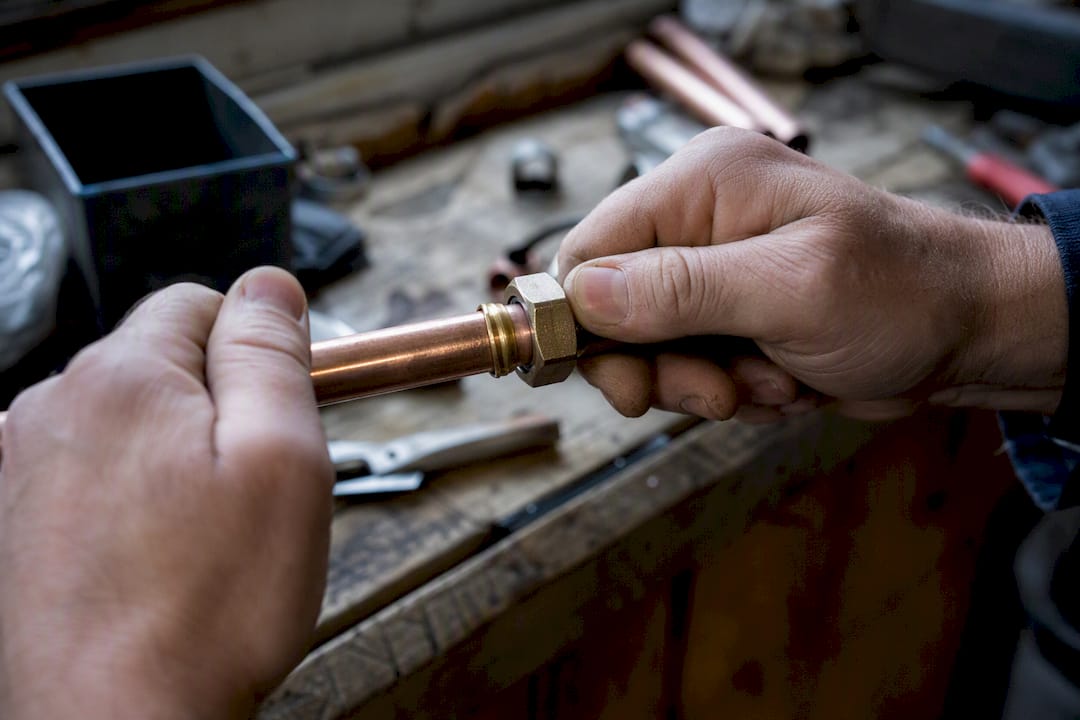
This makes compression fittings the natural choice when you can't drain the pipe, can't safely use a torch, or you're connecting to a valve, radiator or cylinder where future maintenance is likely. Trade guidance is clear that compression is often chosen for environmental reasons rather than material preference, such as working next to combustibles or on a system that's still live.
Two mistakes come up constantly: overtightening (which cracks the olive rather than sealing it) and reusing an old olive after taking a joint apart. Once deformed, an olive rarely reseals reliably second time round.
Pro Tip: Carry a handful of spare olives in your toolbox. They cost pennies, and reusing a squashed one is one of the most common causes of a "mystery" drip weeks later.
Push-fit fittings: quick joints for tight spaces and mixed pipework
Push-fit fittings seal with an internal grab ring that bites onto the pipe and an O-ring that provides the watertight barrier, and they can be released again with a simple disconnect tool. No flame, no spanners, no solvent. You push the pipe in and the joint is made.
They're the best option for:
- Quick repairs under time pressure, especially with the water still partly live
- Connections to washing machines, dishwashers and under-sink appliances
- Jobs mixing copper and plastic pipe on the same run
- Cramped spaces where swinging a torch or spanner isn't practical
Push-fit fittings are generally more costly per joint than end-feed or compression, and that convenience requires proper preparation of the pipe end.
Pro Tip: Always deburr the cut end of copper or plastic pipe before pushing it in. A sharp burr can slice the internal O-ring, causing a slow leak that only shows up hours after the water's back on.
Where do threaded and barbed fittings fit in?
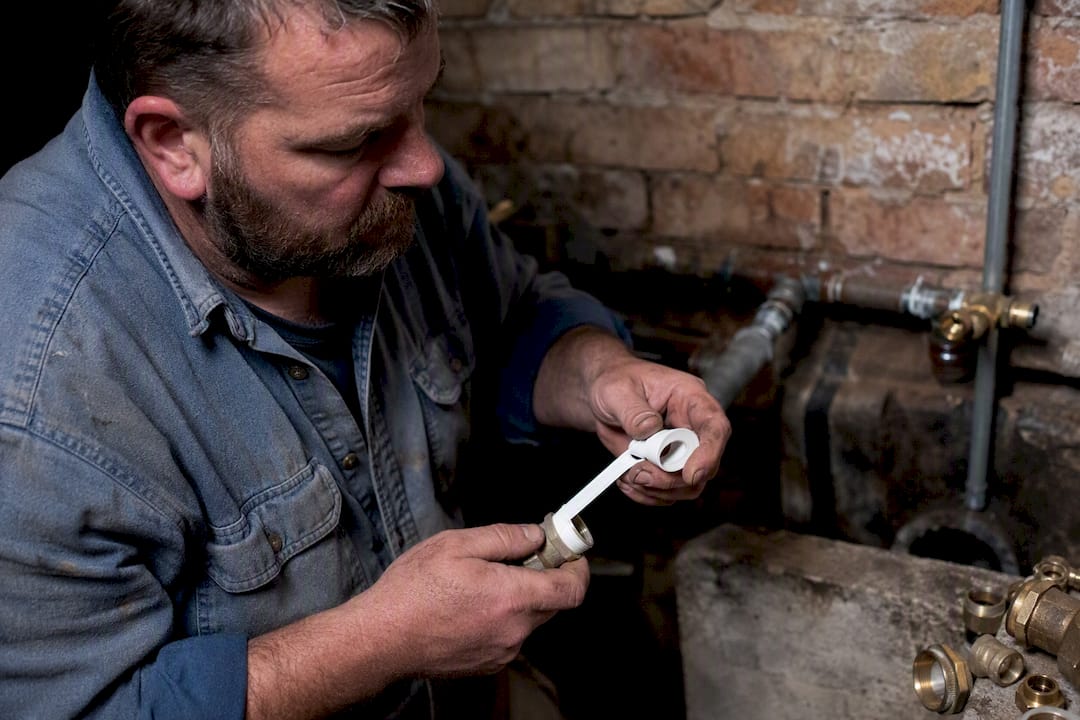
Threaded fittings (often called BSP, for British Standard Pipe) join components with matching screw threads, commonly seen on taps, cylinders and valve connections. Wrap PTFE tape clockwise around the male thread, or use a jointing compound, before assembling. Skip this step and the joint will weep almost immediately.
Barbed fittings are different again: they're designed for flexible hose, with a ridged tail that grips the hose from inside while a hose clip clamps the outside. You'll meet these most often on garden irrigation and washing machine hoses. Always match the hose bore to the barb size, and use a proper worm-drive clip rather than a cable tie, which can slip under pressure.
Solvent-weld fittings for plastic waste and drainage
Solvent-weld joints don't rely on mechanical grip at all. A solvent cleaner and cement soften the surface of rigid plastic pipe and fitting, fusing them into one continuous piece as the solvent cures. It remains the professional standard for rigid plastic waste and drainage systems, producing a joint that's permanent and fully watertight.
Reach for solvent-weld on:
- Waste pipes from baths, basins and sinks
- Soil pipes and underground drainage runs
- Any plastic system where you never intend to take the joint apart
Work in a ventilated space, since solvent fumes are strong, and leave the joint to set fully before running water through it. Rushing this step is the most common reason solvent-weld joints fail early.
MDPE, electrofusion and press-fit: mains and specialist systems
Blue MDPE pipe carries mains water underground to your property, and it needs its own family of fittings. Standard copper push-fit fittings are not suitable for MDPE mains — you need compression or insert fittings specifically rated for buried, pressurised supply pipe.
Electrofusion and press-fit systems go a step further again. These fuse or crimp joints using dedicated trade equipment, and they're built for higher-pressure or larger-diameter mains work. Buried MDPE work should only use mains-rated components, following the manufacturer's instructions for inserts and crimping, which usually means specialist tools and, in many cases, a certificated installer.
If you're digging up a garden and find blue pipe underneath, that's your cue to stop and call in a professional rather than reach for a standard fitting.
Pro Tip: Never assume a compression fitting from your local hardware shop is mains-rated. Check the packaging specifically states it's suitable for MDPE water supply pipe.
What do all the different fitting shapes actually do?
Beyond the joining method, fittings come in a handful of recognisable shapes, and each has a defined job:
- Coupler – joins two pipes of the same diameter in a straight line
- Elbow (90° or 45°) – changes the direction of a run
- Tee – splits one pipe into a branch, feeding two directions from one supply
- Reducer – steps down from a larger pipe diameter to a smaller one
- End cap – seals a pipe run permanently, useful for capping off redundant pipework
- Isolation valve / stopcock – shuts off flow locally for maintenance without draining the whole system
Olives and inserts do the quiet work inside compression joints, and both need replacing whenever a joint is taken apart and remade. A photo on your phone of each shut-off valve and what it controls saves real time in an emergency.
Pro Tip: Label every isolation valve with a permanent marker or tag the day you fit it. Nobody remembers which one feeds the upstairs bathroom six months later.
Permanent versus demountable joints: which should you choose?
The trade draws a firm line between the two. Permanent joints (solder, solvent-weld) are meant to stay put forever, while demountable joints (compression, push-fit) can be taken apart for future access. That distinction should drive your choice as much as material does.
Match the fitting to what's on each end of the pipe:
- Copper to copper – any method works; end-feed for concealed permanent runs, compression where you may need access again
- Copper to plastic (PEX) – push-fit or specific transition fittings, never solder direct to plastic
- PVC to PVC – solvent-weld for a fused, permanent joint
- Brass fittings to copper or MDPE – common on valves and stopcocks, generally compatible across compression systems
Professionals often lean towards compression for concealed or long-term runs where slight movement in a building might otherwise stress a soldered joint over years. That's worth remembering before you assume soldering is always the "better" option.
Pro Tip: If a joint sits behind a boarded panel or under floorboards you might lift again, favour a demountable fitting over solder, even if it costs a little more now.
A quick checklist before you pick up a fitting
- Identify the pipe material – copper, plastic (PVC/PEX) or MDPE, since this narrows your fitting options immediately.
- Check whether you can drain the circuit – if not, compression or push-fit are the reliable choices, because a soldered joint fails on wet copper.
- Look for combustible material nearby – insulation, timber joists or old lagging rule out an open flame.
- Assess access and space – tight corners favour push-fit; open runs make soldering easier.
- Decide if the joint needs to be permanent – concealed, final installations suit solder or solvent-weld; anything you may revisit suits a demountable option.
Isolate the water supply before starting, and if you're working near sockets or an immersion heater, cut the electrics at the consumer unit too. Ventilate the room properly if you're using solvent cement, and never solder near gas pipework or where you can smell a leak. If you find a hidden or persistent leak, you're working on MDPE mains, you're dealing with a complex heating circuit, or you simply don't have the confidence or the right tool for the job, that's the point to stop and call a plumber rather than push on.
A plumber's rule of thumb on fittings
Prefer mechanical joints for repairs you can't drain; save solder for new, concealed, permanent runs. Some mains and heating work genuinely needs a certificated engineer.
If you'd rather leave it to an expert
Fittings are straightforward once you know the rules, but not every job is a good DIY candidate, particularly anything touching mains water, a heating circuit, or pipework you can't easily inspect. Your-local-plumber handles exactly these jobs: leak diagnosis, isolation valve fitting, tap and toilet repairs, and full new installations, all carried out by qualified engineers with fixed, transparent pricing agreed before work starts.

If a repair involves mains pressure, a boiler, or pipework you can't confidently drain yourself, that's the moment to stop guesswork and get a second pair of eyes on it. Book a callout or request a free on-site quote for a new installation, and you'll get a fixed price before anyone picks up a tool.
Sources
- End feed, compression or push‑fit: which copper fitting should you use — APM Plumbing & Electrical
- Diy