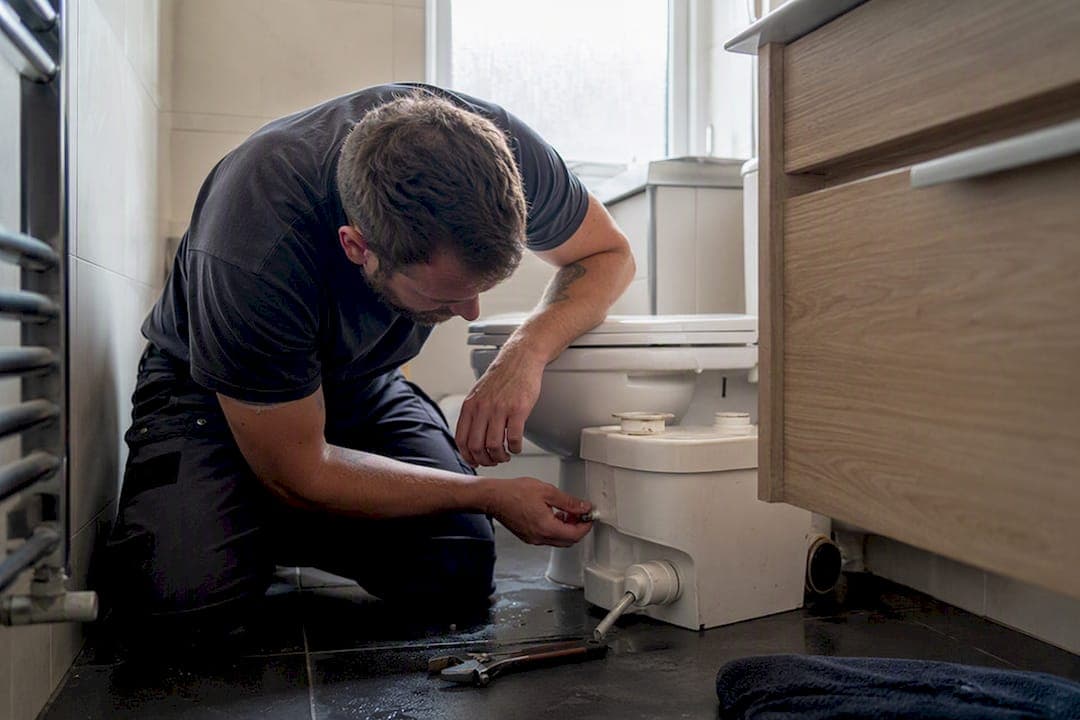
Most Saniflo faults trace back to one of four causes: a blockage in the blades or discharge pipe, a worn membrane or non-return valve, limescale build-up, or an electrical fault tripping the unit. If your macerator doesn't switch off, is running but not pumping, or has started on its own, isolate the electricity supply at the consumer unit before touching anything else, and stop flushing immediately.
Once the power's off, check the obvious things first:
- Has anyone flushed wipes, cotton wool, or anything other than toilet paper recently?
- Is the cistern leaking or dripping into the pan?
- Is there any water pooling around the base of the unit?
A typical flush should trigger 2 to 3 pump cycles lasting 1 to 2 seconds each. If yours runs for much longer than that, you're almost certainly looking at a fouled membrane or a leak feeding the chamber, not a one-off glitch.
Key Takeaways
Most Saniflo toilet problems come down to blockages, worn membranes, limescale, or electrical faults, and each one has a specific, safe first check.
| Point | Details |
|---|---|
| Isolate power first | Always cut electricity at the consumer unit before inspecting or touching the unit. |
| Watch run time | A normal flush cycles 2 to 3 times at 1 to 2 seconds each; longer runs signal membrane or leak issues. |
| Descale twice yearly | Use a Saniflo-formulated descaler, never bleach, and descale more often in hard-water areas. |
| Check leaks for phantom starts | Dripping cisterns and fittings are the most common cause of a unit activating on its own. |
| Know your stop point | Stop DIY at strip-down repairs and call Your-local-plumber for engineer diagnosis and warranty-safe fixes. |
Official Saniflo resources worth bookmarking
For descaler instructions and warranty support, consult the official Saniflo FAQs and installation guidance from Pumpmaster's Saniflo dos and don'ts.
Table of Contents
- Common Saniflo toilet problems and how to fix them
- How do you troubleshoot a Saniflo step by step?
- How often should you descale a Saniflo?
- When should you call an authorised Saniflo engineer?
- Sources
Common Saniflo toilet problems and how to fix them
Saniflo units are reliable machines when installed correctly, but they see a fairly predictable list of failures. Here's what usually goes wrong, and the shortest safe route back to normal.
-
Won't switch off. This is almost always a leaking cistern feeding water into the macerator chamber, a stuck microswitch, or a damaged membrane misreading water level. Check the cistern first: a slow leak here is the cheapest fix by far. If the cistern is dry and the unit still won't stop, the microswitch or membrane needs replacing, which is a job for an authorised engineer.
-
Runs but doesn't pump anything away. If the motor's working but nothing's leaving the unit, suspect a jammed blade or a blocked discharge pipe. Cut the power immediately. Running a macerator against a full blockage burns out the motor within minutes. Don't attempt to force it back on repeatedly.
-
Starts on its own with nobody near it. Phantom activation is usually a leak somewhere in the system rather than a fault with the unit itself. Engineers frequently trace this back to a dripping cistern or a leaking connected fixture sending trickles of water into the chamber, which the sensor reads as a flush signal. A failing non-return valve can do the same thing by letting waste water flow back. Check every connected fixture for drips before assuming the valve's at fault; following how to waterproof bathroom walls can also help protect your finishes from water damage caused by leaks. Our guide on fixing phantom toilet flushing covers this in more depth.
-
Backups in the bath, shower or basin. If other fixtures start backing up when the macerator runs, the inlet pipework serving those fixtures is likely restricted. Stop using those fixtures until the blockage clears, and avoid running large volumes of water through them in the meantime.
-
Vibrating or buzzing noises. A bit of hum during the pump cycle is normal. A grinding, rattling or high-pitched buzz usually means something's caught in the blades, or the motor bearings are wearing out. A foreign object jammed against the blades is a common cause of both noise and motor failure , and while you can remove a visible obstruction yourself once the power's off, full disassembly of the cutting mechanism should go to a qualified engineer.
-
Foaming or leaking from the air vent. Excess detergent, certain cleaning products, or limescale build-up narrowing the vent can all cause foam to escape. It looks alarming but rarely signals a serious fault on its own, unless it's paired with an overflow, which points to a blockage further down the system.
-
Tripping the consumer unit. A single trip could be a one-off surge. A repeated trip on the same circuit means there's a genuine electrical fault, most likely a failing motor winding or damp reaching the wiring. Leave the power isolated and don't reset the breaker more than once before calling a qualified electrician or engineer.
-
Persistent bad smells. Odours usually come from a poorly sealed connection, a dry trap somewhere in the system, or a vent that's partially blocked. A quick check of all visible joints and seals for gaps often resolves it. If the smell keeps returning after cleaning, the seal itself likely needs replacing.
Pro Tip: Keep a note of how long your unit runs on a normal flush. Once you know your baseline, you'll spot a developing membrane problem weeks before it becomes a full breakdown.
How do you troubleshoot a Saniflo step by step?
Work through these checks in order, and stop the moment you hit a point marked below.
-
Isolate electricity, then water. Switch off at the consumer unit first. This protects you from shock and stops the motor from trying to run against a fault. If there's standing water or an overflow risk, turn off the local stopcock too.
-
Do a visual inspection. Look for damp patches around the base, check whether the casing feels warm or hot to the touch, and note any unusual smell. A hot casing after a short run is not normal and points to motor strain.
-
Test the microswitch and non-return valve. With power off, you can usually access the microswitch behind the access panel without specialist tools. A valve that's stuck open or closed is often visible without dismantling the whole unit. If either looks worn, cracked or corroded, note it down for the engineer rather than forcing it.
-
Check the discharge pipe run. Look for kinks, dips that trap waste, or any section using flexi-hose. Flexi-hoses and poor pipe gradients are a leading cause of recurring blockages , so if you spot one in your installation, that's likely your repeat offender.
-
Remove visible foreign objects only. With the power confirmed off, gloves on, and using basic tools, you can lift out anything visible and reachable inside the bowl or access point. If it's not immediately visible or reachable, stop. Forcing a blade mechanism open without proper training risks damaging the seal and voiding any warranty cover.
Roughly two to three seconds of pump time per cycle is what a healthy unit produces. Anything running noticeably longer on every flush is your clearest single sign that something inside needs attention.
How often should you descale a Saniflo?
Descale your macerator at least twice a year, and more often if you live in a hard-water area, since limescale build-up is one of the most preventable causes of Saniflo failure.
- Use a dedicated Saniflo-formulated descaler or an equivalent macerator descaler, never standard household bleach.
- Bleach and harsh acids corrode the rubber pressure-sensing membrane and seals, which is exactly the component responsible for most "won't switch off" faults.
- Pour the descaler into the bowl, leave it for a few hours, then flush so it works through the macerator and pipework.
- Do an occasional test flush and check drainage speed. Slower-than-usual flow is often the first sign of scale building up before any other symptom appears.
Pro Tip: Never flush "flushable" wipes, even occasionally. They don't break down the way toilet paper does, and they're one of the most common causes of jammed blades and blocked discharge pipes.
When should you call an authorised Saniflo engineer?
Some faults are safe to check yourself. Others aren't worth the risk, either to you or to your warranty.
- The casing feels hot to the touch after running.
- The motor runs but nothing discharges, even after checking for visible blockages.
- The consumer unit trips more than once on the same circuit.
- Leaks persist after you've checked and tightened all visible seals and connections.
- The blade mechanism needs opening up or a foreign object isn't reachable safely.
Before calling, find your unit's serial number and date of purchase, since authorised engineers need these to confirm warranty cover and advise on call-out costs. A qualified engineer will check the membrane, microswitch, non-return valve, blade condition and electrical supply, usually in that order, and can tell you within a single visit whether you're looking at a simple part swap or something more involved.
Safety and routine care matter more than most people think
Most of the call-outs behind these faults didn't start as emergencies. A dripping cistern left for weeks becomes a phantom-flushing unit. A skipped descale becomes a seized membrane. Book a routine service before a fault appears rather than after, and save the emergency call-out for the things that genuinely can't wait, like a hot motor casing or a repeated electrical trip. For anything beyond a visible, reachable blockage, a professional visit is usually cheaper than the damage caused by pushing a DIY fix too far.
— Michael
Book a Saniflo repair with Your-local-plumber
Chasing a macerator fault at 11pm on a Sunday is exactly the situation Your-local-plumber exists for. Unlike waiting days for a callback from a manufacturer helpline, you get a fixed-price visit from an experienced engineer who handles emergency repairs, descaling, and routine servicing on the same call-out.

Before booking, have your unit's serial number, a description of the symptoms, and your last descaling date ready. This lets the engineer diagnose faster and avoid a second visit. Your-local-plumber's engineers work across multiple UK towns and cities with transparent fixed pricing, so you know the cost before anyone picks up a tool. If your Saniflo has stopped switching off, won't pump away, or keeps tripping your electrics, book a repair visit today and get it sorted properly.
Sources
- How to clean a macerator toilet | SFA Saniflo (blog)
- FAQs - SANIFLO (official FAQs)
- Saniflo descaler how to clean a Saniflo macerator FAQ
- Saniflo dos and don’ts | Pumpmaster