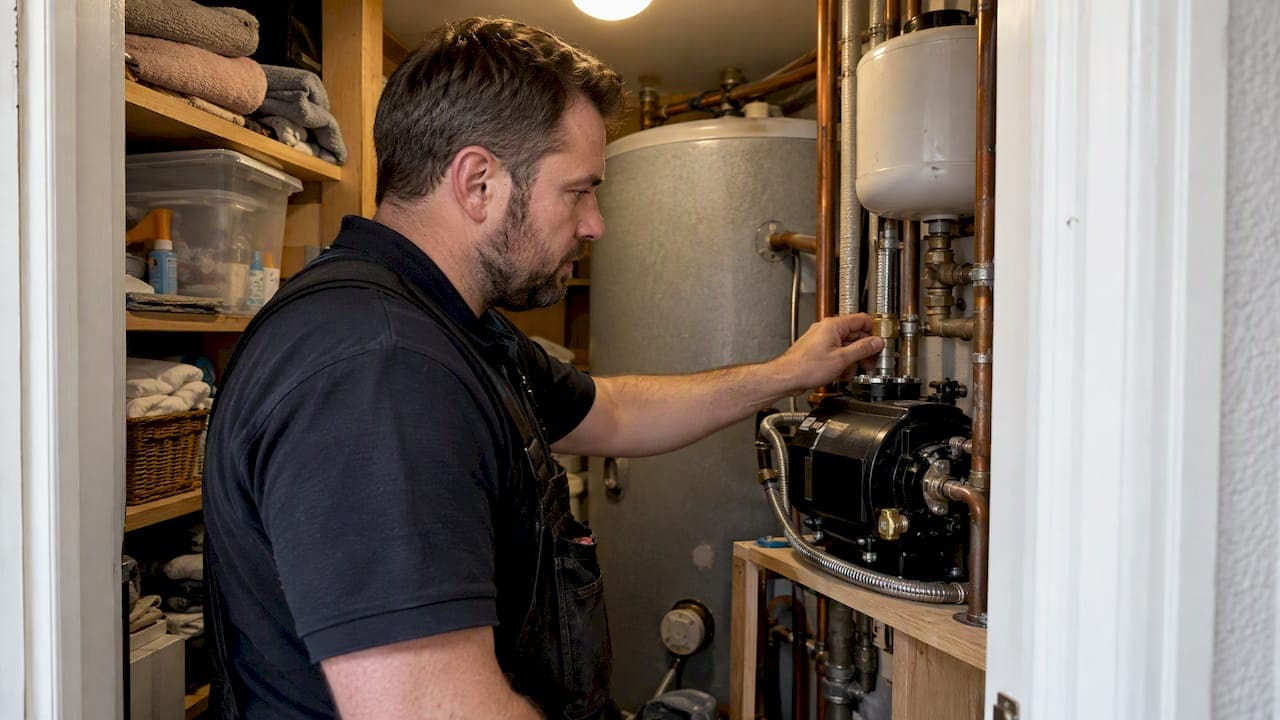
Most shower pump faults trace back to issues such as no power reaching the unit, an airlock or dry run, a blocked inlet filter, or a failed flow or pressure switch. Start by isolating the power and checking the fuse or MCB, then confirm the isolation valves are open and inspect any accessible filters. Stop and call a qualified engineer for anything involving bathroom electrics.
TL;DR:
- Positive head pumps need 250 to 300 millimeters of water head to activate; tanks level with or below them require a negative head kit.
- Stop testing and call a qualified engineer for buzzing motors, burning smells, repeated thermal trips, leaks, or uncertainty involving bathroom wiring.
- Before booking, isolate power, check the fuse and breaker, open both isolation valves, inspect accessible filters, and bleed trapped air without running the pump dry.
- Clean inlet filters, showerhead plates, and hose strainers every few months, check tank levels regularly, and keep the cylinder thermostat at or below 60°C.
Table of Contents
- What symptoms tell you about the fault
- What usually causes these faults
- Safe checks you can do before calling anyone
- When to call a qualified engineer
- What a technician usually fixes
- A simple maintenance routine that prevents most faults
- A practitioner's honest view on shower pump faults
- Getting a qualified engineer out when DIY checks don't fix it
- FAQ
- Sources
What symptoms tell you about the fault
Matching what you see or hear to a symptom category narrows down the likely cause before you touch anything.
- Won't start at all: usually no power reaching the unit, a blown fuse, or a jammed motor.
- Runs on constantly: often a stuck flow or pressure switch, or an electrical fault keeping the circuit closed.
- Pulsing or hunting: points to a failing pressure vessel or a control reed and flow switch issue.
- Noisy, with grinding or knocking: typically worn bearings, cavitation, or air trapped in the system.
- Low flow or a weak shower: often blocked filters, insufficient head, or a pump that was never sized correctly for the system.
- Cycling on and off or cutting out repeatedly: usually overheating or the motor's protective thermotrip activating.
Once you have matched your symptom, the causes below explain what is actually happening and how urgent each one is.
What usually causes these faults
Electrical faults are the most common starting point. A blown fuse, a tripped MCB, loose wiring, or the motor's thermotrip can all stop a pump from starting, or cause it to cut out and restart on its own protective logic.
Water supply problems come next. An airlock, low or negative head, or an empty cold water tank can all prevent the pump from priming properly. Negative-head installations, where the tank sits below or level with the pump, need a specific kit designed for that setup, as practitioner guidance on head requirements explains: flow switches on positive-head pumps generally need a minimum static head of around 250 to 300 millimetres to activate at all.
Blocked inlet filters or clogged shower fittings reduce flow and can trigger cavitation, which shows up as that grinding or knocking noise. Faulty flow or pressure switches, or a failing PCB and controller, are behind most cases of a pump running on or cycling erratically. Installation errors, such as incorrect siting or a missing anti-aeration flange, cause similar symptoms even on an otherwise healthy pump. Manufacturer documentation on common faults confirms that checking the power supply and fuse, clearing blocked filters, and making sure isolation valves are fully open are the first things to verify when a pump misbehaves.
Finally, an overly hot cylinder thermostat shortens pump life over time by pushing the unit beyond its rated operating temperature.

Safe checks you can do before calling anyone
Work through these in order. Each one rules out a simple cause before you move to anything more involved.
- Isolate power at the consumer unit. Never work on a live pump circuit, and leave any wiring or terminal work in bathroom areas to someone qualified: these count as "special locations" under Part P electrical safety guidance.
- Check for power. Look for a pump indicator LED, check the fuse (often 5A) and the relevant MCB, without touching any live terminals.
- Check the hydraulics. Confirm the inlet and outlet isolation valves are fully open, check the cold tank level and ballvalve, and listen or feel for the pump trying to prime.
- Clean the filters. Access and clear the inlet strainer basket and the showerhead plate; keep a towel handy for spilt water and check seals go back correctly.
- Purge trapped air. Open the nearest hot and cold taps to bleed air and let the pump re-prime; never let it run dry.
- Check the shower fittings. Remove and descale the showerhead and hose, since limescale alone can mimic a pump fault.
- Write down what you tried. Note what changed and what did not; this saves time if an engineer needs to take over.
Pro Tip: Keep the pump's make and model number handy once you start checking; it speeds up both manufacturer guidance lookups and any engineer call-out.
When to call a qualified engineer
Some signs mean it is time to stop and book a professional rather than keep testing.
- A buzzing motor, a burning smell, or repeated thermal trips, which point to an electrical or motor fault rather than a simple blockage.
- Leaks at pipe unions or fittings, which need hands-on repair.
- Any uncertainty about bathroom electrics: Part P guidance treats this as a special location where notifiable work should go through a competent person or Building Control.
An engineer visit typically includes electrical verification, flow and pressure measurement, a filter inspection, testing the reed or flow switch and PCB, checking for cavitation and correct siting, then priming and testing the pump under load. Outcomes range from an on-the-spot filter clean or switch reset to arranging a replacement part.
What a technician usually fixes
Most call-outs resolve into a handful of recurring repairs.
- Cleaning or replacing inlet strainers and flushing debris that has built up in the pipework.
- Replacing flow or reed switches, pressure switches, or electronic control boards when the protective logic is misbehaving rather than the motor itself.
- Repairing dry-run damage, which can mean new seals, bearings, or occasionally a full motor replacement, alongside correcting the priming routine so it does not happen again.
- Fitting an anti-aeration flange, repositioning the pump to correct the head, or installing a negative-head kit where the original setup was never right for the tank position.
- Correcting pipework or air ingress that is causing cavitation, and rechecking that the pump is sized correctly against the system's actual head and demand.
These line up closely with the common faults and remedies listed in manufacturer installation and maintenance documentation, which treats most of the above as routine, expected maintenance rather than unusual failures.
A simple maintenance routine that prevents most faults
A little regular attention avoids most of the faults above before they start.
- Clean inlet filters, showerhead plates and hose strainers every few months, more often in hard water areas.
- Check the cold tank level and ballvalve regularly, and avoid letting the tank run low for extended periods, since that is a direct route to dry running.
- Reduce the cylinder thermostat setting to a maximum of 60°C where pump longevity is a concern.
- Arrange an annual check, and flush stored hot water systems after any long period of inactivity, which commissioning and flushing guidance recommends to clear sediment from outlets, hoses and strainers before use resumes.
- Use a registered installer for any replacement work, which keeps the job compliant with Part P and gives you a proper handover.
Pro Tip: If your shower pressure drops gradually rather than all at once, check our guide to fixing low shower pressure before assuming the pump itself has failed.
A practitioner's honest view on shower pump faults
Most shower pump problems are mechanically simple: power, priming, or a blocked filter. The judgement call is knowing where DIY checking ends and bathroom electrics begin. Keep notes on what you tried, and have the pump's make and model ready before you call anyone out.
— Michael
Getting a qualified engineer out when DIY checks don't fix it
When the checks above don't solve it, we send experienced engineers who carry out the electrical and hydraulic checks safely, from fuse and MCB testing to flow switch diagnosis and filter replacement. Have your symptoms, the DIY steps you've already tried, and the pump's make and model ready when you book, and we'll provide clear pricing.

For anything that smells electrical, won't stop running, or has you stuck mid-repair, book our emergency plumbing and heating service for a fast response, or head to our full range of repair and installation services for routine bookings.
FAQ
What is a shower pump?
A shower pump boosts water pressure and flow to a shower, usually where mains pressure or gravity-fed supply alone isn't strong enough. It sits on either the hot supply, the cold supply, or both, and switches on automatically when it detects demand.
Why does my water pump take so long to start?
A slow start is often down to an airlock, insufficient head, or a partially closed isolation valve restricting the supply the pump needs to prime. Clearing trapped air at the nearest outlet and confirming valves are fully open usually resolves it.
How can I increase water pressure in the shower without a pump at home?
Cleaning a blocked showerhead or descaling the hose fixes many low-pressure cases without touching the pump at all. For a fuller set of checks, see our guide to fixing low shower pressure.
Why does my shower pump keep coming on?
This usually points to a stuck or failing flow or pressure switch that is reading demand when there isn't any. It can also mean a small leak somewhere in the system is triggering the pump unnecessarily, which is worth checking before assuming the switch has failed.
When should I avoid DIY and call an electrician instead?
Any fault involving wiring, terminals, or repeated electrical trips on the pump should go to a competent person, since bathrooms count as a special location under Part P guidance. A general electrical safety checklist is a useful reference for knowing where the line sits before you start.