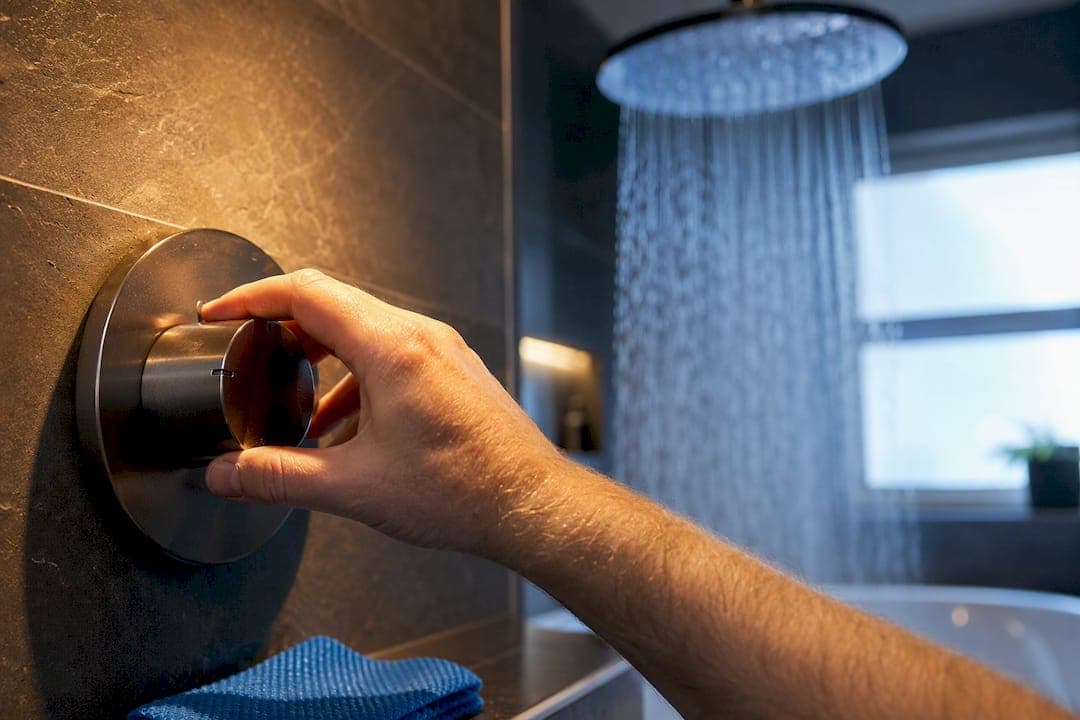
Most temperature swings come from a failing thermostatic cartridge in the shower valve or a combi boiler struggling to maintain flow. The quickest test is free: run a nearby hot tap for half a minute and watch it. Stable water there points to the shower unit itself; if that tap fluctuates too, the fault lies with the boiler, mains flow, or the pipework feeding the whole house.
TL;DR:
- Most temperature fluctuations are caused by a failing thermostatic cartridge in the shower valve or a boiler struggling to maintain flow, not just a faulty thermostat.
- Running a nearby hot tap for 30 seconds helps determine if the issue is with the shower valve or the boiler system.
- Hard-water buildup and debris inside the shower valve can cause temperature instability, which often improves with descaling or cartridge replacement.
- When all hot outlets fluctuate, the boiler or pipework is more likely to be the culprit, especially if the boiler short-cycles at low flow rates.
- Professional diagnosis should include measuring flow rate, temperature differentials, and system pressure, with a focus on potential sensor faults or scale buildup.
Table of Contents
- Quick diagnostic checklist: the five minute tests to narrow the fault
- Shower-side causes: valves, cartridges, blockages and mixers
- Boiler and system causes behind fluctuating water
- Step-by-step checks you can safely try at home
- When to call a Gas Safe engineer and what to tell them
- Michael's expert tips: patterns worth knowing before you call anyone
- The troubleshooting flow most guides get backwards
- Getting a proper diagnosis from Your-Local-Plumber
- Sources
Quick diagnostic checklist: the five minute tests to narrow the fault
Before touching anything, spend five minutes gathering evidence. It saves money whether you fix this yourself or call someone in.
- Run a nearby hot tap alone for 30 seconds. Steady heat here means the shower is the suspect; unsteady heat means the system is.
- Open a second hot outlet while the shower runs, such as the kitchen sink or a basin tap. If the shower temperature dips or spikes the moment that second tap opens, the boiler's flow rate is likely being pushed below its comfort zone.
- Check the boiler display for fault lights or error codes, and note the cold system pressure when the boiler is switched off.
Write down what you find. It becomes the diagnostic script for the next two sections, and for anyone you eventually call in.
Shower-side causes: valves, cartridges, blockages and mixers
If the rest of the house stays stable, the fault almost always sits inside the shower itself, most often in the thermostatic valve. Inside that valve sits a wax element or similar temperature-sensitive mechanism that expands and contracts to blend hot and cold water into a constant output. Limescale buildup or general wear stops that mechanism moving freely, and once it sticks, the mix drifts, sending water scalding hot or suddenly cold.
A handful of other shower-side faults produce the same symptom:
- A blocked shower head or kinked hose restricts flow enough to disturb the mix and can even trigger boiler cycling downstream.
- Debris trapped inside the mixer body creates uneven pressure between hot and cold feeds.
- Reversed or incorrectly connected inlet pipes cause crossflow, where hot water leaks backward into the cold feed (or vice versa) under pressure.
The fixes usually match the fault. Soak and descale removable fittings, especially in hard-water regions where scale accumulates fast, and if the valve still hesitates or sticks at low flow, the cartridge itself typically needs descaling or replacing rather than the whole unit. Swapping to a lower-flow head can also help, since it reduces the demand your boiler has to meet in the first place. Our guide to types of shower valves is worth a read if you're not sure which valve you actually have before ordering parts.
Pro Tip: If the shower is worse at low flow settings and improves slightly on full power, that's a strong sign of a scale-restricted cartridge rather than a boiler fault. Boiler-side cycling tends to behave the same way regardless of how far you turn the dial.
Boiler and system causes behind fluctuating water
When every hot outlet in the house misbehaves, the boiler or the pipework feeding it is the more likely culprit, not the shower. Combi boilers heat water on demand rather than storing it, and each one has a minimum flow rate it needs to fire properly. Drop below that threshold, perhaps because a tap opens elsewhere or a filter restricts flow, and the boiler can short-cycle, switching off and reigniting in a rapid hot-cold-hot rhythm that feels exactly like a faulty shower valve but isn't.
A few specific system faults produce that pattern:
- Limescale in the plate heat exchanger reduces how efficiently the boiler transfers heat into the water passing through, causing inconsistent output even when the burner is running normally.
- A faulty flow sensor or temperature sensor feeds bad data to the control board, which then over-corrects or misfires the burner.
- Control-board faults cause intermittent heating cycles that have nothing to do with water flow at all.
Seasonal shifts play a role too. Mains water arriving at 5°C in January makes a boiler work harder than at 15°C in July, and a boiler that's slightly undersized for the property copes fine in summer but struggles visibly in winter.
One detail worth knowing before you call anyone: a genuinely diagnostic visit measures inlet temperature, flow rate and outlet temperature across a range of settings rather than swapping a part and hoping. Our explainer on how combi boilers work covers the flow-rate mechanics in more depth if you want the full picture.
Step-by-step checks you can safely try at home
Work through these in order using this healthy home environment checklist for safe and effective steps. Each one either fixes the problem outright or tells you something useful for the next step.
- Isolate the fault to one outlet. Run the shower alone, then run it while a second tap is open, as covered in the diagnostic checklist above.
- Clean the shower head and hose. Unscrew the head, soak it in a descaling solution or diluted vinegar for an hour, and rinse the hose through separately.
- Turn the shower flow down slightly if your valve allows it, and see whether a lower flow rate reduces the swings.
- Check boiler pressure on the gauge (most combis want it between 1 and 2 bar when cold) and glance at the display for any fault code, which you should look up and note down rather than ignore.
If cleaning the head doesn't help but the valve still hesitates at low flow, that usually means the cartridge itself needs replacing rather than descaling. Cartridges are a like-for-like swap in most valves and considerably cheaper than a new shower.
Pro Tip: Never open the boiler casing yourself. Anything beyond the external pressure gauge and the digital display involves gas or mains electrical components, and that work is legally restricted to a Gas Safe registered engineer.
When to call a Gas Safe engineer and what to tell them
Book a professional if the cycling is persistent rather than occasional, if water reaches genuinely scalding temperatures, if the boiler locks out repeatedly, if you hear banging or whining from the unit, or if you smell gas at any point. That last one means calling the National Gas Emergency Service before anyone else.
Before the engineer arrives, write down:
- The boiler's make and model, plus any fault code shown on the display.
- The system pressure when the boiler is cold and switched off.
- Exactly which outlets are affected: just the shower, or every hot tap.
- Whether radiators still heat properly while hot water is running.
That list turns a vague callout into a focused visit. An engineer will typically test flow rate, compare temperature differentials across the heat exchanger, and check for scale or sensor faults, work that's far quicker when they're not starting from scratch.
Michael's expert tips: patterns worth knowing before you call anyone
A limescale-seized cartridge tends to respond slowly and gets noticeably worse at low flow settings. A failing boiler sensor behaves differently: the cycling is more random and hits every hot outlet in the house, not just the shower.
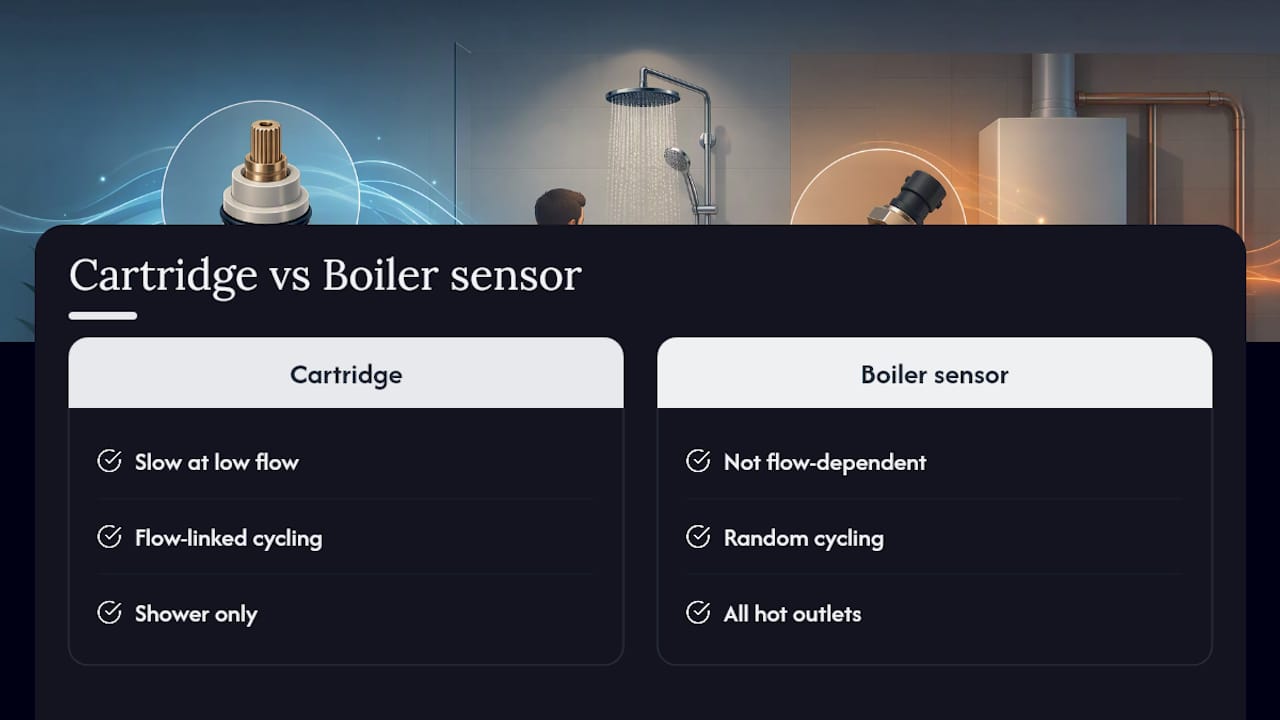
That distinction saves money. In hard-water areas particularly, descaling or swapping the cartridge alone resolves the fault far more often than people expect, without needing to replace the shower unit at all. The three mistakes I see most often: binning a whole shower valve when only the cartridge needed changing, ignoring an intermittent fault code because "it's working again now," and assuming every low-flow shower is automatically a cartridge problem when sometimes it's simply a blocked head.
The troubleshooting flow most guides get backwards
Most advice on this problem starts with the boiler, because that's where people assume the expensive fault lives. In practice, the shower valve is the cheaper and more common culprit, and testing it first takes thirty seconds with a tap.
The conventional wisdom also treats "call an engineer" as a last resort after you've exhausted DIY options. I'd flip that slightly: call one the moment you notice scalding water or repeated boiler lockouts, because those aren't inconvenience issues, they're safety ones. Everything short of that genuinely is worth checking yourself first.
What the reader should actually prioritise is documentation, not diagnosis. You don't need to know whether it's a flow sensor or a heat exchanger. You need to know which outlets are affected, what the pressure gauge reads, and whether there's a fault code on the display. Hand that to a professional and the job gets fixed on the first visit instead of the second.
— Michael
Getting a proper diagnosis from Your-Local-Plumber
A diagnostic visit from Your-Local-Plumber means an engineer actually measures your system, checking flow rate, pressure and temperature differentials across your boiler and shower valve, rather than guessing and replacing parts on a hunch. That's the difference between paying for one visit and paying for three.

Pricing is explained before any work starts, so you know the cost of the diagnostic visit and any follow-up repair upfront. Emergency slots are available at various times for urgent issues that cannot wait until morning. Once the cause is confirmed, your engineer will talk you through the options on the spot, no return visit needed just to hear a quote. If you've already worked through the checks above and the fluctuation hasn't cleared, book a visit with Your-local-plumber and get it diagnosed properly the first time.
Sources
- Shower goes hot and cold: solutions — Aqualisa
- Why your combi boiler hot water keeps turning hot and cold — Embassy Gas
- My shower temperature fluctuates or is only running hot or cold — Crosswater