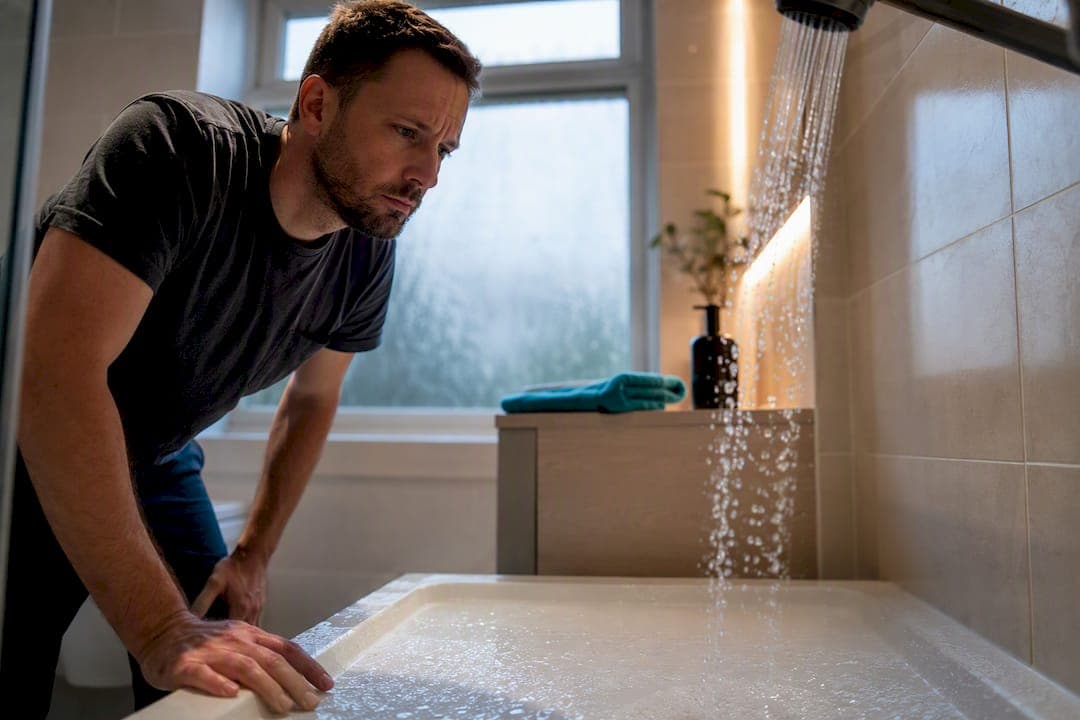
Start with the showerhead. Most weak showers trace back to limescale clogging the nozzle, a kinked hose, or a valve that isn't fully open, and clearing those takes minutes, not a plumber. Try that first, then run the jug or gauge test below if the flow is still poor. Only book a professional if the whole house is affected or a pump installation is on the cards.
TL;DR:
- Most low shower pressure issues are caused by limescale, kinks, or partially closed valves, which can typically be fixed in minutes without professional help.
- The difference between static pressure and flow rate often leads to misdiagnosis, with flow being the key factor affecting shower performance.
- Testing with a jug and a pressure gauge helps identify whether the problem lies with the mains supply, internal pipework, or equipment restrictions.
- DIY solutions, such as cleaning filters, replacing worn hoses, or installing low-pressure heads, resolve the majority of pressure complaints.
- A professional is necessary if low pressure affects the entire house, if hidden leaks are suspected, or if pump and pipework upgrades are required.
Table of Contents
- Quick checks to try before anything else
- What does 'low pressure' actually mean?
- How do you test your shower's water pressure?
- DIY fixes that usually restore flow
- When do you need a pump or accumulator instead?
- Could it be the pipework or the mains supply itself?
- When should you call a plumber?
- Our approach to diagnosing weak showers
- Get a professional to sort it properly
- Sources
Quick checks to try before anything else
Before you touch a spanner or spend a penny, work through the obvious culprits. This takes ten minutes and rules out roughly half of all shower pressure complaints, according to plumbers who trace most low-flow callouts back to simple restrictions rather than anything structural.
- Unscrew the showerhead and handset and soak them in a bowl of white vinegar for an hour. Limescale builds up inside the tiny holes and chokes the flow long before you'd notice it by eye.
- Check the flexible hose for kinks, twists, or a crushed section near the wall bracket. Also look at the inlet filter, a small mesh washer that sits inside the hose connector, since debris collects there first.
- Find the isolation valves under the bath panel or behind the shower unit and make sure they're turned fully parallel to the pipe, not half shut. Then check the main stopcock, usually under the kitchen sink, is opened all the way.
- Run another tap in the house at full flow. If it's weak too, the problem sits with your supply or system rather than the shower itself.
If all four checks come back clean and the shower's still struggling, you're dealing with something more specific, and that's where the testing below earns its keep.
What does 'low pressure' actually mean?
Pressure and flow aren't the same thing, and mixing them up is the single biggest reason homeowners misdiagnose their own shower. Static pressure is the force pushing water through the pipe when nothing's running. Flow rate is the actual volume that comes out once you turn the tap on, measured in litres per minute. You can have perfectly healthy static pressure and still get a feeble shower if something inside the house is restricting the flow, a distinction that trips up more people than any single mechanical fault.
The type of hot water system you have changes what "normal" looks like:
- Combi boilers heat water on demand straight from the mains, so shower performance depends entirely on incoming mains pressure and flow.
- Gravity-fed systems rely on a cold water tank in the loft; performance depends on how high that tank sits above the shower, known as the "head" of water.
- Unvented (mains pressure) cylinders store hot water under mains pressure, so they generally deliver stronger, more consistent flow than gravity tanks.
Typical UK mains pressure runs between 2 and 4 bar, and combi boilers generally need at least 1 to 1.5 bar to fire properly, according to Squote's UK water pressure guide. If your hot water is weak, but cold runs fine, suspect the boiler or hot-side pipework. If both are weak, look at the whole-house supply.
How do you test your shower's water pressure?
Two cheap tests tell you almost everything you need to know.
- The jug test. Hold a litre jug under the flow and time how long it takes to fill. If it fills in six seconds, you're getting roughly 10 litres per minute, using the standard multiplier of six seconds times ten, and that's the rough line most UK guides treat as the cutoff for a genuinely low shower flow.
- The pressure gauge test. A screw-on gauge from a hardware shop, fitted to an outside tap or the kitchen cold tap, gives you a static reading with nothing else running and a dynamic reading with a tap or shower open elsewhere.
Low static reading plus low dynamic reading usually points to the mains supply itself. Good static but poor dynamic points to internal pipework, a valve, or a boiler restriction, exactly the distinction that separates a supplier problem from a plumbing one.
DIY fixes that usually restore flow
Once you've narrowed down the likely cause, most homeowners can fix it themselves without calling anyone out. This is where the bulk of shower pressure complaints actually get resolved.
- Replace the showerhead outright if it's old or heavily scaled, rather than fighting limescale forever. A new head costs far less than a callout.
- Deal with flow restrictors carefully. Many modern heads include a small plastic disc inside the connector designed to cap water use. Removing it entirely can void a warranty or breach water efficiency rules in some fittings, so check the manual before pulling it out.
- Swap the hose if it's kinked, perished, or narrower than the original spec, since some replacement hoses are sold with a smaller bore than the standard fitting.
- Clean the handset filter and any cartridge screens inside mixer valves, since these mesh filters trap grit and scale from the pipework and are easy to miss during a quick clean.
- Choose a low-pressure-optimised shower head where your supply is genuinely marginal. These heads use wider apertures or aerating technology to make a little water feel like a lot.
Pro Tip: Keep the old showerhead nozzle plate after you swap it out. If a plumber visits later, showing them the scale build-up helps them judge instantly whether the whole system needs descaling or if it really was just that one fitting.
Fixing the mechanical stuff first, before spending money on pumps or new valves, saves most homeowners an unnecessary bill. It's the boring checks that solve the problem more often than the exciting ones.
When do you need a pump or accumulator instead?
If your tests point to genuinely weak flow rather than a blocked fitting, and your system is tank fed, a shower pump is often the right next step. Choosing the correct type matters as much as buying one at all.
- Positive-head pumps suit systems where the cold water tank sits well above the shower, giving the pump a head start.
- Negative-head pumps are built for situations where the tank sits at the same level as or below the shower, a common problem in loft conversions and bungalows.
- Never fit a pump that draws directly from the mains supply. Doing so without an appropriately sized accumulator or break tank risks a regulatory breach and can allow contamination through backflow into the public supply, a point water pump manufacturers themselves are explicit about.
- Combi boiler homes have no tank to pump from, so the usual alternatives are an electric shower with its own heating element or a mains-fed accumulator system that stores pressurised water for a stronger burst on demand.
Always check that any pump you're considering is rated for your specific shower valve type, since thermostatic and mixer valves have different minimum head and flow requirements, and a mismatched pump can leave you no better off than before.
Could it be the pipework or the mains supply itself?
Sometimes the fault sits deeper than anything you can see from the bathroom. Older homes, particularly those with original plumbing, often still run on 15mm supply pipe or, in rarer cases, ancient lead pipework, both of which choke flow no matter how clean your showerhead is.
- Undersized 15mm runs are a frequent hidden cause of a weak shower, and replacing them with 25mm MDPE pipe to the stopcock and 22mm internal runs usually resolves the issue permanently.
- Internal corrosion inside old galvanised steel pipe narrows the bore from the inside, gradually strangling flow over years without any obvious external sign.
- A hidden leak elsewhere in the system, under a floor or inside a wall, can also rob pressure from your shower while showing no visible damp at all.
- If your own pipework checks out and every tap in the house is weak, the fault may sit with the supplier. Static pressure below 1 bar at your external stop tap falls under Ofwat's minimum expectation, and that's the point to report it to your water company rather than keep spending on your own system.
When should you call a plumber?
Book a professional once your own checks stop giving you clear answers, or once the fix moves beyond a showerhead and a spanner.
- Whole-house low pressure that isn't explained by the stopcock or an obvious valve.
- Suspected hidden leaks, particularly if you've noticed damp patches, a spinning water meter, or a pressure drop that's gradually worsened over months.
- Any pump, accumulator, or pipe replacement job, since these involve regulatory compliance and, in the case of pumps drawing from the mains, genuine safety risk.
Before the call, have your jug test result, gauge readings if you took them, the time of day you notice the drop, and which specific fixtures are affected. That single sheet of notes often cuts a diagnostic visit in half. Ask the plumber directly about compliance with water regulations, what guarantee covers the parts fitted, and what follow-up applies if the fix doesn't hold.
Pro Tip: Test your shower at the same time you'd normally use it, not first thing in the morning. Pressure often dips during peak usage hours when neighbours are showering too, and that timing detail helps a plumber pin down whether it's your system or the wider network.
Our approach to diagnosing weak showers
We start with the same jug and gauge tests any competent plumber should use, because guessing at pressure problems wastes a customer's money. Most call outs end with a showerhead, valve, or filter fix rather than anything drastic, though we're equipped to fit pumps and accumulators correctly when the system genuinely needs one. Every job comes with fixed pricing agreed before we start, and no surprise add ons once we're on site.
— Michael
Get a professional to sort it properly
If you've worked through the jug test, checked your valves, and you're still getting a trickle instead of a shower, that's usually the point where DIY stops paying off. Your-local-plumber handles the diagnostics properly from there: static and dynamic pressure readings, pump and accumulator installation where a tank-fed system genuinely needs one, and pipework replacement where old 15mm or lead supply is the real bottleneck.

Have your test results ready when you get in touch, since a jug test figure or a gauge reading lets our engineers narrow down the likely cause before they've even arrived. We offer plumbing services with flexible availability and transparent pricing, so there's no guessing what a callout will cost. Book a plumbing diagnosis to have the cause confirmed rather than another round of trial and error.