
TL;DR:
- Understanding UK plumbing systems helps homeowners describe problems accurately and avoid unnecessary work.
- Knowing pipe materials, fittings, and regulations enables better communication with engineers and ensures compliance.
- Clear, honest descriptions of issues are more effective than technical jargon when seeking plumbing assistance.
Imagine a plumber arrives at your home, takes one look under the sink, and says, "Your P-trap's failed and the DWV stack needs rodding." Most homeowners smile, nod, and quietly panic. That confusion is more than uncomfortable — it can lead to agreeing to work you don't need, missing warning signs, or failing to describe a fault accurately when calling for help. Understanding core plumbing terminology puts you back in control. This guide walks you through the essential terms, materials, fittings, and regulations that shape every plumbing job in a UK home, so you can hold a confident conversation with any engineer who comes through your door.
Table of Contents
- Core plumbing system components and terminology
- Guide to common UK pipe materials and standards
- Understanding key plumbing fittings and their functions
- UK plumbing codes, regulations and professional certification
- A fresh perspective on plumbing terminology: why clarity matters more than perfection
- Get expert help for plumbing issues and terminology
- Frequently asked questions
Key Takeaways
| Point | Details |
|---|---|
| Know your system | Understanding water supply, drainage, and venting helps you communicate clearly with any plumber. |
| Materials matter | Choosing the right pipe type can impact cost, durability, and maintenance in your UK home. |
| Fittings and regulations | Learning fittings and legal standards ensures your home meets UK plumbing requirements safely. |
| Certification counts | Always verify that your plumber holds WIAPS or WaterSafe accreditation and provides compliance certificates. |
Core plumbing system components and terminology
Every plumbing system in a UK home is built around three distinct networks working together. Once you understand what each one does, you'll find it far easier to describe a problem accurately.
The three core networks are:
- Water supply system: Pressurised pipes that deliver clean, fresh water from the mains to your taps, appliances, and heating system.
- Drainage, waste, and vent (DWV) system: The network of pipes that removes used water and sewage from your home safely.
- Venting system: A set of pipes, usually running up through the roof, that allows air into the drainage network to prevent pressure imbalances and stop foul odours from entering living spaces.
As noted in plumbing system guides, plumbing systems consist of water supply, DWV, and venting components, each with a distinct role in keeping your home safe and functional.
Here's a quick reference for the parts you're most likely to hear about:
| Component | System | Typical function |
|---|---|---|
| Rising main | Water supply | Brings mains water into the property |
| Cold water cistern | Water supply | Stores cold water, usually in the loft |
| Soil stack | DWV | Vertical pipe removing toilet waste |
| Waste pipe | DWV | Carries grey water from sinks and baths |
| Vent pipe | Venting | Releases pressure and prevents odours |
| Stop valve | Water supply | Shuts off water supply in an emergency |
One of the most common homeowner misconceptions is that all pipes do the same job. In reality, mixing up supply and waste pipes is a serious error that can cause contamination. Another frequent confusion is between the soil stack and a standard waste pipe. The soil stack handles toilet waste and connects directly to the sewer, while a waste pipe carries water from sinks, baths, and showers.
"Knowing the difference between your supply and DWV systems is the single most useful thing a homeowner can learn before calling a plumber. It turns a vague complaint into a precise fault description."
If you want to stay ahead of problems before they escalate, a solid plumbing maintenance checklist is a practical starting point. And if you're ever unsure whether a job needs a permit or a certified engineer, brushing up on UK plumbing regulations will save you a lot of guesswork.
Guide to common UK pipe materials and standards
Once you understand the three systems, the next step is knowing what the pipes themselves are made from. Different materials suit different jobs, and knowing the basics helps you ask the right questions when getting a quote.
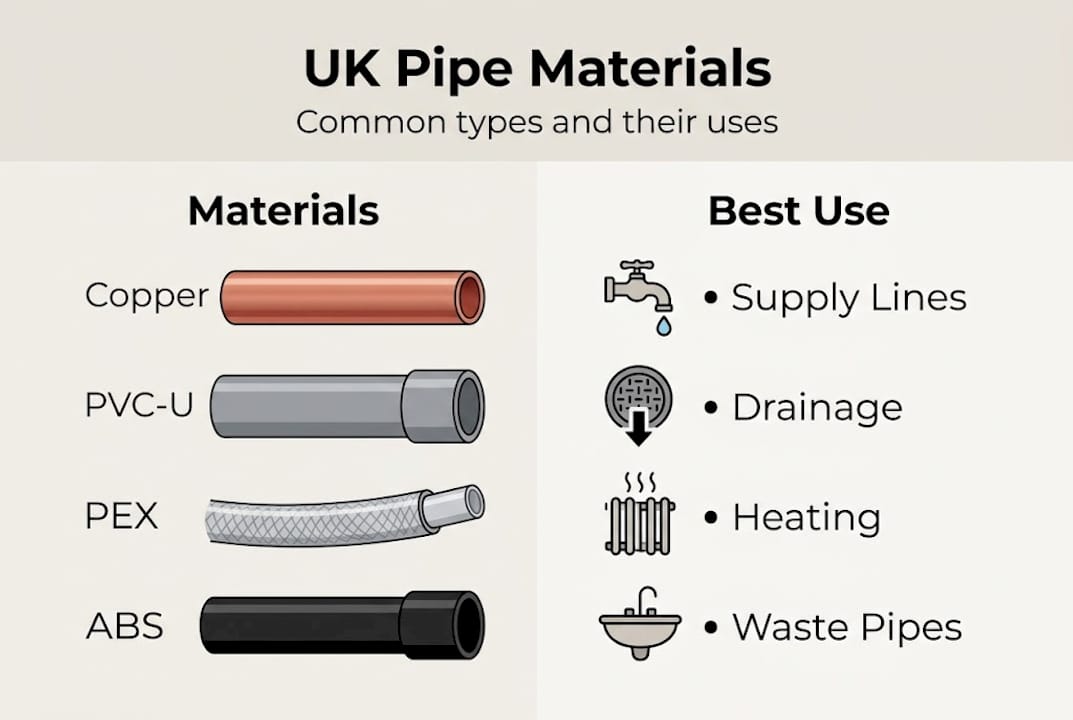
The most common pipe materials in UK homes are:
- Copper: The traditional choice for hot and cold water supply lines. Durable, long-lasting, and fully recyclable, though it costs more than plastic alternatives.
- PVC (polyvinyl chloride): Widely used for drainage. Affordable, lightweight, and resistant to corrosion.
- PEX (cross-linked polyethylene): A flexible plastic used increasingly for supply lines. It handles freezing temperatures better than copper and is easier to install in tight spaces.
- ABS (acrylonitrile butadiene styrene): A rigid plastic used as an alternative to PVC for drainage, particularly in older properties.
According to common UK pipe materials guidance, UK drainage standards favour 110mm PVC-U for underground domestic foul drainage, which is worth knowing if you're planning any groundworks or extensions.
| Material | Best use | Pros | Cons |
|---|---|---|---|
| Copper | Supply lines | Durable, recyclable | Expensive, can corrode |
| PVC | Drainage | Affordable, lightweight | Not suitable for hot supply |
| PEX | Supply lines | Flexible, freeze-resistant | Newer, fewer local stockists |
| ABS | Drainage | Impact-resistant | Less common, harder to source |
When speaking to a plumber about essential plumbing terms, try to describe what you can see: the colour of the pipe, whether it's rigid or flexible, and where it runs. This alone can save significant diagnostic time. If a burst or blockage occurs and you need emergency plumbing support quickly, knowing your pipe material helps the engineer arrive prepared with the right fittings.
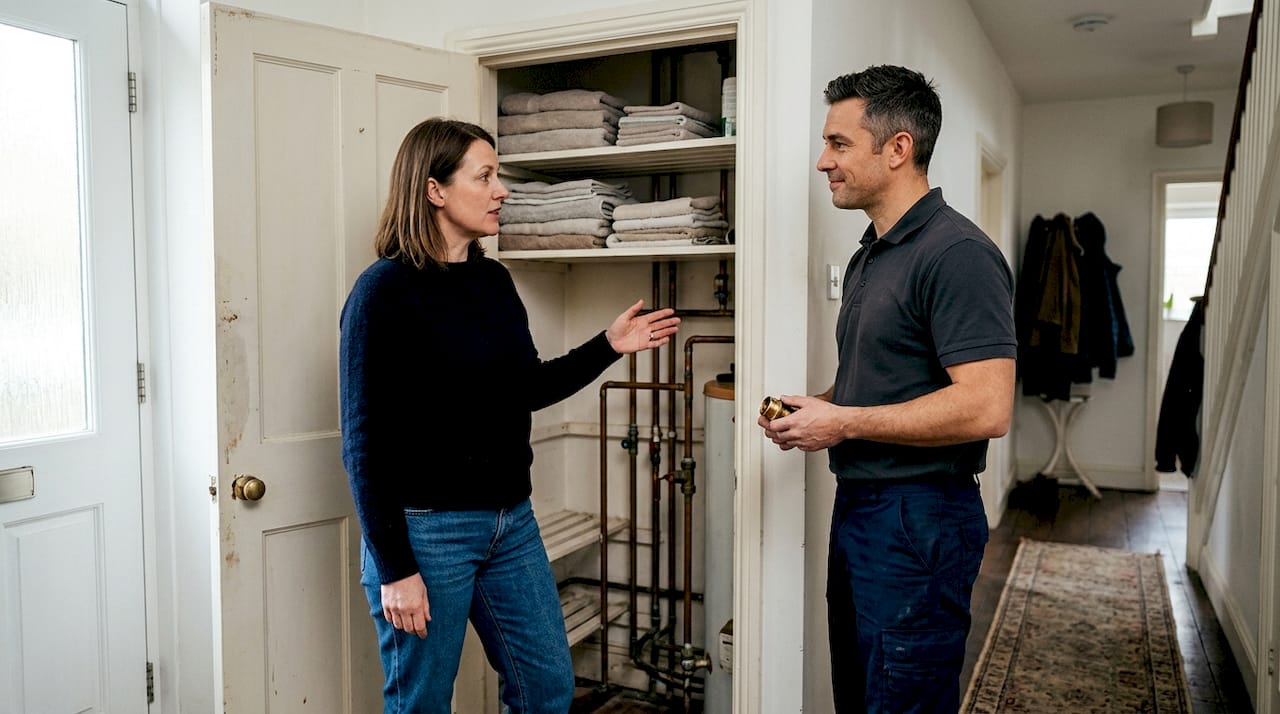
Pro Tip: If a plumber needs to join two different pipe materials, they'll use an adapter fitting. Always ask whether adapters are included in the quote, as they can add unexpected cost if left unspecified.
Understanding key plumbing fittings and their functions
Fittings are the connectors, joints, and components that link pipes together and direct the flow of water. They're small, but getting them wrong causes leaks, blockages, and pressure problems.
Here are the fittings you're most likely to encounter in a UK home:
- Elbow: Changes the direction of a pipe, usually at 90 or 45 degrees. Used when pipes need to turn corners.
- Tee fitting: Splits one pipe run into two, or joins two runs into one. Shaped like the letter T.
- Coupling: Joins two straight pipes of the same diameter end to end. Used in repairs when a section of pipe is replaced.
- Reducer: Connects pipes of different diameters. Essential when upgrading or adapting older pipework.
- P-trap: The U-shaped bend you'll see under most sinks and basins. It holds a small amount of water at all times.
As outlined in fitting identification guides, key fittings include elbows, tees, couplings, reducers, and P-traps, each serving a specific purpose in the system.
To identify the fittings in your own home, follow these steps:
- Start under the kitchen sink. Look for the curved pipe connecting the plughole to the wall — that's your P-trap.
- Trace the pipe from the P-trap to where it enters the wall. Note any T-shaped junctions — those are tee fittings.
- Look at any corners the pipe takes. A sharp angle fitting is an elbow.
- If you see a pipe narrowing before joining another, that's a reducer.
- Note the material of each fitting, as this determines which replacement parts will be compatible.
Pro Tip: Never remove a P-trap without placing a bucket underneath first. They always hold water, and that water contains whatever has gone down the drain. More importantly, if a P-trap dries out because a drain hasn't been used for weeks, foul gases can enter the room. Running the tap briefly once a week in rarely used basins prevents this entirely.
Understanding fittings also helps when speaking to engineers about plumbing engineer roles. Knowing the name of the faulty component means faster diagnosis and a more accurate quote. Your maintenance checklist should include a visual check of accessible P-traps and visible fittings at least twice a year.
UK plumbing codes, regulations and professional certification
Knowing your pipes and fittings is only half the picture. Understanding the legal framework behind plumbing work protects you as a homeowner and ensures any work carried out on your property is safe and compliant.
The key regulations covering plumbing in the UK are:
- Water Supply (Water Fittings) Regulations 1999: These govern how water fittings must be installed to prevent contamination of the mains supply. Any fitting or material used must carry WRAS (Water Regulations Advisory Scheme) approval.
- Part G of the Building Regulations: Covers sanitation, hot water safety, and water efficiency. Relevant for any bathroom installation or boiler replacement.
- Gas Safety (Installation and Use) Regulations 1998: Applies to any work involving gas, including boilers and gas cookers. Only Gas Safe registered engineers may legally carry out this work.
As confirmed by WIAPS consumer guidance, approved plumbers registered through WIAPS or WaterSafe can issue compliance certificates, which may be required when selling your home or making an insurance claim.
When hiring a plumber, watch for these red flags and must-have credentials:
- Always ask to see a current WaterSafe or WIAPS registration card.
- Request a written compliance certificate on completion of notifiable work.
- Check Gas Safe registration independently at gassaferegister.co.uk before any gas work begins.
- Avoid any engineer who is unwilling to provide written quotes or certification documentation.
- Confirm that materials used carry WRAS approval, particularly for fittings near the mains supply.
For a full breakdown of what's required for your specific job, the water fittings regulations page covers the detail clearly. If you want to understand what a fully qualified engineer should be doing on site, the guide to reliable plumber services is worth reading. For anything involving a boiler or gas appliance, the Gas Safe certification article explains exactly what to look for.
A fresh perspective on plumbing terminology: why clarity matters more than perfection
Here's something most plumbing guides won't tell you: you don't need to sound like an engineer. In our experience, the homeowners who get the best outcomes from a plumbing callout are not the ones who rattle off technical terms. They're the ones who describe what they see, smell, hear, and feel clearly and honestly.
"There's a gurgling sound after I flush the toilet" is more useful than "I think there's a venting issue in the DWV stack." A good role of a plumber involves diagnosing from real-world descriptions, not textbook terminology.
The costliest mistakes we see come from confusion, not from using the wrong word. A homeowner who confidently says "I think it's the boiler" when the fault is actually a pressure valve can delay a repair by hours and add unnecessary cost. Using plain language, taking a photo on your phone, and pointing at the exact location of a problem will always serve you better than guessing at technical terms.
Pro Tip: Before calling a plumber, take a short video of the problem. A leaking joint, a dripping pipe, or a stained ceiling tells an engineer far more than any description alone.
Get expert help for plumbing issues and terminology
Now that you're familiar with the key terms, systems, and regulations, the next step is knowing where to turn when something goes wrong. Whether you've spotted a failing P-trap, noticed a damp patch near a soil stack, or simply want a professional to check your pipework before winter, having a trusted local engineer on hand makes all the difference.

At Your Local Plumber, our experienced engineers are used to working with homeowners at every level of knowledge. You don't need to know the right words — just describe what you're seeing and we'll handle the rest. You can book a local plumber online in minutes for fast, transparent service. If you're based in the south west, our 24hr plumbing in Swindon team is available around the clock for urgent callouts.
Frequently asked questions
What does 'DWV' mean in UK plumbing?
DWV stands for Drainage, Waste, and Vent — the system removing wastewater and preventing odours or pressure problems from building up inside your home.
Which pipe types are most common in UK houses?
Copper is the standard choice for supply lines, while PVC and ABS handle drainage duties; PEX is increasingly popular for supply lines due to its flexibility and freeze resistance.
What is a P-trap and why is it important?
A P-trap is the U-shaped pipe under sinks that retains a water seal, blocking sewer gases from travelling up into your kitchen or bathroom.
How do I know if a plumber is certified in the UK?
Ask to see their WIAPS or WaterSafe registration and request a written compliance certificate on completion of any notifiable plumbing work.
Are copper pipes better than plastic in the UK?
Copper lasts longer and is recyclable but carries a higher upfront cost; plastic pipes are lighter and cheaper, and both meet UK standards when installed correctly by a qualified engineer.