TL;DR:
- Most major plumbing projects in the UK require a permit to ensure safety, compliance, and property value. Skipping permits can lead to fines, work removal, insurance issues, and sale complications, making compliance essential. Homeowners performing DIY work must also adhere to permit and inspection requirements, especially for gas-related projects.
A plumbing permit is an official local authority approval that authorises plumbing work to be carried out safely and legally within your jurisdiction. Without one, even well-intentioned home improvements can expose you to fines, insurance voids, and serious safety risks. Understanding plumbing permits is not optional for UK homeowners planning any significant work. It is the difference between a project that adds value to your home and one that creates costly legal headaches for years to come. This guide covers what permits are required, how to obtain them, and what happens if you skip them.
What does understanding plumbing permits actually mean?
Plumbing permits are official approvals ensuring compliance with safety codes that prevent risks like leaks, contamination, and gas hazards. The term "plumbing permit" is the standard industry phrase used by local building departments and councils across the UK, though you may also encounter the broader term "building regulations approval" when dealing with your local authority. Both refer to the same principle: formal sign-off that your work meets current safety and construction standards.
The permit system exists to protect you, your neighbours, and the wider community. Faulty plumbing causes water damage, mould, contamination of drinking water, and in worst cases, gas explosions. A permit triggers an inspection process that catches problems before they become disasters. Permits also create an official public record of compliance that protects your property value and legal standing long-term. That record matters enormously when you come to sell.
Which plumbing projects require a permit and which do not?
The distinction between permit-required and exempt work is more straightforward than most homeowners expect. The general rule is this: if the work involves new pipework, connections to the mains supply or drainage system, or any gas-related installation, a permit or building regulations notification is almost certainly required.
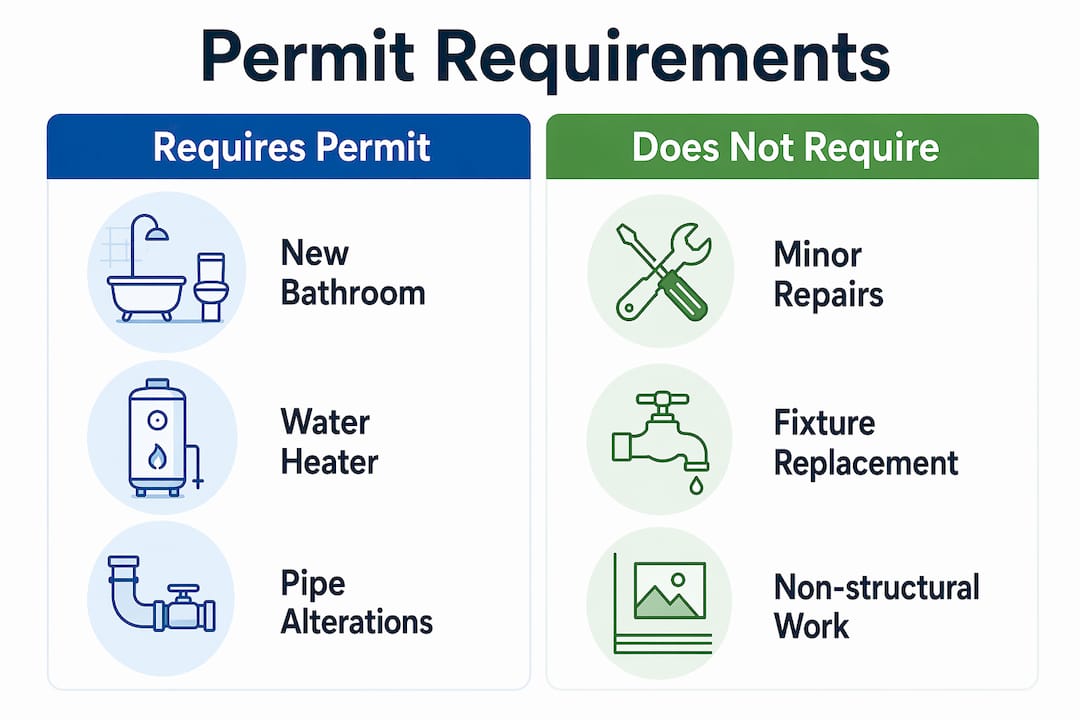
Projects that typically require a permit or building regulations approval:
- Installing or relocating water supply or sewer lines
- Adding a new bathroom, toilet, or shower room
- Water heater or boiler installation and replacement
- Major pipe alterations or re-piping
- Installing a new kitchen sink with altered drainage
- Any work involving gas connections or venting
Projects usually exempt from permit requirements:
- Replacing a tap or washer
- Clearing a blocked drain
- Fixing a minor leak on an existing pipe joint
- Swapping a like-for-like showerhead
The table below summarises common projects and their typical permit status in the UK:
| Project | Permit required? |
|---|---|
| New bathroom installation | Yes |
| Water heater replacement | Usually yes |
| Boiler installation | Yes (Gas Safe registration required) |
| Tap replacement | No |
| Drain clearing | No |
| New kitchen sink with rerouted drainage | Yes |
| Like-for-like toilet replacement | Generally no |
| Full re-pipe | Yes |
One project that catches homeowners off guard is water heater replacement. Water heater replacement is the most commonly skipped permit but is frequently required due to safety-critical installation requirements including gas connections, venting, and seismic strapping under IRC P2801. Treating it as a simple swap is a mistake that inspectors and insurers notice.
How do you get a plumbing permit in the UK?
The plumbing permit process in the UK follows a consistent pattern, though specific requirements vary by local authority. Follow these steps to avoid delays and rejections.
- Contact your local building control department. Before starting any work, ring or visit your local council's building control team. Confirm whether your specific project requires approval and what documentation you need to submit.
- Prepare your application and project plans. Most applications require a description of the work, basic drawings or diagrams, and details of the materials and methods you plan to use. The more complete your submission, the faster the approval.
- Submit your application and pay the fee. Permit fees typically range from £25 to £400 depending on project scope and location, with simple water heater replacements around £70 to £85 and major re-pipes exceeding £300. These fees fund the inspection process, not just the paperwork.
- Await approval. Simple permits may be issued the same day; complex projects requiring plan reviews can take several weeks. All permits generally expire one year after issuance, so plan your timeline accordingly.
- Schedule milestone inspections. Building control officers will inspect the work at key stages, typically before walls are closed up and again at completion. Do not cover pipework before an inspector has signed it off.
- Obtain your completion certificate. Once all inspections pass, you receive a formal completion certificate. Keep this document permanently. It is the proof of compliance you will need for insurance claims and property sales.
Pro Tip: Submit a complete application the first time. Missing documents are the single most common cause of delays. A checklist from your local building control website takes ten minutes to work through and can save weeks of back-and-forth.
Many councils now offer online permit applications, which speeds up the process considerably. Check your local authority website before assuming you need to visit in person.
What are the risks of skipping plumbing permits?
Skipping permits is a gamble that rarely pays off. The consequences range from financial penalties to outright safety catastrophes, and they tend to compound over time.
Skipping required permits can result in fines from £500 to £1,000 per violation, with municipalities imposing daily fines until compliance is achieved. That means a single unpermitted job can cost far more than the permit itself within a matter of weeks.
Beyond fines, the practical consequences include:
- Forced removal of completed work. Councils can require you to expose, redo, or demolish unpermitted plumbing at your own expense.
- Insurance claim denial. If a burst pipe or gas leak is traced to unpermitted work, your insurer has grounds to refuse the claim entirely.
- Property sale complications. Conveyancing solicitors and surveyors routinely check for building regulations compliance. Unpermitted work can delay or collapse a sale, or force you to indemnify the buyer.
- Safety hazards. Unchecked plumbing work is a genuine physical risk. Permit enforcement focuses on preventing floods, explosions, and public health hazards caused by plumbing failures.
"Unpermitted work does not just put you at risk today. It follows the property forever, showing up in searches and surveys for every future owner."
The financial logic is clear. A permit costing £85 protects you against fines, insurance voids, and remedial costs that can run into thousands of pounds. The maths is not close.
DIY plumbing permits: what homeowners need to know
Many UK homeowners assume that doing the work themselves removes the need for a permit. It does not. DIY homeowners must usually obtain permits for major plumbing work, though some jurisdictions allow them to pull their own permits rather than requiring a licensed contractor to do so.
Here is what you need to understand before starting any DIY plumbing project:
- Homeowner-occupant exemptions are limited. Some councils allow the homeowner of an owner-occupied property to apply for and carry out permitted work themselves. This exemption does not apply to rental properties.
- Unlicensed help voids your exemption. Homeowner-occupant exemptions are typically voided if assistance from unlicensed helpers is hired, which invalidates permits and inspections. If you pay a friend who is not Gas Safe registered to help with a boiler connection, you lose your exemption entirely.
- Inspections are still mandatory. Even if you pull your own permit, a building control officer must inspect the work at the required stages. Passing inspection is the only thing that makes DIY work legally compliant.
- Gas work is categorically different. In the UK, any work on gas appliances or pipework must be carried out by a Gas Safe registered engineer. There is no DIY exemption for gas, regardless of permit status.
- Verify local rules before you start. Local codes often include amendments beyond national model codes, including special rules on backflow testing or pipe material restrictions. What applies in one borough may differ in the next.
Pro Tip: Ring your local building control department before buying materials. A five-minute call confirms whether you qualify for a homeowner exemption and what inspections you will need. It costs nothing and prevents expensive surprises.
For a practical overview of what DIY plumbing work typically involves, the plumbing installation process guide from Your-local-plumber is a useful starting point.
How to keep your plumbing work compliant
Compliance is not a one-time event. It is an ongoing practice that protects your home, your finances, and anyone who lives in or buys the property after you.
Keep thorough records. Store every permit, inspection report, and completion certificate in a dedicated folder, physical or digital. These documents are your legal proof of compliance and will be requested during property sales or insurance claims.
Hire licensed professionals for complex work. For anything involving gas, structural changes, or connections to the mains supply, a qualified engineer is not just advisable. It is a legal requirement. Gas Safe registration is mandatory for all gas work in the UK, and the plumbing compliance guide from Your-local-plumber explains the full legal framework in plain terms.
Schedule inspections at the right stages. Do not wait until a job is finished to call building control. Inspectors need to see work before it is concealed. Covering pipework prematurely is one of the most common and costly mistakes homeowners make.
Consult your local authority directly for current requirements. National model codes like the IPC and IRC provide a baseline, but local amendments frequently change what is required in your specific area. The only reliable source for your local rules is your local building control team.
Use the plumbing inspection process to your advantage. An inspection is not an adversarial process. It is a free professional check on your work. Treat it as a quality assurance step, not a bureaucratic hurdle. The plumbing inspection guide from Your-local-plumber explains exactly what inspectors look for and how to prepare.
Key takeaways
Plumbing permits are a legal requirement for most major work, and skipping them creates financial, legal, and safety risks that far outweigh the cost of compliance.
| Point | Details |
|---|---|
| Permits are mandatory for major work | New bathrooms, water heaters, and pipe alterations almost always require formal approval. |
| Fees are modest compared to the risks | Permit fees range from £25 to £400; fines for non-compliance can reach £1,000 per violation. |
| DIY does not exempt you from permits | Homeowners can pull their own permits in some areas, but inspections remain compulsory. |
| Gas work has no DIY exemption | All gas work in the UK must be carried out by a Gas Safe registered engineer, without exception. |
| Records protect your property long-term | Completion certificates and inspection reports are required for insurance claims and property sales. |
Why permits matter more than most homeowners realise
I have spoken with hundreds of homeowners over the years who treated permits as optional bureaucracy. The ones who skipped them rarely regretted it immediately. The regret came later, at the worst possible moment: during a house sale, after a flood, or when an insurer refused a claim worth tens of thousands of pounds.
The permit process is not designed to obstruct you. It is designed to catch the things that experienced plumbers occasionally miss and that DIY enthusiasts miss more often. A building control officer who spots an incorrectly vented water heater before the wall goes up is doing you a genuine favour, even if it does not feel that way at the time.
The part that most guides understate is the relationship you can build with your local building control team. These are professionals who want projects to succeed. If you approach them early, ask questions, and show that you are trying to do things properly, they will often go out of their way to help. That goodwill is worth more than any shortcut.
The uncomfortable truth is that most permit problems are caused by impatience, not ignorance. Homeowners know they should check. They just do not want to wait. The irony is that a complete application submitted on day one is almost always faster than a rejected one resubmitted two weeks later.
— Michael
Get compliant plumbing work done right with Your-local-plumber
Navigating permit requirements and building regulations is straightforward when you have experienced professionals on your side.

Your-local-plumber provides a full range of plumbing services carried out by qualified engineers who understand local compliance requirements inside and out. Whether you need advice on what permits apply to your project, help preparing for a building control inspection, or a licensed engineer to carry out the work from start to finish, the team at Your-local-plumber is ready to help. Transparent pricing, fast response times, and a commitment to doing things properly make them the trusted choice for homeowners across the UK.
FAQ
What is a plumbing permit and do I need one?
A plumbing permit is an official approval from your local building control authority confirming that planned plumbing work meets safety and construction standards. You need one for most major work, including new bathrooms, water heater installations, and significant pipe alterations.
How much does a plumbing permit cost in the UK?
Permit fees range from £25 to £400 depending on project scope and location, with straightforward jobs like water heater replacements typically costing £70 to £85.
Can I do my own plumbing work without a licensed plumber?
Some councils allow homeowner-occupants to carry out their own permitted plumbing work and pull their own permits, but inspections remain mandatory. Gas work is the exception: it must always be carried out by a Gas Safe registered engineer regardless of permit status.
What happens if I do plumbing work without a permit?
Fines can reach £500 to £1,000 per violation, and councils can require you to remove or redo unpermitted work at your own expense. Insurance claims linked to unpermitted work are routinely denied.
How long does it take to get a plumbing permit approved?
Simple permits are sometimes issued the same day, while complex projects requiring plan reviews can take several weeks. Submitting a complete application with all required documents is the most reliable way to avoid delays.