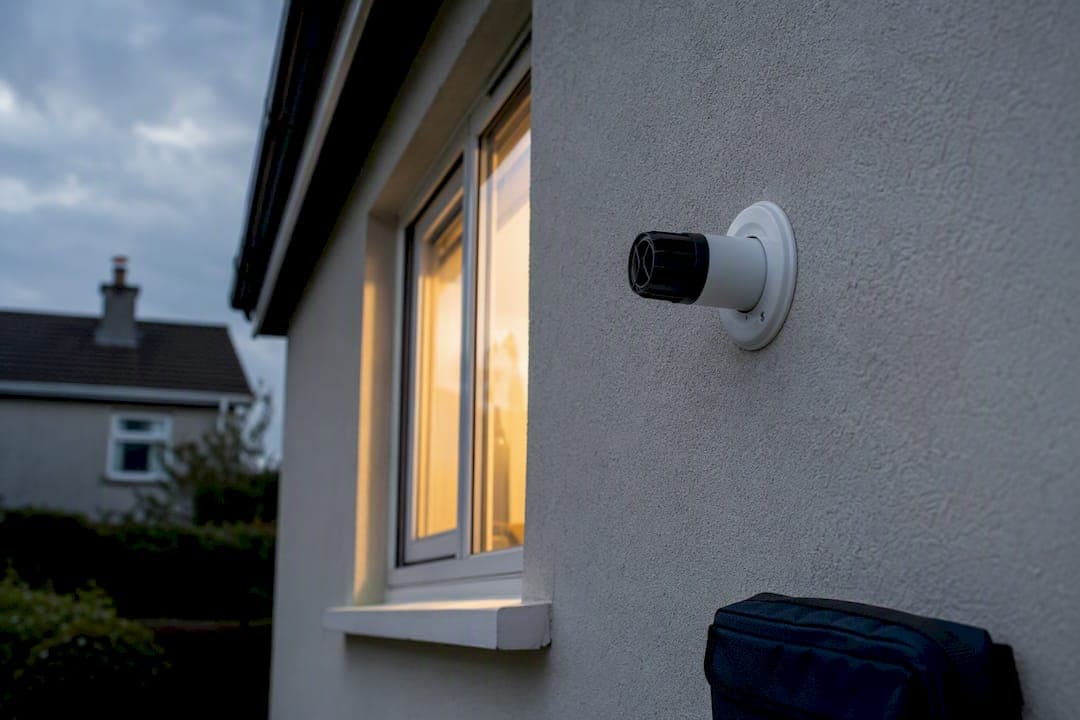
Boiler flues in the UK must be suitable, sited safely, and installed or maintained only by a Gas Safe registered engineer. That's the legal baseline under the Gas Safety (Installation and Use) Regulations 1998, backed by Approved Document J guidance on ventilation and carbon monoxide safety. If you're arranging work on a flue right now, the one thing to do today is book a Gas Safe registered engineer and ask them to confirm the terminal position meets current clearance rules before any work starts.
TL;DR:
- Proper inspection access and avoiding concealed flues are common issues that lead to non-compliance more often than incorrect clearance distances.
- Any work extending or rerouting a flue usually requires notification to building control and must comply with building regulations to ensure safety and legality.
- Regular annual checks are legally mandatory for landlords and recommended for owner-occupiers to prevent faults, with attention to signs like soot, damp patches, or triggered CO alarms.
- Homes with airtight design or strong extraction systems need properly designed ventilation and flue arrangements to prevent dangerous spillage or carbon monoxide buildup.
- Always verify that a Gas Safe registered engineer leaves a durable notice after installation, and keep records of all safety certificates and notices for future proof of compliance.
Table of Contents
- What are the boiler flue regulations UK homeowners need to know?
- How far must a boiler flue be from windows and boundaries?
- Who is legally allowed to install or alter a boiler flue?
- Why carbon monoxide alarms and ventilation matter for compliance
- Do you need permission to move or extend a boiler flue?
- How often should a boiler flue be inspected?
- What should you check before your installer arrives?
- A plumber's view on where flue compliance actually breaks down
- Sources
What are the boiler flue regulations UK homeowners need to know?
Two documents govern flue safety in England, and they work differently. Regulation 27 of the Gas Safety (Installation and Use) Regulations 1998 is statutory law. It states plainly that a gas appliance must only be connected to a flue that is suitable and in proper condition, and it prohibits installing a flue anywhere other than a safe position. It also requires that where a flue pipe enters a masonry chimney, the joint must be left inspectable, so a seal can be checked visually without being torn apart.
Approved Document J sits alongside that law as technical guidance for meeting Building Regulations. Its requirements, labelled J1 through J5, cover adequate combustion air, safe discharge of combustion products, carbon monoxide warning provision, and a durable notice recording what was installed. Part J isn't law in itself, but following it is the recognised way to demonstrate you've met the building regulations. Think of Regulation 27 as the "must" and Part J as the detailed "how" that engineers and building control officers actually use on site, a point the Planning Portal reinforces for anyone trying to interpret compliance in practice.
How far must a boiler flue be from windows and boundaries?
Flue outlet clearances aren't arbitrary. They exist because combustion gases, including small amounts of carbon monoxide, need somewhere safe to disperse before they reach an open window, a door, or a neighbour's washing line. UK boiler flue guidelines set out typical minimum distances that manufacturers and installers follow, though the exact figures vary depending on the boiler's output and the terminal type fitted.
Common clearance points that Gas Safe engineers check on site include:
- Distance from the flue terminal to an opening window, door, or air vent, both directly below and to the side.
- Distance below eaves, gutters, and other overhanging structures.
- Distance from a terminal facing another building or a boundary with a neighbouring property.
- Separation from another flue terminal on the same wall, to stop gases interfering with each other.
- Distance from any surface or corner that could trap discharge gases against a wall.
Horizontal terminals through an external wall are the most common setup in a typical UK home and carry the most familiar clearance rules. Vertical terminals through a roof, or those routed through a rooftop with an adjacent pitched roof nearby, follow different diagrams within Part J, including specific guidance on outlet position relative to a neighbouring pitched roof surface.
Public-facing terminals need extra thought. A flue discharging over a footpath, a shared courtyard, or a balcony used by other residents may need to sit higher than the standard minimum or have protective shielding fitted, simply because passers-by shouldn't be exposed to warm, moist combustion gases at head height. If your boiler terminal opens onto a walkway or a communal area, ask your engineer directly whether the siting meets that higher bar.
Who is legally allowed to install or alter a boiler flue?
Gas flue work is not a DIY job, and it's not legal to hand it to an unregistered tradesperson either. Anyone installing, altering, or repairing a flue connected to a gas appliance must be Gas Safe registered, the UK's official register of competent gas engineers. Always check an engineer's Gas Safe ID card before work begins.
Landlords carry a heavier legal load than owner occupiers. HSE guidance for landlords sets out a clear duty: gas appliances and their flues in rented properties must be checked annually by a registered engineer, with records kept and available to tenants. Skipping that annual check, or losing the paperwork, isn't just poor practice; it's a breach of a landlord's legal safety duty.
Relocating a flue, extending its run, or altering the terminal position is a bigger step than a straightforward swap. That kind of work typically falls under building regulations and may need notification to building control, depending on what's changing and how. A competent installer will know when notification applies and will handle it as part of the job, but it's worth asking the question before work starts rather than after.
Why carbon monoxide alarms and ventilation matter for compliance
Compliance for boiler flues isn't only about the pipe itself. Approved Document J treats air supply, gas discharge, and carbon monoxide detection as one connected safety system rather than three separate boxes to tick. Requirement J2 demands adequate provision for discharging combustion products outside safely, while J3 requires a means of warning occupants if carbon monoxide is released, usually a CO alarm positioned near the appliance but not directly above it.
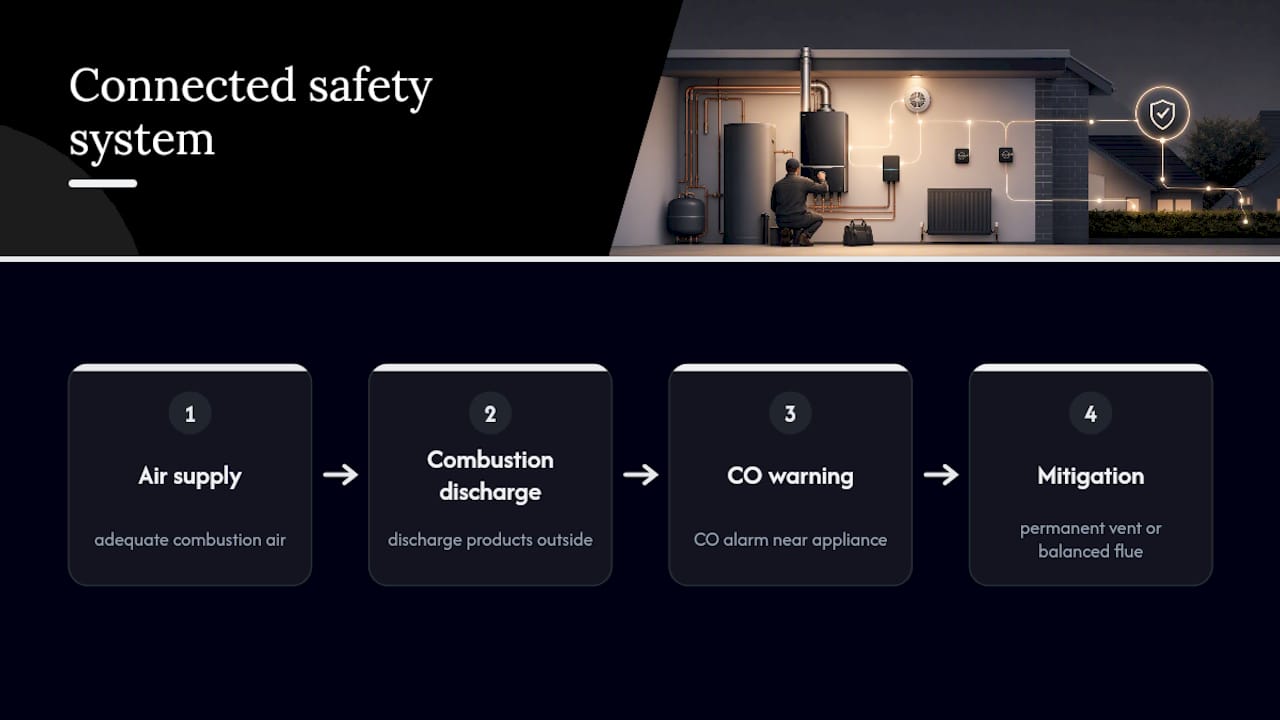
Extractor fans and increasingly airtight homes create a real, practical risk here. A powerful kitchen or bathroom extractor can pull air out of a room fast enough to disturb the pressure balance a flue relies on, occasionally causing spillage back into the room instead of safely outside. Homes with modern double glazing and draught-proofing sometimes lack the natural air leakage older houses had, which is exactly why some installations need a permanent vent or balanced flue arrangement rather than relying on gaps around windows and doors.
Do you need permission to move or extend a boiler flue?
Rerouting, extending, or repositioning a flue usually needs sign off through building regulations, either via a competent-person scheme registration your installer holds or through direct building control notification. Don't assume a small extension is exempt; ask your installer to confirm before work starts.
Once the job is finished, Part J requires a durable notice, a permanent record fixed near the boiler or in the meter cupboard showing what was installed, when, and by whom. Keep an eye out for it.
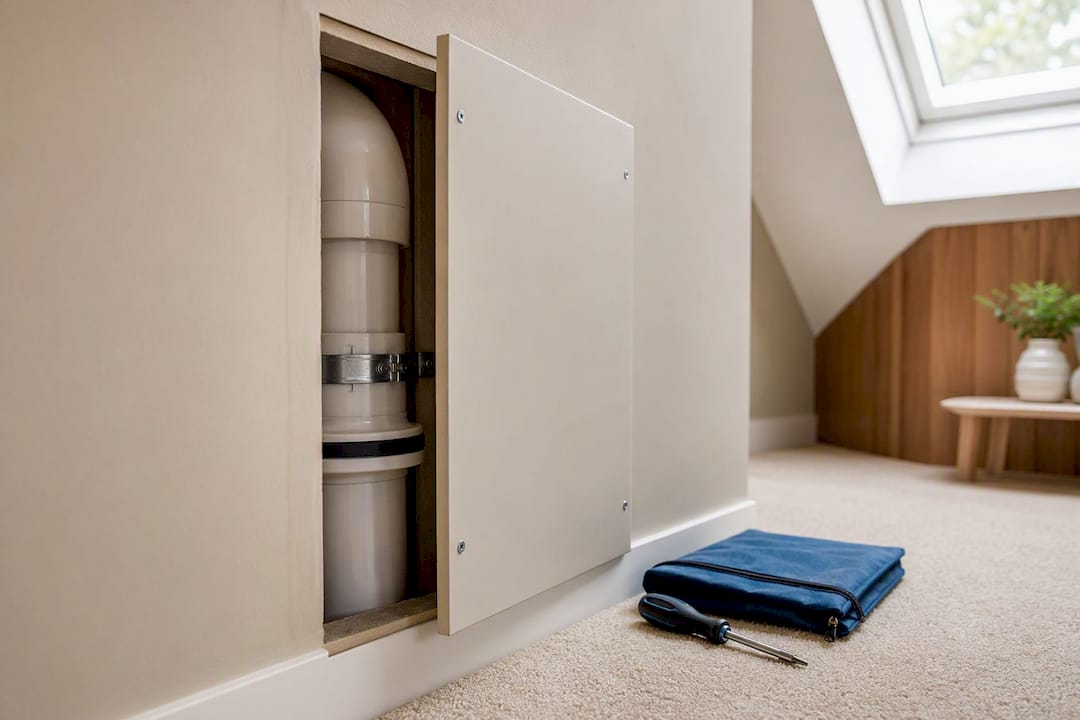
Concealed flues, boxed into a loft or running behind a false wall, must have an inspection panel left in place. Without one, nobody can check the joint or seal later without cutting into the structure, which is exactly the situation Regulation 27 is designed to prevent.
How often should a boiler flue be inspected?
An annual gas safety check covers the flue as well as the boiler itself, and that's a legal requirement for landlords, not just good practice. Owner occupiers should treat it the same way; a flue that's been fine for five years can still develop a fault. Your engineer should service the boiler and check the flue together, since a problem in one often shows up in the other.
Watch for soot or dark staining around the terminal, damp patches near the flue run indoors, an unusual smell near the boiler, or a CO alarm that's triggered even briefly. Any of these, alongside certain fault codes, point to a flue issue rather than a boiler fault. If a CO alarm sounds, get everyone outside into fresh air, turn off the gas supply if it's safe to reach, and call the National Gas Emergency Service on 0800 111 999. Don't go back inside until it's confirmed safe.
What should you check before your installer arrives?
A little preparation makes the visit faster and gives you a paper trail if you ever need to prove the work was done properly.
- Write down your boiler's make, model, and approximate age before the visit.
- Take a photo of the current flue terminal from outside, showing its position relative to windows, doors, and boundaries.
- Ask to see the engineer's Gas Safe ID card and check the registration covers the type of boiler you have.
- Confirm the durable notice will be completed and fixed in a visible spot after the job.
- Ask directly whether inspection access will be left for any section of flue that's boxed in or concealed.
- Ask what spillage and CO tests will be carried out once the work is finished.
Pro Tip: Keep a single folder, physical or digital, with every gas safety certificate, invoice, and durable notice for your property. Landlords especially should treat this as non-negotiable: if a tenant or a future buyer's solicitor asks for proof of compliance, you want to hand over a folder, not spend a weekend hunting for paperwork.
A plumber's view on where flue compliance actually breaks down
The rules themselves aren't complicated. Where things go wrong is almost always inspection access, either an installer boxing in a flue without leaving a panel, or a homeowner boarding over one years later without realising why it was there. I've seen far more problems traced back to a hidden, unchecked joint than to a badly calculated clearance distance. The other recurring issue is DIY tampering: swapping a terminal cover, "tidying up" pipework near a boiler, or blocking a vent for draught reasons. None of that is worth the risk it creates.
If you want a straight answer on whether your current setup is compliant, or you need work carried out properly the first time, book a local Gas Safe registered engineer rather than guessing from a forum thread.
— Michael
Sources
- The Gas Safety (Installation and Use) Regulations 1998
- Approved Document J: Combustion appliances and fuel storage systems (2022)