TL;DR:
- Safe gas boiler servicing involves professional inspection, cleaning, and testing to ensure safety and efficiency. Homeowners can perform basic checks like pressure monitoring and radiators bleeding but must leave internal adjustments to Gas Safe registered engineers. Regular professional service and verifying engineer credentials prevent hazards like carbon monoxide poisoning and maintain warranties.
Safe gas boiler servicing is the practice of inspecting, cleaning, and testing your boiler using correct procedures, proper tools, and qualified professional support to prevent hazards and maintain efficiency. In the UK, all gas work must be carried out by a Gas Safe registered engineer for any task beyond basic visual checks. Knowing how to service gas boiler safely means understanding exactly where your responsibilities end and where a professional's begin. Get this right and you protect your family, your warranty, and your heating bills.
What safety precautions are needed to service gas boiler safely?
Safe gas boiler servicing starts before you touch anything. Regular servicing includes inspecting safety controls, testing combustion, cleaning key parts, and checking gas connections. Homeowners can prepare for and support this process, but must stay within clear limits.
Personal protective equipment and tools
The right PPE protects you during any boiler inspection. Wear safety gloves and safety glasses when checking accessible components. A carbon monoxide detector is non-negotiable. The Carbon Trust and Gas Safe Register both recommend that every home with a gas boiler has a working CO alarm fitted nearby.
For basic homeowner checks, you need:
- A carbon monoxide detector (audible alarm type)
- A pressure gauge reader (most modern boilers have one built in)
- A torch for visual inspection of pipes and joints
- A damp cloth for wiping accessible external surfaces
- A notepad to log pressure readings and any observations
Safety checks before any inspection
Turn off the boiler and let it cool fully before touching any component. Check that the area around the boiler is clear of flammable materials. Inspect the flue outlet outside your property for blockages such as bird nests or debris. Ventilation must be unobstructed. If you smell gas at any point, leave the property immediately, call the National Gas Emergency Service on 0800 111 999, and do not return until the property is declared safe.
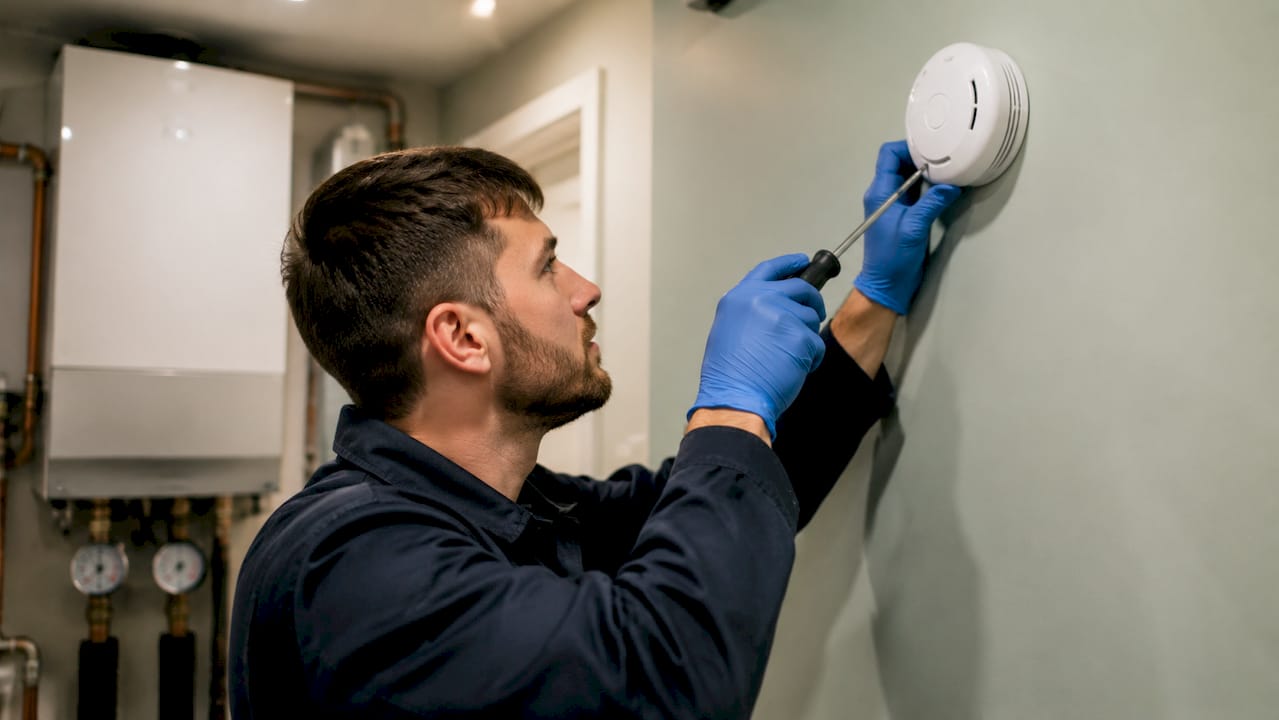
Pro Tip: Fit a carbon monoxide detector within one to three metres of your boiler. Test it monthly by pressing the test button. Replace the unit every five to seven years as sensors degrade over time.
What homeowners must not attempt
Attempting to service a gas boiler without proper training creates serious safety hazards and may void manufacturer warranties. Homeowners must never open internal boiler panels, adjust gas valves, or tamper with the burner assembly. These tasks require specialist tools and Gas Safe registration. Crossing this line risks gas leaks, carbon monoxide poisoning, and legal liability.
Step-by-step routine maintenance for your gas boiler
Routine maintenance follows a clear sequence. Checking system pressure monthly and inspecting for visible leaks or corrosion helps catch issues early. These steps are within safe limits for homeowners.
Steps you can do yourself
- Check the pressure gauge. Most combi boilers operate correctly between 1 and 1.5 bar when cold. If the reading is below 1 bar, the system needs repressurising. Your boiler manual explains the exact procedure for your model.
- Inspect external pipework. Look for signs of corrosion, rust staining, or moisture around joints. Photograph anything unusual to show your engineer.
- Check the flue terminal outside. The flue must be clear of obstructions. A blocked flue forces dangerous gases back into your home.
- Bleed radiators. Trapped air reduces heating efficiency. Use a radiator key to release air from each radiator until water flows steadily.
- Clean the boiler casing externally. Wipe down the outer casing with a damp cloth. Never use chemical sprays near the boiler.
- Test your carbon monoxide detector. Press the test button and confirm the alarm sounds.
- Check the pilot light colour. A healthy flame burns blue. A yellow or orange flame signals incomplete combustion and requires immediate professional attention.
Pro Tip: Schedule your annual service in late summer or early autumn. Engineers are less busy, appointment slots are easier to book, and any faults get fixed before winter demand peaks.
What a professional service covers
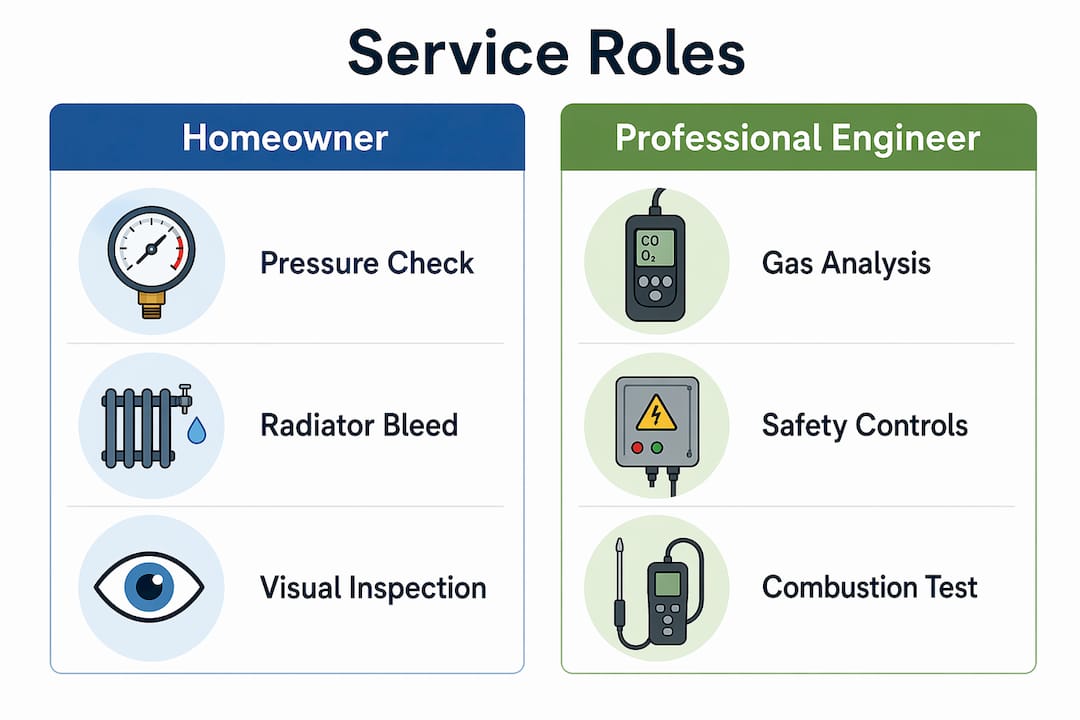
A professional boiler service goes far beyond what homeowners can safely do. Professional engineers perform combustion analysis and electrical diagnostics to confirm safe and efficient operation. These tasks are outside the scope of any homeowner check.
| Task | Homeowner | Gas Safe engineer |
|---|---|---|
| Check pressure gauge | Yes | Yes |
| Bleed radiators | Yes | Yes |
| Inspect external pipework | Yes | Yes |
| Clean heat exchanger | No | Yes |
| Combustion gas analysis | No | Yes |
| Test safety controls | No | Yes |
| Adjust gas valve settings | No | Yes |
| Electrical diagnostics | No | Yes |
A comprehensive professional inspection includes combustion gas analysis and safety controls testing. This confirms safe operation and optimises efficiency in ways no visual check can replicate.
Common mistakes and safety hazards to avoid
Most boiler accidents at home trace back to a small number of repeated errors. Homeowners should never open internal boiler panels or adjust gas components without specialist training and equipment. Doing so can cause gas leaks, carbon monoxide hazards, and void warranties.
The most dangerous mistakes homeowners make include:
- Ignoring a yellow or orange pilot flame. A yellow flame signals incomplete combustion and possible carbon monoxide production. This is a medical emergency risk, not a minor fault.
- Skipping annual professional checks. A boiler that appears to work normally can still have dangerous combustion faults invisible to the eye.
- Dismissing unusual noises. Banging, kettling, or whistling sounds indicate scale build-up, pump failure, or pressure problems. Ignoring them accelerates damage.
- Blocking ventilation around the boiler. Storing items in the boiler cupboard restricts airflow and increases overheating risk.
- Attempting to fix a leak yourself. Even a small water leak near gas components requires a Gas Safe engineer. Water and gas infrastructure do not mix safely without specialist knowledge.
Warning: Carbon monoxide is colourless and odourless. Symptoms of exposure include headaches, dizziness, and nausea. If multiple people in your home feel unwell simultaneously, treat it as a CO emergency. Leave immediately and call 999.
If your boiler shows signs requiring professional service such as unusual noises, a yellow pilot light, or uneven heating, do not delay. Recognising these signs early prevents emergency failures and significantly higher repair costs. A leaking boiler always warrants urgent professional assessment.
When should you hire a Gas Safe registered engineer?
UK law is clear on this point. All gas boiler servicing in the UK must be carried out by a Gas Safe registered engineer. This protects homeowners from unsafe workmanship and gas safety risks. Operating outside this requirement is illegal and invalidates your home insurance in most cases.
Tasks that require a Gas Safe engineer
- Annual boiler service and safety inspection
- Combustion analysis and flue gas testing
- Replacing or adjusting gas valves, burners, or heat exchangers
- Fault diagnosis using electronic diagnostic tools
- Issuing a Gas Safety Record (required for landlords)
- Any repair following a gas smell or CO alarm activation
Professional service versus homeowner checks
| Aspect | Homeowner checks | Professional service |
|---|---|---|
| Frequency | Monthly | Annually |
| Tools needed | Pressure gauge, torch, CO detector | Combustion analyser, diagnostic kit |
| Legal requirement | None | Gas Safe registration required |
| Warranty impact | Neutral | Maintains manufacturer warranty |
| Safety scope | Visual and pressure only | Full system safety assessment |
Professional servicing benefits include an extended boiler lifespan, energy savings, and maintained warranty compliance. These are not optional extras. They are the baseline for a safe heating system.
How to verify a Gas Safe engineer
Every Gas Safe registered engineer carries a photo ID card. Check the card number on the Gas Safe Register website to confirm registration and the types of work the engineer is qualified to carry out. Never accept verbal assurances alone. A legitimate engineer will always welcome this check.
Key takeaways
Safe gas boiler servicing requires monthly homeowner checks, annual professional inspection by a Gas Safe registered engineer, and strict limits on DIY tasks to prevent carbon monoxide hazards and maintain warranty compliance.
| Point | Details |
|---|---|
| Know your DIY limits | Homeowners can check pressure, bleed radiators, and inspect external pipework only. |
| Annual service is non-negotiable | A Gas Safe engineer must service your boiler every year to maintain safety and warranty. |
| Yellow flame means danger | A yellow or orange pilot flame signals incomplete combustion and requires immediate professional attention. |
| Book service in late summer | Scheduling in august or september avoids winter delays and reduces emergency call-out costs. |
| Verify engineer credentials | Always check a Gas Safe ID card number on the official Gas Safe Register website before work begins. |
My view on the DIY versus professional divide
The biggest mistake I see homeowners make is treating the annual boiler service as optional when the boiler appears to be working fine. A boiler that heats your home without obvious faults can still have a combustion problem producing carbon monoxide at levels that accumulate slowly over weeks. You cannot see it, smell it, or hear it. That is precisely what makes it dangerous.
The DIY checks described here are genuinely useful. Monthly pressure checks and radiator bleeding keep your system running efficiently between professional visits. But they are preparation, not a substitute. Think of them the way you think of checking your car's tyre pressure. You do it yourself between MOTs, but you still take the car to a qualified mechanic for the annual inspection.
The other pattern I see regularly is homeowners who delay booking their service because they want to avoid the cost. Skipping one year rarely causes an immediate crisis. But it allows small faults to compound. A heat exchanger crack that costs a few hundred pounds to fix in year one becomes a full boiler replacement in year three. The maths never favours delay.
Book your service in late summer. Verify your engineer's Gas Safe registration. Fit a carbon monoxide detector and test it monthly. These three habits cost very little and protect everything.
— Michael
Gas boiler servicing with Your-local-plumber
Your-local-plumber connects homeowners with Gas Safe registered engineers who carry out thorough, transparent boiler servicing across local areas. Every engineer is fully qualified, ID-verified, and focused on getting your boiler safe and efficient before winter arrives.

Whether you need a routine annual service, a fault diagnosis, or advice on a repair, Your-local-plumber provides clear pricing and fast appointments. See examples of professional boiler work carried out by the team, and book with confidence knowing your home is in qualified hands. For broader plumbing maintenance support, the Your-local-plumber blog covers everything a homeowner needs to stay ahead of problems.
FAQ
Can I service my gas boiler myself?
Homeowners can perform basic checks such as monitoring pressure, bleeding radiators, and inspecting external pipework. Any internal servicing or gas component work must be carried out by a Gas Safe registered engineer.
How often should a gas boiler be serviced?
A gas boiler requires a full professional service once a year. Annual servicing prevents breakdowns, maintains efficiency, and keeps the manufacturer warranty valid.
What does a yellow boiler flame mean?
A yellow or orange flame indicates incomplete combustion, which can produce carbon monoxide. Switch off the boiler immediately and call a Gas Safe registered engineer before using it again.
When is the best time to book a boiler service?
Late summer or early autumn is the recommended time. Booking in august or september avoids peak winter demand, reduces waiting times, and allows faults to be fixed before cold weather arrives.
How do I check if an engineer is Gas Safe registered?
Ask to see the engineer's Gas Safe ID card and verify the card number on the official Gas Safe Register website at gassaferegister.co.uk. This confirms both registration and the specific types of gas work the engineer is authorised to carry out.