TL;DR:
- A proper boiler installation in the UK requires a Gas Safe registered engineer, compliance with Building Regulations, and post-installation warranty registration. Preparation, an onsite survey, and understanding each installation step help ensure a smooth process and avoid costly mistakes. Regular servicing and correct documentation safeguard your warranty and boiler performance over time.
Installing a new boiler is a process that must be completed by a Gas Safe registered engineer, following strict legal requirements and best practices to protect your safety, your warranty, and your home insurance. This install new boiler guide covers every stage of the process, from pre-installation preparation through to post-install aftercare. UK Building Regulations Part L require all new gas boilers to achieve at least 92% efficiency, and non-condensing boilers are no longer permitted except in rare circumstances. Get these fundamentals right from the start, and the rest of the process becomes far more manageable.
What to prepare before your new boiler installation
Preparation is the single biggest factor that separates a smooth installation from a stressful one. Homeowners who arrive at installation day without the right groundwork in place often face delays, unexpected costs, and avoidable complications.
Book a pre-installation survey first. A reputable engineer will always carry out an onsite survey before quoting. Phone quotes are unreliable and regularly lead to unexpected costs on the day. The survey lets the engineer assess your existing pipework, flue route, and system type, so the final quote reflects the actual job.
Before installation day, work through this checklist:
- Clear the area around the boiler location. The engineer needs at least one metre of clear workspace on all accessible sides.
- Locate your existing boiler documentation, including the make, model, and any service history records.
- Confirm your preferred installation date and arrange for an adult to be present throughout the day.
- Check whether your system needs a power flush. If your radiators have cold spots or the water runs discoloured, this is likely.
- Decide on your boiler type in advance. If you are unsure whether a combi, system, or heat-only boiler suits your home, read up on combi boiler options before the survey.
Pro Tip: Experts advise scheduling in spring or summer to avoid engineer shortages and higher prices during the peak October to January period. You will typically get faster availability and more competitive pricing.
How does the boiler installation process work step by step?
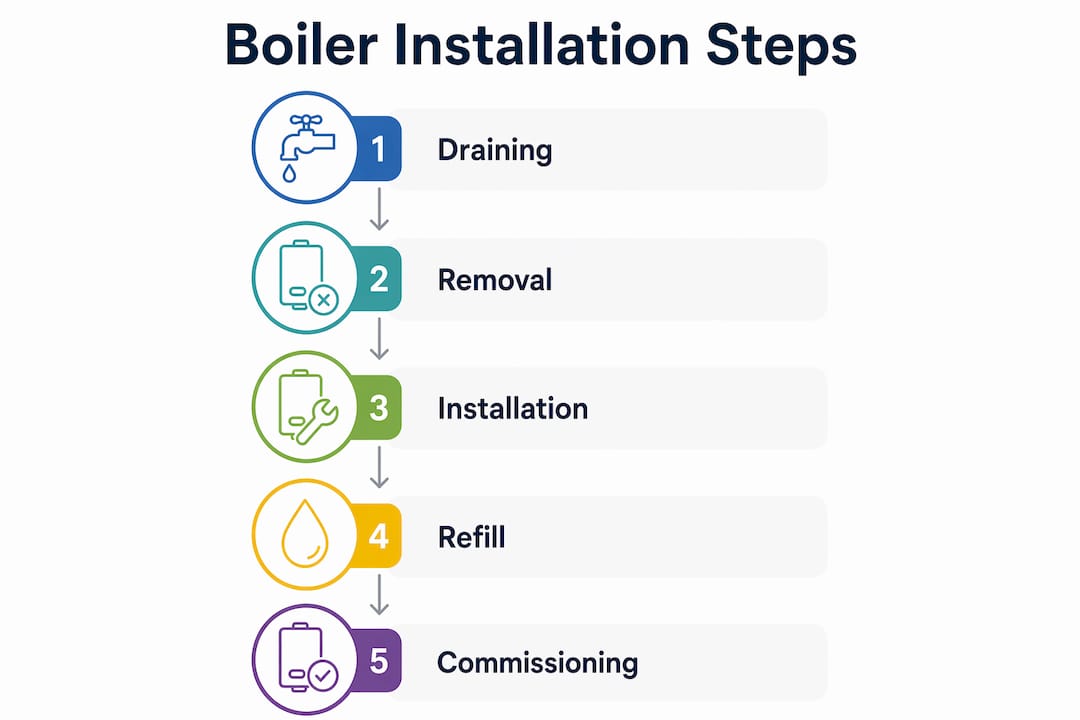
A standard boiler installation follows a clear sequence. Understanding each stage helps you know what to expect and when to ask questions.
1. Draining and isolating the system
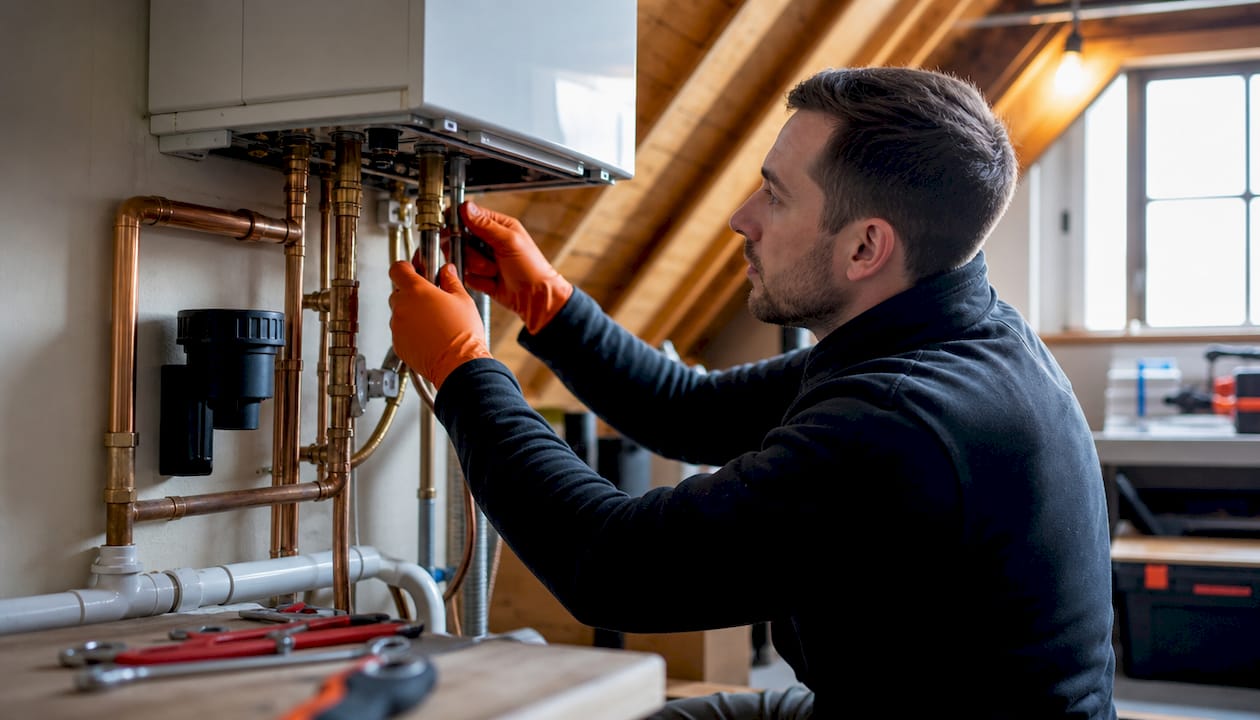
The engineer begins by isolating the gas and water supplies, then draining the central heating system completely. This removes the old water and any accumulated sludge before the new boiler goes in.
2. Removing the old boiler
The old unit is disconnected from the gas supply, flue, and pipework, then removed safely. If the new boiler sits in the same location, this stage is straightforward. Relocating the boiler adds time and cost.
3. Installing the new boiler and adapting pipework
The new boiler is mounted and connected to the existing pipework, with adaptations made where necessary. The flue is installed or repositioned to meet current Building Regulations flue positioning standards. Smart controls and a room thermostat are fitted at this stage, as smart controls are now mandatory under Part L.
4. System refill and pressure test
Once the boiler is connected, the system is refilled with treated water and a chemical inhibitor. The engineer then pressure tests all connections to confirm there are no leaks before firing the boiler for the first time.
5. Commissioning
Commissioning is the final and most important stage. The engineer runs the boiler through its full operating cycle, checks flue gas readings, sets the controls, and completes the Benchmark Commissioning Checklist. This document validates that the installation meets manufacturer and regulatory standards.
Typical timeframes at a glance:
| Job type | Expected duration |
|---|---|
| Like-for-like combi swap | 1 day |
| System boiler replacement | 1–2 days |
| Boiler relocation or upgrade | 2–3 days |
| Full system overhaul | Up to 5 days |
A like-for-like swap in the same location typically takes one day. More complex jobs involving relocation or full system upgrades can take up to five days. Plan accordingly if you have no alternative heating source.
Pro Tip: Ask the engineer to walk you through the new controls before they leave. Most boiler faults in the first month trace back to incorrect settings, not faulty equipment.
What are the legal and safety regulations for boiler installation?
Every boiler installation in the UK is governed by a set of non-negotiable legal requirements. Ignoring them puts your safety at risk and can invalidate your home insurance.
Gas Safe registration is the baseline requirement. Only Gas Safe registered engineers are legally permitted to work on gas appliances in the UK. Hiring an unregistered person risks both your safety and your insurance validity. Always ask to see the engineer's Gas Safe ID card before work begins, and verify their registration number on the Gas Safe Register website.
Key legal requirements every homeowner must confirm:
- The installer holds a valid Gas Safe registration covering the type of work being carried out.
- The new boiler meets the Part L efficiency standard of at least 92% SEDBUK 2009 rating.
- The flue is positioned in compliance with current Building Regulations, including minimum distances from windows and doors.
- Smart thermostat controls are installed as part of the job. This is mandatory, not optional.
- The homeowner receives a Building Regulations Compliance Certificate on completion.
The compliance certificate is your legal proof that the work meets current standards. Keep it with your property documents. You will need it when selling the property or making an insurance claim related to the heating system.
Pro Tip: Check Gas Safe registration online before any engineer visits your home. The Gas Safe Register website lets you search by registration number in under a minute.
What should you do after the boiler is installed?
The work does not end when the engineer leaves. Several post-installation steps protect your warranty and keep the boiler running efficiently for years.
Register your warranty within 30 days. Boiler warranty registration is not automatic. Homeowners must register directly with the manufacturer, and most require this within 30 days of installation. Missing this window can leave you liable for expensive repair bills that would otherwise be covered.
Post-installation tasks to complete promptly:
- Register the boiler warranty with the manufacturer using the serial number from the installation paperwork.
- Retain the Benchmark Commissioning Checklist. This document is required to validate the warranty and proves the boiler was commissioned correctly.
- Bleed your radiators within the first week. Air can enter the system during installation and cause cold spots.
- Check the boiler pressure gauge. Most boilers operate correctly between 1 and 1.5 bar when cold. If pressure drops below 1 bar, the system needs topping up.
- Familiarise yourself with the most common error codes for your specific boiler model. The manual lists these, and most are straightforward to resolve without a call-out.
Pro Tip: Set a calendar reminder for your first annual service, 12 months after installation. Servicing keeps the warranty valid with most manufacturers and catches small issues before they become expensive ones.
Common installation challenges and how to avoid them
Even well-planned installations hit problems. Knowing the most common ones in advance lets you ask the right questions before the engineer starts.
Skipping the power flush is the leading cause of early boiler failure. Failing to flush the heating system with chemicals before fitting a new boiler allows sludge and debris from the old system to circulate through the new unit. This degrades the heat exchanger rapidly and can void the warranty. If your system is more than ten years old, budget for a power flush as part of the installation.
A magnetic filter installed on the return pipe is required by many manufacturers to validate the boiler warranty. Magnetic filters trap metallic debris that would otherwise damage the heat exchanger over time. If your installer does not mention fitting one, ask why.
Condensate pipe placement is another area where corners get cut. External condensate pipes must use insulated pipework to prevent freezing in winter. A frozen condensate pipe causes the boiler to shut down, often on the coldest day of the year. Confirm with your engineer that any external run is properly insulated before they finish the job.
Finally, never accept a final quote given over the phone without an onsite survey. Unexpected pipework adaptations, flue repositioning, or system condition issues only become visible in person. A phone quote that looks attractive often grows significantly once the engineer sees the actual job.
Key takeaways
A new boiler installation requires a Gas Safe registered engineer, compliance with Building Regulations Part L, and prompt post-installation steps to protect your warranty and your home.
| Point | Details |
|---|---|
| Gas Safe registration is mandatory | Always verify the engineer's Gas Safe ID card before work begins. |
| Part L sets the efficiency minimum | New boilers must achieve at least 92% SEDBUK 2009 efficiency rating. |
| Timeframes vary by job complexity | A like-for-like swap takes one day; full system overhauls can take up to five days. |
| Warranty registration is not automatic | Register with the manufacturer within 30 days to keep your warranty valid. |
| Power flushing protects the new boiler | Skipping a system flush is the most common cause of early boiler failure. |
What I have learned from watching homeowners get this wrong
The most common mistake I see is homeowners treating the installation as a one-day transaction rather than a process. They focus entirely on the price, book the cheapest quote they can find over the phone, and then discover on the day that the job is more complex than the engineer anticipated. The result is either a rushed installation or a significantly higher final bill.
The second mistake is paperwork neglect. The Benchmark Commissioning Checklist, the Building Regulations Compliance Certificate, and the warranty registration are not optional extras. They are the difference between a boiler that is covered and one that is not. I have spoken to homeowners who discovered their warranty was void because they missed the 30-day registration window. That is an expensive lesson.
My honest advice: schedule in spring or summer, insist on an onsite survey before accepting any quote, and treat the post-installation checklist with the same seriousness as the installation itself. The plumbing installation process rewards homeowners who stay engaged from start to finish. Those who hand over responsibility entirely and walk away tend to be the ones calling for help six months later.
— Michael
Your-local-plumber: professional boiler installation you can rely on
Your-local-plumber provides boiler installation services carried out by Gas Safe registered engineers who handle every stage of the process, from the pre-installation survey through to commissioning and aftercare.

Every installation includes full compliance with Building Regulations Part L, correct magnetic filter and smart control fitting, and support with warranty registration and documentation. Pricing is transparent, with no phone quotes and no surprises on the day. Whether you need a straightforward like-for-like swap or a more complex system upgrade, Your-local-plumber delivers the standard your home and your warranty require.
FAQ
Does a new boiler have to be installed by a Gas Safe engineer?
Yes. Only Gas Safe registered engineers are legally permitted to install gas boilers in the UK. Hiring an unregistered person invalidates your home insurance and puts your safety at risk.
How long does a new boiler installation take?
A like-for-like combi boiler swap typically takes one day. More complex jobs involving relocation or full system upgrades can take 2–5 days depending on the work involved.
What efficiency rating does a new boiler need to meet?
UK Building Regulations Part L require new gas boilers to achieve a minimum 92% efficiency rating under the SEDBUK 2009 standard. Non-condensing boilers are no longer permitted in most circumstances.
How do I keep my new boiler warranty valid?
Register the warranty with the manufacturer within 30 days of installation and retain the Benchmark Commissioning Checklist. Annual servicing by a Gas Safe engineer is also required by most manufacturers to maintain warranty cover.
What is the typical cost of a new boiler installation in the UK?
New boiler installation costs range from £1,500 to £3,500 depending on the boiler type and job complexity. A basic like-for-like swap costs around £1,800, while premium models with 10-year warranties can reach £3,500.