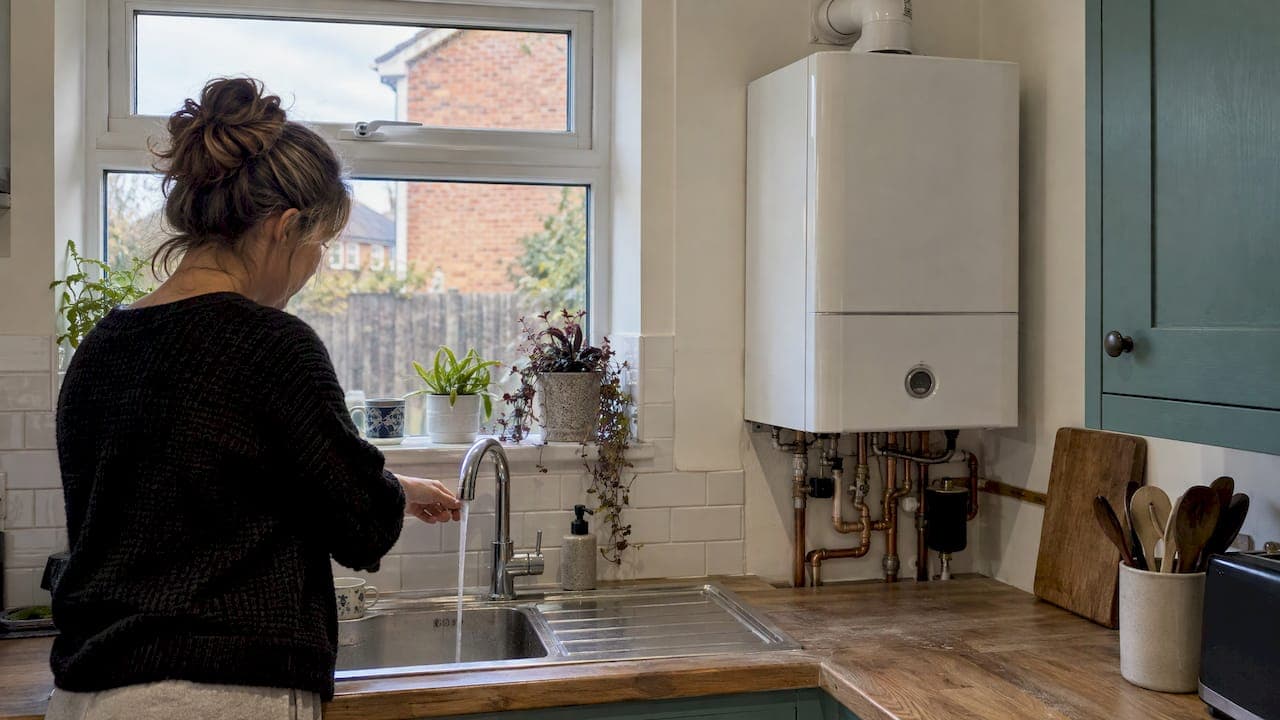
If your combi boiler gives you hot water for a minute and then cold, the cause is usually one of four things. The first is low water flow, so the boiler keeps switching its burner off. The second is a plate heat exchanger clogged with limescale. The third is a sticking diverter valve or flow sensor. The fourth is a worn mixer valve at one tap or shower. Some of these you can check safely in ten minutes. Others need a Gas Safe registered engineer, because they involve the gas appliance itself.
This guide walks through each cause in the order we would check it on a call-out, shows you how to tell a boiler fault from a tap fault, and explains when to stop and phone someone.
TL;DR
- Intermittent hot water from a combi is most often caused by low flow, limescale in the heat exchanger, a sticking diverter valve or a faulty flow or temperature sensor.
- If only one tap or shower runs hot and cold, suspect that outlet's mixer valve or cartridge. If every hot tap does it, suspect the boiler or the water supply.
- Safe checks: open the tap fully, look at the boiler pressure gauge, check for error codes, and try a different tap. Never open the boiler casing yourself.
- Stop using the boiler and call a Gas Safe registered engineer if you see a fault code that will not clear, leaks, scorch marks, or smell fumes.
- We offer a no call-out fee, no fix no fee service, with engineers available 24/7.
Table of Contents
- How a combi boiler makes hot water (and why it can stutter)
- The most common causes
- Is it the boiler or the tap? A two-minute test
- Why your shower runs cold while the boiler is working
- Safe checks you can do yourself
- What if the boiler overheats when you run the hot water?
- When to stop using the boiler and call an engineer
- Prevention: service it and manage scale
- Repair or replace?
- Get a local engineer to your boiler
- FAQ
- Sources
How a combi boiler makes hot water (and why it can stutter)
A combi boiler has no hot water tank. When you open a hot tap, a sensor detects the flow, the boiler stops sending heat to the radiators and fires the burner to heat the incoming mains water as it passes through a small plate heat exchanger. Close the tap and the boiler goes back to heating mode.
That design is efficient, but it means hot water depends on several small parts working in sequence: a flow sensor or turbine, a diverter valve, a temperature sensor and the heat exchanger. If any of them gives the boiler wrong information, or the water moves too slowly, the burner switches off to protect itself. Cold water rushes through, the boiler restarts, and you get the hot, cold, hot pattern.

One company guide to hot and cold combi water describes the cycle as the burner turning on and off because of restricted flow, inaccurate temperature readings or a restricted plate heat exchanger. That matches what we see on site.
The most common causes
| Cause | What you notice | Who fixes it |
|---|---|---|
| Low flow at the tap or shower | Hot for a short burst, then cold, mostly at a partly open tap or a clogged shower head | You (descale or clean), or an engineer |
| Limescale in the plate heat exchanger | Gradually worsening: lukewarm, then hot and cold, worse in hard-water areas | Gas Safe engineer |
| Sticking diverter valve | Heating comes on when you want hot water, or hot water turns lukewarm at random | Gas Safe engineer |
| Faulty flow sensor or temperature sensor | Erratic temperature with no pattern, sometimes a fault code | Gas Safe engineer |
| Low or fluctuating mains pressure | Worse at busy times, or when someone else uses water | Plumber or water supplier |
| Worn mixer valve or shower cartridge | Only one outlet misbehaves | Plumber |
Low flow
A combi needs a minimum flow of water before it will fire. A troubleshooting guide from a heating business puts the figure at roughly 2.5 to 3 litres a minute for most domestic combis, though your boiler's manual gives the exact threshold. Below it, the burner may not hold on reliably.
The usual culprits are a tap that is only slightly open, a shower head furred with limescale, a partly closed isolation valve, or low mains pressure. The heating and catering parts guide above lists partly closed taps, restricted shower heads and low mains pressure as typical reasons for flow falling under the boiler's activation point.
If you also have weak flow at the shower, our guide to fixing low shower pressure walks through the simple checks.

A scaled plate heat exchanger
In hard-water areas, which covers a large part of southern England, limescale builds up inside the narrow channels of the plate heat exchanger. Water passes through more slowly, overheats in places, and the boiler's high-limit control cuts the burner. The result is hot water that surges and then drops away. Both company sources above name a scaled or restricted heat exchanger as a leading cause.
This is not something to clear with a kettle descaler poured down a tap. Cleaning or replacing a heat exchanger means opening the sealed gas appliance, which only a Gas Safe registered engineer should do.
A sticking diverter valve
The diverter valve decides whether the boiler's heat goes to the radiators or to your taps. If it sticks, partly because of scale or debris, heat can be misdirected, giving lukewarm or inconsistent hot water. The heating and catering parts guide lists this as a common cause of hot water that cannot hold its temperature.
A tell-tale sign is radiators warming up when you run a hot tap, or the other way round.
Sensors and the flow turbine
The boiler relies on a flow sensor to know a tap is open and a temperature sensor to judge how hard to fire. When one of these drifts or drops in and out, the boiler gets bad information, and the burner starts and stops. This often shows as random temperature swings with no link to which tap you use. These are replaceable parts, but again, they sit inside the appliance.
Mains pressure
If the mains supply drops at busy times of day, flow to the boiler dips below its minimum and hot water cuts out. If hot water is fine at 3am and poor at 7pm, pressure is a strong suspect. Your water company can tell you whether there is a known issue in your area.
Is it the boiler or the tap? A two-minute test
This is the single most useful check, and it costs nothing.
- Run the hot tap in the kitchen. Then try the bathroom basin, then the shower.
- If only one outlet goes hot and cold while the others stay steady, the fault is probably local: a worn mixer valve, a blocked aerator or a tired shower cartridge. The Squote fault-finder makes the same split: one outlet points to a local mixer or cartridge, every hot tap points to the boiler or supply.
- If every hot tap behaves the same way, the cause is upstream: boiler, pressure or flow.
Mixer showers add another wrinkle. A shower valve balances hot and cold, so if it is worn it can swing the temperature even when the boiler is working perfectly. Our guide to fluctuating shower temperature covers how to tell the two apart.
Why your shower runs cold while the boiler is working
The boiler can be firing perfectly and the shower can still run cold. The usual reasons:
- Flow is too low for the boiler to stay lit. Someone flushing a toilet or running a washing machine diverts cold water and hot flow dips.
- The shower valve is worn. Internal seals and cartridges wear, and the valve can let cold water bypass the hot side.
- The shower is a low-flow or electric-compatible model not suited to the boiler's minimum flow.
- The shower head is blocked with scale, which cuts flow and makes the boiler cycle.
If the shower itself is the problem, a plumber can repair or replace the valve without involving the boiler at all.
Safe checks you can do yourself
These need no tools and no opening of the boiler.
- Open the hot tap fully. A tap only a quarter open can sit below the boiler's firing threshold.
- Look at the pressure gauge. Combis have a gauge on the front or underneath. If the needle has dropped below the range given in your boiler manual, the boiler may lock out or cut out. Your manual explains how to top it up using the filling loop, and if pressure keeps falling, you have a leak that needs investigating. Our guide to a boiler leaking water explains what to look for.
- Read the display. Note any fault code and the make and model. This saves time on the phone.
- Try the reset button once, following the manufacturer's instructions. If the fault returns straight away, do not keep resetting.
- Check other outlets, as in the test above.
- Clean the shower head and tap aerators. Soak them in a descaling solution and rinse. This is a common fix for low flow.
- Check the heating too. If the heating also misbehaves, see our guide on a boiler that keeps turning off.
If the water is lukewarm rather than hot and cold, our tepid hot water troubleshooting guide goes through those causes.
What if the boiler overheats when you run the hot water?
If the boiler seems to overheat, bangs, kettles (a rumbling or whistling noise) or cuts out with an overheat code when you open a hot tap, it is usually the heat exchanger or a flow problem again: water is not carrying heat away fast enough, so the boiler shuts down on its high-limit control. Turn the boiler off at the controls, do not keep resetting it, and have a Gas Safe registered engineer look at it. Do not remove the casing, touch internal pipework or try to bypass controls.
When to stop using the boiler and call an engineer
Call a Gas Safe registered engineer promptly if:
- the problem returns after one reset, or a fault code will not clear;
- you see water leaking from or around the boiler;
- there is soot, scorch marks or staining around the boiler;
- the boiler is noisy in a way it was not before;
- the hot water has been getting steadily worse over weeks, suggesting scale.
If you smell gas or suspect carbon monoxide, which has no smell, switch off the appliance, open windows, leave the building and call the National Gas Emergency Service on 0800 111 999. Do not wait for a booking slot. A working carbon monoxide alarm in the home is a sensible precaution for every gas boiler.
Always use a Gas Safe registered engineer for any work on gas appliances. You can check an engineer's registration on the Gas Safe Register website, and a registered engineer should carry an ID card.
Prevention: service it and manage scale
Most intermittent hot water starts as a small, slowly growing fault: a little scale, a sticky valve, a sensor drifting. An annual service catches these early. The Gas Safe Register recommends annual checks of home gas appliances, and if the manufacturer's guidance is unavailable, an annual service, unless an engineer advises otherwise.
Our own guides explain the reasons to service a combi boiler every year and what boiler servicing involves for safety and reliability.
In hard-water areas, ask your engineer whether a scale-reducing device or periodic descaling makes sense for your boiler and your water.
Repair or replace?
A diverter valve, sensor or flow turbine is usually a straightforward repair. A badly scaled heat exchanger can often be cleaned or replaced too. But if the boiler is old, has needed several repairs and the parts bill starts to approach the cost of a new unit, replacement can make more sense. We supply and fit new boilers from £1,300, and quotes for new boilers are free on site. You decide with the figures in front of you.
Our perspective
In our experience, intermittent hot water is rarely a mystery. When we are called out, the first job is to separate the tap from the boiler: if one outlet misbehaves, we fix that outlet and leave the boiler alone. If every hot tap does it, we look at flow and pressure first, then the diverter valve and sensors, then the heat exchanger.
What matters most to us is that you know the cost before work starts. Our heating and boiler labour is £110 per hour, there is no call-out fee, and we work on a no fix no fee basis, so you pay only after the work is done successfully. Our work carries a 12-month warranty, and you speak directly to the engineer.
Intermittent hot water usually gets worse, not better. A fault that is easy to fix in November can become a no-heat emergency in January, so we would always rather you called early than waited for a breakdown.
Michael
Get a local engineer to your boiler
If your hot water keeps cutting out, we can diagnose it at your home. Our engineers cover boiler diagnostics and repairs, central heating repairs, shower repairs and installations, and tap and toilet repairs, with 24/7 availability including holidays. Heating and boiler work is charged at £110 per hour, with no call-out fee. You can book a plumber online, or if there is no hot water at all and you need someone now, use our 60-minute emergency engineer service.

Thinking of a replacement instead? Ask for a free new boiler quote.
FAQ
Why does my hot water stop working sometimes?
Most often the combi boiler is cutting its burner because water flow is too low, the heat exchanger is scaled, or a diverter valve or sensor is misbehaving. Check whether every tap does it or only one. If only one, the tap or shower valve is the likelier culprit.
Why is my shower running cold off my combi boiler?
The shower may be getting too little flow for the boiler to stay lit, or the shower valve or cartridge may be worn. A blocked shower head and other water use in the house can also drop flow. Try another tap: if it stays hot, the shower is the problem.
Should I keep pressing reset when the hot water cuts out?
No. Reset once, following your manual. If the fault comes straight back, switch the boiler off and call a Gas Safe registered engineer, because repeated resets can hide a fault that needs a proper diagnosis.
Can I fix a scaled heat exchanger myself?
No. It sits inside the sealed gas appliance, and only a Gas Safe registered engineer should open it. You can safely descale your shower head and tap aerators, which helps flow but does not clean the heat exchanger.
How much does it cost to have a combi boiler hot water fault looked at?
Our boiler and heating work is £110 per hour with no call-out fee, and you pay only after successful work. The total depends on the cause and parts needed, and the engineer will explain it before starting.
Sources
- Combi Boiler Hot Water Going Hot and Cold? Causes Explained
- Combi Boiler Hot Water Fluctuating: Causes and Fixes (Squote)
- Check Your Gas Appliances (Gas Safe Register)