TL;DR:
- Tepid hot water in UK homes is mainly caused by boiler faults, system pressure issues, or limescale buildup. Homeowners can often fix the problem by checking pressure, cleaning heat exchangers, or replacing faulty valves without needing a full boiler replacement. When DIY steps fail, a Gas Safe engineer should diagnose and repair internal boiler components to ensure safety and proper functioning.
Tepid hot water is defined as water that fails to reach a genuinely hot temperature despite the boiler firing, and it is one of the most common hot water issues UK homeowners report. The root cause is almost always one of four faults: low boiler pressure, a scaled plate heat exchanger, a faulty diverter valve, or a failed temperature sensor. Fixing a tepid hot water problem does not always require a new boiler. In most cases, a targeted diagnosis and a straightforward repair restores full temperature. This guide walks you through every stage, from boiler-side checks to tap-level faults, so you know exactly where to look and when to call a Gas Safe engineer.
Why is my hot water lukewarm? Common boiler-side causes
The boiler is the first place to investigate when multiple taps produce lukewarm water. A system-wide fault points directly to the boiler or its primary components, not to individual outlets. Narrowing the fault to the boiler saves time and prevents unnecessary part replacements.
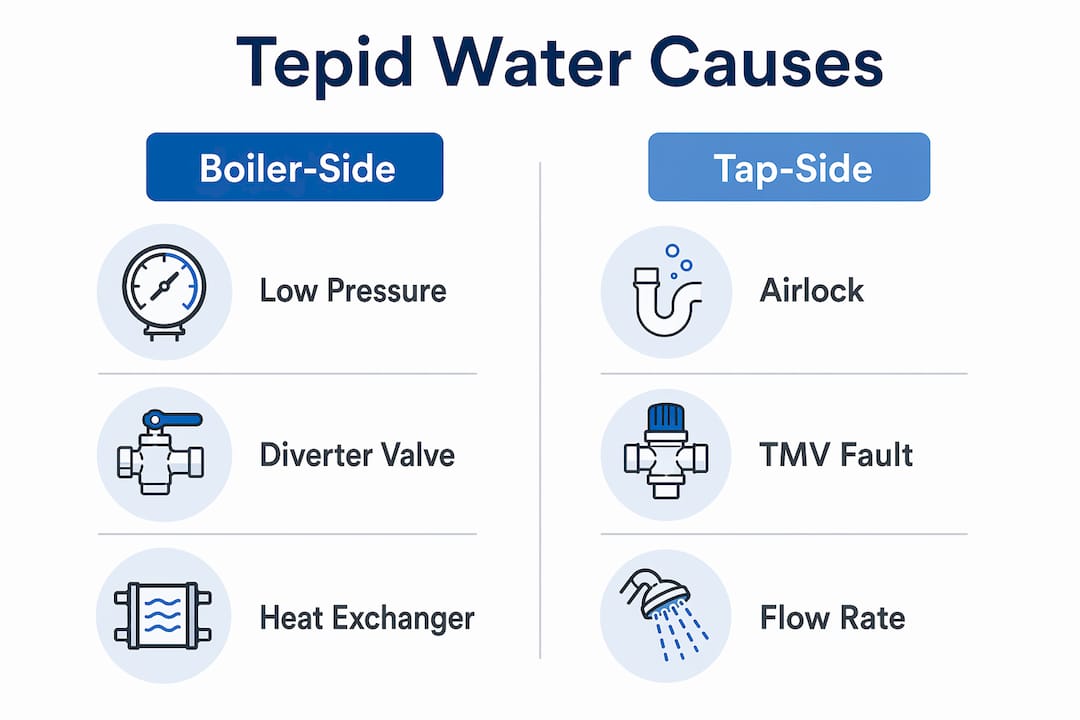
The four most frequent boiler-side causes are:
- Low system pressure. Modern combi boilers require pressure between 1.0 and 1.5 bar. Below that range, the boiler fires intermittently or shuts down early, producing water that never reaches full temperature.
- Scaled plate heat exchanger. Limescale restricts water flow through the heat exchanger, causing the boiler to overheat and cycle off prematurely. In hard water regions such as London, the South East, and the Midlands, scale builds within 2–3 years even in relatively new boilers.
- Faulty diverter valve. The diverter valve directs flow between heating and hot water. When it sticks or the spindle wears, it mixes cold water prematurely, producing intermittent or consistently lukewarm output. A telling sign: your radiators warm up when you run a hot tap, which confirms the valve is not prioritising hot water correctly.
- Failed thermostat or thermistor. A faulty temperature sensor tells the boiler the water is hotter than it actually is. The burner shuts down too early, and the water at the tap never reaches the set temperature.
Pro Tip: If your hot water starts hot and then cools after a minute or two, suspect the diverter valve or a flow rate mismatch. If it is lukewarm from the moment you turn the tap, the plate heat exchanger or pressure is the more likely culprit.
High flow rate shower heads can also exceed boiler output capacity, causing temperature drops during use. This is not a boiler fault. It is a capacity mismatch that requires either a lower flow rate head or a boiler upgrade.
How do I check and adjust boiler pressure safely?
Checking boiler pressure is the first practical step any homeowner can take without tools or specialist knowledge. The pressure gauge sits on the front panel of most combi boilers, marked with a dial or a digital display. The needle or reading should sit in the green zone, which corresponds to 1.0–1.5 bar.
Follow these steps to top up pressure using the filling loop:
- Switch the boiler off and allow it to cool for at least 30 minutes. Working on a hot system risks burns and inaccurate readings.
- Locate the filling loop. This is a braided silver hose, usually beneath the boiler, with one or two valves at each end.
- Open both valves slowly by turning them a quarter turn. You will hear water entering the system.
- Watch the gauge. Stop when the needle reaches 1.2–1.5 bar. Do not exceed 1.5 bar.
- Close both valves fully before switching the boiler back on.
- Reset the boiler and run a hot tap to test the output temperature.
Persistent pressure drops after topping up indicate a leak somewhere in the system. That requires a Gas Safe engineer, not a repeat top-up. Repeatedly over-pressurising the system can damage the pressure relief valve and create a more expensive fault.
Pro Tip: Mark the gauge with a small piece of tape at the correct level after topping up. If the needle drops below that mark within a week, you have a leak that needs professional attention.
What role does limescale play in causing tepid water?
Limescale is the single biggest long-term threat to hot water performance in UK homes. Hard water carries dissolved calcium and magnesium. When that water heats up inside the plate heat exchanger, those minerals deposit as scale on the internal surfaces. Scale acts as an insulating layer, reducing heat transfer and forcing the boiler to work harder to achieve the same output temperature.
The practical consequences are significant:
- Reduced heat transfer means water exits the heat exchanger cooler than the thermostat demands.
- Overheating and safety cycling occur when scale causes localised hot spots, triggering the boiler's overheat protection to shut the burner down.
- Increased energy consumption results from the boiler running longer cycles to compensate.
- Shortened boiler lifespan follows from repeated thermal stress on scaled components.
Annual professional servicing, including descaling and power flushing, directly reduces these risks. Power flushing forces a chemical cleaning agent through the system at high velocity, dislodging sludge and scale from the heat exchanger, pipework, and radiators. A magnetic filter fitted to the return pipe captures metallic debris before it re-enters the boiler. In hard water areas, a water softener or scale inhibitor added to the system provides ongoing protection between services.
Signs that maintenance is overdue include: a boiler that makes a kettling noise (a rumbling or whistling sound), water that takes longer than usual to heat up, and radiators that are cold at the bottom but warm at the top. Any one of these warrants a call to a qualified engineer. For a full overview of hard water's impact on your plumbing, the effects extend well beyond the boiler.
How do I diagnose tap-side causes of lukewarm water?
Not every warm water problem originates at the boiler. When only one tap or shower produces lukewarm water while others run hot, the fault is almost certainly local to that outlet. This distinction matters because it changes the repair entirely.
The most common tap-side causes are:
- Scaled thermostatic mixing valve (TMV) cartridge. A TMV blends hot and cold water to a safe output temperature. When scale builds inside the cartridge, it fails to mix temperatures correctly, producing a persistent lukewarm output regardless of boiler performance.
- Worn mixer tap cartridge. The cartridge inside a mixer tap controls the ratio of hot to cold water. Wear or scale causes it to default to a mixed position, limiting maximum temperature at the outlet.
- Pressure imbalance. If cold water pressure at a tap is significantly higher than hot water pressure, cold water pushes back through the mixer, cooling the output. This is common in homes where the hot and cold supplies run at different pressures.
- Airlock in the hot water pipe. An airlock traps air in the pipework, restricting hot water flow to a specific outlet. The tap may produce a trickle of warm water or sputter before running properly.
Pro Tip: To test for an airlock, connect a hose between the affected hot tap and a cold tap nearby, then turn the cold on briefly. The cold water pressure often clears the airlock. If the problem returns, the pipework needs professional attention.
Cleaning or replacing a TMV cartridge is a straightforward job for a plumber and costs far less than a boiler repair. Before assuming the boiler is at fault, always check whether the lukewarm problem is isolated to one outlet. A step-by-step approach to diagnosing no hot water from taps covers this process in detail.
When should I call a Gas Safe engineer?
Gas appliances carry a legal boundary that homeowners must not cross. Any work that involves opening the boiler casing, adjusting gas connections, or replacing internal components must be carried out by a Gas Safe registered engineer. This is not a recommendation. It is a legal requirement under UK gas safety regulations.
The situations that require professional intervention include:
- Diverter valve replacement. The valve sits inside the boiler casing and requires gas-safe competency to access and replace safely.
- Heat exchanger descaling or replacement. Chemical descaling agents used inside the boiler require specialist handling and correct disposal.
- Thermistor or sensor replacement. Faulty sensors require diagnostic equipment to confirm the fault before replacement.
- Persistent pressure loss. A leak in the system or a failed pressure relief valve needs tracing and repair by a professional.
- Annual boiler service. A Gas Safe engineer inspects the heat exchanger, burner, flue, seals, and safety devices during a service, catching faults before they cause a breakdown.
A Gas Safe engineer does not just fix the presenting fault. They test the entire system for safety, check flue integrity, and verify that the boiler is operating within manufacturer tolerances. Skipping the annual service to save money is the single most reliable way to turn a minor fault into a major repair bill.
Most homeowners who call a professional after following the DIY steps in this guide find that the repair is a component replacement rather than a full boiler change. Most homeowners mistakenly replace boilers when a thermistor or diverter valve cleaning would have resolved the fault at a fraction of the cost. A systematic diagnosis, not a panic replacement, is always the right first move.
Key takeaways
Fixing a tepid hot water problem requires identifying whether the fault lies with the boiler, the system pressure, limescale build-up, or a local tap component before attempting any repair.
| Point | Details |
|---|---|
| Check pressure first | Top up to 1.0–1.5 bar using the filling loop; persistent drops indicate a leak needing professional repair. |
| Limescale is the main long-term cause | Annual servicing and power flushing prevent scale from blocking the plate heat exchanger. |
| Distinguish boiler from tap faults | Multiple lukewarm taps point to the boiler; a single outlet suggests a local cartridge or airlock issue. |
| Diverter valve faults mimic boiler failure | Radiators warming during hot water demand confirms the diverter valve is not prioritising correctly. |
| Gas work requires a Gas Safe engineer | Component replacements inside the boiler casing are a legal requirement for registered engineers only. |
What I have learned from years of tepid water call-outs
The most common mistake I see homeowners make is assuming the boiler is dying when the actual fault costs under £100 to fix. A sticking diverter valve or a scaled thermistor sends people into a panic about a full boiler replacement. Nine times out of ten, a systematic check of pressure, the heat exchanger, and the diverter valve resolves the problem without touching the gas supply at all.
The second mistake is treating the symptom rather than the cause. Topping up pressure every week is not a fix. It is a sign of a leak that will eventually cause water damage. I have seen homeowners top up pressure for months before a ceiling came down. Address the root cause, not the reading on the gauge.
My honest recommendation for any homeowner is this: follow the plumbing maintenance checklist once a year and book an annual boiler service without fail. The service cost is a fraction of what a neglected heat exchanger or a corroded pressure relief valve will cost you in two years. Routine maintenance is not optional in hard water areas. It is the only thing standing between you and a boiler that fails mid-winter.
— Michael
When Your-local-plumber can step in
Tepid water that persists after checking pressure and ruling out tap-side faults needs a professional eye. Your-local-plumber provides Gas Safe registered engineers who carry out full boiler diagnostics, diverter valve replacements, heat exchanger descaling, and annual servicing across the UK.

If the DIY steps in this guide have not resolved your warm water problem, the fault is almost certainly inside the boiler casing. Your-local-plumber's engineers diagnose the root cause on the first visit, provide transparent pricing before any work begins, and carry the parts most commonly needed for same-day repairs. Book a hot water repair with Your-local-plumber and get your system back to full temperature without the guesswork of trial-and-error part replacements.
FAQ
What is the most common cause of tepid hot water in a combi boiler?
A blocked or scaled plate heat exchanger is the primary cause of tepid hot water in UK combi boilers. Limescale restricts flow and triggers premature burner cycling, particularly in hard water areas like London and the South East.
Can I fix low boiler pressure myself?
Yes. You can top up pressure to 1.0–1.5 bar using the filling loop beneath the boiler. If pressure drops again within days, a leak is present and a Gas Safe engineer must locate and repair it.
Why does my hot water start hot then go cold?
Hot water that starts hot then cools usually indicates a faulty diverter valve or a flow rate that exceeds boiler capacity. A Gas Safe engineer can confirm which fault applies and replace the valve if needed.
How do I know if the problem is my tap and not my boiler?
If only one tap produces lukewarm water while others run hot, the fault is local to that outlet. A scaled thermostatic mixing valve cartridge or a worn mixer tap cartridge is the most likely cause.
How often should I service my boiler to prevent hot water problems?
Annual servicing by a Gas Safe engineer is the standard recommendation. Regular servicing includes descaling, safety checks, and flue inspection, all of which prevent the faults that cause lukewarm water output.