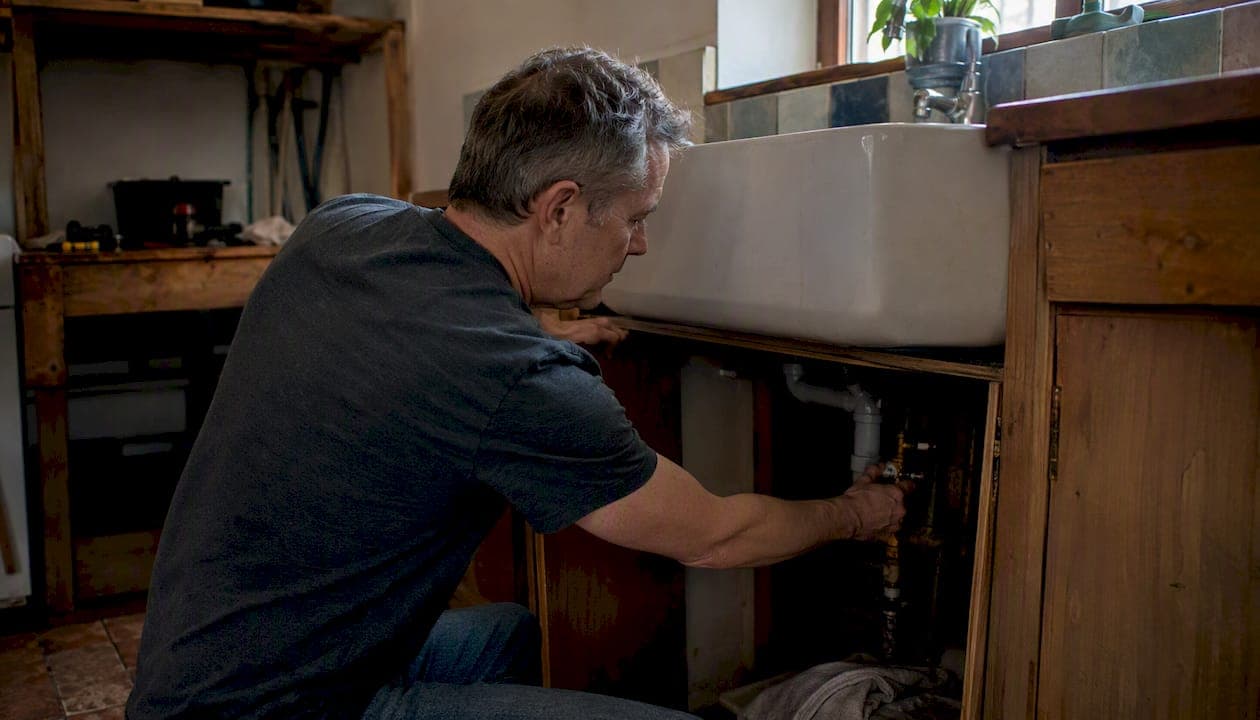
Turn your internal stopcock clockwise until it stops. That single action cuts the water supply to your home and is the first thing you do in any plumbing emergency. WaterSafe confirms the full immediate sequence: close the stopcock, switch off the boiler and heating, open cold taps to drain the system, and isolate the electricity supply if water has reached sockets or appliances.
Quick-action checklist:
- Turn internal stopcock clockwise until fully closed
- Switch off the boiler and central heating immediately
- Open all cold taps to drain residual pressure from the pipes
- Flush WCs once to clear water from cisterns
- Isolate the electricity at the consumer unit if water is near sockets or appliances
- Soak up standing water with towels to limit spread
- Call an emergency plumber or your water company if the stopcock won't move
Pro Tip: Photograph the damage before you mop anything up. Insurers need evidence of the original extent, and a quick phone video takes thirty seconds.
Key takeaways
Turning the internal stopcock clockwise is the single action that stops water entering your home in an emergency; everything else follows from that.
| Point | Details |
|---|---|
| First action in any leak | Turn the internal stopcock clockwise until fully closed, then switch off the boiler. |
| Drain the system | Open all cold taps and flush WCs to release residual pressure after shutoff. |
| Electrics near water | Isolate at the consumer unit immediately if water has reached sockets or appliances. |
| Maintain the stopcock | Exercise it every six months and label its location so everyone in the house knows it. |
| Your-local-plumber | Provides 24/7 emergency attendance with transparent fixed pricing and free on-site quotes for follow-on repairs. |
Table of Contents
- Where is your main stopcock, and how do you check it's accessible?
- What type of valve do you have, and how does each one work?
- How to shut off your home water safely, step by step
- What to do when the stopcock won't turn
- Where is the external stopcock, and who is responsible for it?
- After you shut off the water: what to check and how to restart safely
- Simple maintenance that prevents seized stopcocks and speeds future shutdowns
- What to tell an emergency plumber and how Your-local-plumber can help
- When you need an emergency plumber fast: Your-local-plumber
- Sources
Where is your main stopcock, and how do you check it's accessible?
Most UK homes have the internal stopcock somewhere on the ground floor, close to where the supply pipe enters the building. The most common spot is under the kitchen sink, usually at the back of the cabinet near the cold-water supply pipe. If it's not there, check the downstairs bathroom, the airing cupboard, under the stairs, or near the front door. Garages and cellars are less common but worth knowing about if your property has them.
Flats are a different matter. Many purpose-built flats share a communal stopcock in a riser cupboard on the landing or in a basement plant room. You may also have a flat-specific isolation valve inside your own unit, often under the kitchen sink or in a utility cupboard. If you're unsure, ask your building manager or check your lease documents.
Three things to do right now, before an emergency happens:
- Clear the area around the stopcock so you can reach it in the dark
- Attach a bright label or tie a piece of coloured tape to the valve
- Keep a torch and an adjustable spanner in the same cupboard
Pro Tip: A universal stop tap key, available from most DIY shops for a few pounds, fits the square-section spindle on many stopcocks and makes turning far easier than gripping the pipe itself.
What type of valve do you have, and how does each one work?
Knowing your valve type saves precious seconds in an emergency. The table below covers the four types you're most likely to find in a UK home.
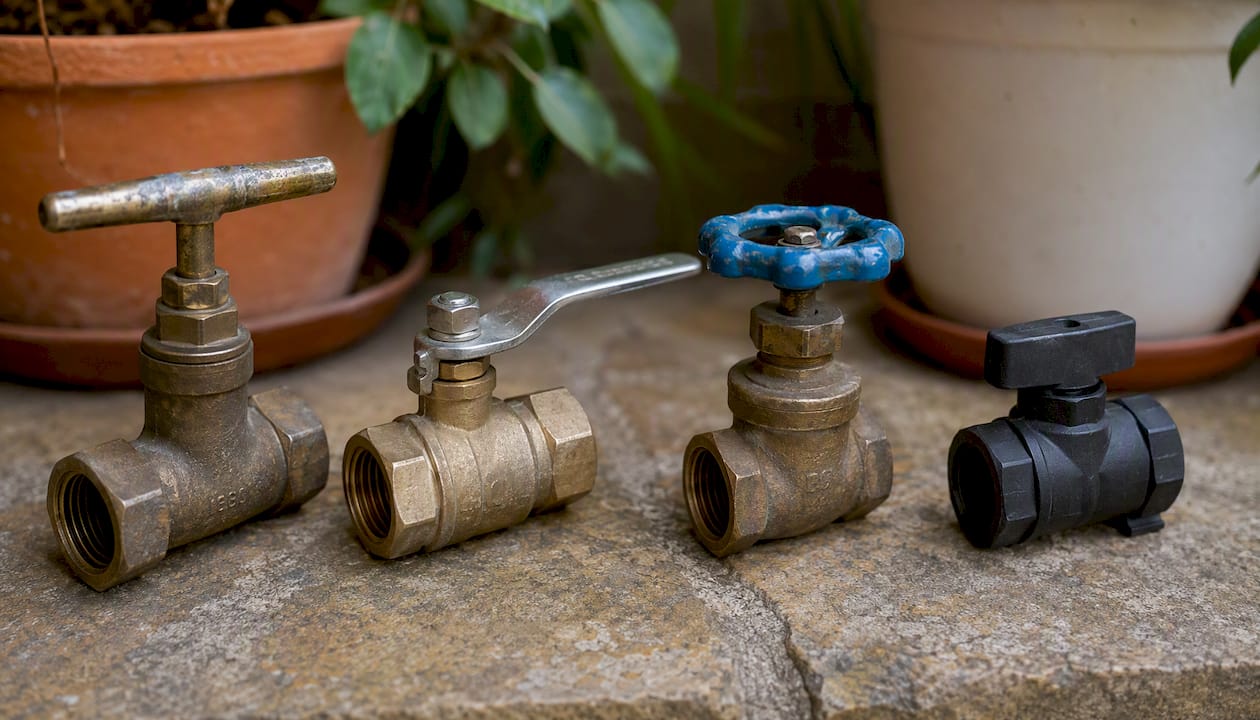
| Valve type | How to identify it | How to close it | Watch out for |
|---|---|---|---|
| Screw-down stopcock | Oval or round handle, multi-turn | Turn clockwise until resistance stops | Seized spindle from years without use |
| Lever/ball valve | Flat lever handle, quarter-turn | Lever across the pipe = closed | Easy to knock accidentally; check position |
| Gate valve | Wheel-shaped handle, multi-turn | Turn clockwise many times | Slow to close; common on older systems |
| Plastic meter-side valve | Flat slot or square head, no handle | Requires a meter key or flat-blade tool | Fragile; avoid excessive force |
The screw-down stopcock is the most common type in UK homes built before the 1990s. Turn it clockwise to close and anticlockwise to open. It can take several full rotations, so don't stop after one or two turns.
Lever ball valves are increasingly common on newer pipework and on individual appliances. When the lever sits parallel to the pipe, water flows; when it sits across the pipe, the supply is cut. That visual check is useful in a hurry.
Isolation valves fitted at individual appliances (washing machines, dishwashers, toilets) let you shut off one fixture without cutting the whole house supply. Which? Trusted Traders notes that installing these valves is the most practical way to manage minor leaks without a full shutdown, and that a plumber can sometimes fit a new internal stopcock if the existing one is seized.
How to shut off your home water safely, step by step
Follow these steps in order. The whole process typically takes two to five minutes once you've located the stopcock.
-
Locate and close the internal stopcock. Turn it clockwise. It may take ten to fifteen full rotations on an older screw-down valve. Water flow from taps will slow and stop within a minute or two as the system drains. Don't panic if it doesn't stop instantly.
-
Turn off the boiler, central heating and any immersion heater. Hot water in the system can continue circulating and cause further damage if the boiler keeps firing. If you have a solid-fuel boiler (a Rayburn or similar), let it cool naturally rather than attempting to extinguish it quickly. CIPHE advises shutting off the mains stop valve and switching off heating as the immediate priority before any other action.
-
Open all cold taps and flush WCs. This drains residual pressure from the pipes and reduces the volume of water that can escape from any split or joint. Do not open hot taps if you suspect pipes are frozen, as this can draw cold air into the hot-water cylinder.
-
Isolate the electricity if water has reached sockets, appliances or the consumer unit. Switch off at the main breaker. If you cannot reach the consumer unit safely because water is pooling near it, leave the building and call an emergency electrician. Place towels at doorways to slow the spread of water to other rooms.
Safety reminders:
- Never use a naked flame, heat gun or blowtorch to thaw frozen pipes. CIPHE's guidance is clear: gentle warmth from a warm cloth or a hairdryer on its lowest setting, working from the tap end of the pipe inward.
- If the stopcock closes but water continues to flow, the leak may be downstream of an isolation valve that is also open, or there may be a second supply route. Check for any secondary stopcocks.
A Severn Trent Water flow guide notes that a healthy supply fills a one-litre jug in around seven seconds. After reopening the stopcock, this test gives you a quick baseline to confirm normal pressure has returned.
What to do when the stopcock won't turn
A seized stopcock is more common than most homeowners expect. WaterSafe recommends exercising stopcocks every six months precisely because lack of use is the main cause of seizing. If yours won't move, here's how to approach it without making things worse.
What you can try:
- Apply a small amount of penetrating lubricant around the spindle base and wait two minutes before trying again
- Use gentle, alternating pressure: try to open slightly, then close, rather than forcing in one direction
- Grip the body of the valve with one hand to prevent torque travelling to the pipe fittings
What you must not do:
- Do not use a cheater bar or extend your spanner with a length of pipe to increase leverage. Forcing a seized spindle risks snapping it entirely, turning a stuck valve into a broken one with no way to isolate the supply.
- Do not use a naked flame to free a seized valve.
| Situation | Action |
|---|---|
| Stopcock stiff but moves slightly | Lubricate, gentle alternating turns, then call a plumber to service it |
| Stopcock completely seized | Go to external stopcock; call water company and emergency plumber |
| Stopcock turns but water keeps flowing | Valve seat may be worn; call a plumber immediately |
| Stopcock broken or spindle snapped | External stopcock only; emergency plumber required |
If the internal valve is completely seized, Anglian Water's guidance confirms that tenants should contact their landlord or housing association, while the water company can assist via the external stopcock if the internal one is inaccessible. United Utilities advises contacting a qualified plumber and your insurer once the immediate flow is stopped.
Where is the external stopcock, and who is responsible for it?
The external stopcock sits outside the boundary of your home, usually under a small metal or plastic cover set into the pavement, driveway or garden path. Southern Water's guidance notes that these covers are typically around 150mm square and that the external valve should not be treated as your primary internal control.
Key points about external stopcocks:
- The water company owns and is responsible for the external stopcock and the supply pipe up to the boundary of your property
- You can operate the external valve in an emergency, but you will need a universal stop tap key (the long-handled tool with a square socket)
- Contact your water company's emergency line directly if you need the external valve operated and cannot do it yourself; major UK regional suppliers run 24-hour emergency lines.
- Mark the cover's location on a rough sketch of your garden or driveway so you can find it quickly in the dark or under snow
- Do not build over or block access to the cover
Thames Water and Anglian Water both publish their emergency contact numbers prominently on their websites. If you don't know your supplier, the Water UK postcode checker identifies your regional company in seconds.
After you shut off the water: what to check and how to restart safely
Once the supply is off and the immediate crisis is contained, work through this sequence before you call it done.
Immediate checks:
- Confirm the water meter has stopped moving (a spinning dial after shutoff indicates a leak between the meter and the stopcock)
- Photograph all affected areas, including ceilings, walls, flooring and any damaged appliances
- Soak up standing water and move furniture away from wet areas to reduce secondary damage
- Check the consumer unit for any tripped breakers caused by water contact
Safe restart sequence:
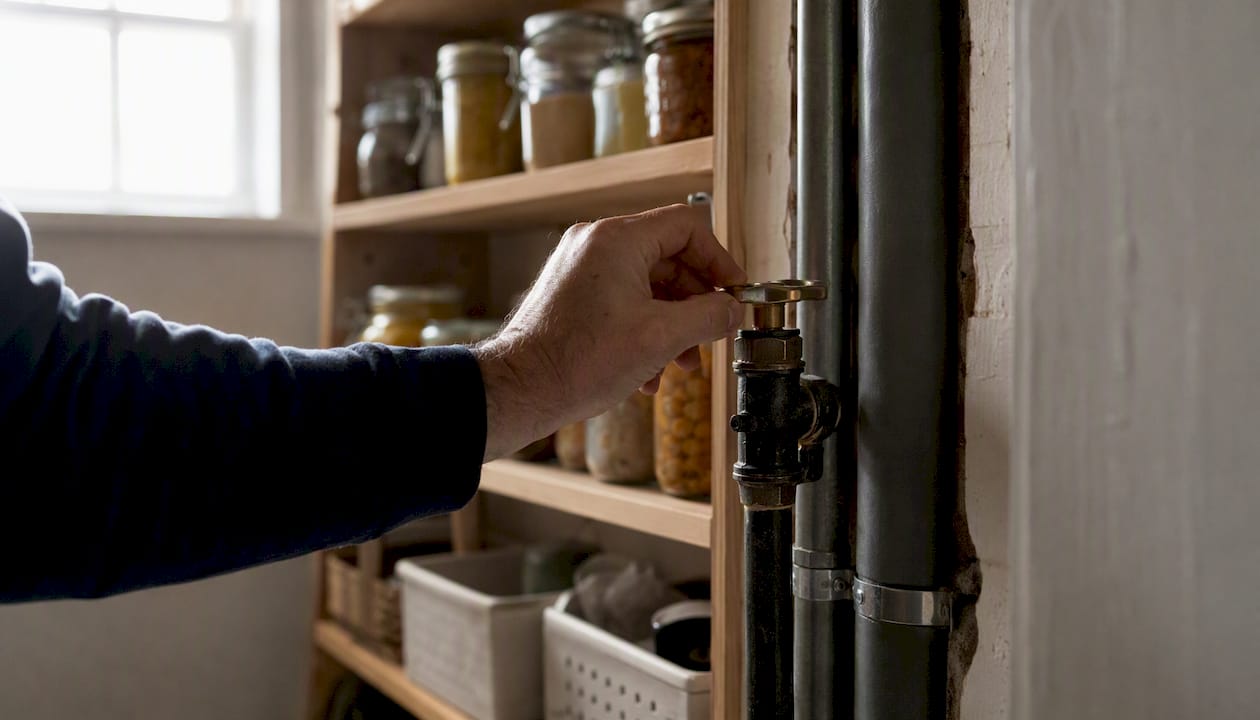
Close all the taps you opened to drain the system. Open the internal stopcock slowly, a quarter-turn at a time. On a screw-down valve, WaterSafe recommends turning it back half a turn after fully opening to prevent future seizing. Let the system refill gradually and check each tap in turn for discoloured water, which clears within a minute or two.
Restart the boiler only after confirming the system has refilled and pressure has returned to normal on the gauge. Follow the manufacturer's reset procedure; most modern combi boilers repressurize via a filling loop.
Pro Tip: Before calling your insurer, note the exact time the leak started, the meter reading at shutoff, and the meter reading when you reopen the supply. That data speeds up the claims process considerably.
Contact your insurer as soon as the immediate situation is stable. Most home insurance policies cover escape of water, but they require prompt notification. An emergency plumber can provide a written report of the damage and the repair required, which insurers typically request.
Simple maintenance that prevents seized stopcocks and speeds future shutdowns
The single most effective thing you can do right now costs nothing: turn your stopcock. WaterSafe's stop tap guidance recommends exercising it every six months. Tying this to the twice-yearly clock changes gives you an easy prompt.
Maintenance checklist:
- Turn the stopcock clockwise until it stops, then back anticlockwise to fully open, then back half a turn. That half-turn back prevents the valve from seizing in the open position.
- For lever ball valves, a single quarter-turn open and closed is sufficient.
- Apply a small amount of silicone grease or plumber's lubricant to the spindle if it feels stiff during the exercise.
- Label the stopcock clearly with a tag or bright tape, and note its location in your home's maintenance file.
- Store a torch, adjustable pliers and a universal stop tap key in the same cupboard as the stopcock.
Camden Council's water supply guidance recommends using a lubricant if the valve is stiff and contacting a WaterSafe-approved plumber if it does not move at all. The WaterSafe register lists approved plumbers by postcode.
Adding isolation valves to individual appliances is a low-cost upgrade worth considering. Which? Trusted Traders confirms that these valves let you isolate a single fixture without shutting the whole house, which is particularly useful for washing machine or dishwasher leaks. A competent plumber can fit them during a routine visit.
Pro Tip: Check out these pipe maintenance habits for a full seasonal routine that takes under an hour a year and can prevent the most common emergency call-outs.
What to tell an emergency plumber and how Your-local-plumber can help
A clear, brief description when you call saves time and means the engineer arrives with the right parts. Have this information ready:
- Location of the leak: which room, which fixture, which floor
- Whether the stopcock closed: fully, partially, or not at all
- Whether electrics were isolated: yes, no, or uncertain
- Any access constraints: locked gates, dogs, narrow driveways
- How long the leak has been running: even an approximate time helps
- Whether the boiler is off: and whether it's a combi, system, or conventional
When the engineer arrives, expect a diagnosis of the source, a temporary isolation or repair to make the property safe, and a written estimate for the permanent repair. Most emergency attendances follow this sequence: assess, isolate, advise. The permanent fix may require a return visit with specific parts.
Your-local-plumber provides 24/7 emergency attendance across multiple UK towns and cities, with local engineers who know common pipe layouts in regional housing stock. Transparent fixed pricing means you know the labour rate before work starts, and free on-site quotes are available for follow-on work such as stopcock replacement or isolation valve installation. Read more about what to expect during an emergency attendance before the engineer arrives.
The thing most homeowners only learn the hard way
The stopcock is the most important valve in your home, and most people have never touched it. That's the real problem. Not the burst pipe, not the seized valve, but the thirty seconds of panic while water pours through the ceiling and nobody in the house knows where to go or what to turn.
Every emergency I attend follows a recognisable pattern: the homeowner finds the stopcock eventually, but by then the water has been running for ten or fifteen minutes. The damage from those extra minutes is almost always worse than the original leak. A split joint or a failed washing machine hose is a small repair. A saturated ceiling, warped floorboards and a damaged consumer unit is a significant insurance claim.
The fix is genuinely simple. Go and find your stopcock today. Turn it. Label it. Tell everyone in the house where it is. That one action, done now, is worth more than any emergency kit you could buy.
When you need an emergency plumber fast: Your-local-plumber
A burst pipe or a seized stopcock at midnight is not the moment to search for a plumber. Your-local-plumber offers 24/7 emergency attendance with local engineers who carry the parts most commonly needed for immediate isolation and repair.

Fixed labour rates are confirmed before work begins, so there are no surprises on the invoice. For follow-on work such as stopcock replacement, isolation valve installation or pipe repairs, free on-site quotes are provided once the emergency is stabilised. To book an emergency attendance or get a quote, visit Your-local-plumber or call the number on the site. Have your address, a brief description of the leak location and whether the water is currently isolated ready when you call.
Sources
The guidance in this article draws on the following authoritative UK sources. Consult them directly for official advice on valve identification, frozen pipes and water-company responsibilities.
- How can I locate my internal stop tap to turn off my water in an emergency? | WaterSafe
- What to do if your stopcock or stop tap doesn’t work | Which? Trusted Traders
- Plumbing emergencies: what to do before help arrives | CIPHE
- Find and use your inside stop valve | Southern Water
- Burst pipe? | United Utilities
- Water supply in your council home | Camden Council
- What to do if you have no water or low pressure | Severn Trent Water