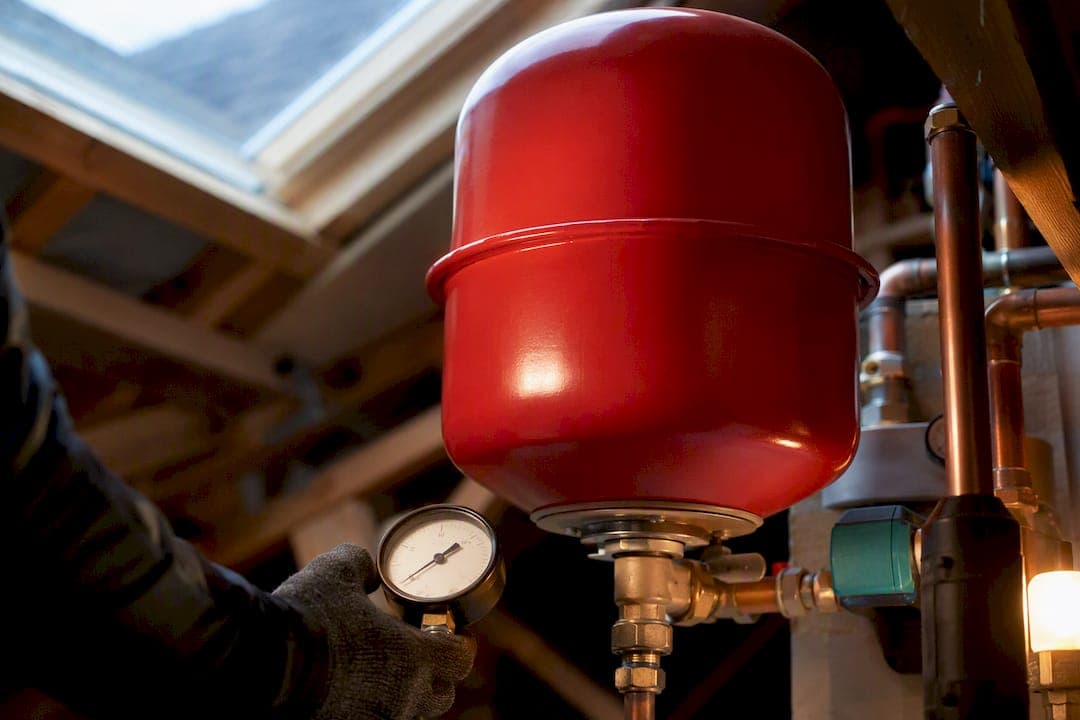
If your boiler pressure keeps climbing when the heating fires, or the pressure relief valve keeps dribbling water outside, the expansion vessel is very likely the culprit. Press the Schrader valve on the vessel: air means it can probably be recharged, water means it needs replacing. Either way, if pressure keeps spiking above 3 bar, isolate the boiler and call a qualified engineer rather than keep resetting it yourself.
TL;DR:
- A pressure reading of roughly 0 bar at the Schrader valve indicates the vessel's pre-charge has leaked and can often be topped up, whereas a water discharge suggests the diaphragm has ruptured and the vessel needs replacing.
- Hard water, sludge buildup, and corroded connections accelerate vessel failure, making regular inhibitor checks and system cleaning essential for prolonging vessel lifespan.
- A repeatedly discharging PRV or pressure rising above 3 bar during heating signals a likely waterlogged vessel that requires immediate professional inspection or replacement.
- Proper sizing and correct pre-charge setting based on the system's total water volume and static fill pressure are crucial to prevent recurring pressure relief valve discharges.
- Most domestic vessels last several years, but issues like recurring pressure loss or a heavy feeling vessel indicate it may be nearing the end of its service life, prompting timely replacement or maintenance.
Table of Contents
- What are the key symptoms of expansion vessel failure?
- How do you test the vessel safely at home?
- What causes expansion vessels to fail?
- Should you recharge or replace the expansion vessel?
- How is expansion vessel size and pre-charge worked out?
- How long do expansion vessels last, and what does replacement cost?
- What does a local engineer see most often?
- Does water quality affect expansion vessel failure?
- A homeowner-focused way to spot, test and fix vessel failure
- How to book an expansion vessel check or replacement
- Sources
- FAQ
What are the key symptoms of expansion vessel failure?
An expansion vessel absorbs the extra volume water creates as it heats up. When it stops doing that job, the symptoms show up fast and they tend to repeat.
The most common giveaway is pressure that rises sharply the moment the heating switches on, often climbing to or beyond 3 bar before settling back down. Alongside that, you'll usually notice one or more of the following:
- Pressure drops considerably once the system cools. This means you're topping up the filling loop every few days
- The pressure relief valve discharges water to a tundish or outside the property, sometimes leaving staining or damp patches on the wall
- Water or a damp residue around the vessel's Schrader (air) valve
- The vessel itself feels unusually heavy, or you can hear sloshing when you tap it
- Repeated top-ups that never seem to solve the underlying pressure problem
Symptoms like these, including rapid pressure rise and PRV discharge, are the classic signature of a failing vessel rather than a boiler fault, though the two often get confused because the boiler is what displays the pressure gauge.
How do you test the vessel safely at home?
Before touching anything, let the system cool fully and isolate it. Do not attempt this while the boiler is running or if you're not comfortable working near gas or hot pipework. If in doubt, this is exactly the point at which you drain a boiler system safely or hand the job to an engineer.
Once the system is cool and isolated, a straightforward sequence tells you a lot:
- Isolate the vessel (or drain the system down if there's no dedicated isolation valve) so it's no longer under water pressure.
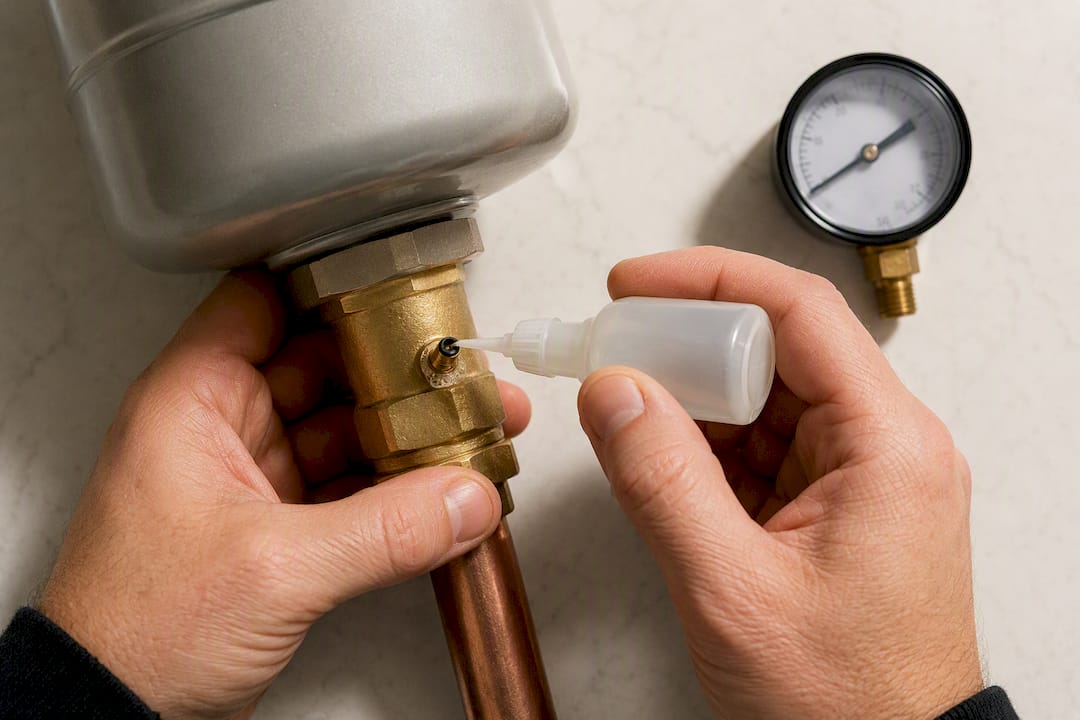
- Locate the Schrader valve on top of or beside the vessel and press it briefly with a small tool.
- Check what comes out. Air hissing out is normal. Water coming out means trouble.
- If only air escapes, attach a tyre-style pressure gauge to the Schrader valve and read the pre-charge.
- Compare that reading against the system's static fill pressure to judge whether it simply needs recharging.
The interpretation matters as much as the test itself. If a vessel's diaphragm has ruptured, pressing the Schrader valve produces water rather than air, and a water reading means the vessel is waterlogged and usually needs replacing. A reading of roughly 0 bar with no water present suggests the pre-charge has simply leaked away over time, which can often be topped back up if the diaphragm is otherwise intact.
The single most common mistake is checking pre-charge while the system is still pressurised. Water-side pressure pushes back on the gauge and gives a falsely high reading, which is why the vessel or system must be depressurised first.
Pro Tip: Dab a little leak-detection fluid around the Schrader valve before you press it. If bubbles form even before you depress the pin, the valve itself is leaking gas slowly, which explains gradual pre-charge loss without ever showing a dramatic fault. Use a gauge rated 0 to 4 bar rather than a standard car tyre gauge; anything coarser won't give you an accurate reading at these lower pressures.
What causes expansion vessels to fail?
Two failure modes account for most cases, and they need very different fixes.
- Slow pre-charge loss: the gas cushion inside the vessel leaks out gradually through the Schrader valve seal or the vessel wall itself, causing pressure symptoms that creep in over months.
- Diaphragm or bladder rupture: the rubber membrane separating air from water tears, letting water flood the gas chamber and "waterlogging" the vessel, usually causing sudden, severe symptoms.
- Undersized vessel or wrong original pre-charge: if the installer fitted a vessel too small for the system's water volume, or set the pre-charge incorrectly from day one, the PRV will keep lifting no matter how many times it's reset.
- Corrosion, sludge and closed isolation valves: debris in the system, poor siting near heat sources, or a valve someone shut and forgot about can all accelerate wear or mask a working vessel as faulty.
This is also why simply swapping the PRV when it keeps discharging rarely solves anything long-term. The valve is doing its job correctly; it's relieving pressure the vessel should have absorbed. Ignore the vessel and the new valve will start discharging again within weeks.
Should you recharge or replace the expansion vessel?
Whether an engineer recharges the vessel or fits a new one depends entirely on what the Schrader valve test reveals.
A recharge is appropriate when the diaphragm is intact (air only from the Schrader valve) and the vessel has an accessible isolation valve. The process is quick:
- Isolate the vessel from the system.
- Drain any residual water pressure from the vessel side.
- Connect a charging pump or cylinder to the Schrader valve and bring the pre-charge up to the correct figure for that system's static fill pressure.
- Reopen the isolation valve, refill the system, and check the pressure gauge behaves normally through a heating cycle.
Replacement becomes necessary once water appears at the Schrader valve, there's visible corrosion or rust weeping from the shell, or the diaphragm has failed. A ruptured diaphragm cannot be repaired on a sealed domestic vessel, so recharging one in that state is pointless; the engineer will drain the system, disconnect and remove the old vessel, fit a correctly sized replacement, set the new pre-charge, then refill and re-pressurise before checking the PRV stays shut through a full heating cycle.
On a typical domestic system with reasonable access, expect the job itself to take somewhere between 30 and 90 minutes. Tucked-away vessels in airing cupboards or lofts, or systems that need a full drain-down first, push that towards the longer end.
How is expansion vessel size and pre-charge worked out?
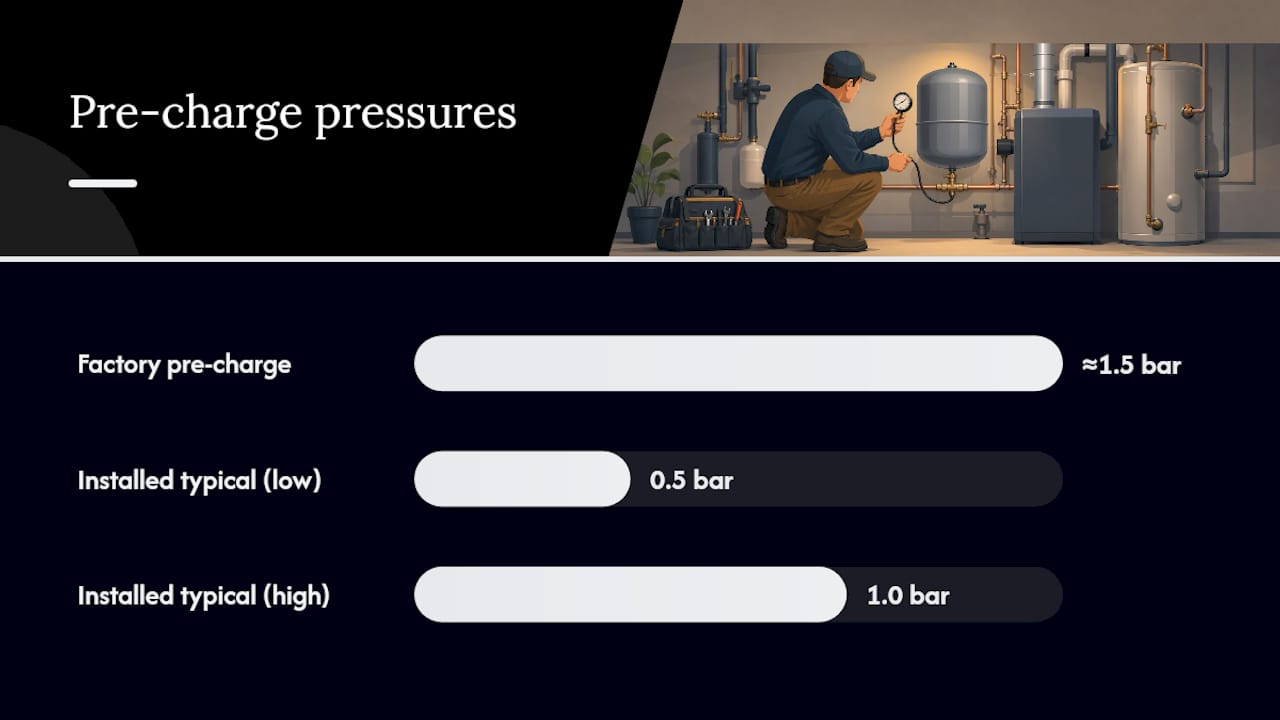
Pre-charge should match the static fill pressure at the point the vessel sits, not an arbitrary number. Vessels often arrive from the factory pre-charged around 1.5 bar, while most domestic systems actually need something closer to 0.5 to 1.0 bar once installed, depending on the height of the system above the vessel.
Sizing follows the system's total water volume and its working pressure, not guesswork. As a rough guide, a 12-litre vessel comfortably handles a system holding around 100 litres of water at typical settings, though sizing calculators exist for more precise figures. Undersizing is the quiet cause behind a lot of "mystery" PRV discharges; oversizing wastes money without adding any real benefit.
Before an engineer leaves, it's worth asking two things directly:
- What pre-charge value did they set, and does it match your system's static fill pressure?
- Have they confirmed the new vessel's litre capacity actually suits your system's water volume, rather than just matching what was removed?
Anyone curious about why water volume changes with temperature in the first place can read more on thermal expansion in plumbing.
How long do expansion vessels last, and what does replacement cost?
Most domestic expansion vessels typically run for several years before the diaphragm or the pre-charge seal starts to give up, though harsh water conditions or a poorly sized original install can shorten that considerably. Signs it's nearing the end include recurring pressure loss despite repeated top-ups, or a vessel that feels heavier than it used to.
Cost depends heavily on access and system type:
- Straightforward swaps on an accessible vessel with easy isolation tend to sit at the lower end
- Vessels buried in tight cupboards, or systems needing a full drain-down, push labour time and therefore cost upward
- Vessel size itself also affects parts cost, since larger systems need larger, pricier units
Bringing pre-charge checks into the annual boiler service is the cheapest insurance against an emergency call-out, since it catches slow pre-charge loss long before it becomes a waterlogged vessel and a soaked airing cupboard.
What does a local engineer see most often?
Most homeowners can safely do the Schrader valve check once the system is cool and isolated. Anything beyond that, particularly draining the system, adjusting pre-charge, or removing the vessel, is engineer territory. If pressure keeps climbing above 3 bar repeatedly or the PRV won't stop discharging, stop resetting it and get someone qualified out.
When an engineer arrives, three questions get you real answers fast: what pre-charge figure are they setting and why, what specifically caused the failure rather than just "the vessel's old", and what warranty covers the parts and labour on the job.
The pattern that shows up again and again on repeat call-outs is a vessel that was never actually pressure-tested during a routine annual service, only glanced at. Navien UK's own data backs this up: roughly one in five warranty calls relate to vessel issues that a proper pre-charge check during servicing would have caught early.
Does water quality affect expansion vessel failure?
Hard water and system contaminants shorten an expansion vessel's working life more than most homeowners realise. Limescale from hard water areas builds up inside the connecting pipework and around the vessel's connection point, gradually restricting the small amount of movement the diaphragm needs to flex freely as pressure changes.
Sludge and corrosion debris circulating in an unfiltered system cause a different problem. Fine black iron oxide sludge, produced as radiators and pipework slowly corrode from the inside, settles wherever flow is sluggish, and the connection to the expansion vessel is often exactly that kind of dead-leg. Over time this sludge coats the diaphragm and stiffens it, so the vessel can no longer expand and contract smoothly even if the pre-charge itself is correct.
Systems without a working magnetic filter or with inhibitor levels that have never been topped up after a power flush are noticeably more prone to this. It's not always the vessel's fault when a "recharged" vessel fails again within a year; sometimes the real problem is sludge working its way back into a freshly serviced system.
This is one of the strongest arguments for pairing any vessel work with a check on inhibitor levels and filter condition, rather than treating the vessel as an isolated component. A vessel replaced in isolation, in a system full of contaminated water, is simply buying time before the same symptoms return.
A homeowner-focused way to spot, test and fix vessel failure
Most guidance on this topic treats every pressure fault as a plumbing mystery requiring a full callout. That's overcautious. The Schrader valve test is genuinely something most homeowners can run safely in five minutes once the system has cooled, and it tells you almost everything you need to know before an engineer even arrives.
Where conventional advice falls short is in treating "recharge or replace" as a coin toss. It isn't. Water at the valve means replace, full stop. Air with a low reading means recharge is worth trying first. The confusion mostly comes from people skipping the depressurised gauge check and guessing instead.
What I'd prioritise first isn't the vessel at all. It's asking whether your annual service has ever actually included a pre-charge check, because the vessels that fail hardest are usually the ones nobody looked at properly for years. Fix the checking habit and you fix most of the recurring failures before they start.
— Michael
How to book an expansion vessel check or replacement
A local plumbing service diagnoses, recharges and replaces expansion vessels as part of heating repair work, with same-day emergency response available if the PRV is actively discharging or pressure is climbing fast. Heating and boiler callouts are charged at £110 per hour, with a fixed new boiler installation starting from £1,300 where a full system upgrade makes more sense than another repair.

Before you book, it helps to have your boiler make and model, the date of your last service, and a rough description of what you've seen: pressure readings, PRV discharge, damp near the vessel. That lets the engineer arrive with the right size vessel already in mind rather than guessing on the day.
Every job comes with a warranty and a no fix, no fee guarantee, so you're only paying for work that actually solves the problem. You can book a plumbing visit online, or if the PRV is discharging right now, use the 60-minute emergency heating response service instead of waiting it out.
Sources
- Expansion Vessels Explained: How to Size, Check, and Replace Them — APM Plumbing & Electrical
- Expansion Vessel Maintenance Guide - Navien
FAQ
What happens if an expansion vessel fails?
Pressure builds rapidly whenever the heating fires, often forcing the pressure relief valve to discharge water outside the property. Left unchecked, this repeated cycling can strain boiler seals and, in a waterlogged vessel, leave your heating system with nowhere to absorb normal water expansion at all.
How much does it cost to replace an expansion vessel?
Cost varies mainly with vessel size and how accessible it is, with tucked-away vessels or full drain-downs pushing labour time up. Your-local-plumber charges £110 per hour for heating and boiler work, which covers diagnosis, recharge or replacement depending on what the Schrader valve test shows.
Can a boiler run without an expansion vessel?
No sealed heating system should run without a working expansion vessel, because there's nowhere for the water to expand into as it heats up. The pressure relief valve will end up doing the vessel's job by constantly venting water, which wastes water and risks damaging boiler components over time.
How long should an expansion vessel last?
Most domestic expansion vessels typically run for several years before the diaphragm or the pre-charge seal starts to give up, though hard water and sludge can shorten that. Getting the pre-charge checked at every annual service is the most reliable way to catch a slow leak before it becomes a full waterlogged failure.