TL;DR:
- Thermal expansion in plumbing causes pressure increases when water heats in closed systems, risking damage. An expansion tank absorbs extra volume, preventing cyclic stress and preserving pipe integrity. Proper maintenance and professional installation ensure safety and compliance, avoiding costly failures.
Thermal expansion in plumbing is the increase in water volume that occurs when water is heated, raising pressure inside your pipes and potentially causing serious damage if the system cannot accommodate it. Every time your boiler or water heater fires up, the water inside expands. In an open system, that extra volume simply pushes back into the mains supply. In a closed system, it has nowhere to go. Understanding the role of thermal expansion in plumbing is the difference between a system that quietly protects itself and one that silently builds towards a costly failure.
What is thermal expansion in plumbing and how does it work?
Thermal expansion is the physical process by which water increases in volume as its temperature rises. Water expands approximately 1.7% in volume when heated from 10°C to 60°C, which translates to roughly 3.2 litres of extra water in a standard 50-gallon water heater. That may sound modest, but inside a sealed pipe network, those extra litres have to go somewhere.
The pressure rise that follows is the real threat. Your pipes, joints, valves, and appliances are all rated to handle a specific pressure range. When thermal expansion pushes beyond that range repeatedly, components wear faster, seals degrade, and the risk of leaks or bursts increases. Think of it like repeatedly over-inflating a tyre. Each cycle does a little more damage until something gives.
This is why understanding how thermal expansion works is not just a technical curiosity. It is a practical home maintenance concern that affects every household with a water heater or boiler.
Open vs closed systems: why the difference matters
The impact of thermal expansion in pipes depends entirely on whether your plumbing is an open or a closed system. The distinction is straightforward but frequently misunderstood.
| System type | How expanded water is handled | Expansion tank required? |
|---|---|---|
| Open system | Excess volume returns to mains supply | No |
| Closed system | Excess volume is trapped with no exit route | Yes |
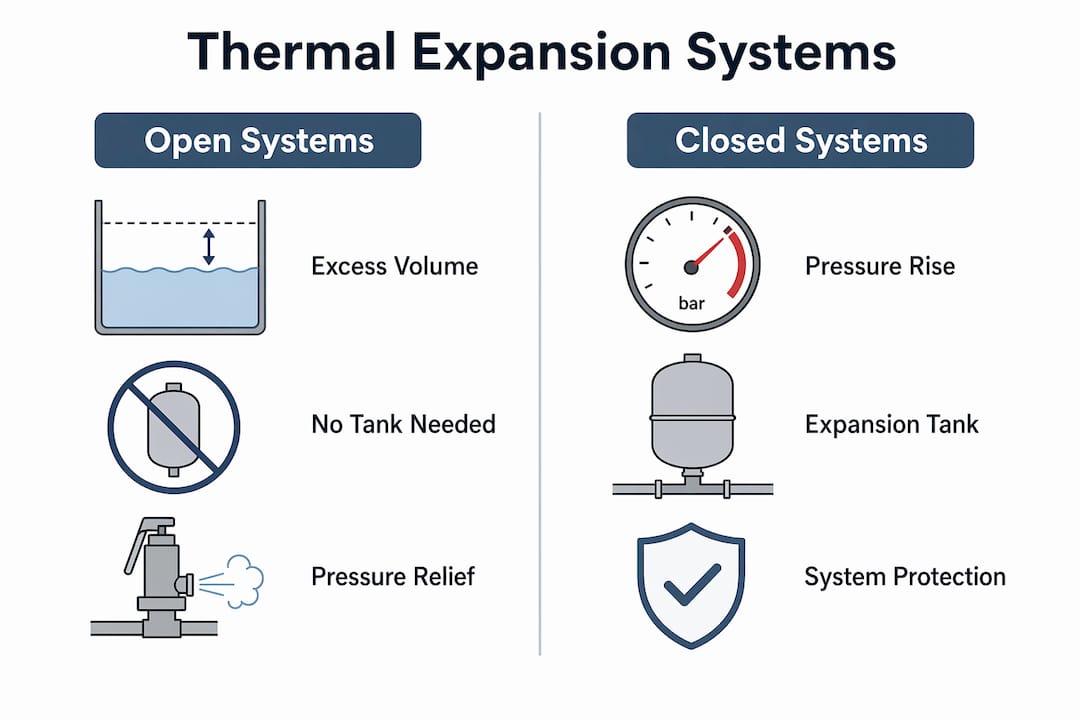
In an open system, your plumbing connects freely to the mains water supply. When heated water expands, the extra volume simply flows back upstream. Pressure stays stable and no additional protection is needed.
A closed system is sealed off from the mains. This happens more often than homeowners realise, for several reasons:
- A pressure-reducing valve (PRV) on your incoming supply acts as a one-way barrier. Installing a PRV converts your plumbing into a closed system, trapping expanded water inside.
- Backflow prevention devices, now required under modern plumbing codes, serve a similar function.
- Check valves fitted to water meters or supply lines also seal the system.
Homeowners often do not realise their system is closed until thermal expansion problems begin to surface. If your home has a PRV or a backflow preventer fitted, assume you have a closed system and plan accordingly. You can read more about how plumbing valves affect pressure in your system to understand this better.
What damage can thermal expansion cause in home plumbing?
Unmanaged thermal expansion effects range from minor nuisances to expensive structural failures. Thermal expansion pressure can exceed 150 psi in closed systems, well above the 80 psi maximum recommended for most residential plumbing. At that level, the consequences are predictable and serious.
Common signs and symptoms include:
- Dripping taps or running toilets caused by pressure forcing water past seals and valves
- A water heater that makes banging or popping noises, indicating pressure cycling
- The temperature and pressure (T&P) relief valve discharging water, which is a safety device doing its job under stress it should not face regularly
- Fluctuating hot water pressure at taps and showers
- Visible moisture or damp patches around pipe joints and fittings
The T&P relief valve is worth understanding specifically. It is designed to open and release pressure if your system reaches a dangerous threshold. If it is discharging regularly, that is not normal operation. It is a warning sign that your system is under chronic pressure stress from plumbing expansion issues. Repeated discharge also wears the valve itself, which can eventually fail to seal properly.
Long-term, cyclic pressurisation from repeated heating puts cumulative stress on every component in your system. Joints weaken, appliance lifespans shorten, and the risk of a sudden failure grows. Identifying these signs early is covered well in this guide to signs you need a plumber.
Pro Tip: If your T&P relief valve is discharging more than occasionally, do not simply replace the valve. Investigate the root cause. Persistent discharge almost always points to an unmanaged closed system with no expansion control in place.
How do thermal expansion tanks work and when do you need one?
An expansion tank is the standard solution for managing plumbing pipe expansion in a closed system. It is a small pressurised vessel, typically fitted near your water heater or boiler, that absorbs the extra volume created when water heats up.
Here is how it works in practice:
- The tank contains two chambers separated by a flexible rubber diaphragm. One side holds air, pre-charged to match your home's incoming water pressure. The other side connects to your hot water circuit.
- When water heats and expands, the extra volume pushes into the tank's water side, compressing the air cushion on the other side.
- Pressure in the system stays stable because the air absorbs the volume increase rather than letting it build against fixed pipe walls.
- When water cools, the compressed air pushes the water back into the system and the tank resets.
Expansion tanks contain a pre-charged air bladder separated from the water by a diaphragm, and the tank body is rated for potable water contact. Sizing matters. A tank that is too small will not absorb enough volume; one that is too large wastes money and space.
You need an expansion tank if your system is closed and you have a traditional storage water heater or a combination boiler with a stored hot water cylinder. Tankless water heaters generally do not require expansion tanks because they heat water on demand without storing a large volume, so the thermal expansion effect is minimal.
The 2024 International Plumbing Code Section 607.3 states that closed water heating systems must be protected by an approved thermal expansion device. This is not optional guidance. It is a code requirement that many UK local authority building regulations mirror in principle.
Pro Tip: Expansion tanks must be pre-charged to match your home's incoming static water pressure. A tank set to the wrong pressure will not function correctly even if it is properly installed. Always check the pre-charge with a tyre pressure gauge before fitting, and adjust using a standard valve if needed.
How can homeowners manage thermal expansion safely?
Protecting your plumbing from expansion-related damage does not require specialist knowledge, but it does require attention. Here are the practical steps you can take:
- Check whether your system is closed. Look for a PRV on your incoming supply, a backflow preventer at the water meter, or a check valve on the supply line. Any of these means you have a closed system.
- Listen to your water heater. Banging, ticking, or pressure-release sounds during or after a heating cycle are early warnings of plumbing expansion issues.
- Inspect your expansion tank annually. Press the Schrader valve on the tank (it looks like a tyre valve). If water comes out instead of air, the diaphragm has failed and the tank needs replacing.
- Test your T&P relief valve once a year. Lift the lever briefly to confirm it opens and reseats cleanly. A valve that drips after testing is worn and should be replaced.
- Know your water pressure. Buy a simple pressure gauge from any plumbers' merchant and attach it to an outdoor tap. Residential systems should sit between 1.5 and 3 bar. Readings above 3 bar suggest a PRV issue or uncontrolled expansion.
When to call a professional: installation of expansion tanks involves cutting into pressurised hot water lines and calibrating the air charge precisely. Improper installation can negate the tank's benefits entirely. If you are unsure about any of these checks, or if you are fitting an expansion tank for the first time, bring in a qualified engineer. Staying compliant with UK plumbing regulations also matters here, as incorrect installations can affect your home insurance and building compliance status. Maintaining backflow prevention devices is equally part of keeping a closed system safe and code-compliant.
Key takeaways
Thermal expansion in plumbing is a pressure problem created by closed systems, and an expansion tank is the single most effective solution for any home with a storage water heater and a sealed supply line.
| Point | Details |
|---|---|
| Thermal expansion defined | Water volume increases by approximately 1.7% when heated from 10°C to 60°C, raising system pressure. |
| Closed systems are the risk | PRVs, backflow preventers, and check valves seal your system, making expansion control compulsory. |
| Warning signs to watch for | Dripping taps, T&P valve discharge, and water heater noise all indicate unmanaged pressure build-up. |
| Expansion tanks absorb pressure | A correctly sized and pre-charged expansion tank protects pipes, valves, and appliances from cyclic stress. |
| Professional installation matters | Incorrect pre-charge or poor fitting negates the tank's function and may breach plumbing regulations. |
Why most homeowners discover this problem too late
I have spoken with dozens of homeowners who only learned about thermal expansion after a T&P valve started weeping, a joint began leaking, or a water heater failed years ahead of its expected lifespan. The frustrating part is that in almost every case, the fix was straightforward. An expansion tank, correctly sized and pre-charged, would have cost a fraction of the repair bill.
The misconception I encounter most often is that a PRV solves the pressure problem. It does the opposite. It creates a closed system that then needs an expansion tank to function safely. Fitting a PRV without an expansion tank is one of the most common DIY plumbing mistakes I see, and it is entirely understandable because the two devices look like they are doing the same job.
Modern plumbing codes are increasingly mandating backflow prevention across new builds and renovations, which means more homes than ever are operating as closed systems without their owners knowing. If your home was built or had its supply line updated in the last ten years, there is a reasonable chance you already have a closed system. The question is whether it has the protection it needs.
My honest advice: treat expansion control as part of your annual home maintenance routine, not as a reactive fix. Check the tank, test the T&P valve, and measure your water pressure once a year. It takes twenty minutes and it is the kind of attention that keeps a plumbing system running quietly for decades.
— Michael
Get expert help with thermal expansion in your home

If you have identified signs of plumbing expansion issues or you are unsure whether your system has the right protection in place, Your-local-plumber can help. Our experienced engineers carry out expansion tank installations, pressure checks, and full system assessments across the UK, with transparent pricing and no unnecessary call-out delays. Whether you need a professional water heater service or a straightforward expansion tank fitting, getting it done correctly the first time protects your home and keeps you compliant with current regulations. Contact Your-local-plumber today for a no-obligation assessment and let us make sure your system is properly protected.
FAQ
What is thermal expansion in plumbing?
Thermal expansion in plumbing is the increase in water volume and pressure that occurs when water is heated inside a closed pipe system. If the system cannot accommodate this extra volume, pressure builds and can damage pipes, valves, and appliances.
Do I need an expansion tank if I have a PRV?
Yes. A pressure-reducing valve creates a closed system by preventing expanded water from returning to the mains supply, which makes an expansion tank compulsory to manage the resulting pressure rise safely.
How do I know if my expansion tank has failed?
Press the Schrader valve on the tank. If water escapes instead of air, the internal diaphragm has ruptured and the tank is no longer absorbing pressure. It needs replacing promptly.
Can thermal expansion damage a water heater?
Yes. Repeated pressure cycling from unmanaged thermal expansion stresses the tank, joints, and internal components of a water heater, shortening its lifespan and increasing the risk of premature failure.
Do tankless water heaters need expansion tanks?
Tankless water heaters generally do not require expansion tanks because they heat water on demand without storing a large volume, so the thermal expansion effect is negligible compared to traditional storage heaters.