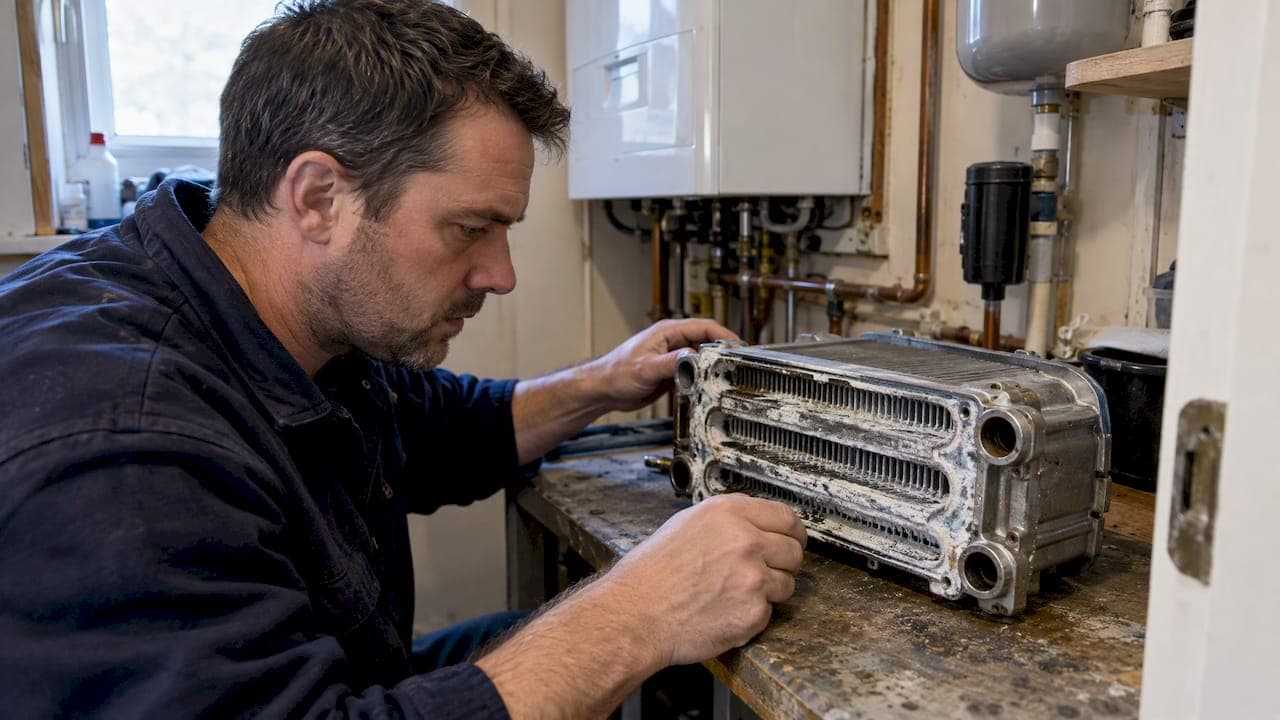
Limescale is a likely culprit if your boiler is taking longer to heat water, making rumbling noises, or your energy bills have crept up for no clear reason. Listen for kettling sounds, check your hot water flow and recent fuel bills, and if you notice lockouts, repeated faults or visible white deposits, arrange a professional inspection rather than waiting it out.
TL;DR:
- Above roughly 200 mg/L calcium carbonate, boiler feed water treatment is worth considering; point of use protection is often more economical than whole house treatment.
- Kettling combined with slow hot water and rising bills points more strongly to limescale than weak flow alone; cold radiator tops usually indicate trapped air.
- Chemical descaling treats scale in the heat exchanger and hot water circuit, while powerflushing clears sludge from radiators; fused scale may require exchanger replacement.
- Magnetic filters catch metallic sludge, not mineral scale; pair them with an inhibitor or softener, and keep inhibitor dosing records to support warranty claims.
- Never pour vinegar, citric acid, or kettle descaler into a boiler; household acids can damage seals, and boiler circuits cannot be rinsed clean like kettles.
Table of Contents
- What limescale is and how it forms inside boilers
- Signs and symptoms of limescale in boiler systems
- How limescale affects boiler efficiency, lifespan and warranties
- How professionals remove or reduce limescale: what each method does and when it's used
- Preventing limescale: long-term measures homeowners can choose
- In-house engineer tips and safety notes
- Is it worth fixing limescale early, or waiting for a breakdown?
- How Your Local Plumber can help with limescale problems
- FAQ
- Sources
What limescale is and how it forms inside boilers
Limescale is the hard, chalky deposit left behind when calcium and magnesium salts dissolved in water come out of solution and settle on hot surfaces. The harder your water supply, the more of these minerals it carries, and the faster scale builds up wherever water is heated repeatedly.
Inside a boiler, this happens most aggressively in the heat exchanger and any once-through water heating components, where water passes quickly across a very hot metal surface. Combination boilers are particularly exposed because they heat water on demand rather than storing it, concentrating scale formation in a small area.
The Drinking Water Inspectorate classes water as hard above roughly 200 mg/l of calcium carbonate, and very hard above 300 mg/l. This 200 ppm threshold matters practically because it is the point where:
- Feed water treatment becomes worth considering rather than optional
- Manufacturers typically expect some form of scale protection to be fitted
- Point-of-use treatment near the appliance tends to be more economical than treating the whole house
If your local supply sits above this line, your boiler is working against a steady mineral load every time it fires up.
Signs and symptoms of limescale in boiler systems
Scale build-up rarely announces itself with one obvious fault. It shows up as a cluster of small, worsening symptoms that are easy to dismiss individually.
- Hot water takes noticeably longer to reach temperature than it used to.
- Flow from taps or the shower feels weaker, even though pressure elsewhere in the house is normal.
- You hear kettling, a rumbling or popping noise, as trapped steam pushes through scale deposits on the heat exchanger.
- The boiler locks out or cuts out more often than before, sometimes resetting fine and sometimes not.
- Your gas or electricity bill has risen without a change in usage habits, because a scaled exchanger needs more energy to transfer the same heat.
Where it is safe to do so, check accessible fittings such as external tap heads or showerheads for white, crusty deposits, and find helpful tips on how to fix a towel rail not heating, since visible scale there often mirrors what is happening inside the system. Radiators that are cold at the top but warm at the bottom usually point to trapped air rather than scale, and a boiler that fires but never reaches set temperature can just as easily be a faulty thermostat. Kettling combined with slow hot water and rising bills is the combination most specific to limescale.
How limescale affects boiler efficiency, lifespan and warranties
Scale acts as an insulating layer between the burner's heat and the water that needs to absorb it. Even a thin coating forces the boiler to burn more fuel to deliver the same hot water, and that inefficiency compounds the longer it is left untreated.
Homes with mains water above 200 mg/l CaCO3 sit in the Drinking Water Inspectorate's "hard" to "very hard" bands, which is the practical cut-off where treating feed water starts to matter for appliance protection. Beyond the efficiency loss, scale puts extra strain on pumps and valves that now have to push water through a narrower, roughened passage, and it raises the risk of localised overheating in the heat exchanger, which is a common trigger for repeated lockouts.

There are compliance and warranty implications too. Approved Document L advises that where incoming hardness exceeds the recognised threshold, suitable measures should treat feed water to the boiler and hot water circuit, with BS 7593 setting out how systems should be prepared and dosed with inhibitor. Skipping this step in a hard water area can leave a warranty claim open to dispute if scale is later found to be the cause of failure. If your boiler is losing pressure alongside these symptoms, that is worth mentioning to an engineer too, since the two issues sometimes share a cause.
How professionals remove or reduce limescale: what each method does and when it's used
Once scale is established, the right fix depends on where it has settled and how long it has been building.
- Chemical descaling uses a controlled acid flush to dissolve scale from the heat exchanger and hot water circuit, followed by a thorough rinse to clear dissolved residue and restore correct water chemistry.
- Powerflushing targets the central heating circuit rather than the hot water side, clearing magnetic sludge and loose debris from radiators and pipework so water circulates freely again.
- Heat exchanger replacement becomes necessary when scale has fused to the metal and chemical treatment can no longer restore performance. Industry guidance notes engineers typically confirm this by measuring heat transfer and inspecting the exchanger after partial disassembly.
These jobs involve draining and refilling part of the system, so expect the heating to be off for a few hours during the work.
Pro Tip: Never attempt an acid-based descale on a boiler circuit yourself: the chemistry has to match the system's materials, and getting it wrong can damage seals that a kettle simply doesn't have.
Preventing limescale: long-term measures homeowners can choose
Prevention is almost always cheaper than repair, and several options work well together rather than as alternatives.
- Corrosion inhibitors dosed into the central heating circuit protect metal surfaces and, when dosing is logged, support any future warranty claim by showing the system was properly maintained.
- Ion-exchange softeners remove hardness from the water supply before it reaches the boiler, though they need regular salt refills and, per WRAS requirements, at least one unsoftened potable outlet must be retained in the home.
- Inline or electrolytic scale reducers fitted close to the boiler are often a more economical alternative to whole-house softening when the goal is simply protecting the appliance.
- Magnetic filters trap metallic sludge and corrosion debris effectively, but Which? is clear that they are not designed to remove mineral limescale, so they work best alongside an inhibitor or softener rather than instead of one.
A simple yearly routine, testing local water hardness, keeping inhibitor dosing records, booking an annual service and cleaning any fitted filter, catches most problems before they become expensive ones. If you are still deciding whether softening makes sense for your home, that decision is worth making before scale has a chance to set in.
In-house engineer tips and safety notes
Before calling an engineer, it helps to note down what you have noticed: when the noises started, how hot water flow has changed, any visible deposits, and whether anyone has recently worked on the system. That detail speeds up diagnosis considerably.
One warning we give every caller: do not pour vinegar, citric acid or any kettle-style descaler into a boiler circuit. As BBC Good Food notes, these work on kettles because you can rinse them clean afterwards. A boiler circuit cannot be flushed that way, and household acids can damage seals and components that a kettle simply doesn't have.
Pro Tip: A proper call-out includes a diagnostic check, a water hardness test, and a written quote for descaling, powerflushing or replacement, so you know exactly what you're paying for before any work starts.
Is it worth fixing limescale early, or waiting for a breakdown?
In our experience, a modest spend on an inhibitor top-up or a scale reducer is consistently cheaper than the heat exchanger replacement that follows years of neglect. Homeowners who service annually and log their inhibitor levels tend to avoid the emergency call-outs altogether.
— Michael
How Your Local Plumber can help with limescale problems
If any of this sounds like your boiler, we offer the full range of work this article has covered: boiler diagnostics, chemical descaling, powerflushing, heat exchanger replacement, inhibitor dosing and annual servicing, carried out by experienced engineers.

At a call-out, we run a proper safety check, test your water and give you a written, transparent quote before any work begins, so there are no surprises on the invoice. We back our work with a warranty and operate on a no fix no fee basis, with no call-out charge. You can book a plumbing visit directly, or if your boiler has locked out or stopped producing hot water altogether, our emergency heating engineer service responds within 60 minutes. Where a heat exchanger is beyond saving, we can also provide a new boiler quote.
FAQ
Does boiling vinegar in a kettle get rid of limescale?
Yes, vinegar is effective for descaling a kettle because the appliance can be rinsed clean afterwards, as BBC Good Food explains. This method should never be used on a boiler, since boiler circuits cannot be rinsed the same way and household acids can damage internal seals.
How to get rid of stubborn limescale?
For small fittings like taps or showerheads, soaking in a descaling solution usually clears stubborn deposits. For a boiler, stubborn or fused scale on the heat exchanger needs a professional chemical descale or, in severe cases, heat exchanger replacement, as industry guidance sets out.
Does hard water cause scaling in boilers?
Yes, water classed as hard or very hard, above roughly 200 mg/l of calcium carbonate according to the Drinking Water Inspectorate, deposits scale on boiler heat exchangers every time water is heated. The higher the hardness, the faster scale accumulates and the sooner protection becomes worthwhile.
Why does my water have limescale?
Limescale forms because your mains water carries dissolved calcium and magnesium picked up from the ground it passes through, and these minerals settle out when the water is heated. Hardness varies by region, so checking your local water supplier's hardness data gives the clearest picture of your own risk.
Sources
- Water hardness / Hard water – Drinking Water Inspectorate
- Approved Document L: Conservation of fuel and power, Volume 1: Dwellings (2021 edition inc 2023 amendments)
- HHIC / industry guidance on water treatment in heating and DHW systems
- Extend your boiler’s life with a magnetic filter - Which?
- How to descale a kettle - BBC Good Food