TL;DR:
- Low water pressure often results from simple issues like clogged fixture parts or closed valves rather than expensive plumbing failures. Diagnosing whether problems are isolated or widespread helps identify whether the cause lies within fixtures, the home's supply, or external municipal supply issues. Consulting a professional plumber is advisable when basic checks fail to resolve persistent or complex pressure problems.
Low water pressure is one of those frustrating problems that can quietly rob your daily routine of comfort for months, sometimes years, before anyone thinks to investigate. Many homeowners in Reading assume it's an unavoidable fact of life, or worse, that it signals an expensive plumbing disaster waiting to happen. In reality, a surprising number of pressure problems trace back to simple, overlooked issues that cost very little to fix. This guide will walk you through the most common causes, help you pinpoint where the fault lies, and give you a clear path forward, whether you tackle it yourself or call in a local expert.
Table of Contents
- How to diagnose your low water pressure: Isolated vs whole-home
- Common fixture-level culprits: Aerators, showerheads and valves
- When the whole house is affected: Supply line, main valves and pipework
- Could it be Reading's water supply? How to spot and respond to municipal issues
- Why the obvious cause isn't always the real problem: A plumber's perspective
- Professional support for persistent low pressure issues
- Frequently asked questions
Key Takeaways
| Point | Details |
|---|---|
| Diagnose the source | Check if low pressure is at one fixture or throughout your home to steer your next steps. |
| Fixture fixes first | Cleaning or replacing a clogged aerator or showerhead can often restore flow quickly. |
| Check for whole-home causes | If every tap has low flow, inspect main valves, look for leaks, or consider pipe condition issues. |
| External supply matters | Sudden pressure loss in your area may be due to council repair works or a water main break. |
| Expert help is available | For problems you can’t solve or persistent low pressure, call a local Reading plumber for support. |
How to diagnose your low water pressure: Isolated vs whole-home
Once you know low water pressure is present, start by narrowing down where and how it's occurring in your home. This single step saves hours of unnecessary guesswork and stops you replacing expensive pipework when the real culprit is a two-pound aerator.
The most useful diagnostic framework splits pressure problems into two categories: isolated issues affecting one fixture, and widespread issues affecting multiple taps or the whole home. According to research into household plumbing faults, low pressure at a single fixture typically points to a localised blockage or valve problem, whereas pressure loss across multiple locations usually signals something further up the supply chain.
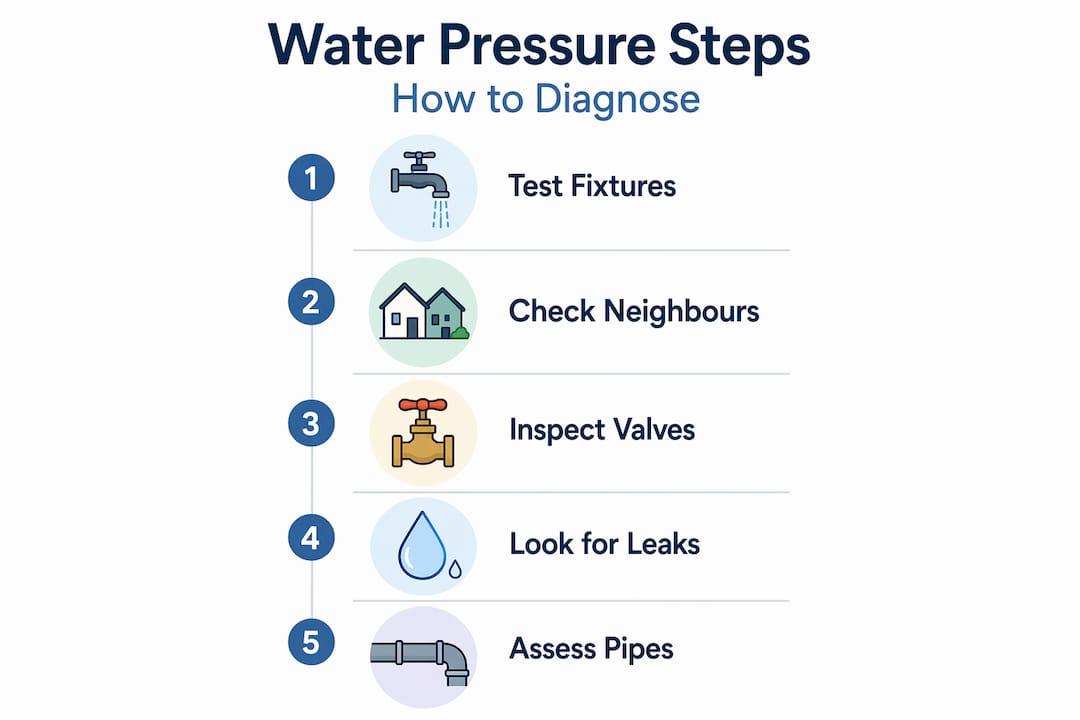
Follow these steps to get a clear picture quickly:
- Turn on the cold tap in your kitchen. Note whether the flow feels weak or normal.
- Test a second tap in a different room, such as a bathroom basin or bath tap.
- Check the shower separately, as showerhead blockages are very common and can mimic whole-home problems.
- Run two fixtures simultaneously to see if pressure drops dramatically when demand increases.
- Speak to a neighbour. If they're experiencing the same issue, the fault almost certainly lies with the municipal supply rather than your home's plumbing.
| Symptom | Likely cause | Next step |
|---|---|---|
| Weak flow at one tap only | Clogged aerator or isolator valve | Clean or replace aerator, check valve |
| Weak pressure in one bathroom | Blocked showerhead or branch pipe | Descale showerhead, inspect pipe run |
| Low pressure across all taps | PRV fault, main valve, hidden leak | Check main shut-off, call a plumber |
| Sudden loss affecting street | Water main break or council works | Contact water utility, check local news |
| Gradual decline over months | Pipe corrosion or scale buildup | Professional inspection recommended |
Pro Tip: Before spending a penny, knock on your neighbour's door and ask if they've noticed low pressure too. This thirty-second conversation can instantly tell you whether the problem is inside your home or out on the street, saving you hours of fruitless DIY work.
For further guidance on fixing low water pressure step by step, or to browse practical DIY plumbing fixes suited to Reading homes, those resources will complement the diagnosis you've just completed.
Common fixture-level culprits: Aerators, showerheads and valves
If you find the problem is isolated, focus your efforts on the fixture itself before worrying about the whole system. The good news is that fixture-level faults are almost always cheap and straightforward to resolve.
Fixture-level restrictions such as clogged aerators and showerheads are among the most frequently reported causes of low pressure at a single point. The aerator is the small mesh screen screwed onto the tip of your tap. Over time, limescale, sediment, and mineral deposits accumulate in this tiny screen and slowly strangle the water flow. Reading sits in a moderately hard water area, which means scale builds up faster here than in softer water regions further north.
"A simple aerator blockage is one of the most common reasons homeowners contact us about low pressure at a single tap. Clean the screen, and the problem is often gone within minutes."
Here's what to inspect and how to tackle it:
- Aerator: Unscrew it by hand or with a cloth for grip. Soak it in white vinegar for 30 minutes, rinse thoroughly, and refit. If it's old or corroded, replace it for just a few pounds from any DIY shop.
- Showerhead: Remove the showerhead, soak it in a bowl of white vinegar overnight, and use a toothbrush to scrub the nozzles clear. Mineral deposits frequently clog the spray holes, dramatically reducing flow.
- Isolator valve: Every tap and toilet has a small isolator valve, usually a flat-head screw slot on the supply pipe beneath or behind the fixture. If this has been partially turned (often by accident during maintenance), it will restrict flow to that fixture only. Ensure it's fully open by turning it so the slot runs parallel to the pipe.
- Flexible tap connector: These braided hoses can kink over time, especially under sinks. Check that they haven't been crushed or bent during storage of cleaning products underneath.
For a detailed guide on cleaning aerators and restoring full flow, refer to our full step-by-step resource.
Pro Tip: Replacing an old, scaled aerator costs around £2 to £5 and takes under five minutes. It's worth doing as a first step on any tap with weak flow before investigating anything more complex. Many homeowners are genuinely astonished that such a tiny component was the cause of months of frustration.
When the whole house is affected: Supply line, main valves and pipework
If more than one fixture is impacted, it's time to look at your home's overall plumbing and supply network. Whole-home pressure problems require a different approach, and some causes are more urgent than others.
Whole-home low pressure frequently traces back to a partially closed main shut-off valve or a fault in the pressure reducing valve (PRV). The main shut-off is typically found where the supply pipe enters the property, often under the kitchen sink, in the downstairs cupboard, or just inside the front boundary. If this valve has been partially closed, perhaps by a previous occupant, a maintenance visit, or by accident, it will throttle the supply to every tap in the home.
The pressure reducing valve is a small brass device that regulates water entering your home from the street main. Most homes in Reading have one, and these valves have a lifespan of roughly 10 to 15 years. When they begin to fail, pressure can drop significantly across the whole property. A plumber can test and adjust or replace a PRV in a single visit.
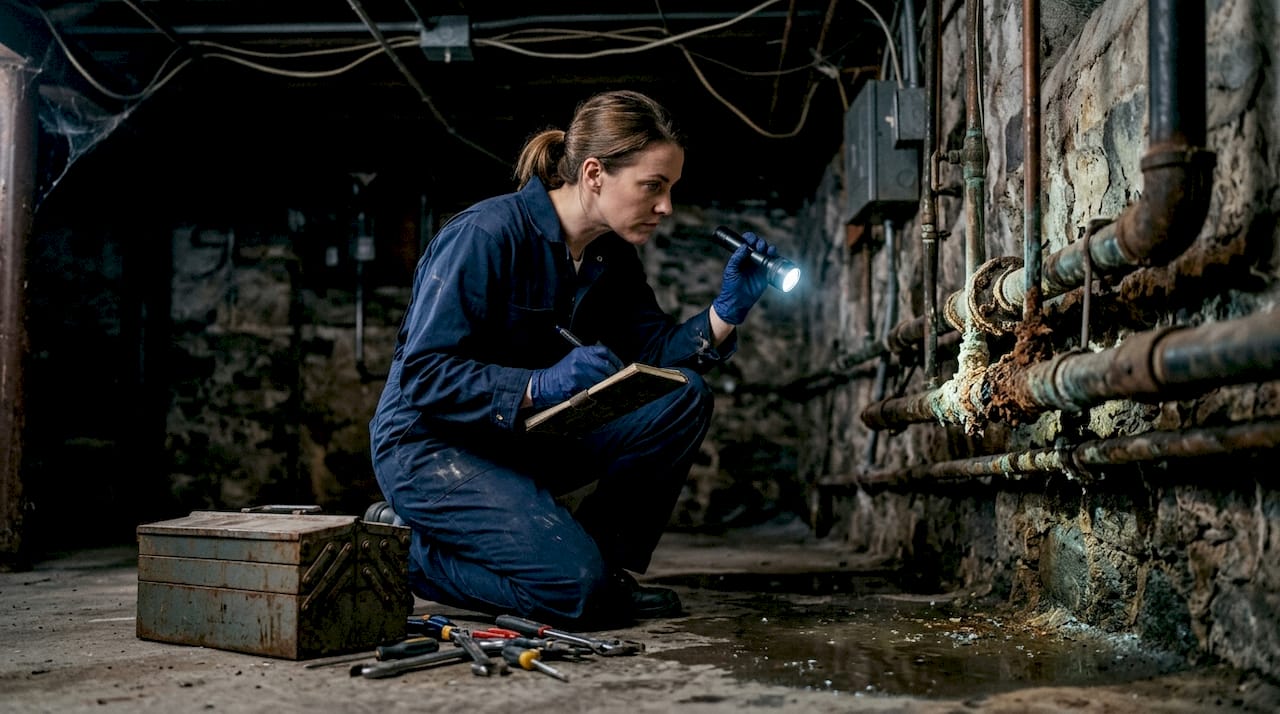
Corroded or older pipes represent another persistent cause that often goes undetected for years. As the internal diameter of a metal pipe narrows due to rust, limescale, and mineral deposits, less water can pass through at any given moment. Many Reading properties built before the 1980s still have original galvanised steel or lead supply pipes, both of which are especially prone to this kind of internal corrosion. Understanding water pressure and your plumbing infrastructure helps you appreciate why old pipework causes such a noticeable drop over time.
| Problem source | Typical symptom | Urgency level |
|---|---|---|
| Partially closed main valve | Low pressure throughout, sudden onset | Check immediately, easy fix |
| Faulty PRV | Gradually worsening whole-home pressure | Medium, needs plumber |
| Corroded pipes | Slow decline over years, discoloured water | High, professional assessment needed |
| Hidden leak | Wet patches, damp smell, pressure drop | High, act quickly |
| Meter valve (water company) | Pressure fine inside but low everywhere | Contact water supplier |
Follow this checklist when investigating whole-home causes:
- Locate your main shut-off valve and confirm it is fully open.
- Find your water meter, usually beneath a cover near the pavement outside, and check whether the meter valve is fully open.
- Inspect pipework under the kitchen sink and in the airing cupboard for signs of corrosion, lime deposits, or damp patches.
- Walk around the exterior of your property looking for unexplained wet or boggy ground, which can indicate a hidden underground leak.
- Check your water bill for unexplained increases, which often reveal ongoing leaks that waste pressure.
If you suspect a hidden leak, our leak detection guide explains how to investigate systematically before calling in a professional.
Could it be Reading's water supply? How to spot and respond to municipal issues
Understanding when the situation is out of your hands can save wasted time and worry. Sometimes the cause of low pressure has nothing to do with your property at all.
Municipal supply problems such as water main breaks, high-demand periods, and planned maintenance work can reduce pressure for hundreds of households simultaneously. These events are outside any homeowner's control, but knowing how to recognise them quickly stops you from wasting time and money checking your internal plumbing unnecessarily.
"A confirmed water main break in Reading can directly explain sudden low pressure for affected areas until repairs restore service, with thousands of customers impacted at once."
The signs that point to a supply-side issue are fairly clear when you know what to look for. Pressure loss that comes on suddenly, affects every tap instantly, and coincides with your neighbours reporting the same problem is almost always a main supply event rather than a household fault. Reading has experienced incidents where over 3,200 customers lost service simultaneously due to a single water main break, illustrating just how widespread these events can be.
If you suspect the supply is the problem, take these steps:
- Check with neighbours on both sides and across the street to establish how widespread the issue is.
- Visit your water utility's website or app for live service updates and reported incidents in your postcode area.
- Follow local news channels and social media, as main breaks in Reading are often reported quickly by residents and local journalists.
- Conserve water while repairs are underway. Avoid running dishwashers or washing machines until normal pressure returns.
- Contact your water utility if the low pressure persists for more than 24 hours without explanation, as they have a duty to investigate and resolve supply faults within defined timeframes.
If the problem is sudden and affects many neighbours, always check with your water utility for main breaks before assuming an internal plumbing fault. This one habit alone can spare you an unnecessary call-out fee.
Why the obvious cause isn't always the real problem: A plumber's perspective
With all the main causes in mind, let's share the perspective that only comes from years of hands-on work in Reading's homes. The most common mistake we see is homeowners jumping straight to the most alarming conclusion. Someone notices weak pressure at the kitchen tap and immediately assumes their pipes are corroded throughout, or they spend an afternoon reading about pressure reducing valves when the aerator simply needs a ten-minute soak in vinegar.
The second most common mistake runs in the opposite direction. Homeowners dismiss the issue as a council supply problem without ever asking a single neighbour. We've attended properties where a customer was convinced a main break was to blame, only to find a partially closed isolator valve under the bathroom basin that had been knocked during a cleaning session weeks earlier.
There is also a subtler problem we encounter regularly in older Reading terraces and Victorian semis. A property will have perfectly sound main pipework and a functioning PRV, but one branch pipe serving an upstairs bathroom will be narrowed by decades of limescale. The homeowner experiences weak pressure in the shower every morning and concludes the whole system needs replacing, when in fact a single pipe section or showerhead swap resolves it entirely.
Our strongest piece of advice is to be methodical. Work through the diagnostic steps in order, starting with the cheapest and simplest possibilities, and resist the urge to skip ahead. It's also worth knowing when to call a Reading plumber rather than persisting with DIY, because some problems genuinely do require professional tools and expertise to diagnose safely.
Pro Tip: Keep a simple written log of what you've tested and when. When a plumber arrives, this record can cut diagnostic time significantly, which saves you money on labour and means the problem gets fixed faster.
The uncomfortable truth is that most low pressure problems in Reading are solved for under £50, often for under £5. The real cost is usually time lost to misdiagnosis and unnecessary panic. A systematic approach, starting small and scaling up, is almost always the most efficient route to full water pressure.
Professional support for persistent low pressure issues
If you've worked through the steps in this guide and still can't identify the cause, or if you suspect pipe corrosion, a failing PRV, or a persistent hidden leak, it's time to bring in a professional.

At Your Local Plumber, our experienced engineers serve homeowners across Reading and the surrounding area, providing fast diagnosis and transparent pricing so you're never left guessing. Whether the problem turns out to be a simple valve adjustment or something more involved like corroded pipework or a pressure regulation fault, we have the tools and expertise to resolve it properly, first time. Our Reading plumbing experts are available for same-day and emergency appointments, with no hidden call-out fees. If persistent low pressure is affecting your daily life, get in touch and let us find the real cause quickly.
Frequently asked questions
How do I know if low water pressure is caused by my plumbing or the council's supply?
Test other taps throughout your home and speak to neighbours. If multiple households are affected simultaneously, it is most likely a supply-side main break rather than an internal plumbing problem.
Can a clogged aerator reduce water pressure significantly?
Yes, considerably so. Clogged aerators and showerheads restrict flow to a single endpoint and are one of the most common causes of weak pressure at an individual tap, yet they take just minutes to clean or replace.
What main plumbing problems cause whole-house low pressure?
A partially closed main valve, a faulty pressure reducing valve, and corroded or galvanised older pipes that have narrowed internally due to scale and rust are the most frequent whole-home culprits, along with hidden leaks.
What should I do during a Reading water main break?
Minimise water use, follow your utility's service updates online, and wait for the repair to be completed. Pressure should restore automatically once crews complete the fix, typically within a few hours.
When should I call a professional plumber for low water pressure?
If basic checks don't reveal a clear cause, or if you suspect pipe corrosion, a faulty PRV, or an active leak, call a qualified plumber rather than investigating further yourself, as these faults require specialist equipment to diagnose and repair safely.