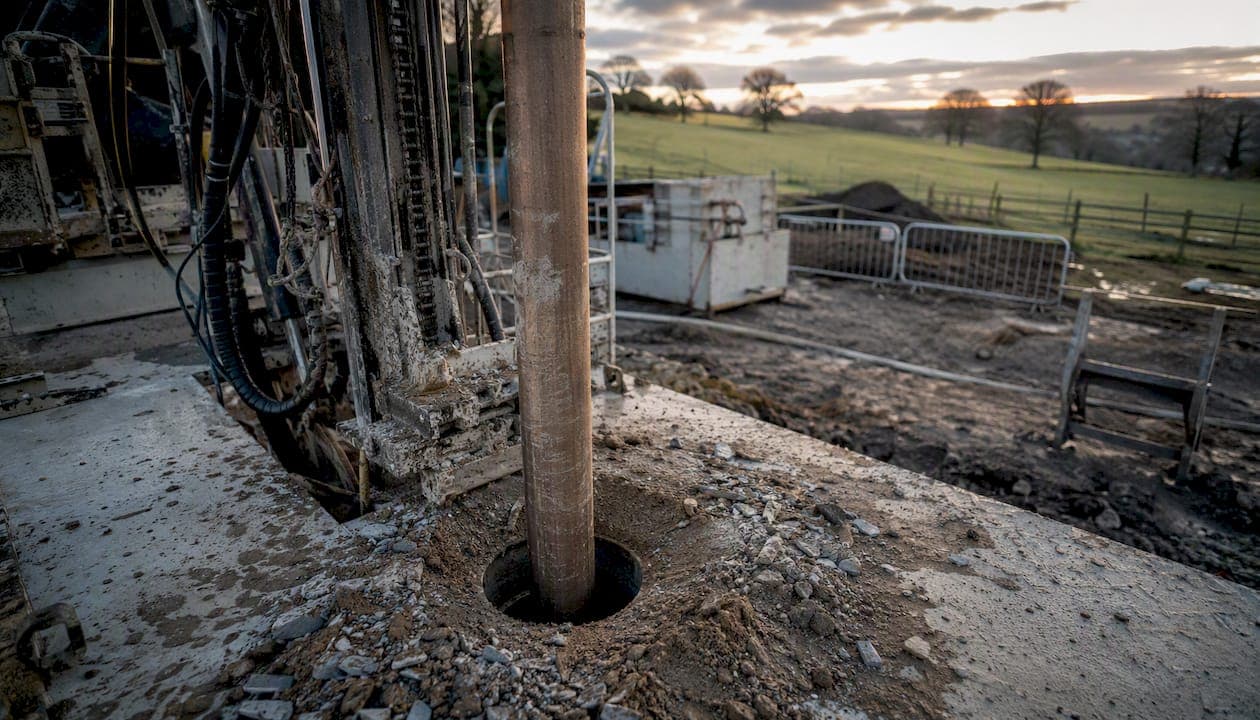
There are four main types of borehole water systems: drilled deep boreholes, shallow boreholes and driven wells, large-diameter dug wells, and borehole arrays or wellfields. Each suits a different combination of geology, water demand and budget. For most UK homeowners, a drilled deep borehole with a submersible pump is the default choice for a reliable potable supply. Before you commit to drilling anything, arrange a hydrogeological site survey and commission an independent water quality test through your local authority or an accredited laboratory.
Quick orientation by use case:
- Single dwelling: drilled borehole (typically several tens of meters deep) with submersible pump, pressure vessel and UV disinfection
- Smallholding or farm irrigation: drilled borehole or shallow borehole depending on water table depth, often with a surface pump and storage tank
- Small commercial supply: drilled borehole with a full treatment train and metered abstraction
- Existing dug well on older property: assess lining condition, upgrade pump and add treatment before relying on it
Key takeaways
Matching your borehole system to your geology, demand and regulatory obligations from the start is the single most effective way to avoid costly mistakes.
| Point | Details |
|---|---|
| Match system to need | Deep drilled boreholes suit most domestic supplies; shallow systems suit high water table sites with lower contamination risk. |
| Always test before drilling | Commission a hydrogeological site survey and independent water quality test before committing to any borehole construction. |
| Headworks above ground | Above-ground headworks with a sanitary seal reduce contamination risk and avoid confined-space hazards during maintenance. |
| Expect test pumping | A 24–72 hour test pump determines safe yield and is the basis for correct pump sizing; always request the full log. |
| Budget for treatment | Groundwater is not automatically safe to drink; a UV unit at minimum, and often a multi-stage train, is usually required. |
Immediate next actions: arrange a site survey with a qualified hydrogeologist, contact your local authority environmental health team, obtain at least two quotes from accredited drillers, and commission an independent water test from an accredited laboratory.
Table of Contents
- What are the main types of borehole water systems?
- How does a borehole system work? Key components explained
- What happens from site survey to commissioned supply?
- Water quality, treatment and UK regulations you need to know
- Borehole system maintenance and when to call a professional
- Costs, benefits and what drives the price
- An honest perspective on borehole projects
- Sources
What are the main types of borehole water systems?
Borehole systems divide cleanly by depth, construction method and the aquifer they target. Getting this choice right before you call a driller saves significant money.
Drilled deep boreholes
These are the most common groundwater extraction systems installed in the UK today. A rotary or percussion rig bores a narrow shaft, typically 100 mm–200 mm in diameter, down to a confined or semi-confined aquifer, often typically several tens of meters below surface depending on local geology. The depth gives them two practical advantages: consistent yield through dry summers and a natural buffer against surface contamination.
According to Ofwat's technical guide, boreholes fitted with proper casings and screens can form arrays or wellfields when a larger supply is needed, and headworks should always sit above ground level to reduce contamination risk. For a single dwelling or small business, a single drilled borehole is usually sufficient.
Shallow boreholes and driven wells
Where the water table sits close to the surface, a shallow borehole or driven well can reach usable groundwater at 10 m–30 m depth, often at lower drilling cost. The trade-off is vulnerability. Shallow systems are more exposed to agricultural run-off, septic tank leachate, and surface flooding. The DWI's manual on treatment for small water supply systems recommends siting at least 50 m from potential pollution sources such as slurry heaps and septic tanks and sealing the upper casing above ground level. If your site cannot meet those distances, a deeper drilled borehole is the safer option even if it costs more upfront.
Large-diameter dug wells
Many rural properties in England and Wales have an existing hand-dug or machine-excavated well, sometimes a metre or more in diameter and lined with brick or concrete rings. These are historical assets rather than a modern installation choice. They can still supply adequate water for non-potable uses such as irrigation, but they need careful assessment: check the lining for cracks, confirm the pump type suits the wider shaft, and treat the water before any domestic use. As Homebuilding notes, dug wells are wider and shallower than boreholes and more likely to run dry during drought.
Borehole arrays and wellfields
When a single borehole cannot meet demand, or when redundancy matters (a care home, a food-processing site, a large farm), multiple boreholes are drilled and connected to a common header main. This is a wellfield or borehole array. Each borehole in the array is individually cased, screened and pumped, and the combined yield is managed through a control panel. The complexity and cost rise sharply, so arrays are rarely the right answer for a single domestic property.
Pump and power variants
The pump type is as important as the borehole type itself. Submersible electric pumps are the standard for drilled boreholes, sitting below the water level inside the casing. Solar-driven submersible pumps suit remote sites without mains electricity and work well for irrigation where demand follows daylight. Hydraulic ram pumps, which use the energy of flowing water to lift a smaller volume to height, are a niche option for spring-fed or stream-fed supplies rather than boreholes proper.
Pro Tip: Before requesting quotes, write down your peak daily water demand in litres. A driller needs this figure to size the pump and storage correctly. A typical UK household uses a moderate amount of water per person per day as a planning baseline.
How does a borehole system work? Key components explained
Understanding what each part does helps you read a driller's quote critically and spot what has been left out.
Casing and screen
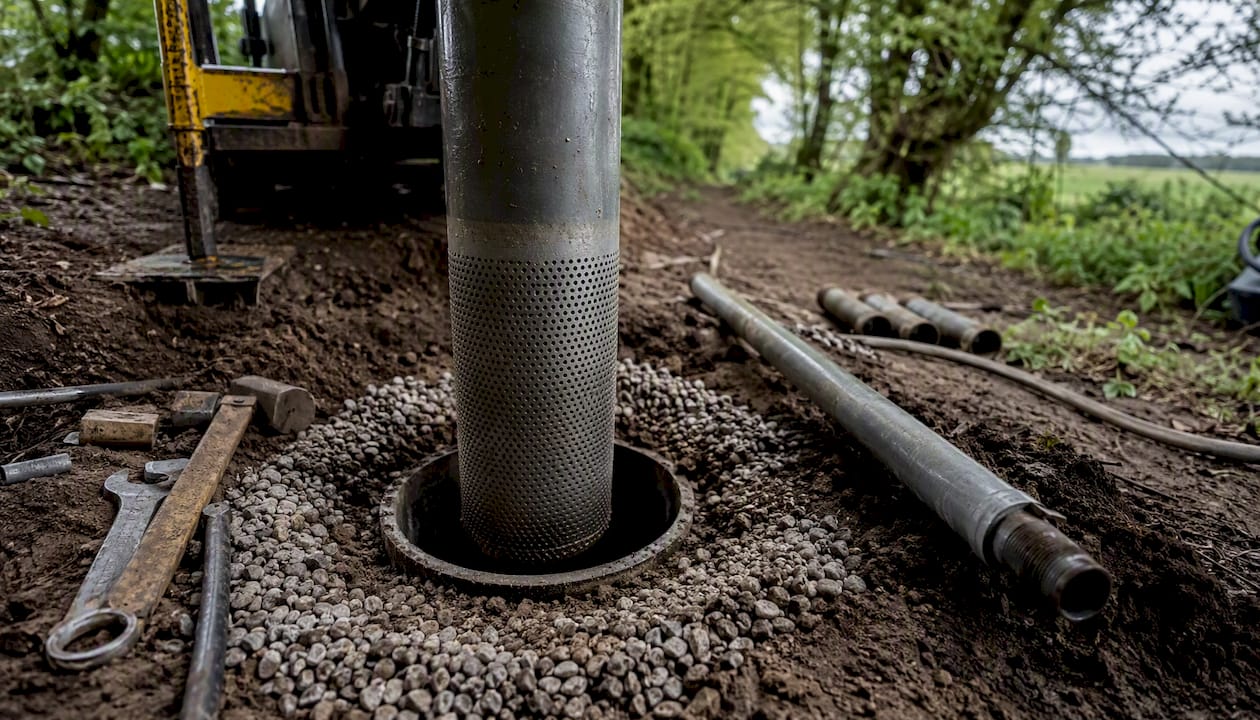
The casing is the structural tube that lines the borehole from surface to depth. It keeps the shaft open, supports the surrounding ground and, critically, seals out surface water. Casings are usually mild steel or well-grade uPVC. The lower section, where the borehole intersects the water-bearing zone, is replaced with a perforated or slotted screen that lets water in while keeping aquifer material out. Where the aquifer is sandy or silty, a gravel pack is placed between the screen and the formation to act as a pre-filter and prevent sand ingress.
Submersible pump
The pump sits inside the casing below the standing water level. Pump selection must match the internal casing diameter and the required flow rate and total head: common UK domestic casing sizes are small and medium diameters, and fitting a pump that is even slightly too wide is a frequent and expensive procurement error. Where sand or fines are present, sand-tolerant pumps or inlet filters protect the impellers from abrasion.
Headworks and sanitary seal
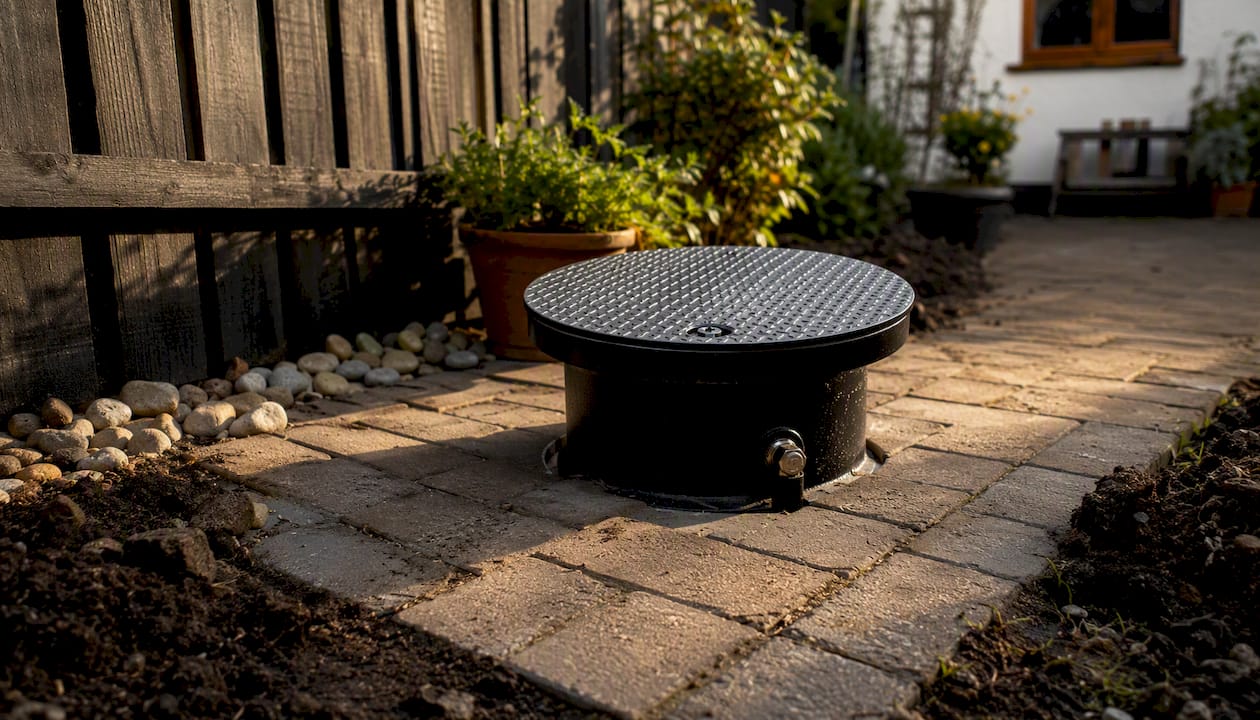
The headworks is the above-ground assembly where the rising main exits the borehole, typically a steel or GRP chamber with a lockable cover. Building it above ground level, rather than in a below-ground manhole, reduces flood risk and avoids confined-space hazards during maintenance. The annular space between the casing and the surrounding ground is grouted with cement or bentonite to form a sanitary seal that prevents surface water from tracking down the outside of the casing into the aquifer.
Storage tanks and pressure vessels
Most domestic borehole installations include either a break-pressure storage tank or a pressure vessel (sometimes called a pressure tank or accumulator). A storage tank holds a day's supply and decouples pump run-time from household demand, which extends pump life. A pressure vessel uses a captive air charge to maintain system pressure between pump cycles. For guidance on how pressure management affects your household supply, the water pressure regulation guide from Your-local-plumber explains the principles clearly.
Key components at a glance:
- Casing: structural lining, seals out surface water
- Screen: perforated lower section, allows water entry, excludes aquifer material
- Gravel pack: pre-filter around screen in sandy formations
- Submersible pump: sized to casing diameter, flow rate and head
- Rising main: delivery pipe from pump to surface
- Headworks: above-ground assembly, lockable, sealed
- Sanitary seal: cement or bentonite grout in annular space
- Pressure vessel or storage tank: manages pump cycling and supply buffer
- Control panel: protects pump from dry-running and electrical faults
What happens from site survey to commissioned supply?
The process from first enquiry to water flowing from your tap typically takes eight to sixteen weeks for a straightforward domestic borehole. Hard rock, permitting complications or a remote site can push that to six months.
-
Desk study and site walkover. A hydrogeologist reviews published geological maps, borehole records from the British Geological Survey (BGS) and any existing abstraction licence data for your area. They then visit the site to assess ground conditions, identify potential contamination sources and confirm siting distances. This is also when any requirement for an abstraction licence from the Environment Agency is established — supplies above 20 m³ per day in England generally need one.
-
Contractor selection. Obtain at least two quotes from drillers who are members of the Water Well Trust or hold equivalent accreditation. Ask for references from recent comparable installations and confirm they carry public liability insurance.
-
Drilling and casing. The rig drills to the target formation, installing temporary casing as it goes. Once the aquifer is reached, permanent casing and screen are set and the annular space is grouted. The FWR householders' guide stresses that drill-bit sterilisation before entering the borehole is a non-negotiable good practice step that prevents microbiological contamination being introduced during construction.
-
Test pumping and yield assessment. The driller pumps the borehole at a controlled rate, typically for 24–72 hours, while monitoring water level drawdown and recovery. This determines the safe sustainable yield, which is the maximum rate at which water can be abstracted without depleting the aquifer, and it is the single most important number for sizing your pump correctly.
-
Headworks, pump installation and electrical connection. Once yield is confirmed, the permanent pump is selected and installed, the headworks are built, and a qualified electrician connects the control panel. Borehole pump circuits should be on a dedicated supply with appropriate protection.
-
Sterilisation and commissioning water sample. The borehole and pipework are disinfected with a chlorine solution, flushed and then sampled. The sample goes to an accredited laboratory. Only after a satisfactory result should the supply be used for drinking water.
Pro Tip: Ask your driller for the full test pumping log, not just a summary yield figure. The shape of the drawdown curve tells you how the aquifer behaves under sustained demand, which matters if you plan to expand use later.
Water quality, treatment and UK regulations you need to know
Groundwater is not automatically pure. Heavy rainfall can push surface contaminants down through shallow soils and into even moderately deep aquifers, and naturally occurring minerals such as iron, manganese and nitrate are common in many UK formations.
Common contaminants
- Microbiological: E. coli and coliforms after rainfall events, particularly in shallow systems
- Nitrate and pesticides: agricultural areas, especially over chalk and limestone
- Iron and manganese: widespread in many UK aquifers, causes staining and taste problems
- Sand and fines: poorly constructed or ageing boreholes
- Hardness: limestone and chalk areas
Treatment options
A treatment train is assembled from the specific results of your water test, not from a generic template. Common components include:
- UV disinfection: effective against microbiological contamination, no chemical residual, low running cost
- Chlorination: provides a residual in storage tanks, useful where microbiological risk is ongoing
- Sand filtration: removes suspended solids and turbidity
- Activated carbon filtration: removes pesticides, chlorine taste and some organic compounds
- Iron and manganese removal: oxidation filter or greensand filter, sized to the concentration found in testing
- Softening: ion exchange resin where hardness causes scaling in hot water systems; see pressurised hot water system benefits for why this matters for cylinder longevity
The regulatory framework
Under the Private Water Supplies Regulations (SI 2016/618), local authorities in England are responsible for risk assessment and monitoring of private supplies. The DWI's guidance for private supply owners confirms that risk assessments are generally required every five years for supplies serving two or more dwellings or commercial premises. A single domestic dwelling is typically excluded from routine local authority monitoring unless a risk is identified or the owner requests it — but that does not mean you are exempt from the duty to supply wholesome water to your household.
If you are buying a property that already has a borehole, the DWI advises commissioning an independent risk assessment and water quality test before exchange of contracts. The legal liability for compliance transfers to you on completion, including any remediation costs.
Key regulatory point: Use your local authority's environmental health team or an accredited laboratory for water testing. Results from accredited labs carry legal weight if a dispute arises; results from unaccredited sources do not.
Borehole system maintenance and when to call a professional
A well-sited, well-constructed borehole needs relatively little attention, but "relatively little" is not the same as none. Neglected headworks and ignored pump symptoms are the two most common causes of preventable failures.
Routine checks
- Monthly: check pump pressure gauge behaviour, listen for unusual noise or short-cycling, inspect headworks cover for damage or animal ingress
- Annually: inspect concrete apron and headworks seal for cracks, check storage tank for sediment or biofilm, verify control panel indicator lights and dry-run protection
- Every 1–3 years: arrange a professional pump inspection and consider a camera survey of the casing if yield has dropped
- Water sampling: at minimum annually for a domestic supply, more frequently if you notice taste or odour changes; use a local authority or accredited laboratory for results that carry regulatory weight
Warning signs that need professional attention
- Sudden turbidity or sand in the water
- Persistent drop in yield or pressure
- Unexplained taste or odour change
- Pump short-cycling (switching on and off rapidly)
- Pump tripping the circuit breaker
Questions to ask any contractor before hiring
- What is the proposed casing diameter and material?
- Will you carry out a full test pump and provide the log?
- How do you sterilise drill equipment before entering the borehole?
- What pump warranty and workmanship guarantee do you offer?
- Can you provide references from comparable recent installations?
- Do you carry public liability insurance, and can I see the certificate?
Pro Tip: Plan for power loss from the start. Borehole pumps run on electricity, so if your supply is critical, a backup generator connection or a solar-driven pump with battery storage removes a significant vulnerability. This is especially relevant for farms and properties in areas prone to outages.
Costs, benefits and what drives the price
Advantages of borehole systems
- Independence from mains supply interruptions and hosepipe bans
- No ongoing water rates for abstracted volumes below the licence threshold
- Deep boreholes in confined aquifers often deliver consistently good microbiological quality
- Long service life when properly constructed and maintained
- Suitable for garden irrigation and non-potable uses without treatment costs
Drawbacks to weigh honestly
- Upfront drilling cost is significant and non-recoverable if yield is poor
- Shallow systems carry persistent contamination risk requiring ongoing treatment
- Pump replacement every 10–15 years is a predictable but real cost
- Electricity consumption for the pump adds to running costs
- Abstraction licensing and permitting can add months to the timeline
What drives the price
Depth and geology are the two biggest variables. Drilling through hard rock costs more per metre than soft sediment and takes longer. A 60 m borehole in chalk costs considerably less than a 60 m borehole in granite. Casing and pump specification add cost in proportion to the flow rate and head required. Site accessibility matters: a rig needs a firm, level working area of roughly 10 m × 20 m, and difficult access adds mobilisation cost. Treatment and storage requirements depend entirely on water test results and can range from a single UV unit to a multi-stage treatment train. Electrical works for a dedicated pump circuit and control panel are a fixed cost regardless of borehole depth.
Timeline is driven by ground conditions, the time needed to obtain any Environment Agency abstraction licence, and the turnaround time for test pumping and laboratory results. Seasonal access on agricultural land can also shift the schedule by weeks.
An honest perspective on borehole projects
The most common mistake homeowners make is treating a borehole as a straightforward installation job rather than a ground investigation project with an uncertain outcome. Drilling costs money whether or not the borehole yields usable water, and a poorly sited or poorly constructed borehole can cost more to remediate than to abandon and redrill.
The second mistake is underestimating the regulatory inheritance. Buyers of properties with existing boreholes routinely discover that the previous owner never tested the water, the headworks are below ground level and the pump has not been serviced in a decade. That is not a minor inconvenience; it is a legal liability that transfers on completion.
What actually helps is front-loading the desk study and site survey before any drilling decision is made, insisting on a full test pump log rather than a verbal yield estimate, and using accredited laboratories for all water testing. The cost of a proper hydrogeological assessment is small relative to the cost of a failed borehole.
Your-local-plumber works with homeowners at the early stages of borehole projects: reviewing driller quotes, checking that headworks and isolation valve specifications meet good practice, and connecting clients with accredited drillers and consultants in their area. If you are at the enquiry stage and want a straightforward conversation about what your property needs, contact Your-local-plumber for an initial assessment.

Sources
The following primary UK sources are the most authoritative starting points for homeowners and landowners researching private water supplies:
- Boreholes technical guide – Ofwat
- Householders' guide to private water supplies – Foundation for Water Research (FWR)
- Legislation
- Borehole and well pumps: a practical guide to specification and installation – Coasting Home Mag
This article is general information, not a substitute for advice from a qualified doctor. Consult a qualified healthcare professional about your own circumstances before acting on anything here.