TL;DR:
- Water pressure in UK homes fluctuates constantly and requires proper regulation to prevent damage to plumbing and appliances. Installing a pressure reducing valve and regularly testing water pressure help homeowners maintain safe, comfortable levels and avoid costly failures. Proactive management and professional assistance ensure long-term plumbing health and compliance with regulations.
Many UK homeowners assume water pressure is a fixed, unchangeable feature of their property, something that simply arrives through the pipes and stays the same. It does not. Water pressure fluctuates constantly, and without proper regulation, those swings can quietly cause serious damage to your pipes, boiler, and appliances. Understanding what is water pressure regulation, and how to manage it in your own home, is one of the most practical things you can do to protect your plumbing and your wallet.
Table of Contents
- How water pressure is supplied and regulated in UK homes
- Why does water pressure vary throughout the day, and what affects it?
- What is water pressure regulation and how does it protect your home plumbing?
- How can homeowners monitor and manage water pressure effectively?
- Comparing water pressure regulation solutions for UK homes
- Why understanding your home's water pressure regulation is key to lasting plumbing health
- Get professional help to manage your home's water pressure effectively
- Frequently asked questions
Key Takeaways
| Point | Details |
|---|---|
| Minimum legal pressure | UK water suppliers must provide at least 1 bar pressure at the property boundary for adequate supply. |
| Pressure varies daily | Water pressure is higher at night and lower during peak usage times due to demand. |
| Regulation protects plumbing | Pressure reducing valves and compliant fittings prevent damage from high water pressure. |
| Homeowner responsibility | Internal plumbing issues affecting pressure are the homeowner’s responsibility to fix. |
| Professional help advised | Licensed plumbers can correctly diagnose and regulate water pressure for lasting plumbing health. |
How water pressure is supplied and regulated in UK homes
Before you can manage your home's water pressure, you need to understand where it comes from and what your supplier is legally required to deliver.
In the UK, your water supplier is obligated to provide at least 1 bar of pressure at the boundary stop valve. That is the point where the supplier's pipe meets your property, typically an outdoor stop tap buried near your pavement or front boundary. Suppliers generally aim for 1.5 bar as an optimal level, but 1 bar is the guaranteed minimum they must meet.
Here is what that means in practice:
- The supplier is responsible for pressure up to and including the boundary stop valve
- Pressure is measured at that boundary point, not at your kitchen tap
- Supply pressure varies depending on the time of day and how many properties share the same pipe network
- Higher elevation properties naturally receive lower pressure than those at the bottom of a hill
- Water pressure's effect on plumbing inside your home depends heavily on what happens after that boundary point
Knowing this matters because if your pressure seems low, the cause may be internal rather than your supplier's problem.
Why does water pressure vary throughout the day, and what affects it?
You might notice your shower loses power during the morning rush or your taps run stronger late at night. That is not your imagination.
Pressure is highest late at night when demand is low, and drops during peak periods like mornings and early evenings when households across your area are simultaneously running showers, filling kettles, and running washing machines. The supply network simply has more demand pulling from it during those windows.
Several factors influence what you experience at the tap:
- Network demand: Shared pipe infrastructure means your neighbours' usage affects your pressure
- Pipe layout and diameter: Older, narrower pipes in Victorian-era streets reduce flow before water even reaches you
- Property elevation: Every metre of height reduces pressure by around 0.1 bar
- Internal plumbing restrictions: Partially closed stop taps, limescale build-up, and faulty valves all reduce effective pressure inside the home
- Appliance demand: Running multiple outlets simultaneously divides the available flow
Crucially, suppliers are responsible only to the boundary; everything inside your property is your responsibility. Many homeowners contact their supplier about low pressure when the actual cause is a partially closed internal stop tap or a clogged filter.
Pro Tip: Before doing anything else, locate your internal stop tap (usually under the kitchen sink) and check it is fully open. Turn it anticlockwise as far as it will go. This single step resolves a surprising number of low pressure complaints and takes under a minute.
If you are dealing with persistent low pressure, our guide on how to fix low water pressure at home walks through the most common causes and how to address them.
What is water pressure regulation and how does it protect your home plumbing?
Water pressure regulation is the process of controlling and maintaining water pressure within your home's plumbing system at a level that is safe, comfortable, and compliant with UK regulations. It is not just about getting enough pressure. It is equally about making sure pressure does not get too high.
Excessively high pressure is actually more dangerous than low pressure. It stresses pipe joints, causes taps and appliances to wear out faster, leads to banging pipes (known as water hammer), and can eventually cause leaks or burst fittings. This is why plumbing fittings must withstand 1.5 times the maximum operational pressure they are designed for. That legal requirement exists precisely because high-pressure events, even brief ones, put real strain on your system.
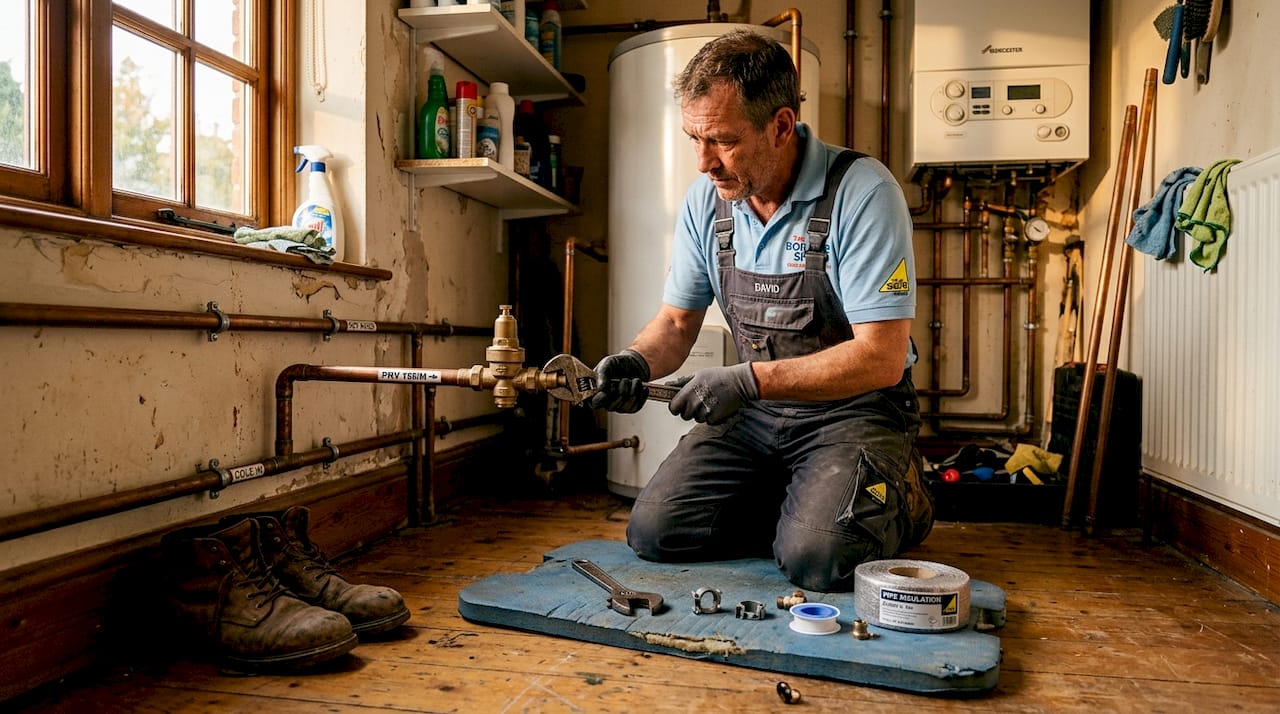
The primary tool for managing high pressure is a pressure reducing valve, commonly called a PRV. This is a small mechanical device fitted to your incoming water supply that automatically limits the pressure entering your home to a set level, typically around 2 to 3 bar. Once installed, it works passively without any input from you.
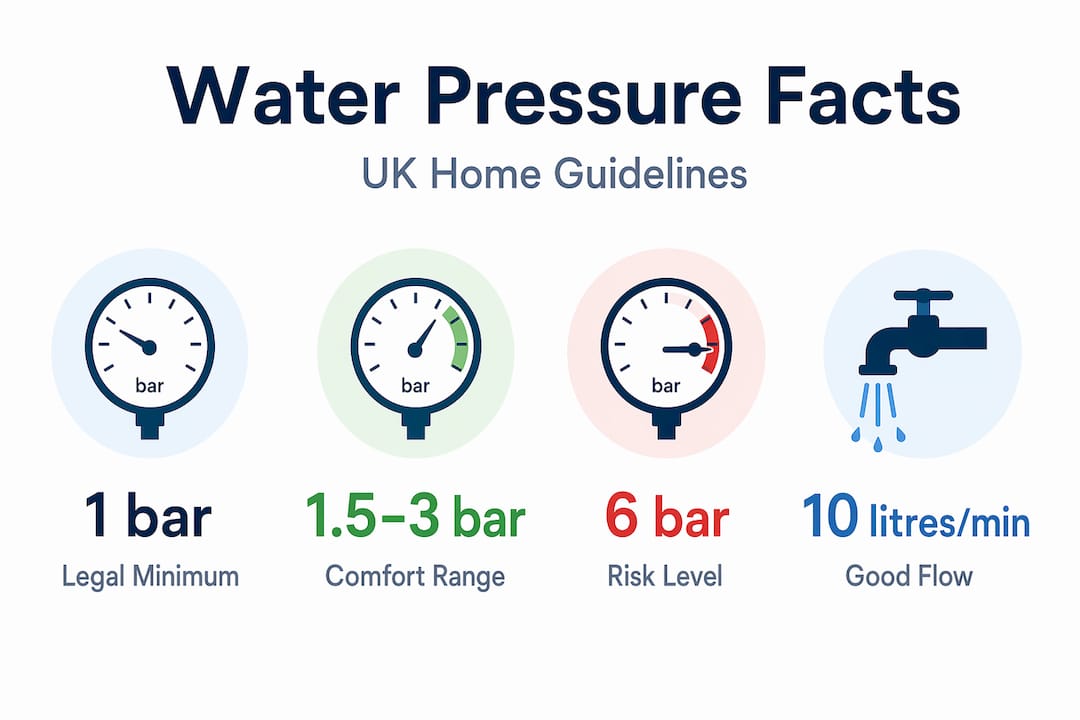
Comfortable home pressure in the UK sits between 1.5 and 3 bar, with flow rate also playing a role in how satisfactory your water supply feels day to day.
| Pressure level | Value | What it means for your home |
|---|---|---|
| Legal minimum supply | 1 bar | Minimum your supplier must deliver at boundary |
| Comfortable range | 1.5 to 3 bar | Suitable for most UK households |
| Legal fitting tolerance | 1.5x max pressure | Fittings must withstand this without failure |
| High pressure risk zone | Above 3 bar | Increases wear, leaks, and pipe stress |
For a fuller understanding of how these regulations apply to your property, the Water Fittings Regulations set out the legal requirements for all plumbing installations in the UK. You can also find practical guidance on UK plumbing regulations that applies directly to homeowners.
Pro Tip: If you live in a newer-build home or a property that has been recently renovated, there is a good chance a PRV has already been fitted. Check near your stopcock or where the supply pipe enters the property. It looks like a small brass dome or bell shape on the pipe.
How can homeowners monitor and manage water pressure effectively?
Understanding water pressure regulation in theory is only useful if you can act on it. Here is how to put it into practice.
Step 1: Test your pressure Attach a pressure gauge (available from most DIY stores for around £10 to £20) to an outside tap or your kitchen cold tap. Run the tap and read the gauge. A reading below 1 bar suggests a supply or internal restriction issue. Above 3 bar indicates you may need a PRV.
Step 2: Check your stop taps Before drawing any conclusions, confirm both your internal and external stop taps are fully open. Many low pressure issues are resolved simply by fully opening internal and external stop taps, something that gets overlooked surprisingly often.
Step 3: Test your flow rate Place a 4.5 litre bucket under your kitchen tap, close all other outlets, and time how long it takes to fill. Under 30 seconds is generally acceptable. Significantly longer suggests a restriction somewhere in your system.
Step 4: Identify symptoms Watch for these warning signs and what they typically indicate:
- Weak flow from all taps: Likely a supply issue or blocked filter
- Strong flow causing pipe vibration or banging: Pressure may be too high
- Inconsistent pressure: Could point to a failing PRV or shared supply problems
- Pressure fine at mains tap but poor upstairs: Gravity and pipe diameter reducing flow to upper floors
Step 5: Adjust or install a PRV If pressure is consistently too high, closing your internal stop tap slightly or having a PRV installed on your private pipework are both practical solutions. PRV installation is a job for a qualified plumber; it requires fitting to the mains supply pipe and setting to the correct pressure.
Step 6: Call a professional If your pressure gauge readings are within the normal range but your water still feels poor, or if you have tried the above steps without improvement, it is time to bring in a professional.
Staying on top of these checks is far easier with a plumbing maintenance checklist as part of your regular home routine.
Comparing water pressure regulation solutions for UK homes
Not every pressure problem requires the same solution. Here is a clear breakdown of the main options available to you.
Quick fixes worth trying first:
- Fully open all stop taps throughout the property
- Clean or replace tap aerators and showerhead filters (limescale build-up dramatically reduces flow)
- Check that appliance isolation valves (on dishwashers, washing machines) are open
- Flush and bleed any water filters fitted to the system
Longer-term regulation solutions:
| Solution | Typical cost | Best for | Maintenance needed | Effectiveness |
|---|---|---|---|---|
| Stop tap adjustment | Free | Temporarily high pressure | None | Low, not precise |
| PRV installation | £150 to £400 fitted | Consistently high pressure | Annual check | High, set-and-forget |
| Pipe replacement | £500+ | Old, corroded or narrow pipes | Long-term | High |
| Booster pump | £300 to £800 fitted | Persistent low pressure | Annual service | High for low pressure |
| Professional diagnosis | £75 to £150 | Unknown or complex issues | N/A | Definitive answer |
High pressure can be fixed by adjusting your stop tap or installing a PRV, but low pressure often requires more investigation. If your neighbours are experiencing similar issues, the problem likely sits with the network rather than your internal plumbing. For a detailed walkthrough of low pressure solutions, our low pressure guide covers the most reliable approaches.
Why understanding your home's water pressure regulation is key to lasting plumbing health
Here is something that does not get said often enough: most plumbing damage caused by pressure problems is entirely preventable, and most of it happens because homeowners do not think about pressure until something goes wrong.
The conversations we have with homeowners after a burst pipe or a failed appliance fitting often reveal the same pattern. They had been ignoring a knocking sound in the pipes for months, or they had noticed their boiler pressure gauge sitting high but assumed it was normal. Water pressure regulation is not a complex technical matter. It is a matter of attention.
The uncomfortable truth is that high water pressure is a slow, invisible threat. Unlike a leak, which gives you an obvious sign to act on, high pressure works quietly over years, gradually wearing out washers, degrading pipe joints, and stressing the seals on your boiler and appliances. By the time it causes a visible failure, the damage has been building for a long time.
Equally, low pressure is routinely blamed on the supplier when the cause is a partially open valve that the homeowner could fix in seconds. Treating your home's plumbing as something that only needs attention when it fails costs you more in the long run, both in emergency repair costs and in the reduced lifespan of expensive appliances.
The homeowners who avoid these issues share one habit: they check. They test pressure periodically, they know where their stop taps are, and they get small issues looked at before they become large ones. Water pressure regulation is not a one-time installation job. It is a continuous, low-effort responsibility that pays for itself many times over.
Get professional help to manage your home's water pressure effectively
If you have read this far and recognised some of the symptoms in your own home, acting sooner rather than later is always the wiser choice.

At Your Local Plumber, our experienced engineers carry out thorough pressure assessments, install and calibrate pressure reducing valves, and can identify whether your issue sits within your property or with the wider supply network. We work to UK plumbing regulations and offer transparent pricing with no surprises. Whether you are dealing with inconsistent pressure, worrying pipe noises, or simply want a professional check to confirm everything is in order, we are here to help. Early intervention consistently prevents costly emergency repairs down the line, and our local engineers can usually be with you quickly.
Frequently asked questions
What is considered normal water pressure in a UK home?
Normal water pressure ranges from 1 to 3 bar, with 1.5 to 3 bar being the comfortable range for most households and 1 bar as the legal minimum your supplier must deliver.
How can I check if my water pressure is too high or too low?
Use a pressure gauge from a DIY store, or estimate by timing how long it takes to fill a 4.5 litre bucket from your kitchen tap. The bucket should fill in under 30 seconds with all other outlets off.
Who is responsible for fixing water pressure problems in a UK home?
Suppliers are responsible up to your property boundary or external stop tap; all internal plumbing from that point onward is the homeowner's responsibility to maintain and repair.
What is the purpose of a pressure reducing valve (PRV)?
A PRV limits the water pressure entering your home to a safe, set level, protecting your pipes and appliances from damage. Installing a PRV is one of the most effective long-term solutions for homes experiencing consistently high pressure.
How often should I check or service my water pressure regulation systems?
Annual checks as part of your regular home maintenance are recommended, including testing pressure, inspecting stop taps, and having any PRVs serviced to ensure they are set correctly and functioning reliably.