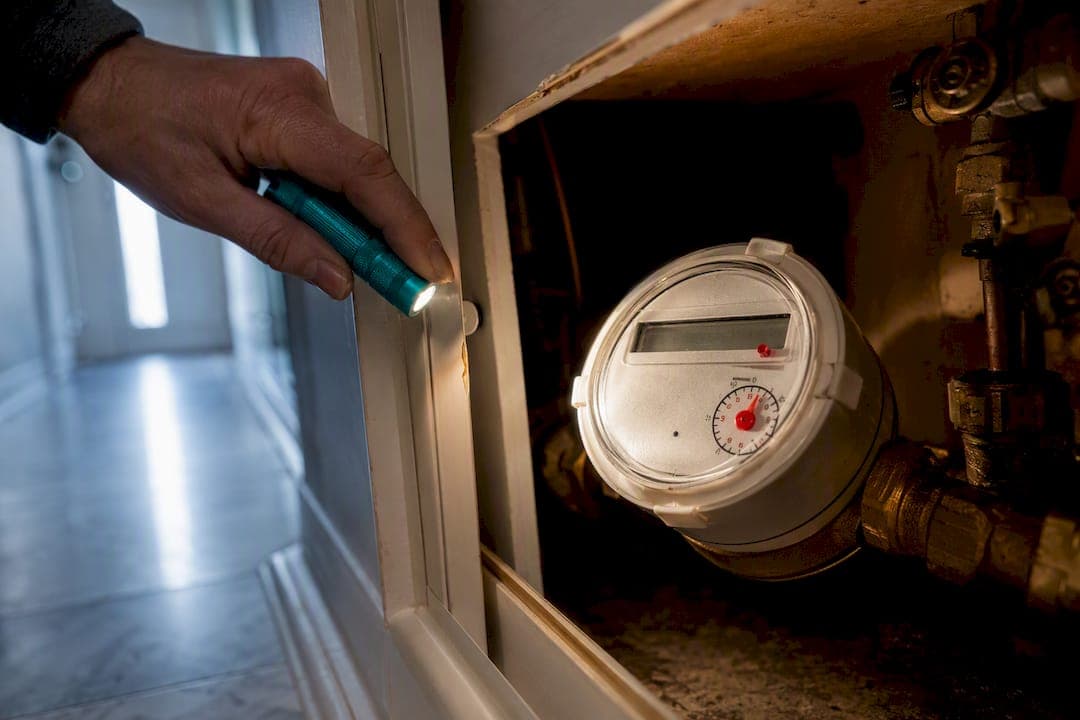
Yes, a water meter flow test will tell you whether you are losing water. Turn off every water-using appliance in the house, take a full meter reading, then wait at least 30 minutes before reading it again. If the numbers have moved and nobody has touched a tap, you have a leak. Close the internal stop tap and repeat the test to work out whether the problem sits inside your home or on the pipe bringing water in from the street.
TL;DR:
- A water meter flow test requires waiting 3 to 6 hours to reliably detect small or intermittent leaks.
- Moving red digits during the test strongly indicate a leak inside or outside your property, depending on whether the stop tap seals properly.
- If the meter only moves before the stop tap, the leak is likely inside your home; if it continues after shutting the tap, the leak is on the supply pipe outside.
- Single, short-duration tests can be misleading; repeating multiple tests over time provides a more accurate assessment of ongoing water loss.
- Professional leak surveys typically cost between £80 and £750, with insurance-grade options available for difficult or underground leaks.
Table of Contents
- What you need before starting the water meter leak test
- Step-by-step: how to test your water meter for a leak
- What your meter reading actually tells you
- What to do next once you've confirmed a leak
- What does leak detection cost in the UK?
- Common mistakes homeowners make with the flow test
- An honest take on the meter test method
- Book a leak survey or repair with Your-local-plumber
- Where to check official guidance
- Sources
- FAQ
What you need before starting the water meter leak test
Find your meter and your internal stop tap before you do anything else. The meter usually sits in a small chamber near the boundary of your property, under a plastic or metal cover, or inside a cupboard near the kitchen sink if it is an internal fitting. Never force open a heavy external cover with a screwdriver or lever. If it does not lift by hand, leave it and call a professional.
Most UK meters show two sets of digits: black (or white) numbers that count whole cubic metres, and red digits that show fractions of a cubic metre. The red digits matter most here, because a small drip will barely move the black numbers over a short test window but will creep steadily across the red dial.
- Locate the meter chamber and the internal stop tap, usually under the kitchen sink.
- Note both the black and red digits, along with the exact time.
- Switch off dishwashers, washing machines, outdoor taps, and any automatic irrigation or fish pond top-up systems.
- Give toilet cisterns time to finish refilling before you take your first reading.
Pro Tip: Check your stop tap turns freely a day or two before the test. A stiff or partially seized stop tap can give you a false reading later, so it's worth testing it in advance rather than discovering the problem mid-check.
Step-by-step: how to test your water meter for a leak
This mirrors the flow test method United Utilities and most other UK water companies recommend, with a few extra checks that catch the mistakes homeowners commonly make.
- Turn everything off. No taps, no washing machine, no dishwasher, no outdoor hose. Wait a few minutes for cisterns to stop refilling.
- Take your first reading. Write down every digit, black and red, and note the exact time. A phone photo of the dial is the easiest way to avoid transcription errors.
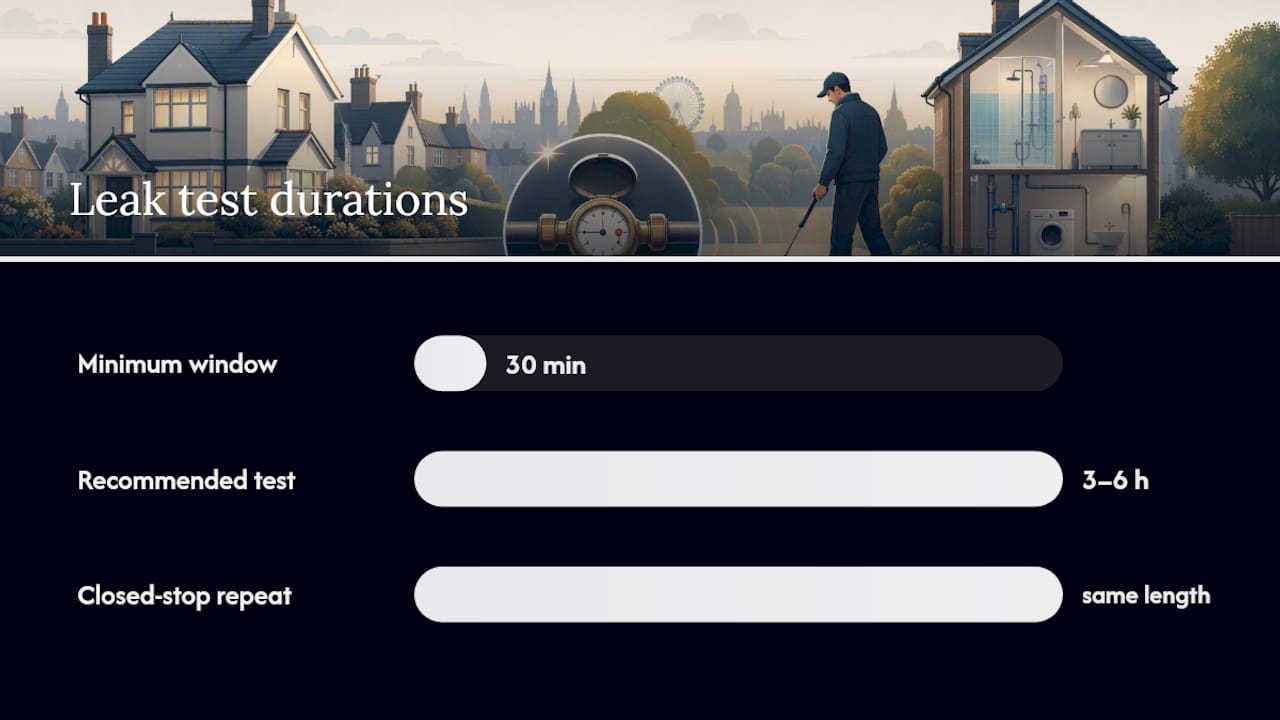
- Wait, then read again. Thirty minutes is the minimum window, but a small or intermittent leak will not always show up that quickly. Best practice is to leave it 3 to 6 hours, or overnight if you can manage without water for that long.
- Repeat with the stop tap closed. Shut the internal stop tap, wait the same length of time, and check the meter again. This isolates whether the leak is inside your property or on the supply pipe running to it.
Even a tiny, persistent leak, the kind that never quite justifies calling a plumber, can register as a slow, steady creep across the red decimal digits over several hours, while the black digits barely shift at all. That is exactly why a 30 minute check sometimes misses what a 6 hour check catches. Professional cost guides and utility engineers both point to longer test windows as the difference between a genuine all clear and a false negative.
If the red dial has moved at all during a period when nobody used a drop of water, treat that as a real signal, not a rounding error. Meters are built for accuracy, not noise.
What your meter reading actually tells you
No movement between readings usually means there is no significant leak, at least not one large enough to register over your test window. Movement means water went somewhere, and the second stage of the test tells you roughly where.
If the meter stops moving once you close the internal stop tap, the leak is inside your property, somewhere between the stop tap and your fittings. If it keeps moving with the stop tap fully closed, the leak is most likely on the supply pipe between the meter and your stop tap, which is still your responsibility to repair even though it sits outside the house, according to Ofwat.
There's a catch worth knowing before you trust that result completely. A stop tap that does not seal fully, common in older properties where it has not been turned in years, will let water through even when "closed," making an external leak look like it is continuing when it might not be. The Consumer Council for Water flags exactly this as a reason to treat a single test result with some caution.
- Damp patches on internal walls or under floors point to an internal leak.
- A soft or sunken patch of lawn, or unexplained pooling near the boundary, often points to a supply-pipe leak.
- A noticeable drop in water pressure at every tap can support either diagnosis.
- A toilet that runs intermittently without being flushed can throw off your first reading if you miss it.
Pro Tip: If your stop tap feels loose or won't turn fully, test it twice with a five-minute gap. If the meter behaves differently each time, the tap itself is the problem, not necessarily the pipework.
What to do next once you've confirmed a leak
If the leak is inside your property, book a qualified plumber. Keep every photo of the affected area, the dated meter readings from your test, and the eventual invoice together, since insurers and water companies both tend to ask for exactly this kind of paper trail.
If the leak sits on the supply pipe, contact your water company directly. Many will offer some assistance locating a leak that does not require excavation, though policies vary, so it is worth asking outright rather than assuming. Keep a log of readings and timestamps regardless of what they say.
Before booking anything invasive or expensive, check your buildings insurance for trace-and-access cover, which often pays for locating a hidden leak and making good the access, even if it does not cover the pipe repair itself.
- Photograph any visible damage, damp patches, or ground disturbance.
- Record at least two meter readings, spaced apart, with timestamps.
- Keep the plumber's invoice and any written correspondence with your water company.
- Ask your water company about a leak allowance if the leak pushed your bill up unexpectedly, since companies commonly ask for proof the fault has been fixed before applying one.
What does leak detection cost in the UK?
A DIY meter test costs nothing, which is exactly why it is worth doing before you book anyone. Paid leak detection only makes sense once your own test has given you a clear signal of ongoing water loss, or your insurer requires a professional report.
Prices vary depending on the method. According to Checkatrade, a short attendance with acoustic listening equipment typically runs from around £80 to £250, while a fuller domestic survey often costs between £250 and £750. Insurance-grade surveys, which usually combine acoustic correlation with thermal imaging or tracer gas for buried, silent leaks, tend to run from £500 up to £1,600 or more, excluding any repair work.
- Acoustic listening is usually the first tool a professional reaches for.
- Thermal imaging maps moisture without digging.
- Tracer gas is typically reserved for stubborn, hard-to-locate leaks underground.
A survey is worth the cost once you have meter evidence of an ongoing loss, visible damage that needs pinning down, or an insurer asking for documented proof before they will act.
Common mistakes homeowners make with the flow test
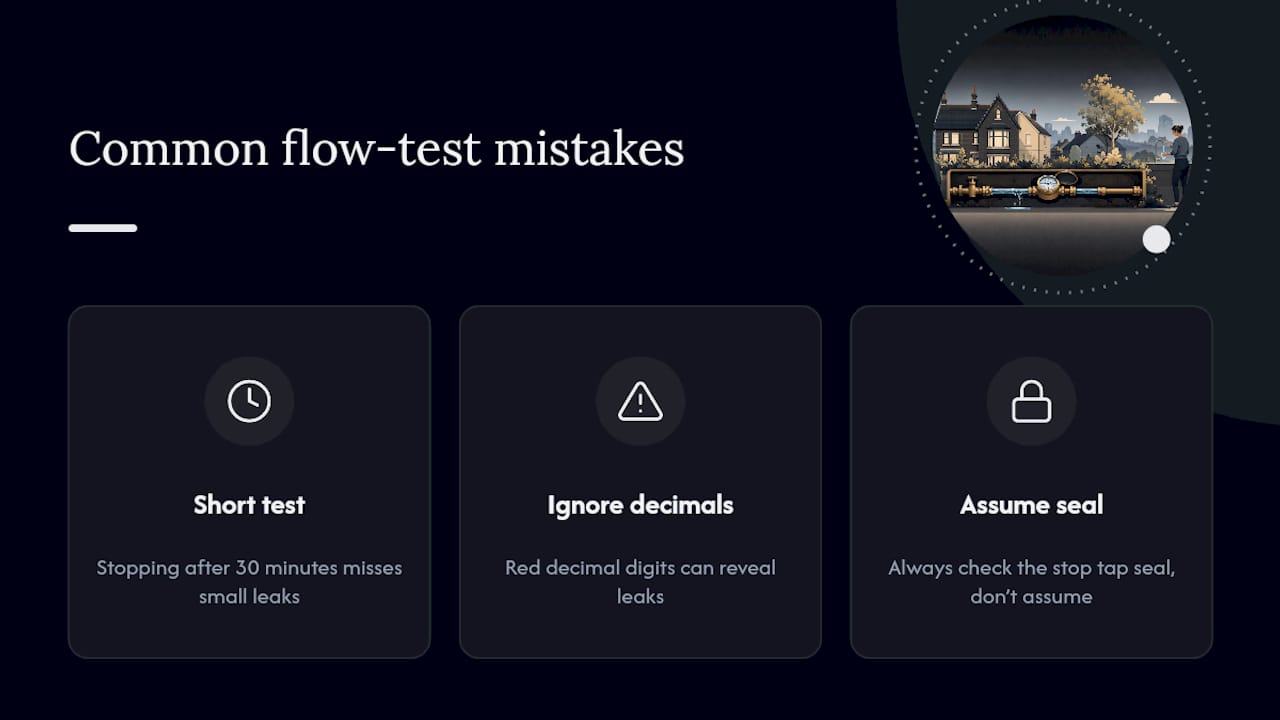
The three mistakes that trip people up most: stopping the test after 30 minutes when a small leak needed hours to show, ignoring the red decimal digits entirely, and assuming the stop tap has sealed properly without checking it. Any one of these can send you down the wrong path.
When a plumber arrives, they will usually retest with the same method first, then move to acoustic listening if your own check was inconclusive, since specialist equipment can isolate a leak faster than a second manual reading ever will. Bring your original readings, timestamps, and any photos of damp patches or pressure changes. For more on spotting problems before they escalate, see our guide on signs of hidden leaks.
An honest take on the meter test method
The water-company flow test is sound, but it gets treated as more definitive than it really is. A single 30 minute check, done once, tells you far less than the same test run three times across a week, at different times of day. Slow leaks are inconsistent. A stop tap that seems to seal on Tuesday might not seal the same way on Saturday if the fault is intermittent, and that single result is what too many homeowners take to their water company as proof.
The bigger gap in the conventional advice is what happens after a positive result. Most guidance stops at "you have a leak," when the real work is building a case: readings over time, not a single snapshot, photographs before anything gets disturbed, and an invoice that explicitly mentions trace and access if you want an insurer to engage with a claim. Water companies and insurers respond to paper trails, not verbal assurances.
If you take one thing from this, take the discipline of repeating the test properly before you spend money on anything else. It costs nothing and it is the single best filter for deciding whether you need a £150 attendance fee or a £1,000 insurance-grade survey.
— Michael
Book a leak survey or repair with Your-local-plumber
A local plumbing service is the practical next step once your own meter test has pointed to a genuine leak, whether that turns out to be inside your walls or on the supply pipe outside. Experienced engineers can carry out leak detection and repair work with transparent, fixed pricing agreed before anything starts, and cover both emergency call outs and scheduled visits.

Booking is straightforward: describe what your meter test showed, including your readings and timestamps, and an engineer can advise whether you need a full survey or can move straight to repair. If your case involves a possible insurance claim, keeping that documentation ready speeds up both the visit and any trace-and-access paperwork your insurer asks for afterwards. For homes already fitted with smart monitoring, a device from a partner like Pure Wave Water can flag unusual flow patterns automatically between manual checks. Get in touch with Your-local-plumber to arrange a visit and a fixed quote.
Where to check official guidance
Ofwat sets out pipe responsibility; your water company's own site gives step-by-step test instructions; Checkatrade publishes current cost ranges; CCW covers consumer rights on leak allowances.
Sources
- What is the Cost of Water Leak Detection in 2026? | Checkatrade
- Responsibility for pipes and pumping stations - Ofwat
- Perform a leak test | United Utilities
- Consumer Council for Water (CCW) guidance on private supply leaks
FAQ
Who is responsible for a leak on a water meter?
Water companies are responsible for the water main and the communication pipe up to your boundary; you are responsible for the supply pipe and plumbing within your property, according to Ofwat.
How do I tell if my water meter is leaking?
Run a flow test: turn off all water use, record the meter reading, wait at least 30 minutes (longer is better), then check again. Any movement on the red digits with no water used points to a leak.
How much does water leak detection cost in the UK?
Short attendance with acoustic equipment typically costs £80 to £250, fuller domestic surveys run £250 to £750, and insurance-grade surveys with thermal imaging or tracer gas can reach £500 to £1,600 or more, per Checkatrade.
Why does my water meter appear to move even though there's no leak?
This is often a faulty or partially open stop tap letting water through despite being "closed," or a toilet cistern still refilling when you took your first reading. Test the stop tap separately before trusting the result.