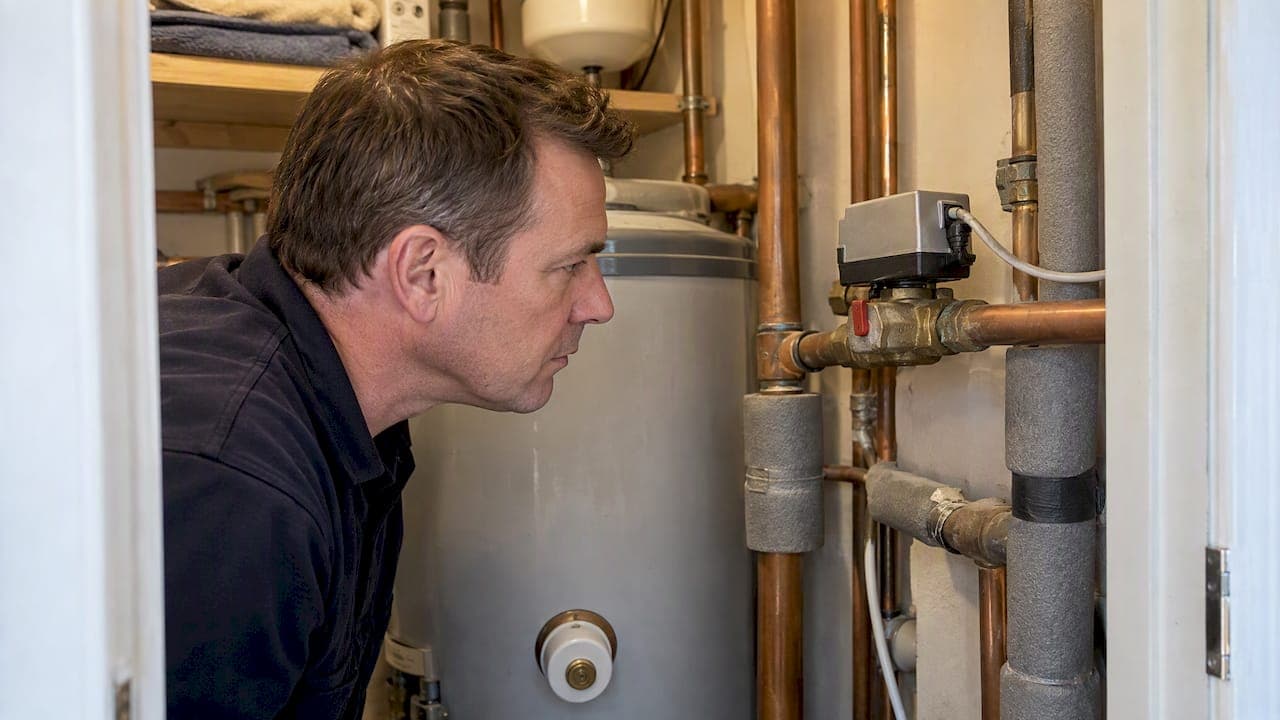
Often you can rule out simple faults in ten minutes by checking the programmer, the thermostat call and the valve's manual lever. If the valve head has power but will not move, the powerhead or gear train has likely failed and needs replacing. Anything beyond that, including electrical work, draining the system or fitting a new valve, calls for a Gas Safe registered engineer.
TL;DR:
- Verify the programmer is on, set the thermostat above room temperature, and return the manual lever to AUTO after any brief test.
- Continuous heat without a demand suggests a stuck open valve, while a cold zone with the pump running elsewhere suggests a stuck closed valve.
- A powered valve head that stays still usually needs a replacement powerhead; a damaged valve body or seals can require full replacement and system draining.
- Call out charges often range from £45 to £150 before parts and labour; request a breakdown, and never force the lever or bridge 24V wiring.
Table of Contents
- Three quick checks to do in 10 minutes
- How motorised zone valves and their actuators work
- Step-by-step safe troubleshooting you can try at home
- Symptoms that show whether the valve is stuck open or closed
- When the valve must be replaced and what to expect from a pro
- Practical tips from our engineer Michael
- Balancing DIY fixes with long-term reliability
- How we can help with a stuck zone valve
- FAQ
- Sources
Three quick checks to do in 10 minutes
Before assuming the worst, rule out the easy stuff. Most "stuck valve" calls turn out to be something simpler further up the chain.
- Confirm the system is actually calling for heat: check your programmer is on and set correctly, and that the room thermostat is set above the current room temperature.
- Check the manual lever position: it should normally sit in "AUTO", not "MAN. OPEN". Nudge it gently to see whether the valve responds at all.
- Look, don't touch, for damage: scorch marks, melted plastic or broken clips on the valve head point to a burned-out motor. Switch off and isolate power before examining it more closely.
If all three check out and the valve still will not move, you are likely dealing with an internal fault rather than a wiring or control issue.
How motorised zone valves and their actuators work
A motorised zone valve controls flow to a heating or hot water circuit using a small electric powerhead mounted on top of a valve body. Depending on the design, the valve is either normally closed or normally open when de-energised, and the powerhead drives it the other way when the system calls for heat. The manual lever lets an installer move the valve by hand, and "AUTO" hands control back to the motor, while "MAN. OPEN" forces the valve open for filling or draining, as Resideo's V4043 documentation explains. Inside the powerhead, a small gear train drives the valve stem, and an auxiliary switch often signals the circulator pump to start once the valve is fully open. Cramped installation with poor airflow around the valve head can cause it to overheat and fail early.

Step-by-step safe troubleshooting you can try at home
Work through this in order, and stop at the first point where you are not confident.
- Confirm a genuine call for heat: raise the thermostat or programmer and listen for the boiler firing and the pump starting elsewhere in the system.
- Check for power at the valve head, carefully: isolate electrical power first. Only remove the cover if you are comfortable doing so, and look for loose or scorched wiring connections. Stop here if anything looks uncertain.
- Test the manual lever properly: move it to "MAN. OPEN" briefly to see whether the valve moves freely, then return it to "AUTO" before restoring power. Manufacturer guidance is clear that "MAN. OPEN" is for commissioning and draining only, not everyday operation.
- Listen and feel for the motor working: a healthy actuator moves smoothly and fairly quietly. Grinding, buzzing without movement, or complete silence under power suggests internal failure.
- Know your stop-points: if fixing the fault means draining the system, soldering pipework or making permanent wiring changes, that is where DIY ends and a professional call begins.
You will need a small screwdriver, a torch and a voltage tester if you are comfortable using one. Never force the manual lever if it resists, and never bridge or jumper the 24V coil terminals to test the valve, since this can damage thermostat components rather than diagnose anything useful, according to Resideo's technical literature.
Pro Tip: Always return the manual lever to "AUTO" before you restore power, even if the valve seemed fine in "MAN. OPEN": leaving it in the manual position keeps the auxiliary switch de-energised and stops the system working normally.
Symptoms that show whether the valve is stuck open or closed
A valve stuck open usually shows up as continuous heating or hot water even when nothing is calling for it. To test, turn the thermostat below room temperature and feel the pipe leaving the valve a few minutes later: if it stays hot, the valve has not closed.
A valve stuck closed does the opposite: the affected zone gets no heat or hot water at all. Call for heat and watch whether the pump runs elsewhere in the system while the valve head stays still and the pipework remains cold.

The auxiliary switch is a useful clue too. If it never trips to start the pump, the valve head genuinely is not completing its travel, which usually points to a mechanical fault rather than a thermostat problem.
When the valve must be replaced and what to expect from a pro
Once you have ruled out the easy fixes, the remaining options sit with a qualified engineer rather than a screwdriver.
- Powerhead replacement is usually tried first, since the motor and gears are the most common failure point.
- Full valve replacement becomes necessary if the valve body, seals or gear train have failed, according to Resideo's technical guidance.
- Draining the system is often required for either repair, which is why this job typically needs a registered engineer rather than a DIY attempt.
Call-out charges for home repairs commonly range from around £45 to £150 depending on your area and the trader, before parts and labour are added, as Which? reports. Ask for a breakdown of call-out, parts and labour before work starts, and check whether a warranty covers the new part. For a wider view of what typical heating repairs cost and how to avoid inflated emergency pricing, see our guide to central heating repair costs.
Practical tips from our engineer Michael
Michael's rule from years on heating call-outs: never leave the manual lever in "MAN. OPEN" once you have finished testing, it must go back to "AUTO" before power is restored, or the zone simply will not behave correctly afterwards. The two mistakes he sees most often are homeowners forcing a stiff lever past resistance, which can shear the mechanism, and attempting to jumper 24V wiring to "test" the valve, which risks damaging the thermostat circuit rather than revealing anything useful.
Balancing DIY fixes with long-term reliability
Quick checks are genuinely useful for ruling out the cheap, common causes, a dead thermostat battery or a lever left in the wrong position costs you nothing to check. But long-term reliability depends on the right part fitted correctly, not a workaround. Annual servicing by a Gas Safe registered engineer catches a sticking valve or a tired powerhead before it fails at the worst moment, and tends to mean fewer emergency call-outs over the life of the system, a point Which?'s servicing guidance also makes. If you want more on what a service actually covers, our guide to boiler servicing sets it out in plain terms, and our Heating Product Calculator | Sydney Underfloor Heating helps plan underfloor heating systems effectively in your home.
— Michael
How we can help with a stuck zone valve

When a zone valve turns out to need a new powerhead or a full replacement, we offer an emergency heating engineer service with no call-out fee, and payment only once the work is done. There is no long wait for a quote once an engineer is on site. Before booking, have your boiler make and model to hand, along with a note of what you have already tried, the lever position, any power checks, the symptoms you noticed. You can book an emergency heating repair online or by phone, with fixed, transparent pricing agreed before work starts.
FAQ
How do I unstick a zone valve?
Start by checking the programmer and thermostat are genuinely calling for heat, then check the manual lever sits in "AUTO" rather than "MAN. OPEN". If the valve head has power but still will not move, the internal gear train or motor has likely failed and needs a replacement powerhead rather than further forcing.
Can I manually turn off a zone valve?
Most zone valves have a manual lever that can force the valve open for filling or draining, but this is a commissioning function rather than a normal on/off control, according to manufacturer guidance. It must be returned to "AUTO" afterwards, or the valve will not respond to the thermostat as it should.
Should steam radiator valves be fully open?
Steam system valves work differently from motorised zone valves on wet central heating systems, and the correct setting depends on the specific valve and system design rather than a single rule. If you are unsure how a particular radiator valve should be set, it is worth asking a qualified heating engineer rather than guessing.
How do I bypass a stuck heater control valve?
Bypassing a faulty valve is not a safe permanent fix. Attempting to jumper the 24V coil wiring can damage thermostat components rather than solve the fault, so the reliable route is replacing the powerhead or valve body through a registered engineer.
What does it cost to fix a stuck zone valve?
Costs vary by job, but call-out charges for home heating repairs commonly fall between around £45 and £150, with parts and labour added on top, as Which? notes. Getting a breakdown of call-out, parts and labour before work begins makes quotes easier to compare.