Most UK homeowners pay between £120 and £750 for a central heating repair, with the average job landing around £300. Emergency call outs push that closer to £225–£675. The single best move once something breaks is to book a Gas Safe diagnostic and insist on an itemised quote before any work starts.
TL;DR:
- Most UK homeowners pay between £120 and £750 for boiler repairs, with emergency callouts averaging around £400 to £450.
- Diagnostic fees typically range from £60 to £120 and are often deducted from the final bill if you proceed with the repair.
- Repairs for minor faults, such as faulty thermostats or frozen condensate pipes, usually cost between £120 and £220, while major component replacements like heat exchangers can exceed £800.
- Always ask for an itemised quote, verify Gas Safe registration, and check whether VAT is included to avoid overpaying.
Table of Contents
- Central heating repair cost at a glance
- Typical repair costs by fault and component
- Boiler repairs versus wider central heating system problems
- What actually moves your final bill up or down
- How to hire a Gas Safe engineer and get a fair quote
- Repair or replace: a practical decision checklist
- Cutting your future repair bills through servicing
- How Your-local-plumber handles diagnostics and quoting
- What homeowners get wrong most often
- Book a straightforward, itemised repair with Your-local-plumber
- Sources
- FAQ
Central heating repair cost at a glance
Before you pick up the phone, it helps to know what "normal" looks like. The figures below cover boiler repairs specifically, which is where most call outs land, though system faults like sludge or leaks carry their own separate ranges covered later.
Average heating repair cost across the UK sits around £300, but that average hides a wide spread. A stuck thermostat costs nothing like a failed heat exchanger, and a same-day emergency callout costs nothing like a repair booked a week in advance.
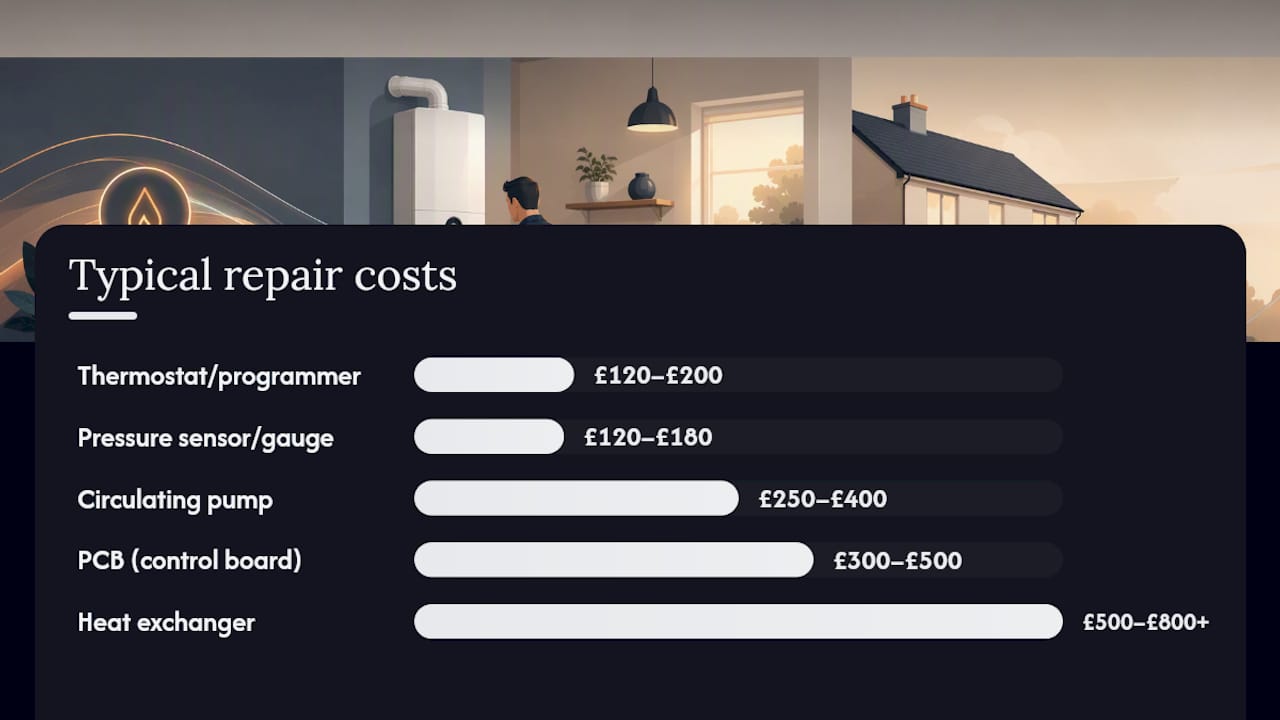
- Scheduled repair (weekday, booked in advance): roughly £120–£600 depending on the fault
- Emergency or out-of-hours repair: typically £225–£675, sometimes higher
- Standard call-out/diagnostic fee: £60–£120, charged before any parts or labour
- Diagnostic fee if you proceed with the repair: often deducted from the final bill
In numbers: the average UK boiler repair costs around £300, with most jobs falling between £120 and £750, and emergency repairs averaging closer to £450.
That last bullet matters more than most homeowners realise. Plenty of engineers will knock the diagnostic fee off your bill if you go ahead with the repair there and then, but it's rarely advertised. Ask before the engineer even opens their toolbox, because assuming it's included can turn a £280 job into a £340 one for no good reason.
Boiler repair costs also vary depending on whether you're dealing with a Gas Safe registered engineer working independently or a national provider with call-centre overheads baked into the price. Independent engineers tend to sit at the lower end of these ranges, partly because they're not carrying the same fleet and marketing costs as the bigger firms.
None of these figures include VAT, which most tradespeople add at 20% unless they're operating below the VAT threshold. Always ask whether a quote is VAT inclusive before comparing it against another one, because a "cheaper" quote that excludes VAT can flip to being the more expensive option once you add it back on.
Typical repair costs by fault and component
Not all boiler faults cost the same, and knowing the rough band for your specific problem is the fastest way to spot a quote that's out of line. Central heating repair prices generally split into three tiers based on how complex the part is and how long it takes to fit.
Minor faults (£120–£250)
These are the quickest, cheapest jobs, usually finished within an hour once the engineer arrives.
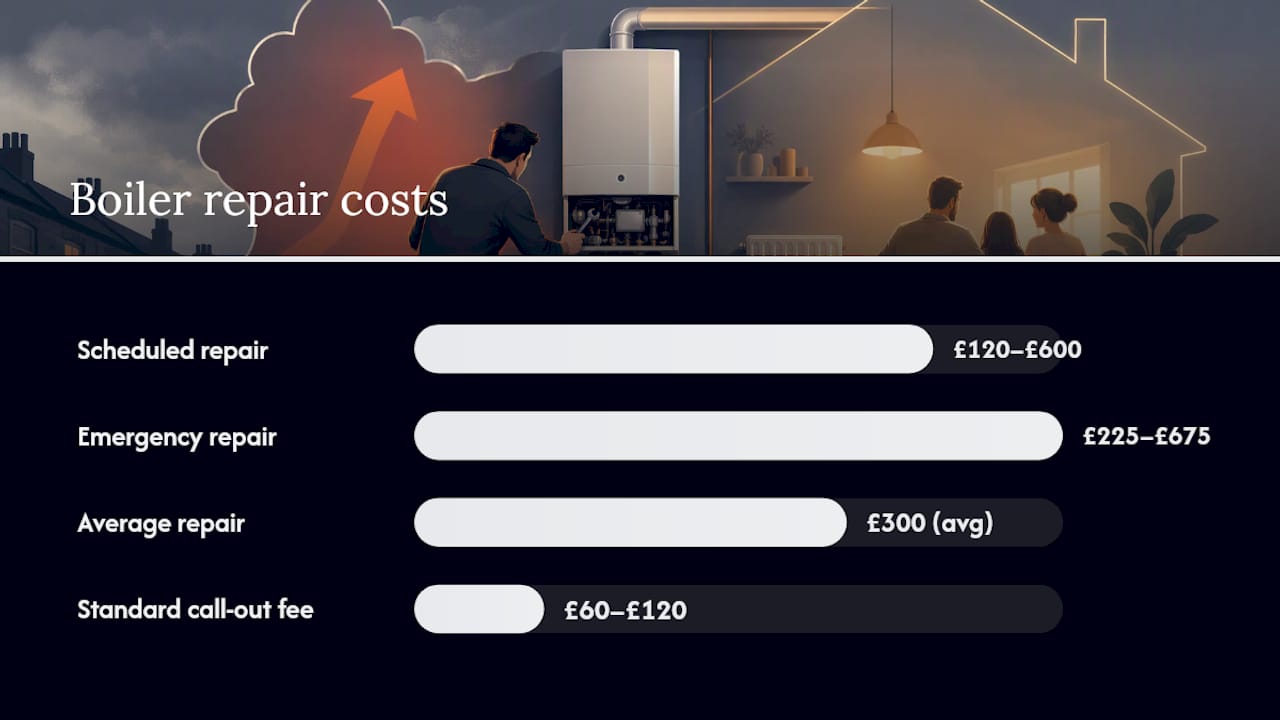
- Faulty thermostat or programmer: £120–£200
- Pressure sensor or gauge fault: £120–£180
- Blocked or frozen condensate pipe: £120–£220
- Minor airlock or bleed issue: £100–£150
Condensate blockages spike every winter when the outside pipe freezes solid. It's one of the cheapest fixes on this list, and one that plenty of homeowners could resolve themselves with a jug of warm water before ever calling an engineer.
Mid-range parts (£250–£500)
This band covers moving parts that see constant wear, so replacement is fairly routine work for any competent engineer.
- Circulating pump replacement: £250–£400
- Diverter valve replacement: £280–£450
- Fan replacement: £250–£400
- Printed circuit board (PCB) replacement: £300–£500
According to Costwise's 2026 cost calculator, these mid-tier parts make up the bulk of everyday boiler repair callouts, because pumps and diverter valves simply wear out faster than the boiler's casing or heat exchanger.
Major components (£500–£800+)
Once you're looking at these parts, it's worth pausing to think about the age of the boiler before committing.
- Heat exchanger replacement: £500–£800+
- Gas valve replacement: £450–£700
- Full control board and wiring fault diagnosis: £400–£650
A heat exchanger repair on a boiler that's already ten years old is the point where most engineers will gently suggest you compare that bill against a new boiler installation instead. It's not a hard rule, but when a single part costs more than half of what a new entry-level boiler would cost fitted, replacement usually wins on value.
On the labour side, expect roughly £60–£90 per hour for a Gas Safe registered engineer, with most straightforward jobs taking one to two hours once the fault has been diagnosed. Parts and labour aren't always itemised separately on smaller jobs, but you're entitled to ask for that breakdown, and any reputable engineer will give it to you without hesitation.
Boiler repairs versus wider central heating system problems
Not every heating complaint is a boiler fault. Sometimes the boiler is working fine and the problem sits somewhere in the pipework, radiators, or the water circulating through them, and that distinction changes both the diagnosis and the bill.
Cold patches at the bottom of radiators, radiators that need bleeding constantly, or a kettling, banging noise from the boiler when it fires up are the classic signs of sludge building up in the system. Left unaddressed, sludge accelerates wear on the pump and heat exchanger, which is exactly how a cheap system problem turns into an expensive boiler one.
A power flush is the usual fix, and it typically costs £400–£800 depending on how many radiators the system has and how badly it's clogged. It's not a job you'll need often. A well-maintained system with an inhibitor added at each service might go a decade without needing one.
Leak detection and repair is the other common system issue, and it's genuinely one of the hardest jobs to price upfront. A leak behind a wall or under floorboards means the engineer is charging for access work as much as the repair itself, so costs here swing widely from £100 for a visible joint fix to several hundred pounds when floors need lifting.
- Check radiators for cold spots before calling anyone, since that tells the engineer where sludge is settling
- Note the boiler pressure gauge reading, ideally between 1 and 1.5 bar when cold
- Listen for banging or gurgling when the heating first fires up
- Check for damp patches, staining, or a musty smell near pipework, which often points to a slow leak
Pro Tip: Bleed your radiators from the top of the system downward, not randomly. Sludge and air both rise, so working top to bottom stops you chasing the same air pocket twice.
If you've done these checks and the boiler itself is firing, heating water, and displaying no fault code, you're very likely looking at a system issue rather than a boiler repair, which is worth telling the engineer upfront so they bring the right kit.
What actually moves your final bill up or down
Two homeowners with the same broken pump can get quotes £150 apart, and it usually comes down to a handful of practical factors rather than one engineer simply being dearer.
Age and warranty status matter more than most people expect. A boiler still under manufacturer warranty, typically five to ten years for newer models, might mean the part is free and you're only paying labour. Once that warranty has lapsed, you're covering everything.
Access and installation quirks drive labour time up fast. A boiler tucked into a tight airing cupboard, or one where the flue runs through an awkward loft space, takes longer to work on than one mounted on an open wall, and engineers price that time in.
Brand and model affect parts pricing directly. Common brands with widely stocked parts tend to be cheaper and quicker to repair than less common imports, where an engineer might need to order a part and wait days for it.
- Regional pricing varies, with London running roughly 20% above the UK average in most cost guides
- VAT at 20% applies on top of most quotes unless stated otherwise
- Waste disposal charges sometimes apply when old parts need removing
- Out-of-hours and weekend work commonly adds £60–£150 to the base price
That last point is worth sitting with. A fault that seems urgent at 9pm on a Friday is often exactly the same job on Monday morning at a lower price, so it's worth asking yourself honestly whether you're facing a true emergency or just an inconvenient time.
How to hire a Gas Safe engineer and get a fair quote
Getting a fair price starts before the engineer even walks through your door. Follow these steps and you'll dramatically cut your odds of overpaying.
- Check the Gas Safe register. Every engineer working on a gas boiler must be Gas Safe registered by law, and you can verify their ID card number on the official Gas Safe Register before booking. Ask to see the physical card on arrival too.
- Request a written, itemised quote. It should break down the call-out or diagnostic fee, parts, labour, and VAT separately, not lump everything into one number.
- Get three quotes for anything beyond a minor fix. For jobs over roughly £250, comparing three written quotes line by line is the single best way to spot an outlier.
- Ask directly whether the diagnostic fee is deducted if you go ahead with the repair. Some engineers do this automatically; others need asking.
- Watch for red flags. A vague verbal quote with no breakdown, pressure to agree to a full replacement before a proper diagnosis, or reluctance to show Gas Safe ID are all reasons to walk away.
Pro Tip: Photograph the boiler's data plate (usually inside the front panel) before calling anyone. Having the exact model number ready speeds up quoting and stops an engineer overestimating parts costs "just in case."
If a company is reluctant to put anything in writing, that alone tells you most of what you need to know about how the rest of the job will go.
Repair or replace: a practical decision checklist
Here's how that plays out with real numbers. Say your boiler is eleven years old and needs a heat exchanger, quoted at £750. A new boiler installation, including labour, typically runs £2,000–£3,500. That £750 repair sits at roughly 30% of the low end of a replacement, right on the threshold, and it's on a boiler already near the end of its expected lifespan.
- Repairs under 20% of replacement cost, on a boiler under eight years old: repair, don't replace
- Repairs above 40% of replacement cost, or a boiler over twelve years old: replacement usually wins
- Anywhere in between: weigh efficiency gains and how many more faults you've already had this year
Cost comparison: a £750 heat exchanger repair on an eleven-year-old boiler versus a £2,800 replacement means the repair only "wins" if the boiler then runs fault-free for at least three to four more years. One more £400 repair within that window and replacement would have been cheaper overall.
Timelines differ sharply too. A straightforward repair is usually diagnosed and fixed within a single visit, sometimes two if parts need ordering. A full replacement, from quote to completed installation, typically takes one to three days once booked, though scheduling can add a week or two during winter's peak demand. Boiler efficiency also improves noticeably with a new unit, which is worth factoring into any close call.
Cutting your future repair bills through servicing
Most expensive breakdowns don't come out of nowhere. They're the result of a system that hasn't been serviced, hasn't had its pressure checked, or has been quietly building sludge for years.
An annual service from an independent Gas Safe engineer typically costs £60–£100, while national homecare plans often charge considerably more for broadly the same inspection, sometimes bundled with call-out cover you may never use. If your boiler is still under manufacturer warranty, check what that warranty actually requires. Some manufacturers insist on an annual service to keep the warranty valid, which makes skipping it a false economy even if the boiler seems fine.
- Book a service every 12 months, ideally before the heating season starts in autumn
- Bleed radiators showing cold spots at the top
- Check the pressure gauge monthly and top up if it drops below 1 bar
- Locate your condensate pipe now, before it freezes in January
Pro Tip: Set aside £300–£500 in a dedicated repair fund rather than relying on a homecare plan you might rarely use. It usually works out cheaper over a five-year stretch, and you keep the flexibility to choose your own engineer.
How Your-local-plumber handles diagnostics and quoting
Every job starts the same way at Your-local-plumber: a proper diagnostic visit, not a guess over the phone. Engineers arrive Gas Safe registered, with ID ready to show before they touch anything, and the diagnostic fee is deducted from your final bill if you go ahead with the repair on the spot.
Quotes are itemised before work begins, splitting out call-out, parts, and labour, so you know exactly what you're paying for and why. A typical minor job, say a pressure sensor fault, might bill out as a £70 diagnostic (waived on proceeding), a £45 part, and £110 labour, giving a total around £155, well within the ranges covered above.
Safety and Gas Safe compliance sit at the centre of every visit, because a heating system is not somewhere to cut corners for the sake of a cheaper quote.
What homeowners get wrong most often
The biggest mistake I see is treating every cold radiator as an emergency. A boiler that's still firing, with hot water elsewhere in the house, can usually wait until the following morning, and that alone can save you well over £100 in out-of-hours charges.
The second is accepting a verbal quote with no breakdown, then feeling stuck once the bill arrives higher than expected. Ask for the itemised version every time, even for a job that sounds simple.
Keep £300–£500 set aside for heating emergencies if you can. Before booking anyone, check their Gas Safe ID, get the quote in writing, and confirm whether the diagnostic fee gets deducted. Those three habits solve most of the overpaying problems homeowners run into.
— Michael
Book a straightforward, itemised repair with Your-local-plumber
Gas Safe registered engineers typically provide a diagnostic visit and an itemised quote before any work begins, helping customers understand expected costs.

Diagnostic fees may be deducted from the final bill if you proceed with the repair, and pricing on parts and labour is often itemised rather than bundled. If a dispute ever arises over a warranty claim on a part, tools like PostRight's warranty claim letter template can help you put the request in writing properly. Whether it's a stuck thermostat, a failed pump, or a full system that's due for replacement, the same transparent process applies from first call to finished job. Get in touch through the Your-local-plumber website to book a diagnostic visit and request your itemised quote before winter puts more pressure on an already tired system.
Sources
The cost ranges throughout this guide are drawn from established UK cost-tracking sites and industry pricing calculators, cross-checked against typical parts and labour bands reported by Gas Safe registered engineers.
- Boiler Repair Costs in the UK in 2026 | Common Faults & ...
- Boiler repair cost calculator UK 2026 | Costwise
- Boiler Service Cost 2026 - What You Should Pay | Less
- Central heating installation costs (MyJobQuote) - 2026
FAQ
How much does it cost to service a central heating system?
A standard annual service from an independent Gas Safe engineer typically costs £60–£100, while national homecare plans often charge more for similar cover.
How much does British Gas charge for boiler repair?
National providers generally sit at the higher end of the market compared with independent Gas Safe engineers, though exact pricing depends on your specific fault and cover plan, so always request a written quote before booking.
Is replacing a boiler a big job?
A full boiler replacement typically takes one to three days from quote to completion, and most installations don't require major structural work unless you're relocating the boiler or upgrading the flue.
How much does it cost to replace a central heating system in the UK?
A full central heating system replacement typically costs £3,500–£6,000 depending on property size and region, while replacing just the boiler usually runs £2,000–£3,500.
Should I pay a diagnostic fee even if I don't proceed with the repair?
Yes, most Gas Safe engineers charge £60–£120 for the diagnostic visit itself, though many will deduct this from your final bill if you go ahead with the repair on the spot.