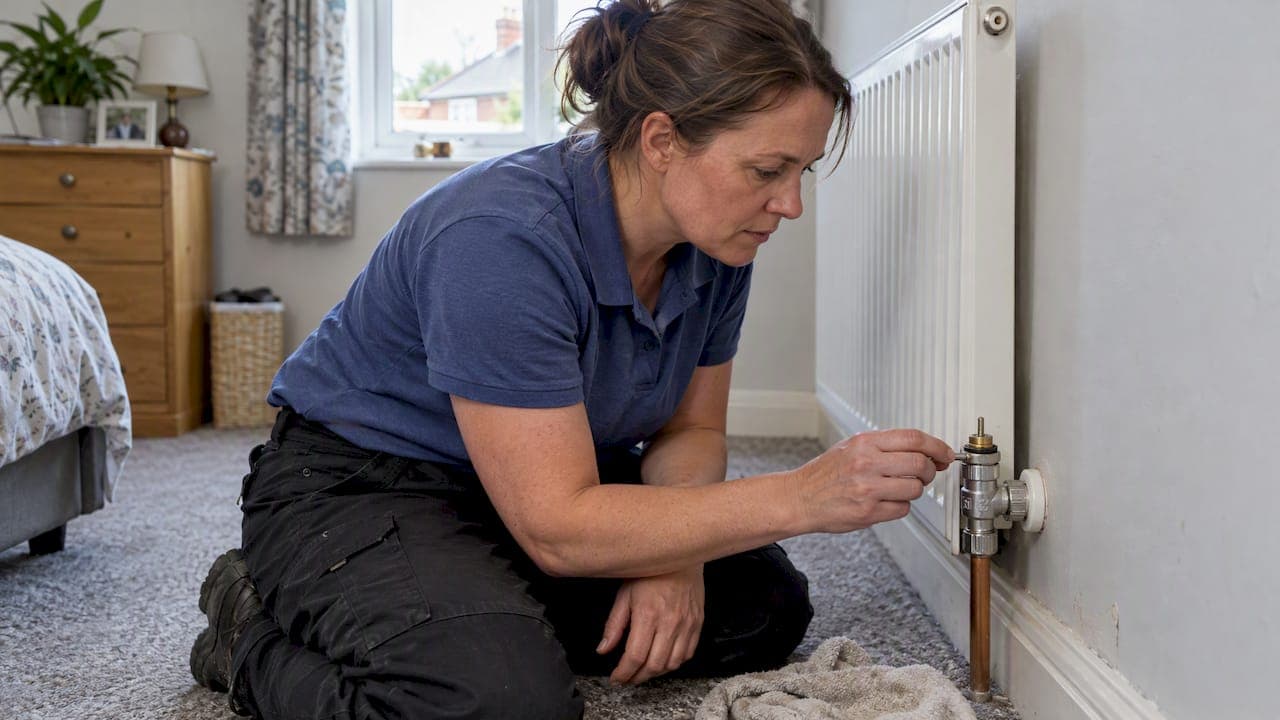
If your thermostat is calling for heat but one radiator stays cold, a thermostatic radiator valve pin is often stuck. In most cases you can free it safely yourself: turn off the heating first, expose the pin, and work it gently until it moves. If it won't budge or the valve body leaks once you've tried, stop there and call a professional rather than forcing it.
TL;DR:
- Most stuck TRV pins result from corrosion or limescale buildup and can often be freed with gentle tapping and working the pin in and out.
- If the pin remains immovable or the valve leaks after attempts to free it, replacing the entire valve is necessary to avoid further damage.
- A radiator staying cold from top to bottom despite normal system pressure typically indicates a deeper fault such as sludge buildup or system imbalance.
- Regular maintenance, including bleeding radiators and controlling water quality, can help prevent stuck pins and prolong valve life.
- Professional repair or replacement becomes essential when a stuck pin is accompanied by leaks or when system faults extend beyond a single valve.
Table of Contents
- Quick checks to confirm the TRV pin is the problem
- Step by step: freeing a stuck TRV pin
- Tools, materials and the lubricant to avoid
- When a stuck pin points to a deeper fault
- What engineers commonly find on a call-out
- How Your-Local-Plumber helps when a stuck valve needs a professional
- Sources
- FAQ
Quick checks to confirm the TRV pin is the problem
Before touching the valve, rule out the simpler faults. A cold radiator isn't always a stuck pin, and ten minutes of checking can save you an unnecessary repair.
- Check the room thermostat and boiler are actually calling for heat, not just on standby.
- Feel the radiator by hand: cold at the top but warm at the bottom often means trapped air, not a stuck valve, and bleeding may fix it.
- Check the TRV dial position. Which? points out that the numbers are temperature set-points, not power or speed settings, so a dial turned to a low number will keep the radiator cooler even though nothing is faulty.
- Try bleeding the radiator first using a standard bleeding technique, since a stuck valve and an airlock can look identical from the outside.
The clearest sign that you're dealing with a genuinely stuck pin rather than another fault is a radiator that stays stone cold from top to bottom while every other radiator on the system heats normally, with the dial turned up and no air escaping when you bleed it. If flow and return pipes both feel cold at that one radiator while the rest of the system is warm, the valve is the likely culprit. For a broader rundown of related radiator faults, see our guide to common radiator problems.
Step by step: freeing a stuck TRV pin
This sequence works for most jammed pins and takes about fifteen minutes. Stop immediately if any step feels wrong and move to calling an engineer instead.
- Turn off the heating and let the system cool fully before you touch the valve.
- If you plan to remove the head completely, isolate the radiator at the lockshield valve on the other side first.
- Unscrew or lift off the TRV head to expose the pin underneath. Most modern heads twist off by hand or release with a small retaining screw; older types may need a spanner on the collar.
- Press the pin gently with a fingertip or the flat end of a small screwdriver to see if it moves at all.
- If it resists, use light, controlled side taps with the handle of a screwdriver rather than forcing it straight down, which can bend or snap it.
- Once the pin moves, work it in and out several times to clear any debris, then reassemble the head.
- Turn the heating back on, bleed the radiator to clear any air that entered during the work, and check the radiator heats evenly within twenty minutes.
Pro Tip: Work the pin little and often rather than one hard push: a stuck pin usually frees with repeated gentle movement, but forcing it increases the risk of snapping it clean off inside the valve body.
If the pin won't move at all after a few careful attempts, feels heavily corroded, or the valve body itself starts leaking once you've removed the head, stop. At that point you're looking at a valve replacement rather than a quick fix, and that's a job for someone qualified. For wider central heating faults that go beyond one radiator, our guide to fixing central heating fast is worth a read before you book anyone.
Tools, materials and the lubricant to avoid
You don't need a toolbox full of specialist kit for this job. A small adjustable set of pliers, a flat or cross-head screwdriver, a radiator key for bleeding, and a decorator's isolator cap if you need to cap the valve temporarily will cover most situations. Keep an old cloth and a dust sheet handy, since residual water in the system can drip when you lift the head.
- Adjustable pliers for gripping the TRV body collar without scratching the finish.
- A small screwdriver for tapping the pin gently and for prising stubborn heads free.
- A decorator isolator cap, useful if you need to leave the valve capped between stages of work.
- A radiator key and old towel for bleeding once the pin is freed.
Reach for a penetrating spray like WD-40 and the temptation is understandable, but WD-40's own guidance on unblocking valves is paired with wider industry caution that spraying penetrating oil inside a TRV body can affect the seals, making it a poor long-term fix for a sticking pin. Danfoss notes that TRVs work by moving a pin via a wax or liquid capsule, a mechanism that oil doesn't actually interact with, so the stickiness usually isn't something a lubricant resolves anyway. Always turn the heating off before working on any valve, and never attempt to open a pressurised boiler component yourself.
When a stuck pin points to a deeper fault
Sometimes freeing the pin doesn't fix the radiator, and that's a sign the real problem sits elsewhere in the system. Vaillant explains that a radiator remaining cold after the pin moves freely is commonly down to sludge build-up, a blocked valve body, or an imbalanced system, all of which need a heating engineer rather than another attempt at the pin itself.
- Test radiators in sequence, starting nearest the boiler, to see whether one valve or the whole system is out of balance.
- Black or gritty water from bleeding is a sign of sludge, which usually calls for a power flush.
- A valve body that stays cold even with the pin moving freely and the lockshield open may need full replacement rather than repair.
Professional diagnosis and repair for these faults typically takes longer than a simple pin unstick, and replacement parts add to the job. It's worth booking an engineer promptly once sludge or imbalance looks likely, since leaving it tends to spread the strain to other radiators on the same loop.
What engineers commonly find on a call-out

Most stuck TRV pins I've worked on come back from a simple manual unstick, especially after a long summer when the valve has sat in one position for months. Drayton's own technical notes back this up, pointing to inactivity, limescale and corrosion as the usual causes, and to modern non-stick internal components as the long-term answer when sticking keeps recurring.
A call-out for this kind of fault is usually quick: freeing the pin and checking performance rarely takes more than half an hour, though a full valve replacement including draining the radiator can run longer. Where the pin simply won't release or the body shows signs of corrosion, replacing the valve is the straightforward fix rather than repeat attempts at lubricating or tapping it free.
— Michael
How Your-Local-Plumber helps when a stuck valve needs a professional
If you've tried freeing the pin and it still won't budge, or the valve body is leaking, that's exactly the point where a call-out saves you time and risk. We handle TRV repair and replacement, radiator isolation, and system balancing checks alongside everyday plumbing and heating work, with a 60 minute response time for genuine emergencies.

- TRV repair and replacement, including stuck pins, leaking bodies and full valve swaps.
- Radiator isolation and lockshield rebalancing where one radiator throws the whole system out.
- Same-day and emergency heating call-outs with no call-out fee and a fix no fee guarantee.
Heating work is charged at an hourly rate, with every job backed by a 12-month warranty and transparent pricing agreed before we start. If the fault turns out to be a failing boiler rather than the valve, we can also provide a new boiler quote on the same visit. Book through our plumbing services page or call for an emergency slot if the radiator has stopped heating entirely.
Sources
- This simple solution helps save money in your home — Danfoss
- Avoid this radiator mistake that can increase your bills — Which?
- How to fix a blocked radiator valve — WD-40 UK
- Why is my radiator not working? — Vaillant
FAQ
How do you unstick a thermostatic radiator valve?
Turn the heating off, remove the TRV head to expose the pin, and press it gently by hand. If it resists, use light side taps with a screwdriver handle rather than forcing it straight down, then work the pin in and out a few times before reassembling.
Can you use WD-40 on a TRV pin?
It's best avoided. WD-40's own guidance covers unblocking valves generally, but penetrating sprays can affect the seals inside a TRV body, so a gentle manual unstick is the safer first approach.
How long does a TRV typically last before needing replacement?
There's no single fixed figure for TRV lifespan, and it depends heavily on water quality and how often the valve is used. Drayton notes that persistent sticking, rather than age alone, is usually the signal that replacement with a modern non-stick valve is the better long-term fix.
How do you open a jammed radiator valve?
Expose the pin by removing the TRV head, then try moving it by hand before resorting to gentle taps with a screwdriver handle. If the pin stays jammed or the valve body leaks once opened, stop and book a heating engineer rather than forcing it further.