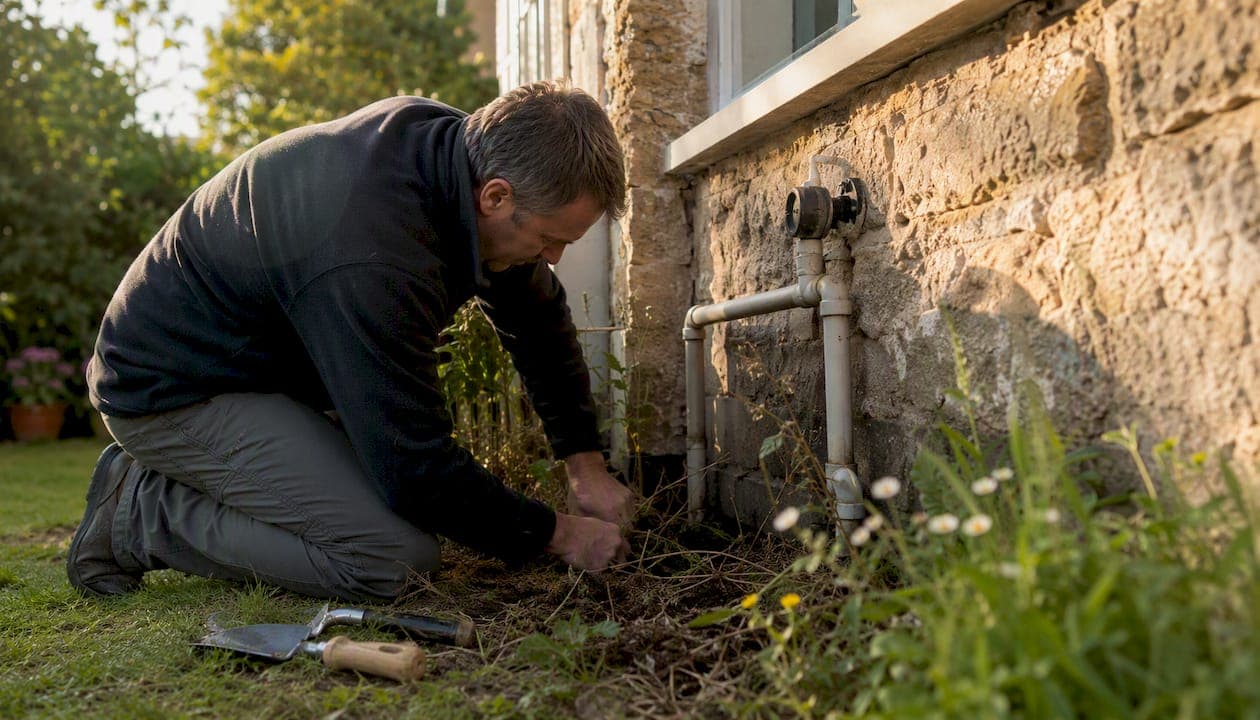
Keep a maintenance log, inspect your system monthly, desludge your septic tank regularly, insulate exposed pipes before winter, never route surface water into your sewage system, know exactly where your stop-tap sits, and call a qualified local plumber the moment something is beyond your skill or access. Those eight habits cover the vast majority of failures rural homeowners face.
Your quick-action checklist:
- Locate and test your internal stop-tap (turn it off and on to confirm it moves freely)
- Start a maintenance logbook: record dates, observations, and any work carried out
- Check your septic tank or treatment plant monthly for odours, unusual levels, or alarm lights
- Arrange desludging at regular intervals depending on household size and system capacity
- Lag all exposed pipework in unheated spaces before October
- Keep surface water, roof drainage, and guttering out of your sewage system
- Know your responsibility boundary: from the property boundary to the internal stop-tap, it is yours
- Book a local plumber for any excavation, pump work, or percolation testing
Pro Tip: Start your logbook today with three columns: date, task or observation, and action taken. A single A4 sheet per year, kept with your property documents, can satisfy a regulator, reassure a buyer, and save a plumber an hour of diagnosis.
Key takeaways
Consistent preventative maintenance for rural pipes, combined with proper off-mains drainage records and timely professional help, prevents the majority of costly rural plumbing failures.
| Point | Details |
|---|---|
| Know your boundary | Homeowners are responsible from the property boundary to the internal stop-tap and all private drainage beyond. |
| Desludge on schedule | Septic tanks and treatment plants need emptying every 12–24 months; records must be kept for five years. |
| Test before you build | Percolation tests must follow BS 6297 in normal weather; poor soakaway design is the leading cause of enforcement action. |
| Act on early signs | Slow drains across multiple outlets signal a tank or drainage field problem, not a local blockage. |
| Your-local-plumber | Provides leak detection, frost protection, percolation test liaison, and 24/7 emergency cover for rural properties. |
Table of Contents
- Who is responsible for which pipes?
- A simple maintenance timetable you can actually follow
- How to manage septic tanks, soakaways and treatment plants
- Warning signs of system failure and what to do immediately
- When should you call a local plumber?
- What can you safely do yourself, and what needs a pro?
- Is your rural water supply safe to drink?
- Managing vegetation and roots near your pipes
- Sustainable water use and rainwater harvesting
- Your-local-plumber is ready when rural maintenance needs a professional
- Sources
Who is responsible for which pipes?
Ofwat guidance is unambiguous: the homeowner is responsible for the private supply pipe from the property boundary to the internal stop-tap, plus all internal plumbing and private drainage up to the connection with public infrastructure. The water company owns and maintains the communication pipe from the mains up to the boundary stopcock. That line in the ground is where your liability begins.
On rural properties, that private supply pipe can run tens of metres across open land, making leak detection genuinely difficult and repair costs higher than urban equivalents. Shared supply pipes, common on older rural estates, create joint responsibilities between neighbours, which can complicate both repairs and cost-sharing.
For off-mains drainage, the regulatory picture adds another layer. Before installing or altering any system, you must:
- Submit a Building Regulations Part H application to your local Building Control body
- Contact the Environment Agency (or Natural Resources Wales/SEPA in devolved nations) to check whether a permit or exemption registration is required for your discharge
- Carry out a percolation test and water-table assessment before finalising drainage field design
- Retain all test results and approval documents with your property records
A simple maintenance timetable you can actually follow
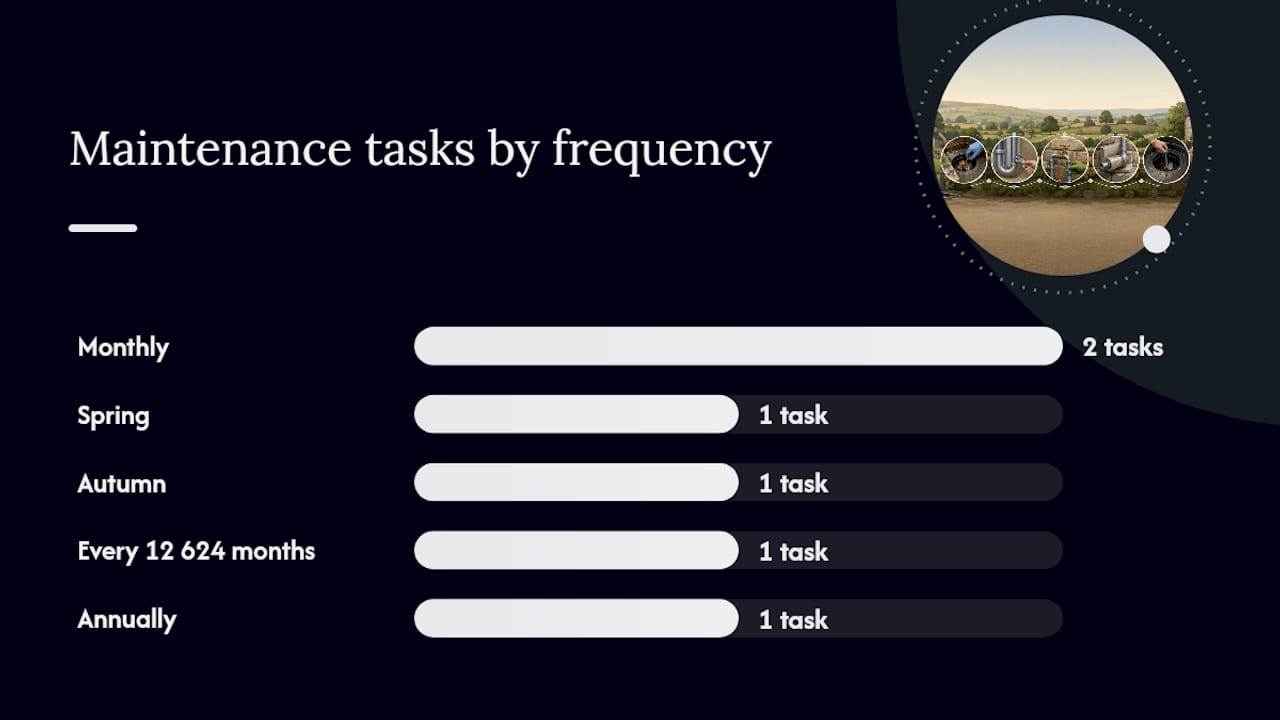
| Frequency | Task | Who does it |
|---|---|---|
| Monthly | Visual check of tank, pump alarm, drain covers, and any wet patches near drainage field | Homeowner |
| Monthly | Check stop-tap moves freely; look under sinks for drips | Homeowner |
| Spring | Inspect exposed pipework for frost damage; clear drain covers of debris | Homeowner |
| Autumn | Lag or re-lag exposed pipes; check boiler and heating pipes before first frost | Homeowner / plumber |
| Every 12–24 months | Desludge septic tank or empty cesspit; service treatment plant | Registered contractor |
| Annually | Full system inspection, percolation re-check if drainage seems slow, update logbook | Local plumber |
Natural Resources Wales recommends monthly inspections and desludging at regular intervals depending on use, with maintenance records retained for five years. That five-year retention rule matters: records are routinely requested on property sale and by local regulators following a complaint.
- When checking your tank monthly, look for: unusually high or low liquid levels, floating solids, odours stronger than normal, or any alarm light on a treatment plant
- For heating pipes, bleed radiators each autumn and check the boiler pressure gauge sits within the manufacturer's range
- Never pour fats, oils, bleach, or strong disinfectants down drains connected to a biological treatment system; they kill the bacteria that make the system work
Pro Tip: Book your desludging and your annual plumber visit on the same day. One call-out fee, two jobs done, and the plumber can inspect the drainage field while the contractor is on site.
How to manage septic tanks, soakaways and treatment plants
Siting a drainage field correctly is not optional. Building control guidance aligned with Approved Document H specifies that drainage fields must sit at least 10 m from any watercourse or ditch, at least 50 m from any water abstraction point, and at least 1.5 m above the seasonal high water table. Vehicle access for a desludging tanker must be planned from the outset; a tank buried where a lorry cannot reach it will cost significantly more to service.
Running a percolation test (BS 6297 method):
- Dig three test holes, each 300 mm square and 300 mm deep, at the proposed drainage field location
- Fill each hole with water and leave overnight to allow the soil to saturate
- Refill to 300 mm depth the following morning and time how long it takes for the water level to drop 150 mm
- Calculate the average time in seconds per millimetre (Vp value)
- Use the Vp figure to determine the required drainage trench length per person served, following East Lindsey's technical guidance
Worcestershire Regulatory Services warn that poor soakaway design and inadequate percolation testing are the most frequent causes of enforcement action. Critically, tests must be run in normal weather conditions: results taken during heavy rain, drought, or frost are unreliable and may not satisfy Building Control.
Choosing the right system:
- Cesspit: fully sealed, no drainage field needed, but requires very frequent emptying (often every 6–8 weeks for a family). No discharge, so no Environment Agency permit required, but running costs are high.
- Septic tank: discharges to a drainage field; needs desludging every 12–24 months. Requires a drainage field that passes percolation testing. Generally needs only an exemption registration rather than a full permit.
- Package treatment plant: higher treatment standard, may discharge to a watercourse with the appropriate Environment Agency permit. Has electrical components requiring annual servicing.
Your logbook for any off-mains system should record: tank size and type, installation date, desludging dates and contractor details, duty-of-care transfer notes, percolation test results, and any alarm events or repairs. Hand these records to any future buyer.
Pro Tip: Keep duty-of-care transfer notes from every desludging contractor. These are legal documents confirming waste was disposed of correctly, and losing them can create problems if a regulator investigates a pollution incident near your property.
Warning signs of system failure and what to do immediately
Signs something is wrong:
- Slow drains across multiple outlets simultaneously (often a tank or drainage field problem, not a local blockage)
- Gurgling sounds from toilets or drains when water is run elsewhere
- Sewage odours inside the property or near the drainage field
- Unusually green or lush grass patches over the drainage field
- Wet or waterlogged ground near the tank or field
- Discoloured or cloudy water from taps (private supply issue)
- Loss of water pressure across the whole property
Immediate steps:
- Isolate the water supply at the internal stop-tap if you suspect a burst or major leak
- Switch off any electrical components on a treatment plant if flooding is near the unit
- Do not use chemical drain cleaners in a system connected to a septic tank or treatment plant
- Contain any surface spillage and keep children and pets away from the affected area
- Photograph the symptoms: wet patches, alarm lights, drain levels, and any visible damage
- Call a local plumber; do not attempt to open a tank yourself
Pro Tip: Photos taken within the first hour of noticing a problem are often the most useful for both diagnosis and insurance claims. A time-stamped image of a waterlogged drainage field tells a plumber far more than a verbal description.
When should you call a local plumber?
Some situations require a professional regardless of how capable you are with a spanner. Call a plumber when:
- A percolation test fails or gives borderline results
- Drains are slow across multiple outlets and the tank was recently desludged
- You have a leak on the private supply pipe between the boundary and the stop-tap
- The treatment plant alarm activates and a visual check reveals no obvious cause
- Any pipework needs excavation or structural alteration
- You are buying or selling a rural property and need a system condition report
Questions to ask before booking:
- Are you registered with a recognised trade body (Gas Safe for heating work; CIPHE or WIAPS for water regulations compliance)?
- Do you have experience with septic tanks and soakaways in this area?
- For desludging, is your contractor registered as a licensed waste carrier with the Environment Agency?
- Do you carry public liability insurance, and will you provide a written quote?
- What access does your equipment need, and can your vehicle reach the tank?
Cost factors to set realistic expectations: access difficulty, pipe run length, soil type (clay soils slow percolation and increase drainage field size), whether excavation is needed, and pump-out frequency all affect the final bill. Understanding what pipe replacement involves before you call helps you ask better questions and avoid surprises.
What can you safely do yourself, and what needs a pro?
Safe homeowner tasks:
- Monthly visual inspections of tanks, drain covers, and exposed pipework
- Clearing small trap blockages at sinks and basins (plunger or manual removal only)
- Lagging exposed pipes with foam insulation sleeves before winter
- Checking and recording alarm panel status on a treatment plant
- Keeping the area around the drainage field clear of vehicles and deep-rooted plants
Leave these to a qualified plumber:
- Any excavation near pipework or tanks
- Percolation testing and drainage field design
- Pump replacement or electrical work on treatment plants
- Pressure testing or acoustic leak detection on long private supply runs
- Structural pipe repairs or replacements
Safety warning: Never enter a septic tank or inspection chamber, even briefly. Confined spaces in sewage systems contain toxic gases that can incapacitate within seconds. Chemical drain cleaners marketed for blocked drains will damage the biological treatment process in a septic tank or package plant and can accelerate system failure. If a treatment plant has electrical components, isolate the power before any inspection near water.
About this guide
This guide was compiled by Michael, a plumbing and drainage specialist with hands-on experience across rural UK properties. The guidance draws on:
- Ofwat's published responsibility framework for supply pipes
- Building Regulations Approved Document H and aligned Building Control guidance
- Natural Resources Wales household sewage treatment guidance
- East Lindsey District Council's technical septic tank notes (BS 6297-aligned)
- Worcestershire Regulatory Services' private non-mains drainage guidance
- Environment Agency registration and permit requirements for off-mains discharge
To check whether your system requires an exemption registration or a bespoke permit, contact the Environment Agency (England), Natural Resources Wales, or SEPA (Scotland) directly. Local authority Building Control can confirm whether your planned works need a Part H application.
Is your rural water supply safe to drink?
Properties on a private water supply, drawing from a borehole, spring, or well, are not covered by the water company's treatment and testing regime. The private supply pipe responsibility sits entirely with the owner, and so does the duty to ensure the water is safe.
Your local authority environmental health team has a statutory duty to inspect private water supplies serving more than one property or any commercial premises. For a single domestic supply, testing is strongly recommended at least annually, covering bacteria (total coliforms, E. coli), nitrates, and pH as a minimum. Accredited laboratories can provide test kits by post; results typically arrive within five working days.
Treatment options depend on what testing reveals. UV sterilisation units are effective against bacterial contamination and require only annual lamp replacement. Activated carbon filters address taste and odour issues. Reverse osmosis systems handle a broader range of contaminants but produce wastewater and need regular membrane changes. A local plumber familiar with private supplies can advise on the right combination for your source water and usage.
Managing vegetation and roots near your pipes
Tree and shrub roots are a slow but serious threat to rural drainage systems. Roots follow moisture gradients and will find any joint, crack, or imperfect seal in a drain run. Clay and older pitch-fibre pipes are particularly vulnerable.

Keep large trees at least as far from drain runs as their mature height. Willows, poplars, and ash are the highest-risk species near drainage fields and private supply pipes; their root systems extend aggressively and can collapse a drainage trench over several years. If you are planting near existing pipework, choose shallow-rooted species and keep them at least 3 m from any drain run.
For existing vegetation, a CCTV drain survey every few years will show root ingress before it becomes a blockage or structural failure. Root cutting is a specialist job: a plumber with a high-pressure jetting unit can clear early ingress, but a root-damaged pipe section will need relining or replacement before long.
Never plant over a drainage field. Grass is the correct surface cover; it allows evapotranspiration and keeps the soil structure intact. Shrubs, trees, or hard landscaping over a drainage field will eventually destroy it.
Sustainable water use and rainwater harvesting
Rural properties often have more flexibility than urban ones when it comes to sustainable plumbing practices. Rainwater harvesting is legal in the UK and can meaningfully reduce demand on a private borehole or the mains supply.
A basic above-ground butt collects roof runoff for garden use and requires no planning permission. A below-ground harvesting system, plumbed to supply toilets and washing machines, is more involved: it needs a correctly sized storage tank, a pump, a first-flush diverter to exclude the most contaminated initial runoff, and a clear separation from the potable supply to prevent back-contamination. Water Regulations require a visible air gap or approved backflow prevention device at any point where harvested water connects near the mains supply.
Reducing demand on your sewage system is equally worthwhile. Spreading laundry loads across the week rather than running multiple cycles in a day reduces hydraulic loading on a septic tank or treatment plant, extending the interval between desludging visits. Fixing dripping taps promptly matters more on a private supply, where every litre lost is water you have pumped or paid for.
A local plumber's perspective on rural priorities
Rural drainage problems tend to share a common thread: they were manageable at some earlier point and became expensive because nobody noticed in time. The most common scenario is a drainage field that has been quietly failing for two or three years, showing only slightly slower drains, until the ground becomes waterlogged and the tank backs up. At that point, the repair involves excavation, a new percolation test, and potentially a redesigned field, rather than a straightforward desludge.
The single most useful thing a rural homeowner can do is walk the drainage field area after heavy rain. Waterlogging that clears within 24 hours is normal. Persistent wet patches, or ground that stays soft for days after rain stops, suggest the field is not coping. Catching that early, before the tank itself is affected, is the difference between a plumber's visit and a significant civil engineering job.
Root management is the other area where early action pays. A CCTV survey on a 20-year-old drain run costs a fraction of what pipe relining or replacement does. If the property has mature trees within 10 m of any drain, that survey is worth doing now.
Your-local-plumber is ready when rural maintenance needs a professional
Rural pipe maintenance covers a lot of ground, literally and technically. When the job moves beyond a visual check or a lagging sleeve, Your-local-plumber provides the hands-on expertise rural properties need: leak detection on long private supply runs, liaison with desludging contractors, percolation test support, frost protection advice, and emergency call-outs with 24/7 availability.

Fixed, transparent pricing means no surprises after the job, and on-site quotes are available for larger works. When booking for dislodging-related work, ask for confirmation that the waste contractor holds a valid Environment Agency waste carrier licence. To arrange a visit or get a quote, contact Your-local-plumber directly through Your-local-plumber.
Sources
- Responsibility for supply pipes | Ofwat
- How to run your household sewage treatment system well | Natural Resources Wales
- Septic tanks for dwellings (technical guidance) | East Lindsey
- Non‑mains drainage guidance | Building control guidance (CND)
- Private non-mains drainage guidance | Worcestershire regulatory services
Record-keeping note: Retain all maintenance records, desludging duty-of-care notes, and percolation test results for a minimum of five years. To verify that a desludging contractor is a registered waste carrier, search the Environment Agency's public register at gov.uk/find-registered-waste-carrier.
This article is general information, not a substitute for advice from a qualified lawyer. Consult a qualified legal professional about your own circumstances before acting on anything here.