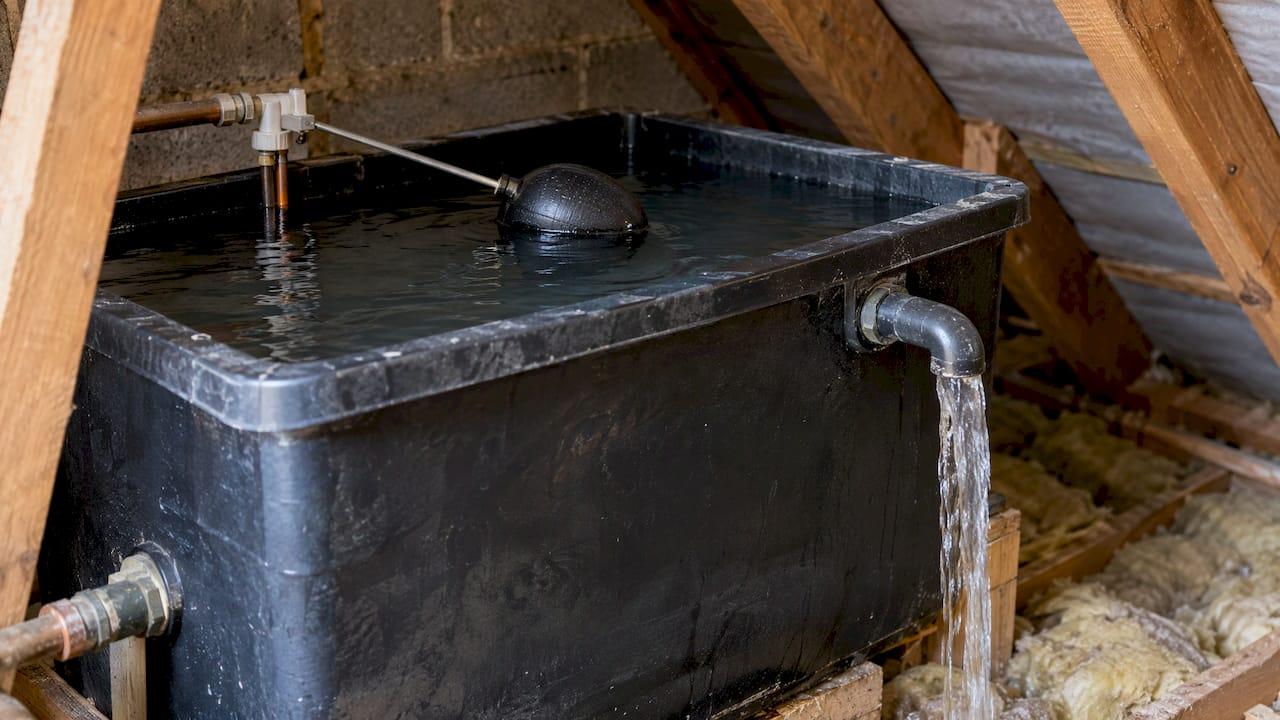
If water is dripping or running from a pipe on the outside wall or under the eaves, your cold water storage tank in the loft is almost certainly refilling when it should have stopped. The usual culprit is a worn or stuck float valve. You can stop the flow in minutes by isolating the tank's supply, and a fault like this is a quick job for an engineer. We offer a 60 minute emergency response with no call-out fee, so a running overflow does not have to wait.
TL;DR
- An overflow pipe that drips or runs means the tank is filling beyond its normal level. The float valve (the ball and arm that shuts off the incoming water) is the most common cause.
- Stop the flow first: turn off the stop tap that feeds the tank, then run a little hot water to lower the level.
- Water on the loft floor, a ceiling stain, or an overflow that continues after you have changed the valve all need an engineer.
- A small drip in cold weather can be a frozen overflow or a sticking valve, so lag the tank and pipes before winter.
- Call us any hour, including holidays: no call-out fee, payment only after successful work and a 12-month warranty.
Table of Contents
- What the overflow pipe is telling you
- Is it really the cold water tank?
- Stop the water first
- The common causes, from most to least likely
- Reading the pattern
- Checks you can make safely
- When to stop and call an engineer
- How to stop it happening again
- Perspective
- Get it fixed today
- FAQ
- Sources
What the overflow pipe is telling you
A loft cold water tank is fed from the mains through a float valve. A float valve is a plastic ball on an arm that rises with the water and closes the inlet when the tank is full. Near the top of the tank sits an overflow, also called a warning pipe, which carries any excess water outside so it does not soak your ceiling.
That pipe is a safety outlet, not a fault in itself. Wandsworth Borough Council explains that overflows exist on toilet cisterns and cold water tanks for exactly this reason, and that they most often run because grit has caught behind the valve that should close when the tank is full. Water Regs UK's installation checklist states that every cold water storage cistern must have an overflow plus a means of warning of an impending overflow.
So when you see water at the outlet, the tank is full to the brim and the valve is not doing its job. The question is why.
Is it really the cold water tank?
Most homes in our area have more than one pipe that can drip outside. Before you start, work out which one it is.
- Cold water storage tank overflow: a plastic or copper pipe poking through the wall or under the eaves, usually near the top of the house. Edinburgh Council's water emergencies leaflet says water dripping from a pipe in the wall or under the eaves is probably from a toilet or cold water storage tank overflow.
- Smaller feed-and-expansion tank: older open-vented heating systems have a second, smaller tank in the loft that tops up the radiators. Its overflow can also drip, and it often does so only when the heating is on.
- Boiler pressure relief pipe: a thin copper pipe that leaves the house near the boiler, usually low down. That is a different fault, and our guide to a boiler leaking water covers it.
- Hot water cylinder: water pooling around the cylinder itself is a leak rather than an overflow. Our guide to a hot water tank leaking walks through safe first steps.
A quick way to tell the tank overflow apart: look at where the pipe exits. High on the wall or under the eaves, and running steadily whatever the heating is doing, points to the large cold tank. If it only runs when the heating is firing, suspect the small feed tank instead.
Stop the water first
You do not need to find the cause before you stop the flow. Futures Housing Group's guidance for an overflow from the header tank is to isolate it with the stop tap in the airing cupboard, the brass tap above the hot water cylinder, turning it clockwise. It also says not to touch other valves, including the red wheel valve, and that running some hot water off can help stop the flow outside.
In practice:
- Find the stop tap that feeds the loft tank. In many homes it is in the airing cupboard, on the pipe above the cylinder.
- Turn it clockwise until it stops. Do not force it.
- Run a hot tap for a minute or two to draw down the tank. The overflow should stop dripping.
- Leave every other valve alone.
If you are unsure which valve is which, our guide to water isolation valves shows what each one does. Isolating the tank means the cold taps that run from it, and the hot water, will draw from a tank that is not refilling, so use water sparingly until it is fixed. The same guidance notes the tank can be refilled by opening the stop tap for about a minute if it runs low.
The common causes, from most to least likely
A worn or stuck float valve
This is the usual answer. Cambridge Water's leaks guidance says a leaking overflow pipe usually points to a faulty float valve, most often a leak in the float itself, which then needs replacing, or faulty washers, which need refitting.
A float with a pinhole slowly fills with water and sinks. It then sits too low to close the inlet, so the tank keeps topping up. Washers inside the valve perish with age, so even when the float rises properly the water still creeps past.
Float set too high
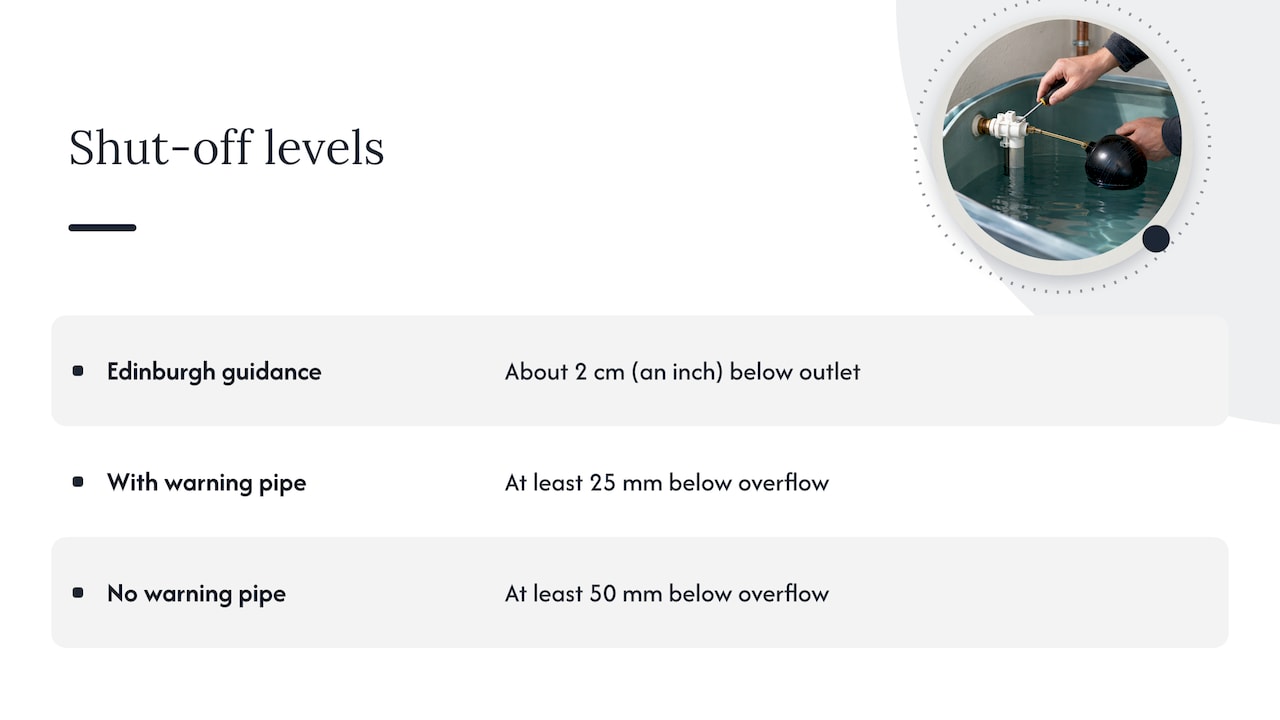
If the arm has been knocked or bent, the valve shuts off too late. Edinburgh Council's leaflet says the float should be set so the water shuts off about 2 cm (an inch) below the overflow outlet. Water Regs UK gives the installer's standard: the inlet valve should shut off at least 25 mm below the overflow, and at least 50 mm if there is no warning pipe.
On older systems with a metal arm, the same leaflet says you may be able to bend the arm carefully, without breaking it, to lower the shut-off level. A sticky or corroded arm will not respond well to this, and in hard-water areas that is common.
Grit or limescale
Debris from an old tank can lodge in the valve seat so it never quite seals. Wandsworth Council suggests flushing a toilet or gently pressing the ball valve below the surface and letting it rise slowly, three or four times, to clear it. If the overflow still leaks after that, a plumber is the next step.
A frozen overflow or stuck valve in winter
Water expands as it freezes and can split pipes or pull joints apart, and UK Home Ready notes that damage often shows up at the thaw. It also says a frozen overflow can stop draining, and a stuck valve may then let the tank overflow into the loft. Our winter plumbing tips cover lagging and what to check before the first hard frost.
The smaller tank is the real problem
If the drip comes from the small heating feed tank, the water level may simply be set too high, or something is pushing water into the heating side. That is a job for a heating engineer, since it can involve the cylinder coil and the whole open-vented circuit, not just a valve.
Reading the pattern
When the overflow runs tells you a lot. Our guide on how to diagnose a header tank overflow by timing goes into more detail. As a rough guide:
| What you see | Likely cause | What it needs |
|---|---|---|
| Constant drip or run, day and night | Worn washer, cracked float or valve not closing | Valve repair or replacement |
| Water level near the brim, float sitting low or half-sunk | Cracked float full of water | New float or valve |
| Overflow runs only in freezing weather | Frozen overflow or sticking valve | Thaw safely, lag the tank and pipes |
| Overflow only when heating is on | Small feed tank level or heating-side fault | Heating engineer |
| Still overflows after a new valve | Another source of water into the tank | Engineer diagnosis |
Checks you can make safely
Only go into the loft if the floor is boarded or you can reach the tank without stepping between joists, and take a torch. Ceilings between the joists will not hold your weight. Switch off the immersion heater first if you will be near the cylinder or any wet area, and keep water well away from electrical fittings.
- Lift the lid and look at the level. If water is touching or near the overflow outlet, the valve is not closing.
- Look at the float. Edinburgh Council's leaflet says a sunken float may have a leak. A float that is half under the surface even when the tank is full is a bad sign.
- Lift the arm gently. If the water stops when you raise the float by hand, the valve and washer are probably fine and the float or arm setting is the issue. If the water keeps coming, the valve itself is faulty.
- Do not stand on, lean on or move an old tank. Brittle plastic or a rusted galvanised tank can fail without warning.
If the float is leaking, Edinburgh Council describes a stop-gap: rest a piece of wood across the tank to hold the ball out of the water, which shuts the inlet. Treat that as something to get you through to the repair, not as the repair.
For most households the best next step after step 3 is to hand the job to an engineer. Replacing a float valve means isolating the supply, draining the tank to the right level, fitting the correct valve for the tank and setting the shut-off height to the standard in Water Regs UK's checklist. Get any of those wrong and the overflow comes straight back.
When to stop and call an engineer
Call straight away if:
- there is water on the loft floor, on the ceiling below or stains spreading on a bedroom ceiling;
- the overflow keeps running after you have fitted a new float valve or adjusted the old one;
- hot water or steam is coming from any pipe;
- the loft is unsafe to move around in, or the tank is old and brittle;
- you suspect the problem is on the heating side rather than the cold tank.
A ceiling stain is urgent because a full tank can hold a lot of water. Turn off the supply, switch off the lighting circuit for any room under a wet ceiling if you cannot be sure it is dry, and ring for help. If the ceiling is bulging, do not stand under it.
How to stop it happening again
- Check the level each autumn. The water should settle comfortably below the overflow outlet, to the clearances above.
- Keep the overflow clear. It should discharge visibly outside and not be blocked by nests, insulation or debris.
- Know your isolation points. A servicing valve on the mains inlet lets the valve be checked without draining the whole system.
- Insulate the tank and pipes. Lag the tank top, sides and bottom, and leave the loft floor beneath it uninsulated so some warmth reaches the tank. That is the approach in Water Regs UK's and installers' guidance for stopping a cistern freezing.
- Replace old valves rather than patching them. A valve that has been adjusted repeatedly is usually near the end of its life.
Perspective
A running overflow looks small and costs a lot if it is ignored. We see it as a two-part job: stop the water, then fix the reason it was running, because a valve that is only adjusted tends to come back.
Our engineers are set up for this. You speak directly to the engineer, we offer 24/7 availability including holidays, and a same-day emergency response, with a 60 minute response time on our emergency booking. There is no call-out fee, and you pay only after the work has been done successfully under our no fix no fee guarantee. Work is covered by a 12-month warranty.
Heating and boiler work is charged at £110 per hour, and new boilers supplied and fitted start from £1,300. Over 300 Trustatrader reviews come from customers who booked jobs like this one.
Michael
Get it fixed today
If your cold water tank is overflowing, book our emergency engineer and we will come out to stop the water and repair the valve. We cover Reading, Newbury, Oxford, Basingstoke, Bristol, Swindon, Windsor and many other towns across the Thames Valley, the South and the South West.
For an urgent job, use our emergency plumber page or book through the emergency heating engineer service.

If your overflow is a heating-side problem, our boiler and heating engineers can diagnose that too. If the system is beyond repair, we give a free on-site quote for a new boiler.
FAQ
Why is my loft tank overflowing when nothing has changed?
Usually because the float valve has worn or the float has sprung a leak, so the valve no longer shuts off at the right level. Limescale or grit can also stop the valve seating. It often shows up only when the mains pressure is higher, such as overnight.
Is a dripping overflow pipe an emergency?
A slow drip is not usually dangerous, but it will not stop by itself and it wastes water. Treat it as an emergency if water is reaching the loft floor or a ceiling, if it runs heavily, or if it freezes in winter. Isolate the tank at the stop tap in the meantime.
Can I fix a loft tank overflow myself?
You can isolate the tank and check the float from a safe position. Replacing the valve, setting the shut-off level to the correct clearance below the overflow and checking the tank are better done by an engineer. We can attend the same day.
What should the water level be in a cold water tank?
The valve should shut the water off well below the overflow outlet. Water Regs UK's checklist says the inlet should shut off a minimum of 25 mm below the overflow, or 50 mm if there is no warning pipe. In practice that means a visible gap, not a full tank.
How much will it cost to fix?
We do not publish a price for a plumbing emergency. Heating and boiler work is charged at £110 per hour, there is no call-out fee, and you pay only after the work is done successfully.
Sources
- Pipes and overflows, Wandsworth Borough Council
- Water emergencies, City of Edinburgh Council
- Installing a cold water storage cistern, Water Regs UK
- Leaks FAQs, Cambridge Water
- Water coming from a plastic pipe on the outside of the property, Futures Housing Group Help Hub
- Snow, ice and frozen pipes, UK Home Ready