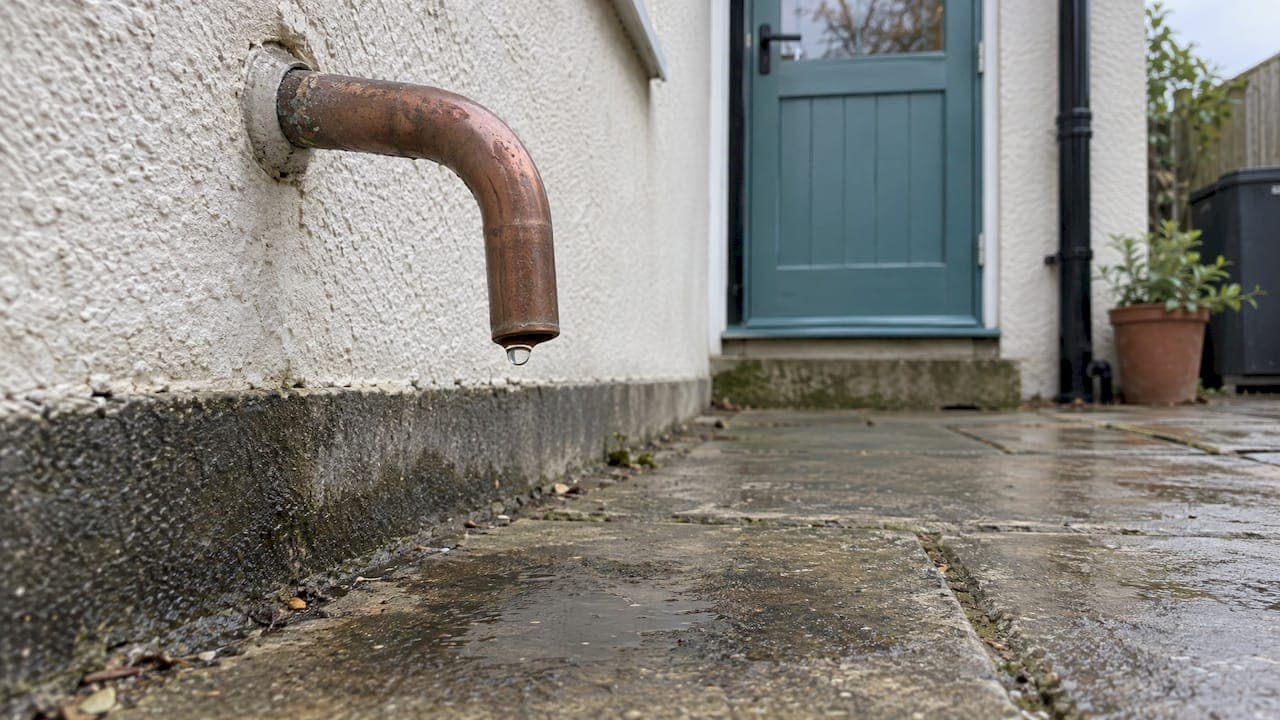
A dripping pressure relief valve is not normal. The valve is a safety device, and if water is coming out of its discharge pipe, it is either opening because the system pressure is too high or failing to close properly after it has opened. Check the pressure gauge first, switch the boiler off if water is running rather than dripping, and call a Gas Safe registered engineer if the drip carries on. If you smell gas at the same time, leave the checks and follow the gas emergency steps further down this page.
TL;DR
- A steady drip from the discharge pipe means the valve is opening under pressure or has stopped sealing. It needs investigating, not ignoring.
- The usual causes are high system pressure, an expansion vessel that has lost its air charge, a filling loop left slightly open, or debris on the valve seat.
- Safe checks: read the pressure gauge, make sure the filling loop is fully closed, and bleed radiators only with the boiler off and cooled.
- A gas smell is a separate emergency: open doors and windows, call 0800 111 999 and do not use the appliance until it has been checked.
- Replacing the valve alone often does not cure the drip, because the cause is frequently elsewhere in the system.
Table of Contents
- What the pressure relief valve does, and where the water goes
- Is a dripping pressure relief valve ever normal?
- Why a pressure relief valve drips
- Safe checks you can make yourself
- Boiler overflow pipe or pressure relief valve?
- If your boiler smells of gas
- When to call an engineer
- Our perspective
- Need it looked at today?
- FAQ
- Sources
What the pressure relief valve does, and where the water goes
A sealed central heating system has no open vent to release excess pressure. As the water heats up it expands, and if pressure climbs too far something has to give. That something is the pressure relief valve, sometimes called the safety relief valve. Altecnic explains that these valves are normally fitted to sealed heating systems and discharge water when pressure reaches the maximum set limit. The valve opens at a calibrated pressure so the system never reaches dangerous levels.
The valve itself sits inside or beside the boiler. What you can see is the discharge pipe: usually a short length of copper or plastic that runs from the boiler through an outside wall and ends in the open air, often near the base of the wall below the boiler. When the valve lifts, water leaves the house through that pipe. A drip at the end of it, a wet patch on the wall or a stain on the ground below is how most people discover a problem.
Unvented hot water cylinders have one too
If you have an unvented hot water cylinder, it has its own pressure relief arrangement, and the pipe from it ends in a small fitting called a tundish. Vaillant describes the tundish as a safety feature that leaves an air gap so you can see when the valve is discharging. The same source notes that Building Regulations G3 for unvented hot water systems require the tundish to be positioned where an escape of water is easy to notice. If water is visible in the tundish, the cylinder is discharging, and that is a job for an engineer qualified in unvented systems. Our guide to a leaking hot water tank covers the safe first steps.

Is a dripping pressure relief valve ever normal?
No. A valve that is doing its job stays closed until pressure reaches its set limit, lets out what it needs to and reseats. A continuous or repeated drip means one of two things:
- Pressure keeps rising to the point where the valve opens, so the valve is working but something else is wrong.
- The valve has opened once and has not sealed again, so the valve itself has a fault.
Worcester Bosch says that if the discharge pipe is wet while the heating system is constantly losing pressure, the pressure relief valve may be faulty. That pairing is a useful clue: a wet pipe plus a gauge that keeps falling points to the valve, while a wet pipe plus a gauge that keeps climbing points to the cause of the pressure.
One occasional discharge, for example on a day when you topped the system up too far, is different from a drip that returns every day. Even so, it tells you the pressure was too high at some point, and it is worth finding out why.
Why a pressure relief valve drips
The table below sets out the common causes, what you might notice and who usually deals with it. Details and sources follow.
| Cause | What you might notice | Who fixes it |
|---|---|---|
| Too much water added to the system | Gauge reads high, drip starts after topping up | You, if the fix is only releasing a little pressure the safe way; otherwise an engineer |
| Filling loop left slightly open | Pressure creeps up over hours or days | You can check the loop is fully closed |
| Expansion vessel with too little or too much air | Pressure spikes when the heating comes on, then falls when it cools | Gas Safe registered engineer |
| Debris, rust or limescale on the valve seat | Intermittent drip even at normal pressure | Engineer |
| Valve used to drain the system | Periodic drip afterwards | Engineer, often with a replacement valve |
| Worn or faulty valve | Constant drip, pressure falling | Engineer |
High system pressure
Viessmann lists the reasons for high pressure as too much water added, too little or too much air in the expansion vessel, or a filling loop left slightly open. The first and last are the ones a homeowner can often check. If you topped up the system recently, you may simply have overfilled it. Our step-by-step guide to boiler pressure that is too high walks through the safe checks.
An expansion vessel that has lost its air charge
The expansion vessel is a small tank with a rubber diaphragm and a cushion of air that absorbs the extra volume as water heats. When the air charge is wrong, that cushion no longer works and pressure shoots up every time the heating fires. The valve then lifts. Installer Online reports that repeated or continuous discharge can come from excessive pressure, an expansion vessel problem, debris stopping the valve reseating, or a valve operating close to its set pressure. The same article stresses that the underlying cause should be investigated rather than the valve simply being swapped.
That matters for your wallet. Viessmann notes that if a replacement valve continues to leak, the expansion vessel may be at fault. Our page on expansion vessel failure explains the symptoms in more detail. Recharging or replacing a vessel is engineer work.
Debris, rust and limescale
Once a valve has opened, a speck of rust or scale can stop the seat closing fully. Viessmann says debris, rust or limescale can block the valve or stop it closing properly, and that a leaking valve may need cleaning or flushing. If the water in the system is dirty, the drip may come back, which is a reason to ask your engineer about system cleaning and protection rather than just a new valve.
Using the valve to drain the system
The valve is not a drain cock. Worcester Bosch has warned that using it to drain a heating system can leave contaminants on the seat, so it does not reseal reliably and drips periodically. If someone has drained your system through the valve in the past, that may explain the drip, and the valve will probably need replacing.
A faulty valve
Valves do wear out. But the Installer Online guidance above makes the point that a discharge does not automatically prove the valve is defective: an expansion or pressure fault may have caused it to open in the first place. Good diagnosis separates the two before any parts are ordered.
Safe checks you can make yourself
These checks need no tools and do not involve opening the boiler. Anything beyond them belongs to a Gas Safe registered engineer.
- Look at the pressure gauge. Most boilers have a dial or digital display on the front. Note the reading with the system cold and again when the heating is running. If it climbs sharply when the heating comes on, suspect the expansion vessel. If it sits high even when cold, suspect overfilling or the filling loop.
- Check the filling loop. This is the flexible hose, or the pair of valves, under the boiler used to top up pressure. Both ends should be fully closed. A loop left slightly open can feed mains water in slowly. Our guide to boiler losing pressure shows what a filling loop looks like and how to close it properly.
- Follow the pipe. Trace the discharge pipe to where it ends. Is water dripping, running or just damp? Take a photo or a short video. Engineers find that useful, because the drip may stop when they arrive.
- Bleed radiators only if the boiler is off and cooled. Viessmann's advice is to bleed radiators only in those conditions. Bleeding lowers pressure slightly, but it is not a fix for a faulty valve or vessel.
- Turn off the heating if the drip turns into a flow. If water is pouring out, switch off the boiler at the fused spur and call for help.
What not to do: do not tighten, cap or block the discharge pipe, and do not wedge the valve shut. It is there to stop pressure building to dangerous levels. Do not lift the valve's test lever to "flush" it unless an engineer has told you to, as this can leave debris on the seat.
Boiler overflow pipe or pressure relief valve?
People often use the words interchangeably, but there are two kinds of pipe that can drip outside. A combi or system boiler's pressure relief discharge points to the heating circuit. An overflow from a tank in the loft or from a cold feed is a different fault, usually a float valve letting too much water in. If you are not sure which pipe you are looking at, our guide to a boiler overflow pipe dripping lists five checks to make first. If the pipe belongs to the boiler and the gauge is high, the causes in this article apply.
If your boiler smells of gas
A drip is a nuisance. A gas smell is an emergency. The two sometimes appear together because a boiler with one fault may have others, but treat the smell first.
HSE advice for a suspected gas leak is to call the National Gas Emergency Service on 0800 111 999, open doors and windows, and shut off the gas at the meter control valve if you know where it is. The HSE's domestic gas FAQs set out these steps and say it is illegal to use a gas appliance you suspect is unsafe: turn it off and leave it alone until a Gas Safe registered engineer has checked it.
In practice:
- Open doors and windows and get everyone into fresh air.
- Do not operate light switches, doorbells or anything that could spark, and put out naked flames.
- Call 0800 111 999. The line is free and open at any hour.
- Do not switch the boiler back on until it has been checked.
Carbon monoxide symptoms
A faulty boiler can also give off carbon monoxide, which has no smell. The HSE says suspected exposure calls for switching off the appliance, shutting off the gas, ventilating the property, calling 0800 111 999 and seeking urgent medical advice. Symptoms include headache, dizziness, nausea, breathlessness and tiredness. If anyone in the house feels like this, move them to fresh air and get medical help straight away.
The Gas Safe Register adds warning signs on the appliance: scorching, sooting, or a floppy yellow pilot flame. If you see any of these, stop using the boiler and call a Gas Safe registered engineer. Our explainer on Gas Safe certification shows how to check an engineer's registration before they start work.
When to call an engineer
Call a Gas Safe registered engineer if any of the following applies:
- The valve drips repeatedly, or constantly, for more than a day.
- The gauge climbs when the heating runs, or falls steadily while the pipe is wet.
- You have checked the gauge and filling loop and the drip continues.
- Water runs from the pipe rather than drips.
- The boiler makes unusual noises, locks out or shows a fault code.
- Anyone has used the valve to drain the system in the past.
The Gas Safe Register says pressure loss and leaking water are common signs that a boiler is not working as it should, and to contact a registered engineer when that is the case. If water is also leaking inside the boiler casing or from pipework, see our guide on whether a leaking boiler is an emergency, and for the wider picture of what leaks can cost, boiler leaking water.
What a good diagnosis looks like
The aim is to find out why the valve opened, not just to stop the water. A thorough visit usually involves reading the pressure cold and hot, checking the filling loop, testing the expansion vessel's air charge, looking at the condition of the system water and only then deciding whether the valve needs replacing. That order saves you paying for a new valve that drips again within weeks. Regular servicing helps catch these problems early, and our homeowner's guide on how to service a gas boiler safely explains what a service covers and what stays with the engineer.

What it costs with us
Boiler and heating repair work with us is charged at £110 per hour, with no call-out fee. We say what we expect the job to need before work begins. Our no fix, no fee guarantee means you pay after the work is successfully completed. If the diagnosis shows the boiler is beyond sensible repair, we give a free on-site quote for a new boiler, with new boilers supplied and fitted from £1,300.
Our perspective
Most dripping valves we see have been treated as a parts problem when they are really a pressure problem. A new valve on an expansion vessel that has lost its charge will drip again, usually inside a few weeks, and the customer has paid twice.
So we start with the system, not the valve. We read the pressure cold and hot, check the filling loop, test the vessel and look at the water. Only then do we decide whether the valve itself needs replacing. If it does, we fit it and explain what caused the fault so it does not return.
We also tell people plainly what to leave alone. The gauge and the filling loop are fair game. The valve, the vessel and anything that smells of gas are for a Gas Safe registered engineer, and a gas smell is for the emergency line first and us second.
Our approach is to keep the pricing clear, with no call-out fee and payment only after the work is done successfully. You can speak directly to the engineer who will visit, and we offer a 12-month warranty on our work. If it is out of hours, we are available 24/7, holidays included.
Michael
Need it looked at today?
If the valve is still dripping after your checks, our emergency plumbing and heating engineer service offers a 60-minute response time, 24 hours a day. We cover Reading, Newbury, Oxford, Abingdon, Bracknell, Windsor, Swindon, Bristol and many other towns across the Thames Valley, the South and the South West.

For a boiler that has had its day, you can request a new boiler quote. For the full list of what we handle, from leak repairs to taps and showers, see our main page.
FAQ
Is a pressure relief valve supposed to drip?
No. It should stay closed and only open when pressure reaches its set limit. A drip means either the pressure is too high or the valve is not sealing after it has opened. Either way, find out which before it gets worse.
Can I just replace the valve myself?
We would not advise it. On a boiler, the valve is part of a gas appliance, and work on it belongs to a Gas Safe registered engineer. Also, Installer Online notes that the underlying cause should be investigated rather than the valve simply being replaced, because a new valve will drip again if the expansion vessel or pressure is at fault.
Is a dripping pressure relief valve dangerous?
The drip itself usually causes water damage rather than immediate danger, but it signals that the safety device is being asked to work or is not sealing. Left alone, the pressure fault behind it can get worse, and a damp boiler or wall can lead to other problems. Get it checked soon, and call at once if water is running rather than dripping.
What should I do if my boiler smells of gas?
Open doors and windows, put out naked flames, shut off the gas at the meter if you know where it is and call 0800 111 999. The HSE sets these steps out. Do not use the boiler until a Gas Safe registered engineer has checked it.
Can I bleed radiators to stop the valve dripping?
Bleeding only lowers pressure a little, and only with the boiler off and cooled. It will not cure an expansion vessel fault, a stuck filling loop or a worn valve, so if the drip returns, book an engineer.
Sources
- Safety Relief Valves: Knowing the Facts, Altecnic
- What is a tundish? Vaillant
- The heating system is constantly losing pressure, Worcester Bosch
- What to do if your boiler pressure is too high, Viessmann
- Safety Relief Valves: what installers need to know, Installer Online
- What does a pressure relief valve do? Viessmann UK
- PRV misuses cause avoidable breakdowns, Worcester Bosch
- Domestic gas: frequently asked questions, HSE
- Carbon monoxide awareness frequently asked questions, HSE
- The home boiler guide, Gas Safe Register