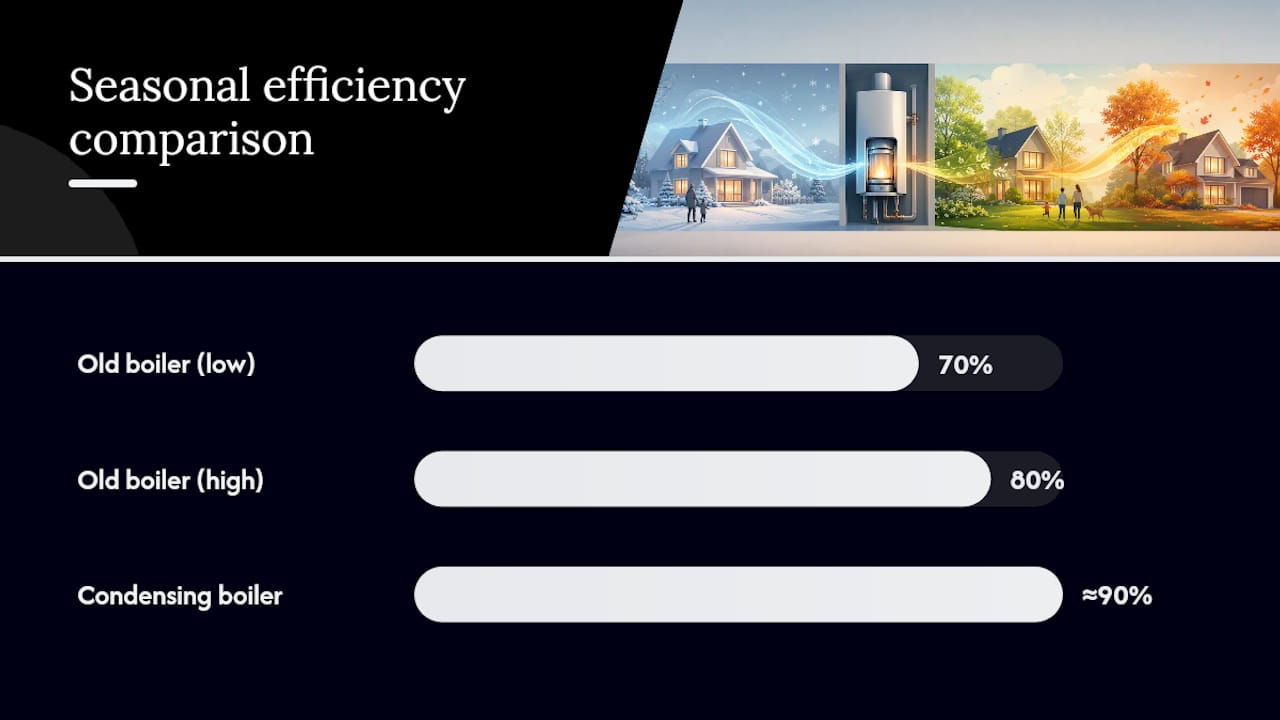
Yes, condensing boilers are genuinely better, and for most homes the case is clear cut. Swapping an old G-rated non-condensing boiler for a modern A-rated condensing model can save a typical household up to £310 a year on energy bills and cut carbon emissions by roughly 1,200 to 1,220 kg annually. Condensing models routinely achieve higher seasonal efficiencies than older boilers, often near 90% compared to 70 to 80% for the replaced units.
- Lower running costs, often by hundreds of pounds a year
- Meaningful CO2 reduction without any change in comfort
- Wider flue and installation flexibility than older designs
None of that is automatic, though. How much you save depends heavily on your return water temperature, how the system was sized, and whether the controls are set up properly, points we'll come back to.
Key Takeaways
Condensing boilers recover heat that older models waste, and that recovery only translates into real savings when the system is sized and commissioned correctly.
| Point | Details |
|---|---|
| Efficiency gap is real | Condensing boilers run near 90% seasonal efficiency versus 70 to 80% for older non-condensing units. |
| Savings depend on your baseline | Upgrading from an old G-rated boiler can save up to £310 a year, but the gap shrinks with a newer starting boiler. |
| Return temperature controls performance | Condensing works best below roughly 55°C, so controls and radiator sizing directly affect your bill. |
| Installation costs sit in the plumbing | Condensate drains, flues, and fans drive extra upfront cost more than the heat exchanger itself. |
| Get a proper sizing survey | Your-local-plumber assesses current efficiency, heat loss, and pipework before quoting a new condensing installation. |
Table of Contents
- What is a condensing boiler and how does the condensing process work?
- What are the main benefits of a condensing boiler?
- Why doesn't my condensing boiler always hit its rated efficiency?
- How much does a condensing boiler cost, and what's the realistic payback?
- Combi, system, or heat-only: which condensing boiler suits your home?
- What should you plan for during installation and servicing?
- How does Your-local-plumber decide if a condensing upgrade is right for your home?
- What actually matters when you're weighing up a condensing boiler
- Get a condensing boiler quote that accounts for your whole system
- Sources
What is a condensing boiler and how does the condensing process work?
A condensing boiler squeezes extra heat out of the same amount of fuel by not letting it escape up the flue as waste. Standard boilers burn gas, extract some heat, and vent the rest of the hot exhaust gas straight outside. A condensing boiler runs that exhaust through a second heat exchanger first, cooling it enough that the water vapour inside it turns back into liquid. That phase change releases latent heat, energy that would otherwise be lost, and the boiler recovers it into your heating system.
That's the entire trick behind the efficiency of condensing boilers: they're not burning fuel more cleverly, they're wasting less of what they burn.
A few consequences follow from this:
- Condensation forms as a mildly acidic liquid, which is why every condensing boiler needs a proper condensate drain
- Flue gases leave the boiler far cooler than in older units, so a fan is needed to push them out, and the flue itself is usually plastic rather than metal because it no longer has to withstand high heat
- The lower the return water temperature coming back into the boiler, the more condensing (and heat recovery) actually happens
That last point matters more than most sales literature admits, and it's worth understanding before you assume the badge on the box guarantees the saving.
What are the main benefits of a condensing boiler?
The headline advantage of a condensing boiler is efficiency, but it cascades into several practical wins for a household.
- Higher fuel efficiency. Condensing models typically run at seasonal efficiencies near 90%, compared with 70 to 80% for older non-condensing units, so less of every unit of gas goes up the flue unused.
- Lower annual bills. Upgrading from an old G-rated boiler to an A-rated condensing model can cut energy costs by up to £310 a year, depending on your current setup and usage.
- Reduced emissions. The same upgrade can reduce your annual carbon footprint noticeably, providing a clear environmental benefit.
- Better modulation and comfort. Modern condensing boilers pair more easily with weather compensation and smart controls, meaning they ramp output up and down to match demand instead of firing at full blast constantly.
- Flue flexibility. Because exhaust gases run cooler, plastic flues open up siting options that steel flues on old boilers simply couldn't offer.
Pro Tip: If your current boiler is more than 10 to 15 years old, check its efficiency rating before assuming a new condensing model will pay for itself quickly. The gap between a G-rated relic and a modern A-rated boiler is where the real savings live, not between two decent boilers a few years apart.
Checking your existing setup against boiler efficiency benchmarks before you commit to a new install is a sensible first move.
Why doesn't my condensing boiler always hit its rated efficiency?
The lab-tested percentage on the box assumes ideal conditions, and most homes don't run in ideal conditions. Condensation, and therefore the extra heat recovery that makes these boilers worth having, only happens efficiently when the return water temperature drops to around 55°C or below. Push your system to run hotter than that constantly, and the boiler spends more time working like an ordinary one.
- Oversized boilers or poorly sized radiators encourage short cycling, which hurts both efficiency and component lifespan
- A proper heat-loss calculation before installation, not a guess based on the old boiler's size, should determine the new unit's output
- Controls that support weather compensation or OpenTherm modulation help keep flow and return temperatures in the condensing range
- Poor commissioning by an installer who doesn't set flow temperatures correctly can quietly erase much of the promised saving
Pro Tip: Ask your installer to confirm the flow temperature they've set on commissioning. Many combi boilers leave the factory defaulted around 70 to 80°C, well above where efficient condensing happens.
How much does a condensing boiler cost, and what's the realistic payback?
Condensing boilers usually cost more upfront than the systems they replace, and the extra expense rarely comes from the heat exchanger itself. It comes from the plumbing around it.
- A condensate drain has to be installed and routed somewhere it won't freeze or block
- A flue fan and, in many cases, new flue pipework are required
- Older systems sometimes need radiator or pipework upgrades to run efficiently at lower flow temperatures
Set against that outlay, the potential savings of up to £310 a year mean many households recoup the difference over a period of several years, though the exact timeline depends on your current boiler's age and efficiency, local fuel prices, and how much hot water and heating your household actually uses. A flat in a well insulated new build with a reasonably efficient boiler already in place will see a slower payback than a draughty older house running a 20-year-old back boiler. It's worth checking current government-backed energy saving schemes too, since incentives can shift the maths in your favour.
Combi, system, or heat-only: which condensing boiler suits your home?
Not every condensing boiler is built the same way, and picking the wrong type undermines the whole upgrade regardless of its efficiency rating.
- Combi boilers heat water on demand with no cylinder or tank, making them the go-to choice for flats and smaller households with limited space and modest hot water demand.
- System boilers work with a hot water cylinder but no cold water tank, suiting larger households that need multiple bathrooms running simultaneously without a pressure drop.
- Heat-only (regular) boilers rely on both a cylinder and a loft tank, and tend to fit older properties already plumbed for that setup rather than new installs.
The Energy Saving Trust points out that mains gas condensing boilers are often the cheapest heating option where gas is available, but the right type still depends entirely on your household size and hot water habits. A sizing survey from a qualified installer, not a like-for-like swap, is the only reliable way to get this right.
What should you plan for during installation and servicing?
Installing a condensing boiler is more involved than fitting an old-style unit, mainly because of where the condensate has to go. It needs to drain to an internal waste pipe or soil stack, ideally, and where that's not possible a condensate pump or an external run with proper insulation is needed to stop it freezing in winter.
- Masonry chimneys generally aren't suitable for condensing flue gases without a specialist liner, so most installations use a new plastic flue routed through a wall or roof
- The mildly acidic condensate (roughly pH 3 to 5) means neutralisers are sometimes fitted before it reaches a drain, particularly in commercial settings
- Annual servicing should check the condensate trap for blockages, inspect the flue, and verify controls are still calling for the right flow temperature
- Work must be carried out by a Gas Safe registered engineer, full stop, no exceptions on this one
Pro Tip: A frozen condensate pipe is one of the most common winter boiler breakdowns in the UK. Lagging the external section properly at installation avoids a callout you didn't need to have.
Regular boiler servicing is one of the simplest ways to protect the efficiency gains you've paid for, and it's far cheaper than a breakdown repair.
How does Your-local-plumber decide if a condensing upgrade is right for your home?
Michael and the team at Your-local-plumber approach every boiler enquiry the same way: check the existing system before recommending anything new. That means looking at your current boiler's age and efficiency, running a heat-loss assessment, inspecting radiators and pipework for compatibility with lower flow temperatures, and confirming there's a viable route for the condensate drain.
- Current boiler condition and efficiency rating
- Heat-loss and sizing requirements for the property
- Radiator and pipework suitability
- Condensate drainage access
From there, you get a written quote and a commissioning check that confirms the flow temperature is actually set for efficient condensing, not just left on a factory default.
What actually matters when you're weighing up a condensing boiler
The efficiency numbers around condensing boilers are solid and well documented, but most advice stops at the percentage and never gets to the part that decides whether you actually see it on your bill. That's the mistake. A boiler rated at 90% efficiency running with a return temperature of 65°C isn't delivering 90% efficiency in your home, it's delivering something closer to what an older boiler managed, just with a shinier badge.
Conventional advice treats the boiler as the whole decision. It isn't. The controls, the radiator sizing, and the installer's commissioning choices matter as much as the unit itself, arguably more once you're past the basic condensing-versus-non-condensing question. Homeowners who prioritise finding the cheapest installer over one who'll actually set the flow temperature correctly are quietly giving away a chunk of the saving they paid extra for.
If you take one thing from this: ask your installer directly what flow temperature they're setting and why. That single question tells you more about whether you'll see real savings than any efficiency percentage on a brochure.
— Michael
Get a condensing boiler quote that accounts for your whole system
A new boiler is only as efficient as the system it's connected to, which is exactly why Your-local-plumber doesn't just swap units, it assesses flow temperatures, radiator sizing, and condensate routing before recommending anything. That systems-first approach is the difference between a boiler that hits its rated efficiency and one that quietly underperforms for the next 15 years.

Whether you're replacing a decade-old non-condensing boiler or upgrading a tired combi, Your-local-plumber's engineers carry out a proper heat-loss assessment and commissioning check as standard, not as an optional extra. For a broader look at what a full installation involves before you commit, the team at Rare Plumbing covers similar ground on installation considerations worth reading alongside this guide.
Ready to find out what a condensing upgrade would actually cost and save in your home? Book a free on-site quote with Your-local-plumber and get a straight answer, not a sales script.
Sources
Readers wanting to dig deeper can check the CREDS briefing on condensing boiler market transformation for the regulatory history behind the 2005 mandate, the Energy Saving Trust's boiler guidance for choosing between boiler types, GOV.UK's energy-saving measures page for current incentives, and the technical Wikipedia overview for how the condensing process itself works.
- Condensing vs non‑condensing boilers — GreenMatch
- Condensing boiler — Wikipedia
- Boilers — Energy Saving Trust