TL;DR:
- Hard water deposits minerals inside appliances and pipes, causing efficiency loss, shortened lifespans, and increased energy bills. Early testing and treatment like softeners or descaling can prevent costly damage and extend appliance longevity. Ignoring hard water risks ongoing performance decline and significant household costs over time.
Hard water damage is one of those problems that creeps up quietly. You might notice a chalky ring around your tap or spots on your glassware and assume it's a cosmetic nuisance. In reality, what is hard water damage goes far beyond surface marks. Inside your boiler, water heater, washing machine, and pipes, dissolved minerals are steadily building up, strangling efficiency, shortening appliance lifespans, and quietly inflating your energy bills. Most homeowners only discover the true scale of the problem when a boiler fails early or a plumber pulls apart a pipe clogged solid with limescale.
Table of Contents
- Key takeaways
- What hard water actually is
- Hard water effects on plumbing and appliances
- Signs of hard water damage to watch for
- Preventing hard water damage: solutions that work
- The real cost of doing nothing
- My take on hard water: stop treating it as cosmetic
- How Your-local-plumber can help
- FAQ
Key takeaways
| Point | Details |
|---|---|
| Damage is invisible and cumulative | Hard water scale builds inside pipes and appliances long before visible symptoms appear. |
| Appliances fail significantly earlier | Water heaters can last half as long with hard water compared to soft water. |
| Energy bills rise with scale | Even a thin layer of scale forces heating elements to work harder, increasing running costs. |
| Early testing saves money | A professional water hardness test is the fastest route to a treatment plan that fits your home. |
| Multiple solutions exist | From ion exchange softeners to regular descaling, prevention options suit different budgets and needs. |
What hard water actually is
Hard water contains elevated levels of dissolved calcium and magnesium minerals, picked up as water filters through rock formations like chalk and limestone. The more mineral content, the harder the water. In the UK, hardness is commonly measured in milligrams per litre of calcium carbonate (mg/L CaCO3) or grains per gallon (GPG). Here is how the scale breaks down:
- Soft: 0 to 60 mg/L (less than 3.5 GPG)
- Moderately hard: 60 to 120 mg/L
- Hard: 120 to 180 mg/L
- Very hard: above 180 mg/L
Much of south-east England, including London, the Home Counties, and areas like Reading and Oxford, regularly exceeds 200 mg/L. That places millions of UK households firmly in the very hard category. Water above 7 GPG promotes rapid scale buildup inside pipes and appliances, particularly wherever heat is applied. When water is heated, calcium carbonate precipitates out of solution and adheres to surfaces. That is the white, chalky substance you see on your kettle element. Inside your boiler and water heater, the same process happens invisibly, and far more destructively.
Hard water effects on plumbing and appliances
The hard water impact on plumbing is where the real financial damage begins. Scale does not just sit there looking unpleasant. It actively degrades performance and cuts the working life of everything it touches.
Water heaters and boilers
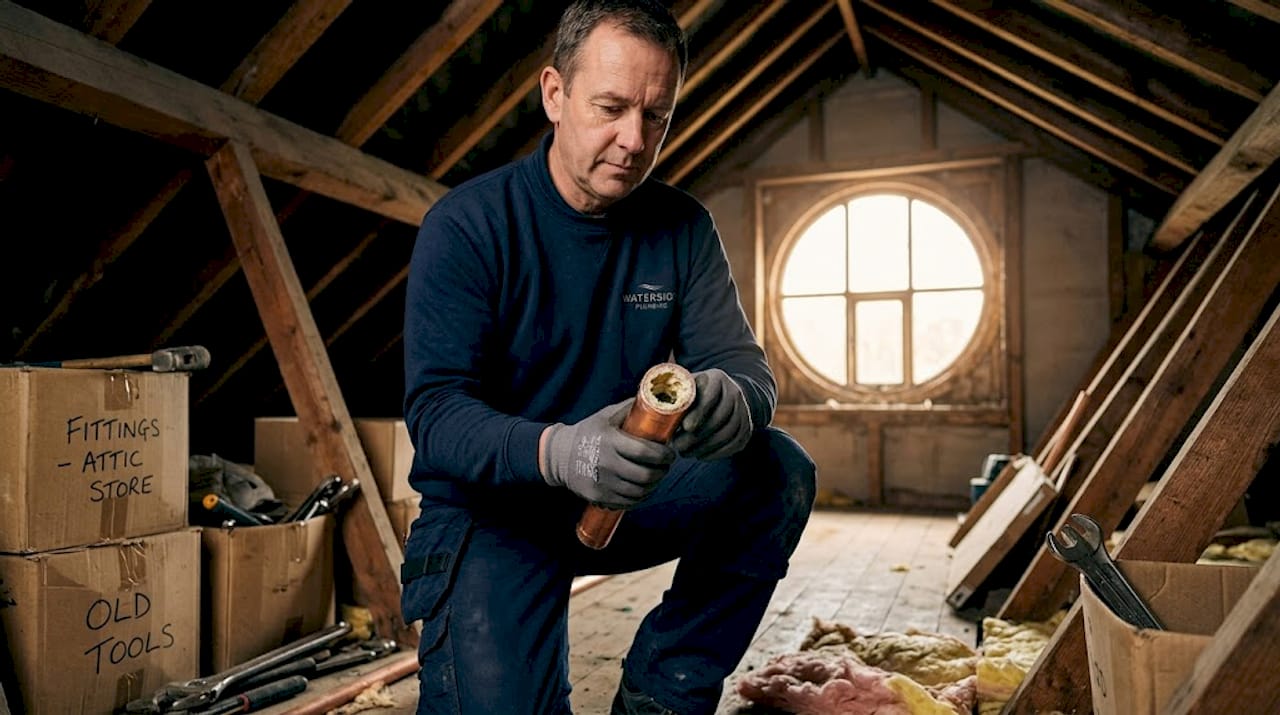
Scale inside a water heater acts as insulation between the heating element and the water. A quarter-inch of scale reduces heating efficiency by 25% to 40%, and half an inch pushes losses beyond 50%. Your boiler burns more fuel to heat the same volume of water, and the extra stress accelerates component failure. Hard water halves the lifespan of a typical water heater. An appliance that should last 11 years may fail in as little as 5.5 years with untreated hard water.
Tankless water heaters suffer particularly badly. Their narrow flow paths and sensitive heat exchangers show scale symptoms earlier than conventional tank units, making regular descaling non-negotiable if you have one fitted.
Washing machines and dishwashers
Scale builds on heating elements and spray arms, reducing cleaning performance and forcing machines to run longer cycles to compensate. Hard water effects cut washing machine lifespan from an expected 11 years down to roughly 7.7 years.
| Appliance | Lifespan with soft water | Lifespan with hard water |
|---|---|---|
| Water heater | 11 years | 5.5 years |
| Washing machine | 11 years | 7.7 years |
| Dishwasher | 10 years (approx.) | 7 years (approx.) |
Pipes and faucets
Scale narrows the internal diameter of pipes over time, reducing flow and causing pressure issues throughout your home. Aerators on taps and showerheads clog fastest because flow concentrates there. The frustrating part is that visible scale on fixtures does not always reflect how badly the internal components are affected. A tap might look clean while the pipe behind it is heavily restricted.
Pro Tip: If you have a water softener fitted, ion exchange resin beads can degrade over time, and the fragments may clog aerators and valves downstream. Check aerators every few months as part of routine maintenance.
Signs of hard water damage to watch for
Hard water damage is deceptive because it develops slowly. By the time something breaks, the damage has been mounting for years. These are the signs homeowners most commonly overlook:
- Chalky white deposits on taps, showerheads, kettle elements, and tiles around the bath or shower tray
- Reduced water flow from a single outlet, such as a shower or tap, when the rest of the house seems normal
- Rumbling or popping noises from your water heater or boiler, caused by scale sediment heating and cracking at the bottom of the tank
- Shorter hot water supply before cold water comes through, indicating a scaled element working less efficiently
- Stiff laundry and dull fabric colours after washing, even with detergent
- Spots and a film on glassware that does not disappear after washing
- Rising energy bills without an obvious explanation, particularly heating costs
- More frequent repairs on the same appliances, such as repeated boiler callouts within a short period
Any two or three of these together is a strong signal that hard water is actively damaging your home's systems. An essential plumbing maintenance checklist can help you spot these patterns before they escalate.
Preventing hard water damage: solutions that work
Prevention is substantially cheaper than repair. Here is a practical order of steps to follow.
-
Get a professional water hardness test. Before spending money on equipment, confirm your actual hardness level. Professional testing is the most reliable foundation for choosing the right treatment. DIY test strips exist but lack the accuracy needed for selecting equipment.
-
Install a whole-house ion exchange water softener. For hardness levels above 10 GPG, an ion exchange softener is the proven long-term solution. These units replace calcium and magnesium ions with sodium ions, preventing scale formation throughout your entire plumbing system. They require periodic salt top-ups and annual servicing, but they protect every appliance and pipe in the building simultaneously.
-
Consider SACr systems if salt use concerns you. Surface Accelerated Crystallization technology is a newer, salt-free alternative that causes minerals to form harmless crystals rather than sticky scale deposits. These systems reduce water usage by up to 50% compared to conventional softeners, making them a strong option for environmentally conscious households.
-
Flush your water heater annually. Sediment collects at the base of tank heaters and accelerates scale formation. A plumbing sustainability approach to water heater maintenance includes flushing it once a year to remove loose deposits before they harden.
-
Descale appliances on a schedule. Kettles and showerheads are easy to descale at home using white vinegar or a proprietary descaler. Washing machine drums and dishwasher elements benefit from a monthly descaling cycle using a dedicated product.
-
Bypass outdoor taps from the softened water supply. Softened water contains sodium, which is harmful to plants and soil. Outdoor faucets are typically bypassed during installation, and many homeowners also keep the kitchen cold tap unsoftened for drinking and cooking.
Pro Tip: DIY descalers work well on accessible surfaces but cannot reach scale deposits inside boiler heat exchangers or pipe walls. For internal plumbing descaling, a qualified plumber with specialist equipment is the only effective option.
The real cost of doing nothing
The financial case for preventing hard water damage is straightforward. Scale-related heating inefficiency adds 25% to 50% to your water heating costs over time. Couple that with appliances failing years ahead of schedule, and the cumulative cost runs into thousands of pounds across a household.
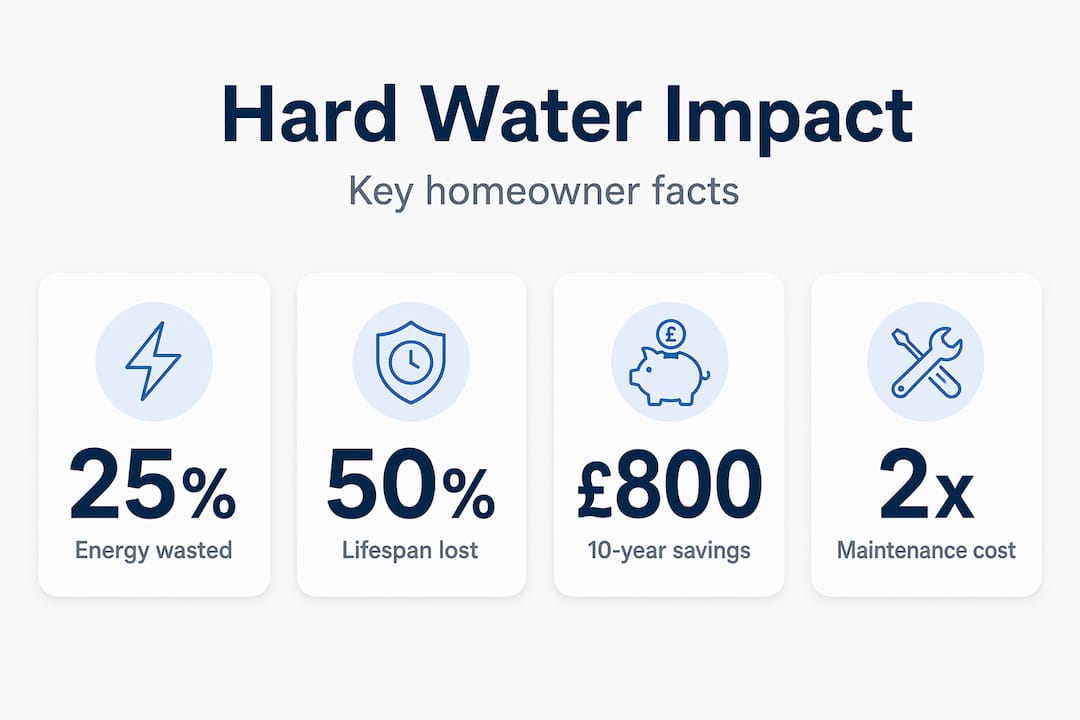
Softened water saves homeowners over £800 across a decade through reduced appliance replacements and maintenance. That figure does not include energy savings, which in a heavily scaled boiler can be significant on their own.
| Scenario | Energy cost impact | Appliance replacement frequency | 10-year maintenance cost |
|---|---|---|---|
| Untreated hard water | 25% to 50% higher heating bills | Up to twice as frequent | High |
| Softened water | Baseline efficiency | Normal manufacturer lifespan | Substantially lower |
| Regular descaling only | Moderate reduction | Moderate improvement | Medium |
The pattern is clear. Homeowners who treat hard water problems early spend less overall, experience fewer breakdowns, and get full value from their appliances. The mistake most people make is treating hard water as something to manage reactively. By the time a boiler fails at year six instead of year eleven, the opportunity to act cheaply has long passed. Reviewing your plumbing costs proactively is one of the most effective things you can do as a homeowner.
My take on hard water: stop treating it as cosmetic
In my experience working with homeowners across hard water areas, the single biggest mistake I see is assuming that limescale is just a cleaning problem. People scrub their showerheads, run a descaler through the kettle, and consider the matter dealt with. They have no idea that the same mineral deposits are coating the inside of their boiler heat exchanger, restricting flow through their pipes, and quietly shaving years off every appliance they own.
Hard water damage is cumulative. There is no dramatic moment of failure early on, which is precisely what makes it so easy to ignore. What I have found is that homeowners who book a professional water hardness test tend to be genuinely surprised by the result, and that surprise is usually the thing that motivates them to act. Once you know your actual hardness level, the decision between a softener, an SACr system, or a rigorous descaling schedule becomes much simpler.
My honest advice is this: if you are in south-east England and you have never had your water tested, do it before you spend money on a new boiler or washing machine. The appliance may not be the problem. The water it has been running on might be.
— Michael
How Your-local-plumber can help
Hard water problems rarely stay surface level for long. At Your-local-plumber, we carry out professional water hardness assessments and can recommend the right treatment for your home's specific needs, whether that is a whole-house softener, a targeted descaling programme, or a combination of both.

Our experienced engineers handle everything from appliance descaling and aerator cleaning to full water softener installation and plumbing pipe assessments. We work transparently, explain what we find, and give you clear options before any work begins. If you want to see the standard of our recent work, take a look at our project gallery, then get in touch to book a consultation or arrange a same-day assessment.
FAQ
What does hard water damage actually do to pipes?
Hard water deposits calcium carbonate scale on the internal walls of pipes, gradually narrowing the bore and reducing water flow. Over time this can cause low pressure and, in severe cases, full blockages.
How can I tell if hard water is damaging my boiler?
Rumbling or popping sounds from your boiler or water heater are a common early sign. These noises occur when trapped scale sediment cracks and shifts as water heats around it.
Can I fix hard water damage myself?
Surface scale on taps, showerheads, and kettles can be removed with white vinegar or a proprietary descaler. Internal scale inside boilers, pipes, and appliance heating elements requires professional equipment and should not be treated as a DIY job.
What is the most effective solution for hard water problems?
Ion exchange water softeners are the most proven long-term solution for hardness above 10 GPG, protecting all appliances and pipes simultaneously. For those concerned about salt and water usage, SACr systems offer a credible alternative.
How quickly does hard water damage occur?
Damage begins as soon as hard water flows through your plumbing, but noticeable effects on efficiency and appliance performance typically develop over months to years, depending on your hardness level and how often appliances are used.