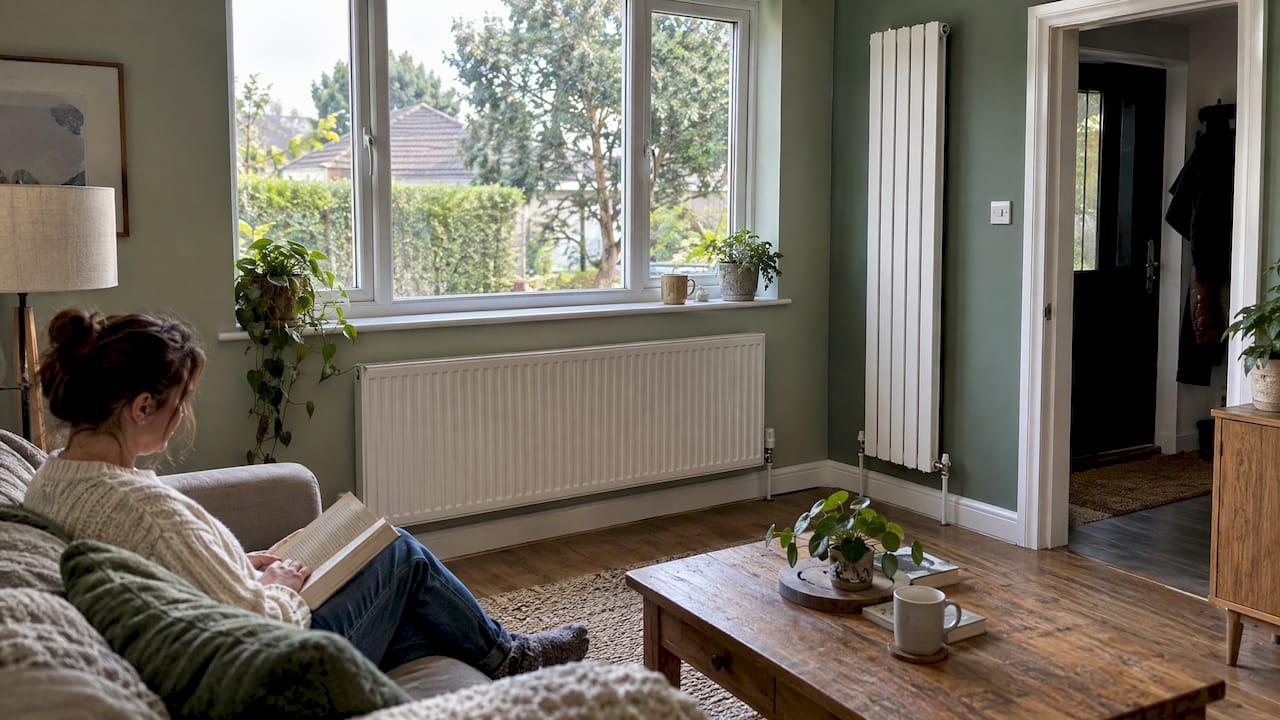
A vertical radiator heats a room just as well as a horizontal one, provided it is the right size. So the choice is about your wall space and your pipework, not about better or worse heat. Pick horizontal when you have a free stretch of wall, especially under a window. Pick vertical when floor-to-ceiling height is all you have to spare. Whichever you choose, check the BTU figure (the unit radiators are rated in) before you look at the finish. If the swap involves pipework, valves or balancing the system afterwards, our heating engineers can take it on at a published rate of £110 per hour.
TL;DR
- Orientation does not change efficiency: a radiator with the same dimensions and panel configuration gives the same heat output, tall or wide.
- Horizontal suits under windows and long walls. Vertical suits alcoves, narrow wall sections and rooms with little free wall.
- Size by BTU first, then choose the shape. A narrow vertical often has to be taller or double-panelled to match a wide horizontal.
- In a bathroom, a heated towel rail is a top-up and towel dryer. A larger bathroom usually needs a proper radiator as well.
- Swapping like for like on existing pipes is the cheapest job. Moving pipes or changing pipe centres costs more.
Table of Contents
- The real difference between horizontal and vertical radiators
- Are vertical radiators any good?
- Where each type works best
- How to size a radiator before choosing a shape
- What each option costs
- Can you turn a vertical radiator on its side?
- Towel rail or radiator in the bathroom?
- Clearances and placement mistakes
- When to bring in a heating engineer
- Need a hand with your radiators?
- Our view on horizontal and vertical radiators
- FAQ
- Sources
The real difference between horizontal and vertical radiators
A horizontal radiator is wider than it is tall. It normally sits low on a wall beneath a window. A vertical radiator is taller than it is wide, often 1,800mm or more in height, in a slim footprint. Stelrad's guide describes horizontals as the most common UK arrangement and verticals as the choice for modern homes with limited wall space, or where the radiator is meant to be seen.
That is the whole difference. Water flows through the same kind of panels and the room is warmed in the same way. What changes is where the heat is released and how much wall it uses.
Are vertical radiators any good?
Yes, when they are sized properly. The common worry is that a tall, slim radiator must be a weaker heater. The evidence does not back that up. Heatingpoint makes the point plainly: a radiator rated at 3,000 BTU gives 3,000 BTU whether it is tall and slim or low and wide. What matters is surface area, material and correct sizing. Radiators4U calls the idea that vertical radiators heat worse a myth, and says the real test is whether the radiator provides the heat the room needs.
Where people go wrong is sizing. Vertical radiators tend to be narrow, so a 500mm-wide vertical replacing a 1,200mm-wide double-panel horizontal may deliver far fewer BTU. Stelrad describes that as a sizing issue, not an efficiency disadvantage.
There is also a small difference in how the heat spreads. In a standard steel panel radiator, roughly 20 to 30% of output is radiant heat and the rest is convection. A horizontal unit creates an even rising current across its full width, while a vertical one sends it up in a narrow column. Stelrad says most homeowners will not notice this in rooms up to about 20 square metres.
Where each type works best
Horizontal: under windows and along long walls
Cold air sinks from glass. A radiator beneath the window sends warm air upwards to meet it, which mixes the air and spreads the heat more evenly, as Heatingpoint explains. Even with modern glazing, the space under a window is often wall you could not easily use for furniture. That is why horizontal radiators remain the default in living rooms and bedrooms.
They are also usually the simplest swap. If you are replacing an old radiator and the pipes already sit in the right place, a horizontal of similar size is the least disruptive choice.
Vertical: alcoves, hallways, kitchens and big glazing
Vertical radiators earn their place where horizontal ones cannot fit. Think of a narrow wall beside a door, a chimney alcove, a hallway, a kitchen with units along every wall, or a room with bi-fold doors and large windows. EDF Energy's radiator guide notes that a vertical radiator saves space by going up the wall rather than along it, and that the heat output is the same as a horizontal one of equivalent specification.
Tall ceilings suit them too. A radiator that fills the height of the wall looks deliberate rather than squeezed in.
A quick comparison
| Horizontal | Vertical | |
|---|---|---|
| Shape | Wider than tall | Taller than wide |
| Best position | Under windows, long walls | Narrow walls, alcoves, beside doors |
| Floor and wall use | Needs a run of free wall | Needs little floor or wall width |
| Typical cost | Usually cheaper | Usually dearer for the same output |
| Heat output | Set by size and panels | Set by size and panels |
| Like-for-like swap | Often simplest | Easiest where connections match |
How to size a radiator before choosing a shape
Heatingpoint's advice is to size correctly first and decide on style second. That ordering stops you buying a handsome radiator that leaves the room cold.
One published method, from Radiator Store's 2026 buying guide, is to multiply the room volume in cubic metres by 153 to get a baseline BTU figure. Then add 20% for poor insulation and 10% for large windows.
Worked example. A living room measuring 4m by 3m with a 2.4m ceiling has a volume of 28.8 cubic metres. Multiplied by 153, that gives about 4,406 BTU. With large windows, add 10%, which brings it to roughly 4,850 BTU.
Now compare the shapes against that target. Geyser's June 2025 comparison gives typical outputs: a 1,400 x 600mm double panel with fins at 5,000 to 6,000 BTU would cover it on its own. A 1,800 x 500mm vertical designer radiator at 3,000 to 4,500 BTU would fall short alone, so you would need a higher-output model or a second radiator.

Bathroom Mountain's guide uses a different baseline (volume multiplied by 50) and adjusts for insulation, glazing and north-facing rooms. Formulas vary, so treat any of them as a first estimate, not a final answer. A heating engineer who has seen the room, its insulation and its boiler can confirm the figure.
If your system runs at a lower flow temperature, for example with a heat pump or a low-temperature set-up, the brochure BTU figure can overstate what you get. Ask for the output at the flow and return temperatures your system actually uses. A wide double or triple-panel horizontal can be the better fit in that case.
For the panel question, our guide to single versus double radiators shows how an extra panel changes output without changing the footprint much.
What each option costs
Prices move, so read these as ranges from 2026 guides, not quotes.
- EDF Energy puts standard radiators from around £40 up to £250, designer and towel radiators at £125 to £350, and installation from around £150.
- Bathroom Mountain's cost guide puts vertical radiators at £300 to £850, with installation of £250 to £450. A 1,800mm vertical adds around 25% installation time compared with a 600mm horizontal. Mounting on plasterboard can add £60 to £80 for reinforcement.
- The same site's buying guide gives £150 to £250 for a standard like-for-like replacement and £300 to £600 for relocating or upgrading a radiator.
The pattern is clear. A vertical radiator usually costs more to buy and a little more to fit. Moving it to a new wall costs more again. The running cost is about the same, because the same water is heated by the same boiler.
Can you turn a vertical radiator on its side?
Sometimes. Some designer verticals are made to be fitted either way, and the manufacturer's instructions say so. UK Radiators' installation guide for one model shows that, depending on the radiator, you may need to remove the flow diverter and use separate horizontal brackets in place of the hook brackets. It also covers fixing to masonry and bleeding and balancing the system afterwards.
Before you try this, check three things:
- The manufacturer's instructions for your exact model. Not every radiator is designed to be rotated.
- The pipe centres. The Radiator Company explains that most standard panel radiators have both connections at the same height, while most towel rails have them one above the other. Confirm the configuration before you measure, and avoid altering pipework permanently until the new radiator and valves are in place.
- Your wall. A heavy radiator on plasterboard needs proper reinforcement.
After any change, the radiator needs bleeding and the system balancing. Our guides on bleeding a radiator and balancing radiators walk through both.
Towel rail or radiator in the bathroom?
In everyday UK use, a heated towel rail and a towel radiator are the same sort of thing: a rail that warms the room and dries towels. "Towel radiator" tends to mean one plumbed into your central heating, while "heated towel rail" can also mean an electric or dual-fuel unit.
The real question is whether the rail has to heat the whole room. Bathroom Mountain's comparison puts a radiator at 1,500 to 3,000 watts for full-room heating and a heated towel rail at 200 to 800 watts. It suggests a rail alone suits compact bathrooms under about 4 square metres, with a radiator better for larger or family bathrooms.
Bathroom heat needs by size, from two 2026 guides:
| Bathroom | Rough heat need |
|---|---|
| Cloakroom or small en-suite (under about 4m²) | about 1,000 to 2,000 BTU |
| Medium standard bathroom | 2,000 to 4,000 BTU |
| Large family bathroom | 4,000+ BTU |
Those bands come from Elegant Showers' room-by-room guide. Elegant Radiators adds that towels draped over a rail absorb 10 to 20% of the heat, which matters if the rail is your only source.
In practice:
- Small bathroom, tall narrow wall: a vertical towel radiator on the central heating does both jobs.
- Bathroom with a window: a horizontal rail beneath it works against cold downdraughts, the same logic as in any other room.
- Larger bathroom: a radiator for warmth and a towel rail for drying.
In a bathroom, electric and dual-fuel rails have to sit outside the water-splash zones, so have an electrician position them. Elegant Showers lists 600mm from the bath or shower as the boundary for electric and dual-fuel rails.
Clearances and placement mistakes
A good radiator in the wrong place still heats badly. EDF Energy advises leaving 15 to 30cm between a radiator and furniture so air can circulate, and warns that an undersized or poorly placed radiator gives uneven heat.
For bathroom rails, Elegant Showers suggests at least 150mm from the floor and 100mm from the ceiling. Check these against the radiator's own instructions before you mark the wall.
A tall vertical radiator also puts a lot of heat high up. If it is the only radiator in a room with a high ceiling, make sure it is sized for the whole volume and not just for the wall it stands on.
When to bring in a heating engineer
A like-for-like swap on existing pipes is a modest job. The work gets more involved when:
- You are moving a radiator to a different wall.
- The new radiator has different pipe centres from the old one.
- A tall vertical needs a wall that cannot take the weight without reinforcement.
- The radiator is cold at the top or bottom after fitting, or the room still struggles to warm up.
- You are changing several radiators and the system needs balancing.
If radiators are heating unevenly, our list of common radiator problems and quick checks is a good first step. If a valve is dripping, see what to do about a leaking radiator valve.
Need a hand with your radiators?
Our heating work is charged at £110 per hour, with no call-out fee and payment only after the work is done successfully. Our work carries a 12-month warranty, and you deal directly with the engineer. If a radiator or boiler fails out of hours, our emergency heating engineer service offers a 60-minute response and is available 24/7, including holidays. You can book a heating or plumbing engineer online, or book an emergency visit when it cannot wait.

If you are replacing an ageing boiler as well, we supply and fit new boilers from £1300, and a free on-site boiler quote will tell you what suits your home. Radiator sizes and boiler size go together, so see our guide to choosing the right boiler size.
Our view on horizontal and vertical radiators
We are asked this most often by people who have fallen for a tall, slim radiator in a showroom and want to know if it will keep the room warm.
Our answer is that shape is a style decision and output is an engineering one. Decide the BTU figure first. Then pick the shape that fits the wall you have. If the numbers work, a vertical radiator is a perfectly good choice.
What we care about is that the job is done properly: the radiator hung securely, the valves fitted, the system bled and balanced so the new radiator actually reaches temperature. That is where a heating job succeeds or fails, and it is why we work on a no fix, no fee basis, with payment only after successful work and a 12-month warranty.
If you are unsure between the two, talk to the engineer who will do the work. You get a direct line to them, a clear price and no call-out fee.
Michael
FAQ
Are vertical radiators as efficient as horizontal ones?
Yes. With the same dimensions and panel configuration, a vertical radiator gives the same heat output as a horizontal one. Vertical models are often narrower, so check that the BTU figure meets your room's needs. That is a sizing question, not an efficiency one.
Is a heated towel rail better than a radiator in a bathroom?
It depends on the room. A towel rail dries towels and gives gentle warmth, which suits a small bathroom or cloakroom. A larger bathroom usually needs a radiator for full-room heat, with a towel rail added for drying.
Can I put a vertical radiator where a horizontal one was?
Often yes, but the pipe positions have to match or be altered. Check the connection centres, the radiator's weight on your wall and the new BTU output before you buy. Altering pipework is a job for an engineer, and the system should be bled and balanced afterwards.
Which is cheaper, horizontal or vertical?
Horizontal radiators are usually cheaper to buy and easier to swap like for like. Bathroom Mountain puts vertical models at £300 to £850, with installation of £250 to £450. Running costs are about the same for the same output.
Sources
- Stelrad: How radiator shapes affect your space and heating
- EDF Energy: Radiator buying guide
- Heatingpoint: Vertical vs horizontal radiators
- Radiators4U: Radiator myths
- Radiator Store: Complete radiator buying guide 2026
- Geyser: Choosing between vertical and horizontal radiators
- Bathroom Mountain: Radiator cost guide
- Bathroom Mountain: Radiator buying guide
- Bathroom Mountain: Radiators vs heated towel rails
- UK Radiators: Designer radiator installation guide
- The Radiator Company: What are pipe centres?
- Bathroom Point: Bathroom radiators and heated towel rails
- Elegant Showers: Room-by-room radiator guide
- Elegant Radiators: Heated towel rail buying guide