TL;DR:
- Most radiator faults stem from trapped air, sludge, faulty valves, or leaks, which homeowners can often diagnose themselves.
- Repeated bleeding or persistent leaks indicate deeper issues requiring a Gas Safe engineer, especially for boiler or gas pipe problems.
Most radiator faults come down to one of ten issues: trapped air, internal sludge, closed or faulty valves, leaks, noisy pipes, a stuck thermostatic radiator valve (TRV), an unbalanced system, controls that won't switch off, corrosion, or a pump or boiler fault further up the chain. Before you read further, do three things right now: check your thermostat and timer settings are correct; feel both the inlet and outlet pipes at the base of the problem radiator (one should be warm, one cooler); and if the radiator is cold at the top, try bleeding it with a radiator key. If you smell gas, see a major leak, or suspect a boiler fault, stop and call a Gas Safe registered engineer immediately. Central heating faults can often be traced to one of these ten causes, and most are safe to investigate yourself.
Quick safety checklist before you start any DIY check:
- Turn off the heating and let the system cool before touching valves or bleed screws.
- Keep a towel and a small container ready when bleeding or loosening fittings.
- Never attempt boiler repairs, gas pipework, or electrical wiring yourself.
- If in doubt, call a Gas Safe registered engineer. You can verify any engineer's registration at the Gas Safe Register.
Table of Contents
- The most common radiator problems, diagnosed and fixed
- 1. Radiator cold at the top (trapped air)
- 2. Radiator cold at the bottom (sludge or magnetite)
- 3. Radiator not heating at all
- 4. Leaking radiator
- 5. Noisy radiator (gurgling, kettling, or banging)
- 6. Stuck or faulty thermostatic radiator valve (TRV)
- 7. Uneven heating across the house (system out of balance)
- 8. Radiator heating when it should be off
- 9. Signs of corrosion and rust
- 10. How to isolate a radiator safely before any DIY fix
- Preventive maintenance: what to do and when
- When should you call a Gas Safe engineer?
- Balancing your radiators: the fix most homeowners miss
- Key takeaways
- The faults homeowners keep missing
- Your-local-plumber: fast, local help when DIY isn't enough
- Useful sources
The most common radiator problems, diagnosed and fixed
According to Geyser UK, most radiator faults are straightforward to diagnose at home. The ten problems below cover the full radiator issues checklist, from the simplest bleed to the faults that genuinely need a professional.
1. Radiator cold at the top (trapped air)
Symptom: The top of the radiator stays cool or lukewarm while the bottom is warm.
Trapped air is the most common cause. Air accumulates in the system over time, rising to the highest point in each radiator and blocking hot water from filling the full panel. According to DIY Doctor, this is the textbook cold-top symptom and bleeding is the correct first response.
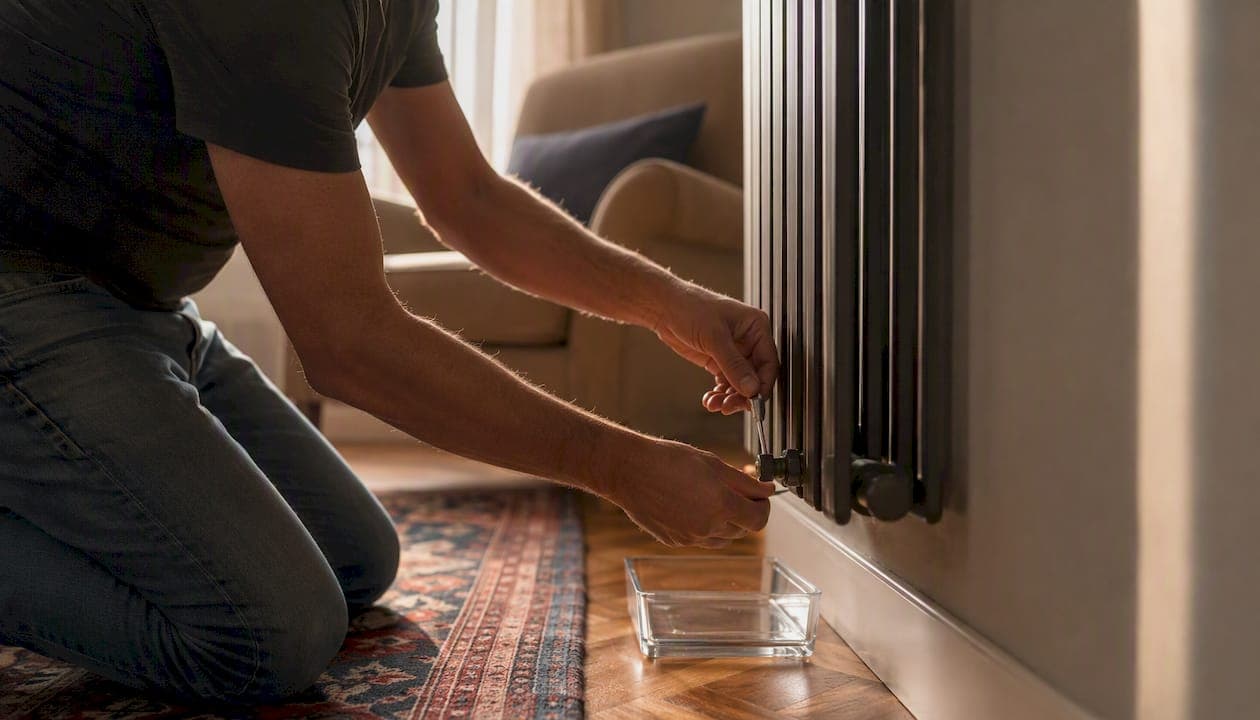
How to bleed a radiator safely:
- Turn the heating on until the system reaches normal temperature, then switch it off and wait 20–30 minutes for pressure to stabilise slightly.
- Place a towel and a small container under the bleed valve (top corner of the radiator).
- Insert a radiator key and turn it a quarter-turn anticlockwise. You will hear a hiss as air escapes.
- As soon as water dribbles out steadily, close the valve. Do not over-loosen it.
- Check your boiler pressure gauge afterwards and top up if it has dropped below 1 bar.
Call a Gas Safe engineer if you need to bleed the same radiator every few weeks. EDF Energy warns that repeated bleeding points to a failing pump or a leak admitting fresh oxygen into the system, not simple trapped air.
Typical cost: A plumber investigating repeated air ingress usually charges £80–£150 for a diagnostic visit, depending on location.
2. Radiator cold at the bottom (sludge or magnetite)
Symptom: The top of the radiator is hot but the bottom stays cold or has patchy cold spots.
This is almost always internal sludge, a black, muddy deposit called magnetite that forms when iron particles corrode inside the system. It settles at the bottom of the radiator and blocks water flow. Bleeding won't fix it.
The short-term DIY option is a chemical central heating cleaner added to the system via the feed-and-expansion tank or a radiator bleed point, followed by a flush. For severe cases, a powerflush by a heating engineer is the proper solution. DIY Doctor confirms that sludge typically needs a system flush or chemical treatment rather than repeated bleeding.
Call a Gas Safe engineer if the cold spots persist after chemical treatment, or if multiple radiators are affected. A powerflush costs roughly £300–£600 for an average home, and BestHeating notes that flushing cannot fix a radiator that is already corroded internally. Replacement may be the better call.
3. Radiator not heating at all
Symptom: The radiator is completely cold even when the heating is running.
Work through these checks in order:
- Check the TRV and lockshield valve. Both valves at the base of the radiator must be open. The TRV (usually the larger, numbered valve) should be set above 0. The lockshield (the capped valve on the other side) should be open at least a few turns.
- Check the boiler and zone controls. If multiple radiators are cold, the problem is upstream: low boiler pressure, a faulty pump, or a zone valve that hasn't opened.
- Hot water from taps but no heating? This is a classic sign of a stuck motorised diverter valve in a combi boiler. EDF Energy identifies this as one of the most common combi boiler faults, and it requires a Gas Safe engineer to diagnose and replace. See also: no hot water from taps for related boiler diagnostics.
Call a Gas Safe engineer if the boiler pressure keeps dropping, the pump is noisy or not running, or if it's a diverter valve fault.
4. Leaking radiator
Symptom: Water pooling beneath the radiator, damp patches on the wall, or visible drips from valves or fittings.
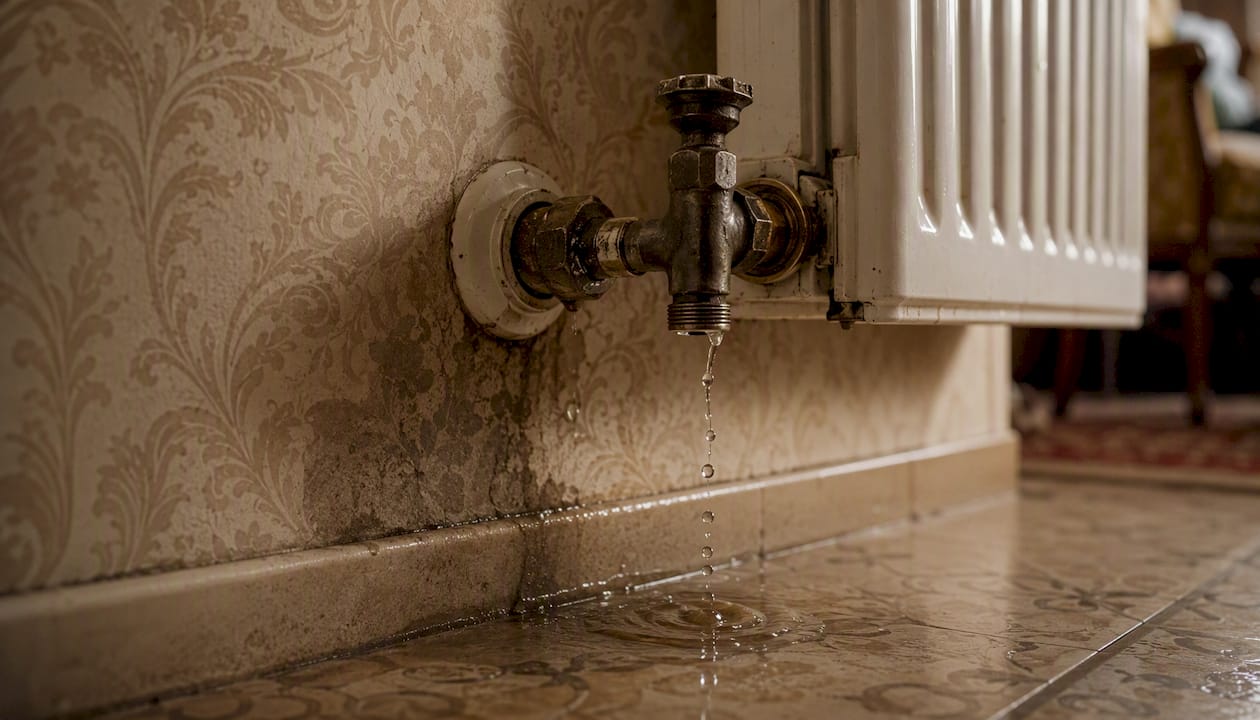
Leaks usually come from one of four places: the valve body, the bleed screw, a compression fitting (the nut connecting the valve to the pipe), or a pinhole in the radiator body itself. Each has a different fix.
Temporary measures you can take now:
- Tighten the bleed screw gently if it is the source.
- Wrap PTFE tape around a leaking valve gland or compression nut (with the heating off and the radiator isolated first).
- Place towels and a container to catch drips and reduce water damage.
- Isolate the radiator by closing both valves at the base.
For full step-by-step leak detection guidance, including how to isolate a radiator safely before a professional arrives, follow the linked procedure.
Call a Gas Safe engineer if the leak is from the radiator body itself (pinhole corrosion), if PTFE wrapping doesn't hold, or if the leak is near the boiler or pipework. A leaking boiler is a separate emergency: see is a leaking boiler an emergency.
Typical cost: Valve replacement runs £100–£200 including parts and labour. A corroded radiator replacement is typically £200–£400 fitted.
5. Noisy radiator (gurgling, kettling, or banging)
Symptom: Gurgling, clicking, banging, or a rumbling kettle-like noise from the radiator or pipes.
| Noise | Likely cause | First check |
|---|---|---|
| Gurgling | Trapped air or low water pressure | Bleed the radiator; check boiler pressure |
| Kettling (rumbling) | Limescale or sludge on heat exchanger | Descaler treatment or powerflush |
| Banging / knocking | Pipes expanding against joists, or pump cavitation | Check pipe clips; check pump speed setting |
| Hissing | Air escaping from bleed valve or loose fitting | Tighten bleed screw; check valve gland |
Gurgling is usually resolved by bleeding. Kettling is more serious and often means limescale has built up on the boiler's heat exchanger, a job for a heating engineer. Banging pipes can sometimes be quieted by fitting foam pipe lagging around pipes that run through joists, but persistent banging warrants a professional check.
6. Stuck or faulty thermostatic radiator valve (TRV)
Symptom: The radiator stays cold even though the TRV is set to a high number, or it stays hot regardless of the setting.
TRVs contain a wax or liquid-filled sensor that expands and contracts to control flow. They stick, particularly after summer when the system has been off for months. Remove the TRV head (it usually unclips or unscrews) and look at the pin underneath. If the pin is stuck down, press it in and out several times with a cloth or use pliers very gently. A freeing spray can help if it's corroded.
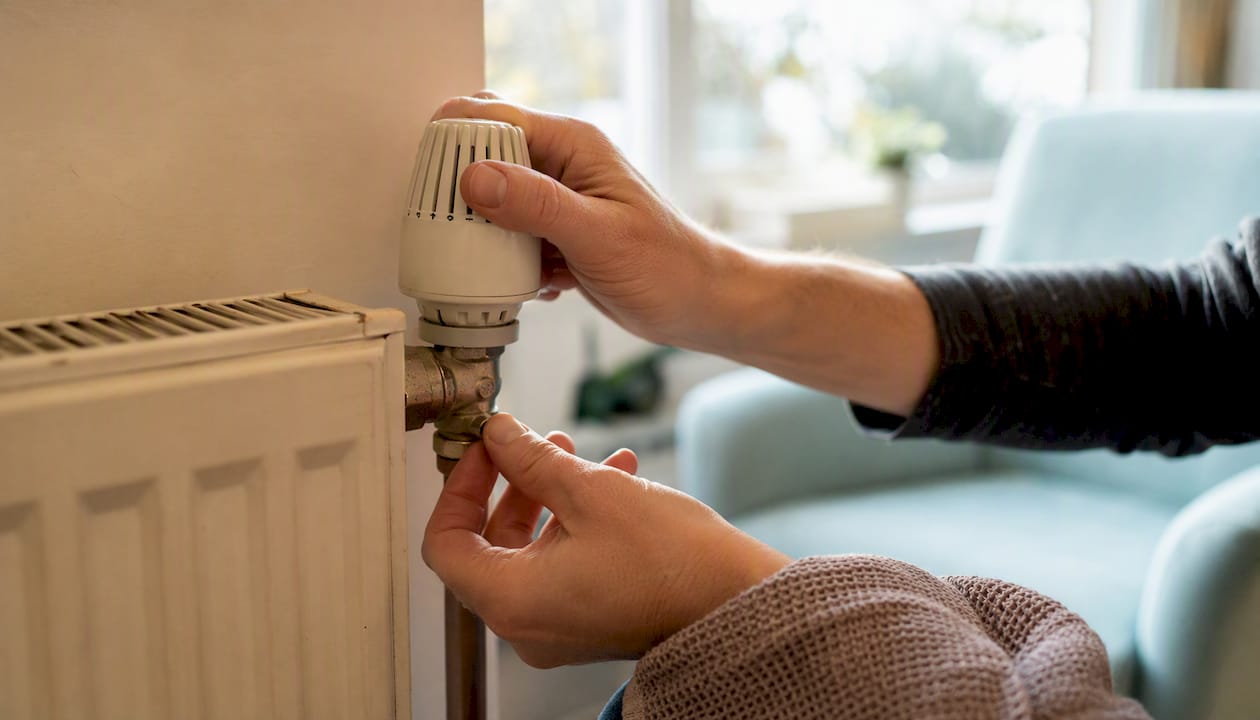
If the pin moves freely but the radiator still misbehaves, the TRV body or head needs replacing. Thermostatic radiator valves are relatively inexpensive to replace (£30–£80 for parts, plus a plumber's call-out if you're not confident with pipework).
Pro Tip: Leave at least one radiator in the house without a TRV, or fit a bypass radiator, so the pump always has somewhere to push water when all TRVs close simultaneously.
7. Uneven heating across the house (system out of balance)
Symptom: Radiators near the boiler are very hot; rooms further away stay cool even at the same TRV setting.
This is a balancing problem. Hot water takes the path of least resistance, so radiators closest to the boiler get the most flow. Balancing adjusts the lockshield valves to restrict flow to the nearest radiators and redirect it to those further away. It's one of the most overlooked fixes in domestic heating, and it costs nothing to attempt yourself. Full guidance is in Section 5 below.
8. Radiator heating when it should be off
Symptom: Radiators stay warm or hot after the heating has been switched off, or heat up at the wrong time.
Two causes dominate. The first is thermosyphoning: hot water circulates by convection even when the pump is off, because the system isn't properly balanced or the check valve has failed. The second is a faulty zone valve or programmer that isn't closing the circuit correctly.
Check your programmer and room thermostat settings first. If those are correct and the radiators still heat up uninvited, the zone valve or motorised valve likely needs replacing. This is a job for a qualified engineer.
9. Signs of corrosion and rust
Symptom: Orange or brown staining on or around the radiator, discoloured water when bleeding, or visible rust patches on the panel.
Homebuilding notes that modern radiators typically last around 10–15 years, but failures are often driven by internal corrosion from untreated system water rather than age alone. Discoloured water when you bleed a radiator is a reliable early warning: it means corrosion is already underway.
External rust patches that feel soft or show pinhole weeping mean the radiator body is compromised. At that point, no amount of inhibitor will save it. Replacement is the right call, and BestHeating confirms that a powerflush cannot restore a radiator with physical corrosion damage.
10. How to isolate a radiator safely before any DIY fix
Before you loosen any fitting, tighten any valve, or attempt to remove a TRV head, isolate the radiator properly.
- Turn the TRV to 0 (or fully clockwise).
- Close the lockshield valve on the other side by turning it clockwise until it stops. Count the turns so you can reopen it to the same position.
- Place towels on the floor and a container under any fitting you plan to touch.
- If you need to drain the radiator fully, attach a hose to the bleed valve and run it to a drain before opening it.
Never work on a pressurised, hot system. Let it cool completely first.
Preventive maintenance: what to do and when
Most of the faults above are preventable. A short annual routine keeps the system running efficiently and extends radiator life well beyond the typical 10–15 year mark.
Annual maintenance checklist:
- Book an annual boiler service with a Gas Safe registered engineer. A boiler service catches pressure faults, pump wear, and heat exchanger scaling before they become breakdowns.
Pro Tip: A chemical inhibitor is the single most cost-effective thing you can add to a central heating system. It prevents magnetite sludge from forming, which is the root cause of cold bottoms, noisy pipes, and premature radiator failure. Add it via a bleed point or the feed-and-expansion tank — the bottle label will tell you which method suits your system type.
The Homebuilding guide on central heating lifespan confirms that water quality and inhibitor treatment matter more to radiator longevity than the brand or age of the radiator itself.
At-home flushing (filling and draining the system a few times) can shift light deposits, but it won't clear heavy magnetite sludge. For that, a powerflush by a heating engineer is the proper solution.
When should you call a Gas Safe engineer?
Some faults are genuinely safe to investigate yourself. Others are not. Here is a clear dividing line.
Call a qualified engineer if:
- You smell gas anywhere near the boiler or pipework. Leave the property and call the National Gas Emergency Service on 0800 111 999.
- A leak is coming from the boiler itself, or from pipework you cannot isolate.
- You need to bleed the same radiator repeatedly (more than once a month).
- You have hot water from taps but no central heating, which points to a diverter valve fault.
- The boiler pressure drops repeatedly even after you top it up.
- The pump is noisy, running hot, or not running at all.
- A zone valve or motorised valve needs replacing.
- You suspect heavy sludge requiring a powerflush.
- Any radiator shows pinhole leaks or soft rust patches on the body.
- There are electrical faults with the boiler or controls.
What to expect on a professional visit: The engineer will check system pressure, inspect valves and the pump, run the boiler through its cycle, and advise on whether a flush, component replacement, or full radiator swap is needed. Always verify Gas Safe registration before any engineer works on your boiler or gas pipework.
Ballpark costs for common professional jobs:
| Job | Typical cost range | Typical time |
|---|---|---|
| TRV replacement | £80–£150 | 1–2 hours |
| Radiator valve replacement | £100–£200 | 1–2 hours |
| Full radiator replacement | £200–£400 | 2–4 hours |
| Powerflush (average home) | £300–£600 | 4–8 hours |
| Diverter valve replacement | £150–£300 | 2–3 hours |
| Annual boiler service | £80–£120 | 1–2 hours |
Costs are indicative ranges for the UK and vary by location, access, and parts. Always get a written quote before work begins.
Balancing your radiators: the fix most homeowners miss
Balancing means adjusting the lockshield valves across your system so that hot water is distributed evenly, rather than flooding the nearest radiators and barely reaching the furthest ones. It costs nothing and often cures rooms that have been cold for years.
When balancing is worth trying:
- Radiators near the boiler are noticeably hotter than those in distant rooms.
- Bleeding has not improved the cold rooms.
- The system pressure and pump are working normally.
- There is no evidence of heavy sludge (no cold bottoms, no discoloured bleed water).
Basic balancing steps:
- Open all lockshield valves fully (turn anticlockwise until they stop). Note how many turns each one takes.
- Turn the heating on and let it run for 20 minutes.
- Feel or measure the temperature of each radiator. The ones closest to the boiler will be hottest.
- Starting with the hottest radiator, close its lockshield valve by a quarter-turn clockwise. Wait 10 minutes and feel again.
- Repeat, making small adjustments only, working from the hottest radiator toward the coolest.
- The goal is for all radiators to reach roughly the same temperature within a similar time.
Pro Tip: An infrared thermometer (available for under £20 from most DIY retailers) makes this process far more accurate than guesswork. Aim for a flow-to-return temperature difference of around 10–12°C across each radiator. Record your lockshield positions before you start so you can reset if something goes wrong.
Balancing will not fix a sludge-blocked radiator or a failing pump. If adjustments make no difference, or if one radiator stays stubbornly cold regardless of valve position, the problem is elsewhere and a heating engineer should take a look. The DIY Doctor guide covers balancing in more detail for those who want the full procedure.
Key takeaways
Most radiator faults are diagnosable at home, but repeated bleeding, persistent leaks, or a stuck diverter valve all need a Gas Safe registered engineer.
| Point | Details |
|---|---|
| Bleed first, then investigate | A cold top means trapped air; bleed it, but investigate further if it recurs monthly. |
| Sludge needs more than bleeding | Cold bottoms mean magnetite; use a chemical inhibitor or arrange a powerflush. |
| Annual service prevents most faults | Book a Gas Safe engineer each year to catch pressure, pump, and heat exchanger issues early. |
| Know your red flags | Gas smell, persistent leaks, diverter valve faults, and electrical boiler issues all need a professional. |
| Your-local-plumber covers it all | From valve replacements and powerflushing to emergency leak repairs, Your-local-plumber provides transparent fixed pricing and 24/7 availability across the UK. |
The faults homeowners keep missing
Most call-outs I attend could have been caught earlier. The two that come up most often are a stuck TRV pin after a long summer and a system that's never been balanced. The TRV fix takes five minutes with a cloth and a bit of patience. Balancing takes an afternoon but can transform how evenly a house heats. Neither requires a professional.
What does require one is anything involving the boiler internals, gas pipework, or a diverter valve. I've seen homeowners spend weeks bleeding radiators when the real problem was a pump running at the wrong speed or a zone valve that had seized. If bleeding the same radiator more than once a month, or if hot water works fine but the heating doesn't, stop the DIY and get a Gas Safe engineer in. Those two symptoms together almost always mean a diverter valve fault, and it won't resolve itself.
The other thing worth saying: inhibitor is cheap. A bottle of Fernox F1 or Sentinel X100 costs around £15–£20 and protects the entire system. Most of the corroded radiators I replace could have lasted another decade with proper inhibitor treatment. Add it, check it every two years, and the rest of the top radiator problems on this list become far less likely.
Your-local-plumber: fast, local help when DIY isn't enough
When the fault is beyond a bleed key and a bottle of inhibitor, you need someone on-site quickly, with the right parts and a clear price before work starts.

Your-local-plumber handles the full range of radiator and heating faults: valve replacements, TRV swaps, powerflushes, full radiator replacements, and emergency leak repairs. Every job comes with transparent, fixed pricing so there are no surprises on the invoice. Engineers are available 24/7 for emergencies and carry common parts as standard, which cuts the time between diagnosis and fix.
To book a visit or get a same-day quote, call or book online at your-local-plumber.co.uk. If you're not sure whether your fault needs a professional, the team can advise over the phone before anyone comes out.
Useful sources
- Diagnosing Radiator and Heating System Problems and Fixing Them
- 8 reasons why your radiator isn't heating up (and how to fix it) | EDF
- Common Radiator Problems and How to Fix Them | Geyser UK
- How long does central heating last? | Homebuilding
- Is it time to replace your old radiators? | BestHeating
- Central heating does not work: fix it fast
- Step-by-step leak detection: Find and fix water leaks