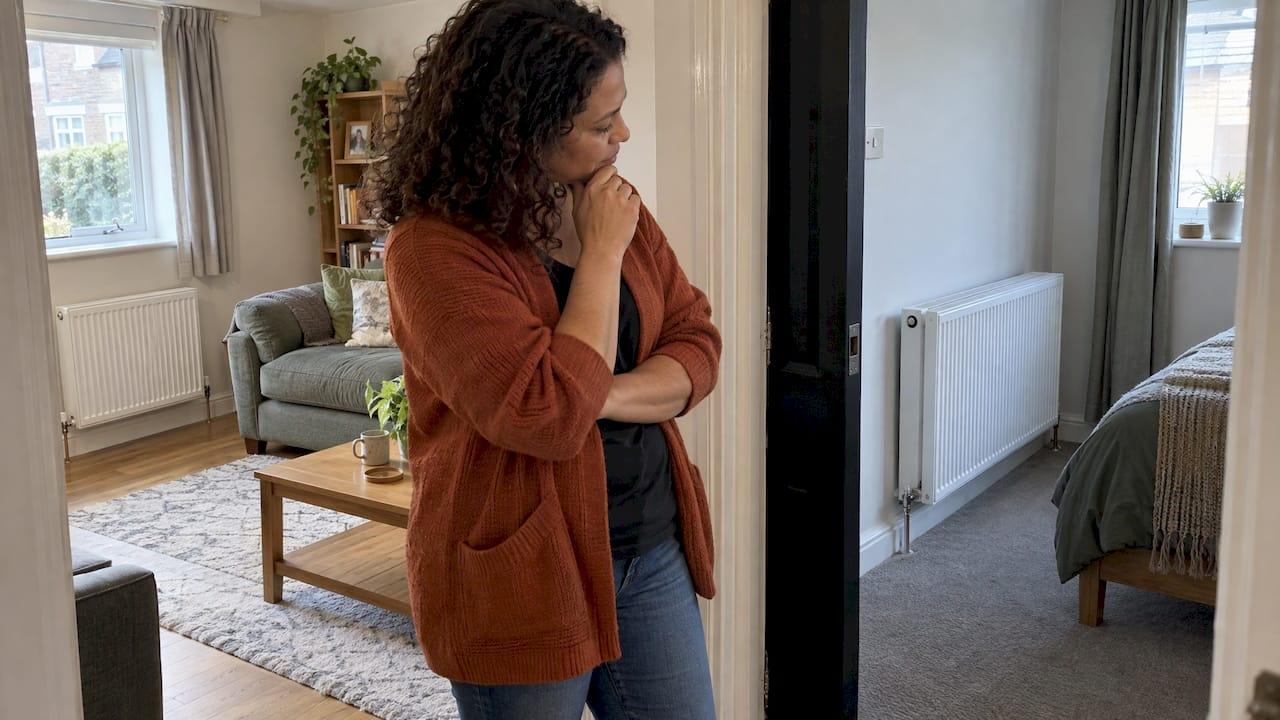
A double panel radiator gives out more heat than a single panel radiator of the same height and width, because it has more surface to warm the room. A single is thinner, cheaper and often the better fit for small rooms, hallways and bathrooms. Which one is right depends on how much heat the room loses, how your system runs and how much wall depth you can spare. If you are swapping one for the other, a heating engineer should check the pipework, valves and boiler first, and that is a job we do every day for homeowners across Reading, Oxford, Newbury, Bristol and the surrounding towns.
TL;DR
- Type 11 is a single panel with one fin, Type 21 is a double panel with one fin, and Type 22 is a double panel with two fins. The more panels and fins, the more heat from the same wall space.
- On average, Type 21 gives about 40% more output than a single and Type 22 about 80% more, but a Type 22 is also about 100 mm deep against 57 mm for a single.
- Size the radiator to the room's heat loss, not to the gap on the wall. Insulation, windows and external walls matter as much as floor area.
- A like-for-like swap is usually possible, but valves, wall fixings, water volume and boiler load should be checked by an engineer.
- If you run, or plan to run, a lower flow temperature, a radiator delivers less than its label says, so a larger or double unit may be needed.
Table of Contents
- What single and double radiators actually are
- How much more heat does a double give out?
- Type 21 vs Type 22: is the second fin worth it?
- When a single radiator is the right call
- How to choose for a specific room
- Swapping a single for a double (or the reverse)
- Does a double cost more to run?
- Our approach: radiator choice is a heat-loss question
- Getting the swap done properly
- Quick decision guide
- FAQ
- Sources
What single and double radiators actually are
A panel radiator is a flat steel panel that hot water runs through. Fitted to the panel are thin, folded metal strips called convector fins. They give the water more surface to warm the air passing through, so warm air rises and circulates more effectively.
The naming comes down to two digits: the first is the number of water panels, the second is the number of fin sets. Wickes defines the three types you will meet most often like this:
| Type | Panels | Fin sets | Typical depth |
|---|---|---|---|
| Type 11 (single) | 1 | 1 | 57 mm |
| Type 21 (double panel, single fin) | 2 | 1 | 67 mm |
| Type 22 (double panel, double fin) | 2 | 2 | 100 mm |
Manufacturers use their own labels. Stelrad's guide, for example, identifies K1 as Type 11, P+ as Type 21 and K2 as Type 22. If you see K1, K2 or P+ on a quote or an old radiator, that is the same system.
So when people search for "single panel vs double panel", they are really choosing between Type 11 and either Type 21 or Type 22. And when they search "Type 21 vs Type 22", they are choosing between one and two fin sets inside a double panel.
How much more heat does a double give out?
The short answer is a lot more, from the same height and width. Wickes states that on average Type 21 delivers 40% more than a single, Type 22 delivers 80% more than a single and 25% more than a Type 21.

A worked example from one manufacturer range makes it concrete. PlumbXtra's comparison of 600 mm high by 1,000 mm wide Kartell radiators at the standard test condition lists 950 W for Type 11, about 1,415 W for Type 21 and 1,835 W for Type 22. That is roughly 49% and 93% more than the single. The exact percentages vary by maker and model, which is why the averages above are a guide and not a promise.
Two points help when you compare figures:
- Watts and BTU are the same measure in different units. Radiator output is quoted in BTU or watts, and BTU is still widely used in the UK. Compare like with like.
- Check the test condition. Published outputs are measured at ΔT50 under BS EN 442, which means 75°C flow, 65°C return and a 20°C room. ΔT is simply the gap between the average water temperature in the radiator and the room temperature. If two radiators are quoted at different ΔT values, the numbers cannot be compared.
Type 21 vs Type 22: is the second fin worth it?
Both have two water panels. Type 21 has a single fin set and is about 67 mm deep. Type 22 has two fin sets and is about 100 mm deep, and Wickes says it averages 25% more output than a Type 21.
The second fin set is what you pay for in depth. Type 22 is the better choice when:
- the wall space is limited and you cannot go longer or taller, but you can go deeper;
- the room is big or hard to heat, where Stelrad says K2 (Type 22) and K3 (Type 33) are generally the highest-output standard compact options;
- you want to replace a long, low radiator with a shorter, more compact one while keeping the same output.
Type 21 is the better choice when you need more heat than a single can give but the room is not especially cold, or when the extra 30 odd millimetres would stick out too far into a walkway, behind a door or beside furniture.
One more factor: airflow. Convection supplies around 60 to 75% of the usable heat from most modern panel radiators, and the same source says blocked airflow can cut output by 15 to 30%. A deep Type 22 hidden behind a sofa or a full-length curtain will underperform. Leave space above and below it.

When a single radiator is the right call
A double is not automatically better. A correctly sized single is the sensible pick in several situations:
- Narrow spaces. Double panels stick out further from the wall, so a single can be more practical in narrow hallways, bathrooms or anywhere a door or walkway could be obstructed.
- Small, well-insulated rooms. Heat and Plumb says small, well-insulated rooms and constrained locations often suit correctly sized singles.
- Rooms you want to warm quickly. A single has less metal and less water to heat, so it responds sooner. A double holds more water, so it takes a little longer to come up to temperature.
- Budget. Singles use less material and cost less to buy.
A double earns its place in large rooms, rooms with poor insulation, several external walls or big windows. The same guide says these may justify a double's greater output.
How to choose for a specific room
Do not choose by the size of the gap on the wall. Stelrad's advice is to size from a heat-loss calculation, because output depends on panel count, fin count, size and system flow temperature.
Step 1: Work out the room's heat requirement
Start with the volume: length × width × height in metres. Hudevad gives a rough indicative figure of room volume in cubic metres multiplied by 67 watts, and says plainly that it is guidance only and professional advice may be needed.
A worked example: a living room 5 m × 4 m with a 2.4 m ceiling is 48 m³. At 67 W per cubic metre that is about 3,216 W, or roughly 11,000 BTU. That is a starting point, not a final answer.
Step 2: Adjust for the things that change heat loss
High ceilings, large areas of glazing, poor insulation, several external walls and exposure all push the requirement up. Heat and Plumb recommends allowing for insulation, external walls, window size and orientation before deciding between single and double. A north-facing Victorian bedroom with a bay window needs a very different radiator from a south-facing, well-insulated new-build bedroom of the same floor area.
Step 3: Match the output to the system's flow temperature
This is the step most people miss. The labelled output assumes a 75°C flow. Modern boilers are often set lower to run efficiently, and heat pumps run lower still. In a system running at 55°C flow and 45°C return (ΔT30), the correction factor is 0.51, so a radiator rated at about 5,800 BTU at ΔT50 delivers only about 2,975 BTU. A radiator that was fine at 75°C can feel weak at 55°C.
If you have or plan a heat pump, the effect is bigger: rooms previously served by a single may need a double or a larger radiator. Upgrading to double panels is one way to compensate, and it is worth doing before you commit to buying.
Step 4: Check the space
Measure the available height, width and depth, including skirting boards, window sills, furniture and door swings. Then check the clearance around the radiator so air can circulate. If a room needs a lot of heat, rooms above about 8,000 BTU may be better served by two smaller radiators than one very large one.
Swapping a single for a double (or the reverse)
It is generally possible. Replacing a single with a double of about the same height and width is usually doable, but the extra output should be checked against the boiler and the wider heating system by a heating engineer or plumber.
Here is what has to be considered on the day:
- Valve and pipe alignment. With the same width, the valves should line up with the existing pipes, but because the double is deeper, angled or offset radiator valves may be needed.
- Weight and water volume. Double radiators hold twice as much water and are far heavier, so plasterboard or stud walls need fixings into studs or heavy-duty anchors rated for the load, according to the same guide.
- The system as a whole. Extra output in one room changes how the rest of the circuit behaves. The radiators may then need rebalancing. Our guide to balancing radiators explains why, and our piece on thermostatic radiator valves shows how to keep each room at its own temperature once the new unit is in.
- Boiler capacity. Adding several double panels to a system built around singles can change what the boiler needs to deliver. Our article on boiler sizing covers the principle.
After any radiator is changed, air in the circuit and cold spots are the usual early symptoms of something off. Our common radiator problems checklist walks through them.
Drain-down, refilling and reconnecting a heating circuit is where homeowners tend to run into trouble: a missed valve, a leak at a compression joint, a radiator that never fully fills. Our engineers handle radiator swaps as part of heating work, and we offer a no fix, no fee guarantee with payment only after successful work.
Does a double cost more to run?
Not in the way people assume. A radiator does not use energy on its own: your boiler does. What matters is how long the boiler needs to run, and at what temperature, to bring the room to the temperature you want.
A correctly sized double panel can reach the target temperature at a lower flow temperature than an undersized single would need. That is because flow temperature defines surface temperature, and surface temperature defines how much heat the room receives. The same source says a 10°C drop in flow temperature reduces output by 25 to 35%. Rooms that struggle to warm up with a single are often better served by a larger emitter running at a gentler temperature. Boiler efficiency also plays a part, and our overview of boiler efficiency explains it.
Our approach: radiator choice is a heat-loss question
We are asked "single or double?" almost every time a homeowner is replacing an old radiator, and the honest answer is that the question comes too early. The right first question is how much heat that room loses and what temperature your boiler runs at.
Our approach is simple. We look at the room, the pipework, the valves and the boiler together, because a radiator is only one part of a heating circuit. A double panel put on pipework that cannot carry it, or on a wall that cannot hold it, causes more problems than the original single did.
What we offer is one engineer you can speak to directly, a no call-out fee, payment only after the work is done successfully, and a 12-month warranty. If your heating needs more than a radiator, we also carry out boiler diagnostics and repairs, central heating repairs and new boiler installations.
Michael
Getting the swap done properly
If you are replacing a radiator or planning a change in heating, we can do it with you. Our heating and boiler work is charged at £110 per hour, with no call-out fee, and we are available 24/7 including holidays. If the existing radiator has failed and water is escaping, our emergency engineer response is designed to reach you within 60 minutes.

For anything that calls for a new boiler, new boilers supplied and fitted start from £1,300 as a one-off price, and you can request a new boiler quote free of charge on site. For radiator and heating jobs, you can book a plumbing or heating visit online, and for a leak or a failure outside normal hours, use the emergency engineer page. We cover Reading, Newbury, Oxford, Abingdon, Bracknell, Windsor, Basingstoke, Swindon, Bristol and many more towns across the south and Midlands.
Quick decision guide
| Situation | Usually the better fit |
|---|---|
| Small, well-insulated bedroom or box room | Type 11 single, correctly sized |
| Bathroom, hallway or landing with tight space | Type 11 single |
| Average living room or bedroom, moderate heat loss | Type 21 |
| Large room, big windows, several external walls | Type 22, or two radiators |
| Limited wall length but room for depth | Type 22 in place of a longer single |
| Lower flow temperature or planned heat pump | Larger or double panel, sized at ΔT30 |
| Radiator behind a door or in a walkway | Single, or relocate it |
Treat the table as a starting point. The final choice should rest on the room's heat loss and your system, which is exactly what a site visit settles.
FAQ
Is a double radiator always better than a single?
No. A double gives more output from the same height and width, but it is deeper and heavier, and it takes longer to warm up. In a small, well-insulated room or a narrow hallway, a correctly sized single is often the better fit.
What is the difference between a Type 21 and a Type 22 radiator?
Both have two water panels. Type 21 has one set of convector fins and is about 67 mm deep, while Type 22 has two sets and is about 100 mm deep. Wickes says Type 22 averages 25% more output than Type 21 at the same height and width.
Can I replace a single radiator with a double one?
Usually yes, if the height and width are about the same. The valves, wall fixings and the extra water volume need checking, and the added output should be checked against your boiler and system. An engineer can confirm all of this on the day.
Will a double radiator make my room warmer?
It will if the room was under-heated and the system can supply enough hot water. If the cause is air in the system, a poorly balanced circuit or a failing valve, a bigger radiator will not fix it. Our guide to bleeding radiators is a good first check.
Do I need a double radiator for a heat pump?
Often you need more emitter area, because heat pumps run at lower flow temperatures than gas boilers. That reduces each radiator's output against its label, so rooms served by a single may need a double or a larger radiator. Have the room's heat loss calculated at the planned flow temperature before you buy.
Sources
- Radiators buying guide | Wickes
- A Guide to the Best Radiators for Heat Output | Stelrad
- Type 21 vs Type 22 Radiator: Sizes, BTU & Prices | PlumbXtra
- What is the difference between single and double panel radiators
- Radiator BTU Chart: Sizes and Outputs (UK Guide)
- Radiators in Modern Heating: Flow Temperature and Heat Output
- The difference between single and double convector radiators
- Single vs. Double Radiators: Which One Do You Need?
- Radiator guide | Hudevad
- Radiators: Types, Sizing for Part L 2021, Installation
- Single vs Double Radiator: Which Should You Choose?
- BTU Calculator: How To Size Your Radiator for Any Room
- Single, Double & Triple Panel Convector Rads - Explained
- How to Replace a Single Radiator With a Double Radiator