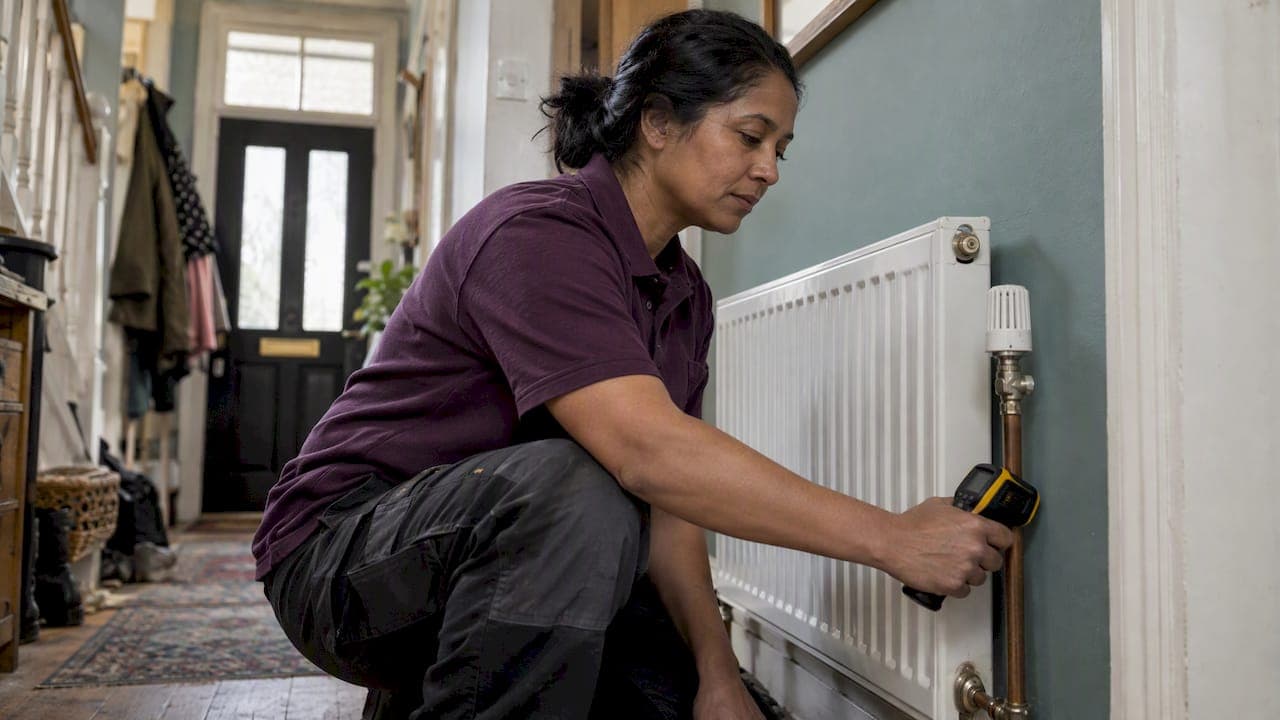
Balancing radiators means adjusting the lockshield valve on each one so hot water is shared evenly around the whole system. Without it, the radiators nearest the boiler hog the flow and the ones furthest away stay lukewarm. You need a radiator key, a lockshield adjuster or small spanner, a thermometer and about two hours. This guide takes you through the job in order, explains which way to turn the valves and tells you where DIY should stop.
TL;DR
- Balancing restricts flow to the radiators that heat first, so water reaches the ones that heat last. Bleed every radiator first.
- Start with the heating off and every radiator cold. Open all valves fully, then close the lockshield on the first radiator to heat up, then the next, working outwards.
- Turn a lockshield clockwise to close it and anticlockwise to open it. Leave a few minutes after each adjustment.
- A temperature drop of about 12°C between the flow and return pipes on each radiator is the usual target.
- If a valve leaks, the system will not settle or you have a combi or new boiler to commission, call an engineer.
Table of Contents
- What balancing radiators actually does
- Signs your radiators need balancing
- What you need before you start
- How to balance radiators, step by step
- Which way do you turn a lockshield valve?
- A worked example
- Why radiators can still heat unevenly afterwards
- When to call an engineer
- Need a hand balancing your heating?
- Our perspective: balance is the cheapest upgrade you have not tried
- FAQ
- Sources
What balancing radiators actually does
Hot water leaves your boiler and takes the easiest route. In an unbalanced system that means the radiators closest to the boiler fill and heat quickly, while those at the far end of the pipework get little flow. The HHIC consumer guide to balancing describes balancing as optimising how water is distributed through the radiators by adjusting the lockshield valves, so that the system delivers the intended temperature in each room.
The same guide notes that once a system is balanced, radiators heat up at an even rate. In most cases the boiler can then run at a lower temperature, which improves efficiency. That is the real payoff: not just warmer back bedrooms, but a boiler that does not have to work as hard to compensate for a poor distribution of water.
Industry commentary suggests the job is sometimes skipped when domestic systems are installed and commissioned, according to a Danfoss installers' guide to hydronic balancing. So a system that has never been balanced is more common than you might expect, including in fairly new homes.
Signs your radiators need balancing
You probably need to balance your system if you recognise any of these:
- Some rooms are boiling while others never reach a comfortable temperature, even with the heating on for hours.
- Radiators near the boiler get hot within minutes while those upstairs or at the end of a pipe run take a long time.
- Thermostatic radiator valves (TRVs) hiss or whistle. The HHIC guide says valves given too much flow can become noisy.
- You have added, removed or replaced a radiator recently. Changing one affects the rest.
Balancing is not the fix for every cold radiator. If a radiator is cold at the top, the cause is usually trapped air. If it is cold at the bottom, it is often sludge or a blockage. Rule these out first with our guides to a radiator cold at the top and a radiator cold at the bottom. For a wider checklist, see common radiator problems and quick fixes. If the whole system is dead rather than uneven, start with what to do when central heating does not work.
What you need before you start
Gather these before touching a valve:
- A radiator bleed key.
- A lockshield valve adjuster, or a small adjustable spanner. Some lockshields take a flat screwdriver.
- A digital thermometer, or a multimeter with a temperature probe. Infrared guns can work, but readings on shiny or painted pipework can mislead, so a clip-on or contact probe is better.
- A notepad and pen to record which radiator heats in which order, and how far you closed each valve.
- Old towels and a small bowl, in case a valve weeps.
The Stelrad guide to balancing a system lists the same basic kit and says to bleed the radiators, turn the heating off and let everything cool before you begin. Bleeding matters because trapped air blocks flow and makes the readings meaningless. If you have not done it before, our guides to radiator bleeding best practice and a ten-minute bleed for air in central heating walk you through it.
Check the system is ready
A few checks save frustration later:
- Bleed every radiator, starting downstairs and finishing upstairs, then check the boiler pressure on its gauge and top it up if your boiler manual says to.
- Make sure no radiator has a stuck valve or a visible leak.
- Set the room thermostat high enough that the boiler will keep firing while you work.
- Pick a day when you can leave the house warm. Balancing is slow, and cold weather outside gives you a more honest test than a mild afternoon.
If you are also thinking about changing what heats your home, for example moving to low-temperature emitters, it is worth understanding heat pump emitters and convectors before you decide, because a well-balanced system makes any low-temperature setup easier to run.
How to balance radiators, step by step
This is the standard method, drawing on the Stelrad and Vaillant guidance.
Step 1: open everything
Turn every radiator valve fully open. On a TRV, set the head to maximum. On the lockshield valve, which is the plain valve at the other end of the radiator, remove the plastic cap and open it fully by turning anticlockwise. Write down that all are open.
Step 2: note the heating order
Turn the heating on. Walk round and touch each radiator, or use your thermometer, and write down the order in which they get hot. Vaillant points out that radiators closer to the boiler typically heat first, so expect your list to follow the pipework. Let every radiator reach full temperature, which can take a while for the last one.
Step 3: let it cool
Turn the heating off and wait until every radiator is cold. Hurrying this step is the commonest reason a DIY balance goes wrong, because warm radiators hide the differences you are trying to correct.
Step 4: restrict the first radiator
Turn the heating back on. Go to the radiator that heated first. Close its lockshield valve clockwise until it is almost shut, then open it back by a set amount. Industry practice, described in the Danfoss guide, is to restrict the hottest radiators by around 50 to 60 per cent to begin with and then monitor performance. Treat that as a starting point rather than a rule, because every house differs.
Step 5: work outwards
Move to the second radiator on your list and restrict it slightly less. The third gets a smaller restriction again. The last radiator on the list stays fully open. After each change, wait a couple of minutes so the temperature can respond before you judge the result.
Step 6: measure the temperature drop
This is the part many guides skip. Use your thermometer on the pipe going into the radiator and the pipe leaving it, near the valves. Stelrad suggests aiming for a difference of 12°C between the two readings. If the drop is much bigger, the radiator is getting too little flow, so open its lockshield a touch. If it is much smaller, close it slightly. Go round the whole house, then go round again, because every change affects the others.
Step 7: refit caps and record settings
Once the readings are close on every radiator, refit the lockshield caps. Note how many turns each valve is open, ideally on a card kept near the boiler. If you ever drain the system or replace a radiator, you can return to those settings instead of starting from scratch.
Which way do you turn a lockshield valve?
Clockwise closes it and anticlockwise opens it, as Viessmann's balancing guide puts it: right to close, left to open. Use gentle pressure and a snug-fitting tool. Lockshield spindles are small and soft, and forcing them can round the flats or loosen the gland, which is how leaks start.
Do not mistake the lockshield for the TRV. The TRV, with the numbered head, responds to room temperature and is for you to adjust day to day. The lockshield is a set-and-forget valve that governs flow. Our explainer on the role of thermostatic radiator valves covers how the two work together.
A worked example
Suppose a three-bedroom semi has seven radiators. After step 2 your list reads: hall, living room, kitchen, bathroom, bedroom 1, bedroom 2, bedroom 3. The hall and living room are scorching, bedroom 3 barely warm.
You close the hall lockshield most of the way, the living room slightly less, the kitchen a little less again, and so on. Bedroom 3 stays fully open. When you measure, the hall radiator shows a 20°C drop between pipes, so you open it a quarter turn. Bedroom 3 shows 6°C, which usually means it has plenty of flow but is not emitting much heat, so you check it for trapped air and then look at whether it is simply undersized for the room.
This is the pattern in many homes: the first pass gets you most of the benefit, and the second and third passes sharpen it.

Why radiators can still heat unevenly afterwards
If results are patchy after balancing, work through these causes:
- Interaction between radiators. The HHIC guide warns that a change to one radiator can affect all the others, so a single tweak can undo earlier work. Go round more than once.
- Air or sludge. Cold spots at the top or bottom of a radiator are not a balance problem. Bleed and, if needed, have the system flushed.
- TRVs closing. Once a room reaches temperature, its TRV shuts and flow shifts to the other radiators. That is normal and why the system should be balanced with the TRVs fully open.
- Mild-weather behaviour. Danfoss points out that lockshield valves are a common but time-consuming and not very accurate method, and settings tuned for cold winter days can deliver more flow than needed on milder days. Dynamic valves exist that limit flow automatically, but they are an upgrade rather than a necessity.
- Pump speed or boiler settings. A pump set too low starves distant radiators. Changing it is an engineer's job.
- Undersized radiators. If a room is simply too big for its radiator, no valve setting will fix it.
When to call an engineer
Balancing looks simple, but valves are old, soft metal and the system is under pressure. Viessmann's own advice is to speak to a heating engineer, because water leaks can occur when adjusting radiator valves and the work is usually done by an engineer. Call someone in if:
- a valve spindle drips, will not turn or will not close;
- the boiler pressure keeps dropping after you have adjusted valves, or the system needs repeated bleeding;
- you have a new boiler or a recent installation that was never commissioned with a flow and return check;
- you cannot get an acceptable temperature drop on every radiator after two rounds;
- a radiator is leaking from a pipe joint. Our guide on stopping a leaking radiator pipe shows the four safe steps while you wait.
If you want a sense of what heating work costs and how to avoid paying a premium, read how to avoid emergency markups on central heating repairs.
Need a hand balancing your heating?
We carry out heating and boiler work across Reading, Newbury, Oxford, Bristol, Swindon, Milton Keynes and many other towns. Heating and boiler labour is charged at £110 per hour. There is no call-out fee, and our no fix, no fee guarantee means you pay only after the work is done successfully. Work carries a 12-month warranty, and you speak directly to the engineer. If a radiator has failed completely, our emergency heating engineer service offers a 60 minute response time. For non-urgent jobs, book through our plumbing and heating page.

If your boiler is old and no amount of balancing helps, new boilers supplied and fitted start from £1,300, and you can request a free new boiler quote.
Our perspective: balance is the cheapest upgrade you have not tried
We see the same story on many heating call-outs. A homeowner is convinced they need a bigger boiler or new radiators, when the real problem is that the water is taking the shortest path home. A couple of hours with a thermometer and a lockshield adjuster often does more than a big spend.

Our advice is practical. Bleed first, always. Do not skip the cooling-down step. Write down every setting. And be honest with yourself about the limits: if valves are seized, if the system has never been flushed, or if you are tempted to force a spindle, stop and call someone. A weeping lockshield on a Sunday evening costs far more than the call-out you were trying to avoid.
We also tell customers that balancing is not a one-off forever. Add a radiator, change a boiler or drain down for a bathroom refit, and the settings need another look. That is why we like to leave a note of the valve positions with the customer.
— Michael
FAQ
Do radiators need balancing?
Not every system does, but many benefit, especially if some rooms are always hot while others stay cold. It is also worth doing after any change to the radiators or boiler. A balanced system lets radiators warm at a similar rate and often lets the boiler run cooler.
Should I balance with the TRVs open or closed?
Open. Set every TRV to maximum so that flow is governed only by the lockshield valves. Once the system is balanced you can set each TRV to the temperature you want in that room. Closing them during the process will distort your readings.
How long does balancing radiators take?
Allow two to three hours for an average house, mostly waiting for radiators to heat and cool. The valve adjustments are quick, but each needs a few minutes before you can judge it. Larger homes with many radiators take longer, and a second pass is normal.
Can I balance radiators myself?
Yes, if the valves are in good condition and you are comfortable with a spanner and a thermometer. Be aware that valves can leak when disturbed. If you hit a problem, or the system will not even out, an engineer can finish the job and check the pump and boiler settings.
Sources
- HHIC: Consumer Guide to balancing the central heating system
- Stelrad: Balancing a system
- Danfoss: An installers' guide to hydronic balancing
- Vaillant: How to balance radiators
- Viessmann UK: How to balance radiators
- Heat pump convectors and emitters