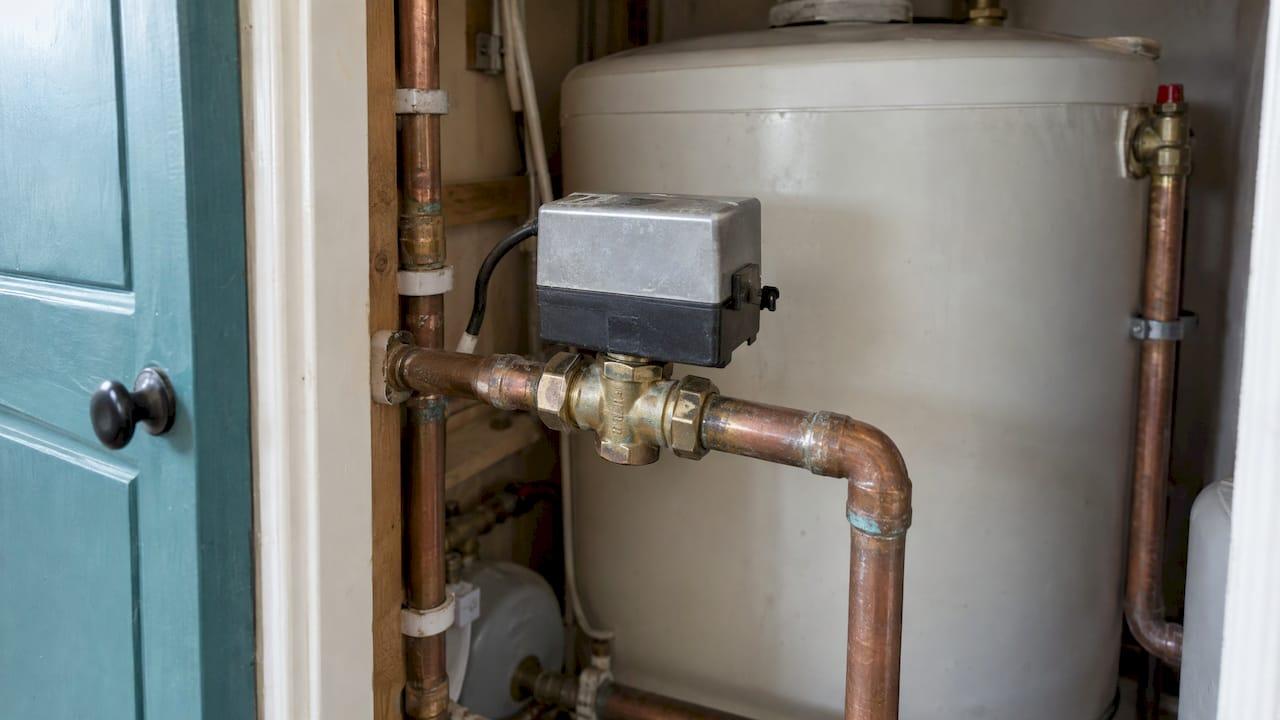
If your motorised valve is not working, the usual signs are hot water but cold radiators, radiators that stay hot when they should not, or a valve head that hums and does not move. In most cases the fault is the actuator (the motor head on top), not the brass valve body. Some quick checks are safe for any homeowner. Anything involving wiring, draining the system or replacing the valve is a job for an engineer, and our engineers cover this across Reading, Newbury, Oxford, Basingstoke, Bristol and the surrounding towns.
TL;DR
- A motorised valve (also called a zone valve or 3 port valve) is an electric gate that sends hot water from the boiler to your radiators, your hot water cylinder or both.
- Typical signs of failure: hot water but no heating, heating that will not turn off, a humming head, a stiff lever or a boiler that never fires.
- Safe checks: thermostat, timer, boiler pressure, and whether the manual lever is stuck in the MANUAL position. Do not touch the wiring without isolating the mains.
- If the head is dead but the lever moves freely, the actuator is the likely culprit. If the lever is jammed or the valve leaks, the valve body needs replacing.
- We offer a 60 minute emergency response, no call-out fee and a 12-month warranty on repairs.
Table of Contents
- What a motorised valve does in your heating system
- Symptoms: what your faulty valve is telling you
- Why motorised valves fail
- Safe checks you can do before calling anyone
- Why hot water but no central heating?
- Actuator or whole valve: what gets replaced
- When to stop and call an engineer
- Promo: fast help with valve faults
- Perspective: why we start with the symptom
- What to tell the engineer when you call
- Keeping valves working longer
- FAQ
- Sources
What a motorised valve does in your heating system
A motorised valve is a brass valve body with an electric motor head fitted on top. When your thermostat or cylinder thermostat calls for heat, the motor opens the valve. That opening also signals the boiler to fire. When the demand is met, a spring closes the valve again.
Homes in the UK usually have one of two layouts:
- S-plan: one 2 port valve for each circuit, typically one for heating and one for hot water. In this layout the boiler only fires after a valve has opened and its auxiliary switch (the grey and orange wires) has closed, as Plumbrevise's wiring guide explains.
- Y-plan: a single 3 port mid-position valve that sends water to the radiators, the cylinder or both. DIYWiki describes how, at rest, a spring holds the flow towards the hot water port, and the valve can sit in a mid position with both outlets open.
A third type, the 3 port diverter valve, sends water to only one outlet at a time. It is used where heating and hot water are never needed together.
The important point is that the boiler waits for the valve. If the valve will not open, the boiler never gets its signal and nothing heats. If the valve will not close, you get heat where you do not want it.
Symptoms: what your faulty valve is telling you
The symptom narrows down the fault before anyone picks up a tool. This table pulls together the patterns described in the Y-plan guidance from Hive's engineer app and in Siemens and Salus documentation, translated into plain terms.
| What you see | Likely cause |
|---|---|
| Hot water works, radiators stay cold | Valve stuck closed on the heating side, failed motor or failed internal switch |
| Radiators heat whenever hot water is on | 3 port valve stuck in mid position, or lever left in manual |
| Heating will not switch off | Actuator, microswitch or valve not returning on its spring |
| Head hums or buzzes but nothing moves | Motor or seized spindle |
| Boiler never fires, nothing heats | Valve not opening, so the boiler never gets its signal |
| Water around the valve | Worn seal or valve body |
| Loud banging when heating switches off | Valve closing abruptly; needs an engineer to look at the valve and pump |
If you have hot water but no heating, our guide to no hot water but the heating works covers the opposite situation, and it is worth a read for comparison because the two problems share a cause surprisingly often.
Why motorised valves fail
Motorised valves wear out in predictable ways.
Motor failure. The motor is powered the whole time the valve is held open, so it works hard. When it dies the valve stays closed, the internal switch never makes and the boiler never receives a demand, as Flameport's guide to motorised valves describes.
Microswitch failure. The microswitch tells the boiler the valve has travelled. If it fails, the boiler gets no signal even though the valve may have opened.
A seized valve body. Scale, sludge and age can make the spindle stiff. The motor then hums against a spindle that will not turn.
Wiring faults. The head may simply not be receiving its control signal, which can look identical to a dead motor.
A worn seat or seal. If the valve leaks, or radiators stay warm when they should be off, the body itself may need replacing.
The good news is that the valve body usually lasts much longer than the actuator, so a faulty motor head does not always mean a whole new valve.
Safe checks you can do before calling anyone
Motorised valves are wired to the mains. Before you do anything beyond the checks below, remember that Siemens states in its installation guide for 2 and 3 port valves that the mains must be disconnected before changing an actuator, valve or motor. Do not remove covers or touch terminals on a live system.
These checks need no tools and no wiring:
- Check the programmer and thermostat. Make sure the heating is switched on, the timer is in an "on" period and the room thermostat is set above the room temperature. Fresh batteries in a wireless thermostat solve more "valve faults" than you would expect. If the timer is the suspect, see our guide to a heating timer that is not working.
- Check the manual lever. Salus's manual for its 3 port motorised valve says that if the valve fails to work, you should confirm the heating is on and that the lever is not latched in the MANUAL position. A lever left in manual keeps the valve open and the actuator out of the loop.
- Look at the boiler. Note any error code and check the pressure gauge. Many boilers want roughly 1 to 1.5 bar when cold. If it has dropped, a low-pressure lockout can look like a valve fault.
- Listen. Humming without movement points at the motor or a seized spindle. Silence when the heating should be calling for heat points at the motor, the wiring or the control signal.
- Look, do not touch. Check for drips or staining around the valve body. Any leak means stop and book an engineer.
- Check the pump. A stopped pump can mimic a valve fault. Our guide to a heating pump not working lists the signs. Note that the valve's end switch only confirms the valve moved, not that water is flowing, which is why the pump needs its own check.
For a step by step version of the stuck valve check, see our guide on how to diagnose a stuck zone valve safely.
Using the lever to tell actuator from valve
On many valves the manual lever gives a useful clue. If the lever moves freely and the valve is dry, the body is probably fine and the actuator has failed. If the lever is stiff or jammed, the valve body has probably seized. Move it gently and never force it. A forced lever on a seized valve can snap or start a leak, and that turns a small repair into a drain-down.
This is also why heating engineers like to know the make and age of your valve. Older actuators were fitted as a complete assembly, while most modern ones come off and go back on quickly. Whichever you have, we deal with it on the day rather than leaving you waiting for a part order where we can avoid it.
Why hot water but no central heating?
This is the most common version of the problem. On a system with motorised valves, hot water and heating are controlled separately. If the heating valve is stuck closed or its motor has burned out, the cylinder still heats but the radiators stay cold.
On a Y-plan, the pattern tells you more:
- Hot water works but heating-only mode does nothing: the valve's internal switch may have failed, so the heating demand never reaches the boiler.
- Valve motor dead: the valve sits at the hot water port, so water never reaches the radiators.
- Radiators and hot water always come on together: the valve is stuck in mid position or the lever is in manual.
Before you decide it is the valve, rule out stuck thermostatic radiator valves (a stuck pin in a TRV can leave one radiator cold, which is a different problem; see our guide to a stuck TRV pin) and a boiler that is ignoring your thermostat (see boiler not responding to thermostat). If every radiator is cold and the hot water is fine, the valve is high on the suspect list.
Actuator or whole valve: what gets replaced
This decision drives the cost, so it is worth understanding.
The actuator alone is replaced when the fault is electrical or about switching: a dead motor, a failed microswitch or a head that will not return. The lever still moves, the body does not leak and the spindle turns freely. On most modern valves the head comes off without draining the system, after the power has been isolated.
The whole valve is replaced when the body leaks, the seat is worn or the spindle has seized. That means draining part of the system, fitting a like for like valve the right way round, refilling, venting air and checking for leaks before the head is wired back in.
The key point is that this is the part of the job where DIY goes wrong. The wiring ties into your boiler's control circuit, the flow direction matters and a drained system must be refilled and vented properly. That is why we recommend an engineer for both routes, and why the diagnosis matters: you should not pay for a new valve when a new head would do, or fit a new head onto a valve that is jamming.

When to stop and call an engineer
Stop troubleshooting and book an engineer when:
- you can see water around the valve body
- the lever is jammed or the valve hums and does not move
- the heating stays on or the boiler runs when nothing is calling for heat
- the checks above are done and the heating is still cold
- the fix would need covers off, wires touched or the system drained
- you smell burning or the valve head is very hot
A valve that will not stop heating can overheat the hot water cylinder, so do not leave a runaway fault running. If you have a hot water cylinder and the water is dangerously hot, switch the heating off at the programmer and call for help. If a pipe is actively leaking, turn off the water at the stopcock first. If you ever smell gas, leave the property and call the National Gas Emergency Service on 0800 111 999.
Promo: fast help with valve faults
We repair motorised valves and heating faults across Reading, Newbury, Abingdon, Oxford, Bicester, Basingstoke, Winchester, Swindon, Bristol, Cheltenham and many other towns. Heating and boiler work is charged at £110 per hour. We have no call-out fee, and our no fix, no fee guarantee means you pay only after the work is done successfully. Repairs carry a 12-month warranty, and you deal directly with the engineer.

If the heating is off right now, our emergency plumbing and heating engineer service offers a 60 minute response time, 24 hours a day including holidays. For a fault that can wait, you can book a plumbing or heating visit online. If the valve is a symptom of an ageing system and you are weighing up a replacement, ask for a new boiler quote; new boilers supplied and fitted start from £1300.
Perspective: why we start with the symptom
The most common mistake we see is replacing the wrong part. A homeowner or a tired installer sees a cold radiator, assumes the whole valve is dead and fits a new one, when a free-moving lever and a dry body say the actuator is the issue.
Our view is simple. Diagnose first, then replace the smallest part that fixes the fault. That keeps your bill down and means the repair lasts. It is also why we like to talk you through what you are seeing before we arrive: whether the lever is stiff, whether the head hums, whether hot water works. It lets the engineer arrive prepared.
A valve fault is rarely a reason to panic, but it is a reason not to leave the system running with the symptoms. Heating that will not switch off and hot water that is far too hot are the ones to treat as urgent. With our no call-out fee and no fix, no fee guarantee, you can ask for an engineer without worrying that a visit will cost you money for nothing.
Michael
What to tell the engineer when you call
A few minutes of notes make the visit quicker. Have these ready:
- Whether you have hot water, radiators or neither
- Whether the fault started suddenly or built up over weeks
- Any noises: humming, buzzing or banging
- The boiler make, any error code and the pressure reading
- Whether you have one 3 port valve or several 2 port valves (a count of the brass valves near the cylinder and boiler will do)
- Whether the lever moves freely
- Any leaks or marks
That gives the engineer a head start on which part to bring, and it helps you judge a quote. A real diagnosis names the failed part and says why, rather than just proposing a bigger job.
Keeping valves working longer
Motorised valves have few moving parts but they do wear. Salus states that its valve needs no special maintenance and has no user-serviceable parts, so prevention is about the system around it:
- Have your heating serviced regularly, so sludge and scale do not reach the valves.
- Fit a magnetic filter if you do not have one, and keep the system water in good condition.
- Do not leave the heating running with a known fault. A failed microswitch can make a motor run far longer than it should, and it can burn out.
- Act on early signs: a slower heat-up, a hum or a lever that feels stiffer than it did.
If you are already replacing a valve, it is a good moment to ask for isolating valves to be fitted so the next change does not need a full drain-down. That is a standard tidy installation habit and well worth asking for.
FAQ
Why is my motorised valve not opening?
The usual causes are a dead motor in the actuator, a failed microswitch, a seized spindle or a wiring fault so the head gets no signal. First check that the heating is on, the thermostat is calling for heat and the lever is not stuck in MANUAL. If those are fine, an engineer should test the head and the valve.
Can I fix a stuck motorised valve myself?
You can safely check the thermostat, timer, boiler pressure and lever position. Anything beyond that involves mains wiring and possibly draining the system, so it should be left to an engineer. Forcing a seized lever can crack the valve and cause a leak.
Does a faulty 3 port valve mean I need a new valve?
Not always. If the lever moves freely and the body is dry, the fault is probably the actuator, which can often be replaced on its own. A leaking or seized body needs the whole valve replaced.
Why do I have hot water but cold radiators?
On a system with motorised valves, the heating valve may be stuck closed, its motor may have failed or its switch may not be signalling the boiler. Cold radiators can also come from a stopped pump, low boiler pressure or a thermostat problem, so the quick checks above are worth doing first.
How quickly can you attend a valve fault?
Our emergency heating engineer service has a 60 minute response time and runs 24/7, including holidays. There is no call-out fee, and under our no fix, no fee guarantee payment is due only after the work is completed successfully.
Sources
- Plumbrevise: motorised valve controls, S-plan and Y-plan
- DIYWiki: Motorised Valves
- Flameport: motorised valves for heating systems
- Hive engineer app: Y-plan guide
- Salus Controls: 3 port motorised valve manual
- Siemens: demountable 2 and 3 port motorised valves installation guide