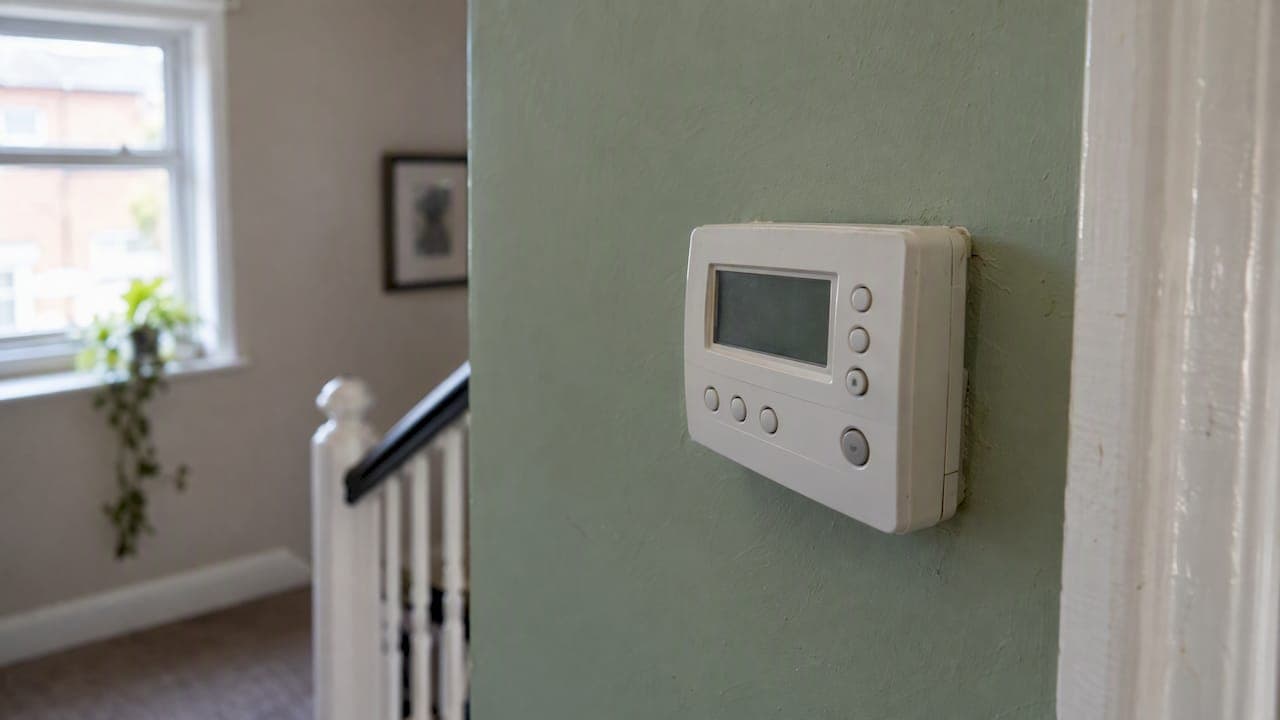
When a heating timer stops working, the cause is usually simple: no power reaching the programmer, a clock or schedule that has been knocked out by a power cut or the clocks changing, or a room thermostat that is stopping the heating from starting. Work through those checks in order and you will often have the heating back on in ten minutes. If the timer is fine and the boiler still will not respond, or the boiler has locked out, it is time for a qualified engineer.
This guide covers boiler timers and central heating programmers, whether you have a combi, a system boiler or a boiler with a hot water cylinder. It tells you what to check, what you can safely do yourself, and what should be left to a Gas Safe registered engineer.
TL;DR
- A blank display usually means no power: check the fuse, the consumer unit and the isolation switch beside the boiler.
- A power cut or a clock change can reset the time, day or schedule, so check those before anything else.
- Set the heating to permanently on and turn the room thermostat up: this tells you whether the timer or the controls are at fault.
- Never open the boiler casing or reset a locked-out boiler more than twice. Anything involving gas or combustion parts needs a Gas Safe engineer.
- If the checks fail, we can send an engineer: no call-out fee, and you only pay after the work is done.
Table of Contents
- First, work out what kind of timer you have
- Step 1: Check the display and the power supply
- Step 2: Check the time, the day and the schedule
- Step 3: Make sure the timer is actually calling for heat
- Step 4: Rule out the room thermostat
- Step 5: Check boiler pressure and lock-out
- Quick diagnosis table
- Can you replace a boiler timer yourself?
- When to stop and call an engineer
- Prevent timer problems coming back
- What a fix costs with us
- Need an engineer?
- FAQ
- Sources
First, work out what kind of timer you have
The fix depends on what is actually controlling your heating. In most UK homes, the timer is one of these:
- A built-in clock on the boiler. Common on older boilers, with small pins or a dial and an on/off/auto switch.
- A separate programmer or timer on the wall or in an airing cupboard. It switches heating and hot water on and off at set times.
- A programmable room thermostat. It combines the timer and the thermostat in one unit, usually on the hallway wall.
- A smart thermostat or app-based controller. It does the same job, but also depends on your Wi-Fi and its own power supply.
The Energy Saving Trust explains that a programmer controls when the heating comes on and off, while a room thermostat switches it off once the chosen temperature is reached. That matters, because a timer that looks dead is often a timer that is working perfectly while another part of the chain says no.
Step 1: Check the display and the power supply
Start with the obvious. If the display is completely blank, the timer is probably not getting electricity. OFTEC's consumer advice says a blank programmer display suggests it has no electricity supply, and tells you to look for three things:
- A blown fuse, for example in the fused spur that feeds the boiler or controls.
- A tripped switch in your consumer unit (fuse box).
- A heating-system power switch that has been turned off.
If a consumer unit switch has tripped, flip it back on once. If it trips again straight away, leave it off and call an electrician or heating engineer, because something is drawing too much current or has failed.
Also check the isolation switch next to the boiler. Vaillant notes that an overnight power outage can reset boiler programming and advises checking the consumer unit fuses and that the isolation switch beside the boiler is on.
If you have a wireless or smart controller, check its batteries too. A receiver near the boiler and a thermostat on the wall often run on separate power, so one can be dead while the other looks fine.

Step 2: Check the time, the day and the schedule
A timer that has lost power, even for a few seconds, can come back with the wrong time or a wiped schedule. Viessmann lists clock changes, power interruptions, failed backup batteries and altered settings as typical causes of timer problems.
Go through this list:
- Is the time right? Check AM and PM, and the day of the week on a seven-day programmer.
- Are the on and off periods still programmed? A reset can leave the unit on factory defaults, or with no switching times at all.
- Has the clock changed recently? The Energy Saving Trust says many programmers adjust automatically for the spring and autumn clock changes, but some need manual adjustment. If your heating came on an hour early or late after the clocks went back, this is the likeliest reason.
- Is the display ticking? A clock that is frozen or not advancing, with a lit display, points to a faulty timer rather than a setting problem.
- Is there a boost, holiday or override active? A one-hour boost, an away mode or a temporary override can make the heating behave strangely until it ends. Cancel it and see.
On a programmer with a battery backup, a flat battery is a classic reason for the time resetting after every power cut. Replace it according to the manufacturer's instructions.
Step 3: Make sure the timer is actually calling for heat
Many "broken" timers are simply in the wrong mode. Most have a switch or button with settings such as On, Off, Auto, All Day and Advance or Boost.
For the Potterton Promax Combi, the manufacturer's instructions say to check that the timer is on and calling for heat and that the room thermostat is set high enough. The same logic applies to almost every boiler: the timer says when heat is allowed, and the thermostat decides whether it is needed.
A simple test, recommended by OFTEC, is to temporarily set the heating and hot water to permanently on. Then:
- Set the programmer to constant, "On" or "Continuous" for both heating and hot water.
- Turn the room thermostat up well above the current room temperature.
- Listen for the boiler firing and the pump running, and check whether the radiators start to warm over the next ten to twenty minutes.
If the boiler fires on constant but not on Auto, the boiler is fine and the problem sits in the timer's schedule or its clock. If it does not fire even on constant, the fault is elsewhere: thermostat, boiler, pressure or a motorised valve. Remember to set the timer back to Auto afterwards, otherwise you will pay to heat the house all day.
Step 4: Rule out the room thermostat
The timer can be working perfectly while the thermostat quietly blocks the heating. If the room is already at or above the thermostat's target, the boiler will not start, whatever the programmer says.
OFTEC suggests turning the room thermostat to maximum to test it. If the boiler then comes on, the thermostat was satisfied, set too low, or in the wrong place (a thermostat in a warm hallway can stop the whole house heating).
Common thermostat faults include:
- Flat batteries in a wireless or digital thermostat.
- A wireless thermostat that has lost its link with the receiver at the boiler.
- A thermostat fitted where it catches sun, a radiator or a draught, so it reads the wrong temperature.
- A temperature setpoint reset to a low default after a power cut.
If your thermostat is the programmable type, it also has its own clock and schedule, so repeat step 2 on that unit.
Step 5: Check boiler pressure and lock-out
A healthy timer cannot start a boiler that is shut down for another reason. Two checks you can make safely:
- Pressure. On a sealed system, OFTEC says pressure below 0.5 bar may mean the system needs water added. Check the gauge. If it is low and you are unsure how to top up, or it keeps dropping, you may have a leak. Our guide to a boiler leaking water explains what to do next.
- Lock-out. If the boiler has gone into lock-out because of a fault, OFTEC says to consult the user instructions before resetting it, and never to reset it more than twice. A boiler that locks out repeatedly is telling you something is wrong.
If the boiler tries to start but fails, our article on a boiler not igniting covers the causes and when to call a Gas Safe engineer. If the whole system is cold, central heating that does not work has a wider checklist covering radiators, pumps and valves.
Quick diagnosis table
| What you see | Likely cause | What to try |
|---|---|---|
| Blank display, nothing lit | No power to the timer | Check fuse, consumer unit and isolation switch; replace backup batteries if fitted |
| Display on, wrong time or day | Power cut or clock change | Reset the time and day, then check the schedule |
| Display on, no switching times | Settings wiped or altered | Reprogramme the on and off periods |
| Works on constant, not on Auto | Schedule or clock fault | Reprogramme; if it persists, the timer may need replacing |
| Heating off even on constant | Thermostat, pressure, lock-out or a valve | Turn the thermostat up, check pressure, check boiler for a fault code |
| Timer clock not ticking | Failed timer mechanism | Replacement by a competent professional |
| Boiler goes to lock-out repeatedly | Boiler fault | Stop resetting and call a Gas Safe engineer |
Can you replace a boiler timer yourself?
It depends on where the timer is and what the job involves. A wall-mounted programmer or a programmable room thermostat is a low-voltage or mains control that sits outside the gas side of the system. A boiler with its timer built into the casing is different.
The Gas Safe Register says a non-gas part housed in the boiler's casing, such as a pump or a central heating control valve, could be replaced by a competent plumber or electrician only if the work does not break a combustion chamber seal, disturb gas-carrying components or disturb a combustion-control module. That is a narrow condition. If you are not certain, you should not be inside the case.
Some sensible rules:
- Switch the power off at the isolator before touching any control, and never work on live wiring.
- Do not open the boiler casing unless you are qualified and the job is clearly outside the gas and combustion side.
- Use the same type of control the system was designed for. A replacement programmer must match the wiring, the number of zones and the boiler's controls.
- Get an electrician or heating engineer if you are unsure about wiring. Mains wiring done wrongly is a fire and shock risk.
On a forum thread you will find people removing the boiler case and swapping a timer in 20 minutes. It might work for them, but their boiler, wiring and skills are not yours. If your boiler is a gas appliance and you are not sure that the job is separate from gas components, treat it as a job for a Gas Safe engineer.
When to stop and call an engineer
Call a professional when:
- The boiler has locked out more than once or shows a fault code you do not understand.
- You smell gas, see soot or staining around the boiler, or have a pilot light that keeps going out.
- A switch trips as soon as you reset it.
- The timer is built into the boiler and the fault is not a simple setting.
- The heating works on constant but the controls remain unreliable after you have reset them.
- You have no heating or hot water in cold weather, especially with children, older people or anyone vulnerable at home.
The HSE is clear that if you suspect an appliance is unsafe, it is illegal to use it: turn it off and do not touch it until a Gas Safe registered engineer has checked it. The same page says gas appliances, flues and pipework should be maintained and serviced at least annually by a Gas Safe registered engineer.
That advice is not only about gas. OFTEC warns that faulty, poorly installed, poorly serviced or badly ventilated fossil-fuel appliances can produce carbon monoxide, and that suspected combustion problems should be left to a qualified technician. If you are unsure how to check an engineer's credentials, read what Gas Safe certification means.
Prevent timer problems coming back
A few habits cut down on repeat faults:
- Check the clock after every power cut and every clock change, unless your model adjusts itself.
- Replace backup and thermostat batteries once a year, at the same time as your smoke alarm batteries.
- Write down your schedule, so you can reprogramme it in two minutes rather than guess.
- Service the boiler annually. The Gas Safe Register says that even with careful owner upkeep, annual servicing by a registered engineer is the most reliable way to keep a gas boiler safe and effective. Our guide on how to service a gas boiler safely shows what a good service covers.
- Leave boiler flow temperature alone unless you know why you are changing it. The Energy Saving Trust warns never to set it below 65°C on conventional boilers with a hot water cylinder, because of legionella risk.
What a fix costs with us
Heating and boiler work with us is charged at £110 per hour, and there is no call-out fee. Where a timer fault turns out to be something bigger, we tell you what we have found and what it will cost before we carry on. If you are weighing up repair against replacement, our piece on central heating repair costs explains how to avoid paying emergency premiums.
Our view on heating timer faults
Most heating timer calls we attend are not dramatic. The programmer lost its settings in a power cut, a thermostat battery died, or the clocks changed and nobody adjusted anything. We would always encourage you to try the free checks first, because it is good to get the heating back without paying anyone.
Where we earn our place is the point at which the checks stop making sense. A timer that works on constant but not on Auto, a boiler that locks out, or a control built into the casing is not a guessing job. We work to fixed, transparent pricing, with no call-out fee and a no fix, no fee guarantee, and you pay only after the work is done successfully. You also speak to the engineer directly, which saves explaining the problem three times.
Our repairs come with a 12-month warranty, and we are available 24/7, holidays included. A heating fault never picks a convenient moment, and we would rather you rang early than sat in a cold house waiting.
Michael
Need an engineer?
If you have worked through the checks and the heating still will not behave, we can help. Book a visit through our plumbing and heating booking page, or if you have no heating or hot water and cannot wait, request our emergency heating engineer with a 60 minute response time. You will have no call-out fee, a fixed price explained up front and payment only after successful work.

If the timer is a symptom of an ageing boiler, you can also request a free on-site new boiler quote. New boilers supplied and fitted start from £1,300 as a one-off price.
FAQ
Why has my heating timer stopped working?
The most common reasons are a loss of power, a reset after a power cut, a wrong clock after the clocks change, or altered settings. Start with the fuse, the consumer unit and the isolation switch beside the boiler. Then check the time, day and programmed periods.
How do I reset my boiler timer?
There is no single method, because it depends on the make. Check the instruction booklet, then set the time and day and re-enter your on and off periods. Make sure the timer is set so that central heating is on. If the boiler has locked out, do not reset it more than twice.
Can you replace the timer on a boiler?
Yes, but who can do it depends on the design. A wall-mounted programmer is normally a straightforward replacement for a competent electrician or heating engineer. A timer built into the boiler casing should be left to a Gas Safe engineer unless the work clearly avoids gas and combustion parts.
My heating timer is on but the heating will not come on. Why?
The room thermostat may be satisfied or set too low, the boiler may have locked out, or system pressure may be low. Turn the thermostat to maximum and set the heating to permanently on to see whether the boiler responds. If it does not, a heating engineer should look at it.
Is it safe to use the boiler if the timer is faulty?
A timer fault on its own is a controls problem, not a gas problem. You can switch the heating on manually while you arrange a repair. If you smell gas or suspect the appliance is unsafe, turn it off and do not use it until a Gas Safe registered engineer has checked it.
Sources
- Trouble shooting tips, OFTEC consumer advice
- Boiler not igniting, Vaillant
- My boiler is working but I have no hot water, Viessmann UK
- Heating controls, Energy Saving Trust
- The most economical ways to use your central heating, Energy Saving Trust
- Should I turn my boiler's flow temperature down?, Energy Saving Trust
- Potterton Promax Combi user manual
- Home improvements, Gas Safe Register
- The home boiler guide, Gas Safe Register
- Gas safety for home owners, HSE
- What is carbon monoxide?, OFTEC