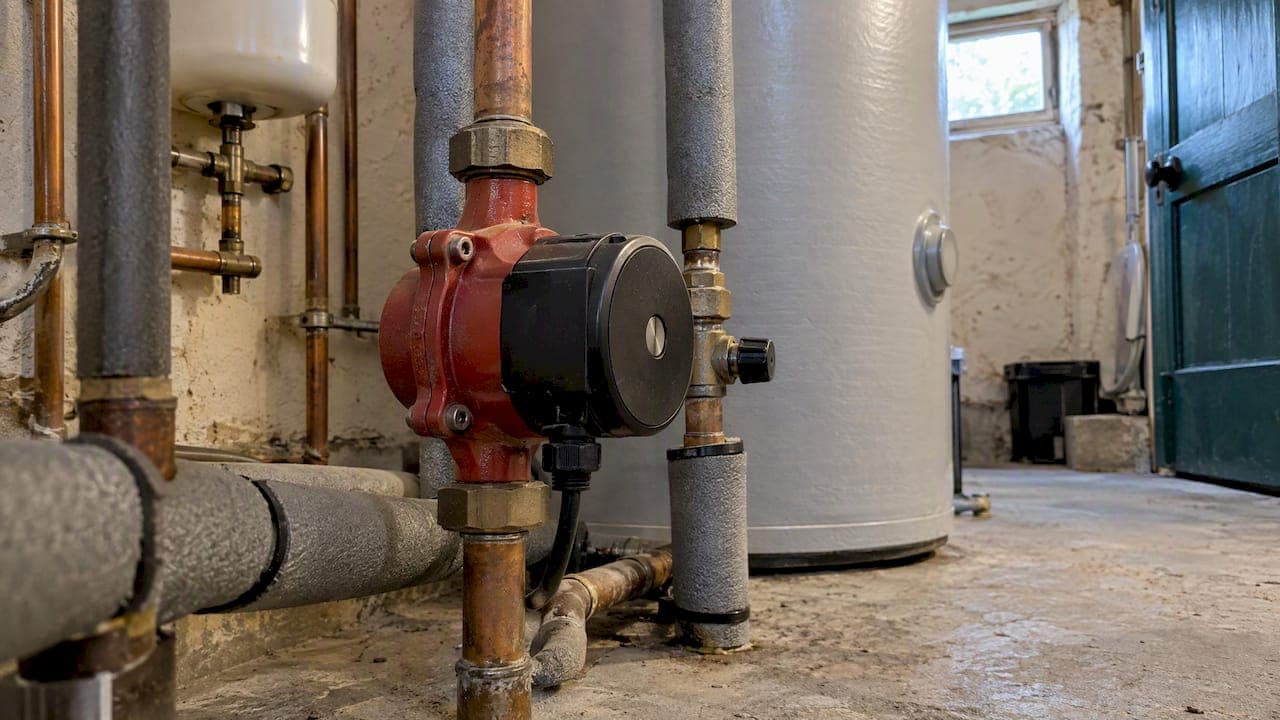
If your heating pump is not working, the boiler may fire up while the radiators stay cold, or the whole system may sit silent. The pump is the part that pushes hot water round your pipes, so when it stalls, the heat stays in the boiler. Often the cause is a seized pump, trapped air or a blockage, and a few safe checks will tell you which. Replacing the pump itself is a job for a heating engineer.
This guide shows the signs of a failing circulator, the checks you can safely do from the floor, how to tell a pump fault from a valve, control or boiler fault, and what replacement involves.
TL;DR
- A failed pump usually shows as several or all radiators staying cold, no hot water, odd noises, a leak, or a casing that is too hot to touch.
- Safe checks: confirm heating is being called for, check boiler pressure, look at any pump LEDs, and bleed radiators. Do not take the pump apart with the power on.
- A pump that runs but does not move water points to air, sludge, closed valves or a blocked filter, not necessarily a dead motor.
- Swapping the pump without finding the cause can mean the new one fails too, so have the whole circuit checked.
- We can send an engineer to diagnose and replace a pump: heating work is charged at £110 per hour, with no call-out fee.
Table of Contents
- What the pump actually does
- Signs your central heating pump has failed
- Why pumps fail
- Safe checks before you call anyone
- Pump running but not pumping water
- When it is not the pump at all
- Central heating that will not turn off
- Repair or replace the pump?
- Our view: fix the circuit, not just the pump
- Need a hand with a failed pump?
- FAQ
- Sources
What the pump actually does
Your boiler heats the water. The circulation pump, usually a small motor housing sitting on the pipework near the boiler or cylinder, moves that water round the radiators and back again. Without it, the water in the boiler gets hotter and hotter while the rest of the house stays cold. On many boilers that ends with the boiler shutting itself down on overheat, which is why a seized pump so often looks like a boiler that runs for a few minutes and then stops.
Pumps in modern homes are often built into the boiler (combi and many system boilers). Older systems and those with a separate hot water cylinder may have an external pump. Where yours sits changes how easy it is to reach, but not how it fails.
Signs your central heating pump has failed
No single symptom proves it, but a cluster of them points strongly at the pump. Homebuilding lists the typical signs: several or all radiators not heating, a leak at the pump, unusual noises, a hot pump casing and no hot water.
Cold radiators across the house
One cold radiator is almost always a local problem: air, a stuck valve or sludge. When every radiator is cold or only barely warm while the boiler is clearly running, suspect circulation. Pipes close to the boiler may be hot while the rest of the system is stone cold.
Humming, vibrating or banging
A struggling pump can hum or vibrate. Loud banging can indicate air trapped in the pump, and a pump set too high may be noisy while one set too low can leave radiators poorly heated. We have a separate guide to a noisy central heating pump if noise is your main complaint.
A pump that is too hot, or leaking
A casing that is much hotter than the pipes either side suggests the motor is working hard against a restriction or is failing. Any weeping at the pump body or its unions needs an engineer, because a leaking pump sits right next to electrical connections.
No hot water
If you have a cylinder heated through the boiler, a dead pump can mean no hot water as well as no heating. If you have hot water but no heating, the fault is more likely a motorised valve or control, and our guide to no hot water but the heating works covers the reverse case.
The boiler fires, then shuts off
A jammed pump commonly makes the boiler run for a few minutes, then cut out and refuse to relight until it has cooled. If that is your pattern, treat the pump as the first suspect.
Why pumps fail
Seizing from lack of use. Pumps that sit idle all summer can stick. One iFixit contributor suggests running the pump for a few seconds once a month, even in summer, to reduce the chance of it seizing. It is a sensible habit, and most modern programmers have a summer-exercise setting for the same reason.
Debris and sludge. Anchor Pumps notes that debris in the pump is often a sign of an ageing system where pipes and radiators have started to rust or break down. Black, gritty water when you bleed a radiator is a warning sign. Treating the pump alone in that case only buys time.
Air. Air in the circuit makes pumps noisy and can stop them moving water at all. Our ten-minute guide to clearing air from central heating walks through the bleeding process.
Electrical or control faults. A pump may be perfectly healthy but receive no power because of wiring, a failed circuit board or a control that never calls for heat. Replacing a good pump in that situation is a costly mistake.
Age and wear. Bearings wear and motors burn out. Wilo advises that circulation pumps are inspected at the annual boiler service, which is the cheapest way to catch a tiring pump before the first cold snap.

Safe checks before you call anyone
These need no tools beyond a radiator key and your eyes. Stop at any point where you are unsure.
- Make sure heating is actually being requested. Check the programmer is in a heating-on period, the room thermostat is set well above room temperature, and any smart thermostat has power and signal. If the boiler never responds, see our guide to a boiler not responding to the thermostat or room thermostat faults.
- Check the boiler has power and normal pressure. Look at the pressure gauge or display. Low pressure stops many boilers firing, and a pump may be held off with it. Follow your manufacturer's instructions for repressurising, and call us if it keeps dropping.
- Read the boiler display and any pump lights. Note any fault code. On Grundfos Alpha and UPSe circulators, a red light means the pump has stopped on an alarm and a yellow light means a warning, such as low supply voltage. Grundfos publishes its fault tables for these models, so keep the model number from the pump label handy for the engineer.
- Listen and feel, carefully. With the heating on, hold your ear near the pump body. A smooth faint hum is normal. Silence, a grinding or a loud buzz without movement is not. Touch only the pipework, never wiring, and remember the casing can be very hot.
- Bleed the radiators. Start with the radiator furthest from the boiler and work towards it, with the heating off. Our radiator problems checklist shows what each symptom means.
- Check valves. Open any lockshield and thermostatic radiator valves that might have been closed or stuck shut. If just one radiator is cold, see cold at the top or cold at the bottom.
What not to do: do not remove a pump while the system is hot or pressurised, do not touch the electrical terminals, and do not force a stuck spindle with the power on. If you are not confident about isolating the supply, leave it.
Pump running but not pumping water
This is one of the most common searches, and it has a more hopeful answer than a dead motor. According to Staffordshire Training Services' fault-finding guide, a pump can run without circulating when the impeller or motor performs poorly, the speed setting is wrong, or flow is restricted by air, sludge, blocked filters, closed valves, pipework or a heat exchanger.
To tell the difference from other faults, work through this order:
| What you notice | Likely area | Who should deal with it |
|---|---|---|
| Pump silent, no lights, boiler dead | Power supply, fuse, controls | Engineer, after you check the programmer and thermostat |
| Pump silent, boiler fires then cuts out | Seized pump or overheating | Engineer |
| Pump humming, radiators cold, gurgling | Air in the system | You can bleed first; engineer if it returns |
| Pump running, uneven heat, black water | Sludge or blocked filter | Engineer (system clean) |
| Pump warm and running, one room cold | Valve or balancing | You can check valves; engineer if no change |
| Boiler fault code displayed | Boiler, not pump | Engineer |
The same source says an engineer should assess flow and return temperatures and boiler fault codes, and that diagnosing from pump operation, temperatures, valves, filters, pipe resistance and heat exchanger condition together avoids treating the symptom instead of the fault. We agree with that approach, and it is how we work.
When it is not the pump at all
Plenty of faults copy a failed pump: a stuck motorised valve, a thermostat that never calls for heat, a blocked heat exchanger, or low pressure. A German heating installer has a useful prioritised checklist for rooms that will not warm up that runs through other heating faults with similar symptoms and is worth a look if the checks above come up clean.
Tepid water at taps or a shower swinging between hot and cold are separate problems with their own causes. See fixing tepid hot water and fluctuating shower temperature.
Central heating that will not turn off
It sounds like a pump problem but usually is not. The room thermostat sends a signal telling the pump and boiler to stop heating; boiler interlock is what prevents the boiler staying on constantly without that signal. So if the heating will not switch off, the likely culprits are:
- a thermostat or programmer that is faulty, mis-set or has flat batteries;
- a motorised valve stuck open;
- wiring that keeps the pump live regardless of the controls.
A pump that keeps running with the boiler off is not harmful in itself, but it means a control is not doing its job, and it wears the pump. Check the programmer and thermostat settings first, then call an engineer if the system runs through the night with the controls off.
Repair or replace the pump?
A seized pump can sometimes be freed, but on an older unit that is often a short reprieve. If the pump is the real cause, a new one may be needed, and a heating engineer can advise and fit it. Replacement makes sense when the motor has burnt out, the pump leaks, it is loud and unfixable, or it has seized more than once.
What a proper replacement involves:
- Diagnose first: confirm heat is being called for, the pump has power, and flow is restricted or absent.
- Isolate the electrics and isolate the pump with its valves, or drain down part of the system if there are no isolation valves.
- Photograph the wiring before disconnecting it, as DIY Doctor suggests, so the new pump is connected the same way.
- Fit the matching pump, or a suitable replacement of the right length, connections and head, with new washers.
- Refill, vent the pump and system, check for leaks and set the speed to suit the circuit.
- Check the radiators heat evenly and the boiler runs without cutting out.
Do-it-yourself replacement is possible for the competent, but it involves electrics, water and a hot system, and a wrong speed setting or trapped air gives you the same fault back. Most homeowners are better paying for an engineer who can also look at the cause.
What it costs
Replacement pump prices vary with the model, how accessible the pump is and whether isolation valves are fitted. Our heating work is charged at £110 per hour with no call-out fee, and we only charge once the work is done successfully. Because we quote on what we find, you pay for the actual time and parts, not a guess. If the diagnosis shows that sludge or a faulty valve is the real problem, we will tell you before replacing anything.
If the pump is old and the boiler is old too, a repair is not always the best use of money. We offer free on-site quotes for a new boiler, with boilers supplied and fitted from £1300.
Our view: fix the circuit, not just the pump
We get called out to many cases where the pump has been replaced and the radiators are still cold. The pump was the symptom. A blocked filter, a stuck valve or a system full of rust sludge was the cause, and the new pump was working just as badly an hour later.
So our approach is simple. We check that heating is being called for, that the boiler is healthy and at the right pressure, and that water can flow before we recommend a new pump. Where the pump really has failed, we replace it, then check the whole circuit is flowing properly. If we find the system is full of debris, we say so plainly and explain the options.

The cheapest pump repair is the one you do not need. Have your pump and system checked at the annual boiler service, run the heating briefly in the summer months, and bleed your radiators at the start of every heating season. Do those three things and most pump failures never reach the stage where you are sitting in a cold house wondering what has gone wrong.
And when you are, do not put up with it. We work direct with you, you speak to the engineer, and the price is clear before work starts.
— Michael
Need a hand with a failed pump?
If your radiators are cold, the pump is silent or noisy, or your boiler keeps cutting out, we can diagnose it quickly. Our engineers cover emergency heating and hot water faults with a 60 minute response time and 24/7 availability, including holidays, a no call-out fee policy, a no fix no fee guarantee and a 12-month warranty on the work. You pay after the job is done.

Book an emergency heating engineer or, for a non-urgent visit, book a plumbing and heating appointment. You can see our full list of services on our main site.
FAQ
How do I know if my central heating pump has failed?
Look for several or all radiators staying cold while the boiler runs, no hot water, humming or other unusual noise, a leak at the pump or a very hot casing. Pump lights, where fitted, help: on Grundfos Alpha models a red light means an alarm stop. If you see a cluster of these signs, call an engineer.
Should a boiler pump run all the time?
No, not normally. In most systems the pump runs only when the thermostat and programmer call for heat, and then stops. Some pumps run briefly after the boiler switches off to clear residual heat. If the pump runs constantly with the controls off, a thermostat, valve or wiring fault is likely.
Why is my pump running but not pumping water?
The pump may have air in it, a worn impeller, the wrong speed setting, or the system may be restricted by sludge, a blocked filter or closed valves. Bleeding the radiators is a safe first step. If that does not help, an engineer needs to check flow and return temperatures.
Is it expensive to replace a boiler pump?
It is generally a modest repair compared with a new boiler, but the price depends on the pump model, access and whether the system must be drained. Heating work with us is £110 per hour with no call-out fee, so the final bill reflects the time the job actually takes. Ask for the parts cost and the time estimate before work begins.
Can I replace a central heating pump myself?
A competent DIYer can, but it involves isolating the electrics, draining water and setting the pump correctly. Photograph the wiring first and make sure the new pump matches the old one. If you are unsure at any step, stop and call an engineer.
Sources
- Radiator not heating up properly? Homebuilding
- Why is my boiler making noises? Viessmann UK
- How does a central heating pump work? Viessmann UK
- Is your boiler overheating? Viessmann UK
- What is boiler interlock? Viessmann UK
- Servicing a central heating circulation pump, Wilo
- Central heating pump problems, Anchor Pumps
- Alpha and UPSe troubleshooting, warnings and alarms, Grundfos
- Gas boiler pump and circulation fault finding, Staffordshire Training Services
- How to replace a central heating pump, DIY Doctor
- Räume werden nicht warm? Prioritised checks