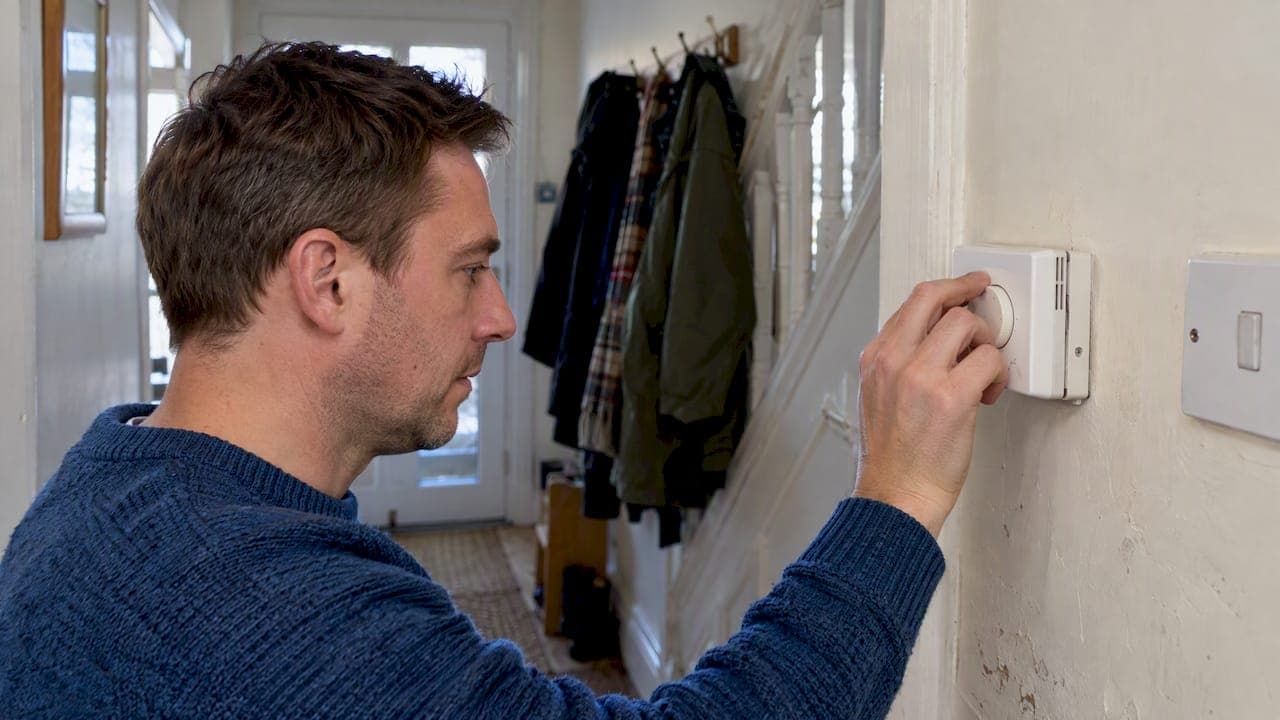
If your boiler ignores the thermostat, the cause is usually something simple: a set temperature below the room temperature, flat batteries, low boiler pressure or a thermostat sitting in the wrong spot. Those checks are safe for any homeowner. If they don't work, the fault is probably in the wiring, the receiver or the boiler itself. That is gas work, and it belongs to a Gas Safe registered engineer.
This guide takes you through the checks in the order a heating engineer would do them. It also explains what each result means and where to stop.
TL;DR
- Set the thermostat a few degrees above the current room temperature. The boiler only fires when the room is colder than the target.
- Replace the thermostat batteries and check the programmer or timer is calling for heat.
- Check the boiler pressure gauge. Below about 1 bar, many boilers lock out.
- If you smell gas or suspect carbon monoxide, turn the boiler off, open the windows, leave the property and call 0800 111 999.
- Anything beyond batteries, settings, a reset and a pressure top-up is for a Gas Safe registered engineer.
Table of Contents
- How a thermostat tells a boiler to fire
- Step-by-step checks you can safely do yourself
- Reading the symptoms
- Smart and wireless thermostats
- Where DIY stops
- Our view on thermostat faults
- Choosing an engineer for a boiler fault
- When you want an engineer to take over
- Keeping the problem from coming back
- FAQ
- Sources
How a thermostat tells a boiler to fire
The room thermostat is a switch. It measures the temperature where it is mounted and, when the room is colder than your target, it closes a circuit that asks the boiler for heat. When the room reaches the target, it opens the circuit and the boiler stops.
The Energy Saving Trust says a central heating system should include at least a programmer, a room thermostat and thermostatic radiator valves. If you have a hot water cylinder, it should also have a cylinder thermostat. Any of these can stop heat reaching the radiators. Your boiler may be fine while the instruction never reaches it.
The signal can be lost in several places:
- the thermostat itself (settings, batteries, placement or a failed unit)
- the programmer or timer that sits between the thermostat and the boiler
- the wiring, or the wireless link between a receiver and the boiler
- the boiler (lockout, low pressure, a fault code or a failed component)
Work from the simplest and cheapest to the most technical. Most people never need to go past the third step.
Step-by-step checks you can safely do yourself
1. Check the set temperature against the room temperature
It sounds obvious, but it is the most common cause. If the house has already reached the target, the boiler will not fire. Vaillant's guidance suggests, for example, setting the thermostat to 20°C if the house is currently 19°C. Turn it up a few degrees and listen for a click from the thermostat or receiver. Within a minute or two the boiler should start.
Also check the mode. A thermostat set to "off", "holiday" or "frost protection", or a programmer set to "off", will not call for heat however high you set the temperature.
2. Replace the batteries
A blank or unresponsive display usually means flat batteries. Many wireless thermostats also stop sending a signal before the screen goes completely dark. Fit fresh alkaline batteries of the type the manual specifies, wait a minute and try again. This is a good first step if the thermostat works for part of the day and then drops out.
3. Check the programmer or timer
The programmer decides when heating is allowed. Check that the time and day are correct, as they often reset after a power cut. Check that the heating channel is set to "on" or "auto", and that the current time falls inside a heating period. Press the "advance" or "boost" button once to force a heating period. If the boiler fires on boost but not on schedule, the fault is in the programme, not the thermostat or boiler.
4. Look at where the thermostat is
A thermostat that measures the wrong temperature will behave as if it is not responding. Which? explains that thermostats need clear airflow to read the room accurately. If it sits near a lamp or a TV, or behind a curtain, it can report that the room is warm when it isn't, so the boiler never fires.
Common culprits include:
- a thermostat in a hallway beside a radiator
- a unit in direct sunlight through a window
- a lamp or TV on the shelf below it
- a curtain or piece of furniture blocking airflow
Move the obstruction or the heat source and give it half an hour before judging the result. For a wireless unit, try moving it a short distance towards the boiler or receiver in case the signal is weak.
5. Read the boiler pressure gauge
If the thermostat is calling for heat but the boiler stays silent, look at the boiler itself. Which? notes that ideal pressure is typically between 1 and 1.5 bar, and that low pressure can lock a system out. It also says you can top up pressure yourself if you know whether you have an internal or external filling loop. Your manual will tell you which type you have.

If the pressure keeps falling after a top-up, there is probably a leak somewhere in the system. Our guide on what homeowners can do when a boiler loses pressure covers the topping-up steps in detail. If the gauge is too high instead, see what to do when boiler pressure is above 2.5 bar.
6. Check the display for a fault code
Many boilers show a code that points straight to the problem. Which? advises reading the manufacturer's manual or website to interpret it rather than guessing, which can save money on unnecessary call-outs. Write the code down before you reset anything. An engineer can use it to arrive with the right parts.
7. Reset the boiler once, correctly
A reset can clear a temporary lockout. Vaillant's reset guide explains how to find the reset button and what to check first. Treat it as a diagnostic step, not a fix. The same guide makes the point that a boiler needing repeated manual resets has an unresolved fault and needs a professional inspection.
If you reset it once and it locks out again within a day, stop resetting it.
8. Don't confuse the boiler dial with the room thermostat
Many households have two separate temperature controls. The room thermostat sets the temperature of the house. The dial on the boiler sets the flow temperature, which is how hot the water leaving the boiler is. The Energy Saving Trust describes them as distinct settings, and mixing them up leads to poor heating performance.
Some manuals also suggest turning up the central heating temperature control if the hot water works but the radiators stay cold. Ideal Heating's troubleshooting manual gives that advice for its Vogue Max Combi range. Check your own model's manual before you change anything.
Reading the symptoms
The table below links what you see to the most likely cause. It is a guide, not a diagnosis.
| What you see | Likely cause | Who fixes it |
|---|---|---|
| Blank or dim thermostat display | Flat batteries | You |
| Thermostat clicks, boiler stays silent | Receiver, wiring or boiler fault | Engineer |
| Boiler fires on "boost" but not on schedule | Programmer settings | You, or an engineer |
| Room always reads warm, house feels cold | Thermostat placement | You |
| Pressure gauge below 1 bar | Water loss or leak | You (top-up), engineer if it keeps dropping |
| Boiler locks out repeatedly | Underlying fault | Engineer |
| Fault code on display | Varies by model | Check manual, then engineer |
| Hot water works, radiators cold | Heating-side control, pump or valve | Engineer |
Smart and wireless thermostats
If you have a smart thermostat, add a few more checks. Confirm the Wi-Fi is connected, the app shows the heating as "on" and the receiver has power. Which? points out that "smart" simply means internet-connected, so a dropped connection is a common reason a smart control stops behaving.
With wireless units, the thermostat and receiver need to be paired. If the receiver light does not change when you raise the target temperature, the link may have dropped. Follow the pairing procedure in your manual. If it still won't pair, the receiver or thermostat may have failed.
A new or replacement thermostat can also be incompatible with an older boiler. If the problem started straight after fitting a new unit, tell the engineer. It is a likely cause.
Where DIY stops
The checks above need no tools and no access to the boiler's interior. Beyond them, the line is firm. Which? advises that gas work is legally restricted and that anything beyond basic troubleshooting, such as checking batteries, resetting or topping up pressure, must be done by a Gas Safe registered engineer.
Call an engineer if:
- the thermostat works, the programmer is correct and the pressure is right, but the boiler still doesn't fire
- the boiler locks out repeatedly
- you see a fault code the manual says needs a professional
- you hear banging, see leaks or notice the pilot light or flame behaving oddly
- you suspect faulty wiring or a failed receiver
Don't remove the boiler casing, and don't bypass the thermostat by linking wires at the boiler. A bypassed control can leave the boiler running with nothing to stop it.
Gas smell or carbon monoxide: act first
This is the one case where you don't troubleshoot. The HSE says that if you suspect a gas hazard, you should turn the appliance off, open windows, leave the property and call the National Gas Emergency Service on 0800 111 999. Carbon monoxide has no colour, smell or taste, and symptoms include headaches, dizziness and nausea. A boiler that is working badly can produce it, so a heating fault together with those symptoms is an emergency. Don't wait for an appointment.
Our view on thermostat faults
We see the same pattern again and again. Customers ring convinced the boiler has died, and the cause is a thermostat in the wrong place, a flat battery or a programmer that lost its time after a power cut. We would rather you fix those yourself in ten minutes than pay for a visit. Nobody should be charged for something they could have solved with a battery.

We also see the opposite. A boiler has been reset five or six times over a week, and the homeowner has kept going because it worked each time. That is the boiler telling you something. A repeat lockout is a fault, and the sooner it is looked at, the smaller the repair usually is.
Our advice is to do the safe checks, write down any fault code and the pressure reading, and then call. Tell the engineer what you have already tried. It saves time on the day and gets the heating back sooner. We price clearly, and heating and boiler work is charged at £110 per hour. We don't charge a call-out fee, and we work on a no fix, no fee basis, with payment only after successful work.
— Michael
Choosing an engineer for a boiler fault
For any gas boiler repair, check the engineer's registration before work starts. The Gas Safe Register lets you check an engineer using the unique 7-digit licence number on their ID card. Which? also advises confirming any call-out charges or diagnostic fees beforehand so there are no surprises.
Our guide on three checks to choose a plumber covers Gas Safe and insurance in more detail. If cost is on your mind, see how to avoid emergency markups on central heating repairs.
When you want an engineer to take over
If the checks haven't solved it, you can book our emergency heating engineer online, with a 60 minute response time. We offer 24/7 availability including holidays, and you deal directly with the engineer. There are over 300 Trustatrader reviews to read first if you want to see how other customers found the service.
Heating and boiler work is charged at £110 per hour. If the boiler is simply beyond sensible repair, new boilers supplied and fitted start from £1300 as a one-off price, and you can request a free new boiler quote. Repairs come with a 12-month warranty.
Keeping the problem from coming back
- Service the boiler yearly. A service includes checking the boiler's controls, including heating controls, to make sure they work properly, according to the Energy Saving Trust. Our homeowner's guide to servicing a gas boiler safely explains what to expect.
- Replace thermostat batteries once a year, ahead of winter, rather than waiting for them to fail on a cold night.
- Keep the thermostat area clear of lamps, TVs and curtains.
- Check the pressure monthly in the heating season. Note the normal reading so you can spot a drop.
- Fit a carbon monoxide alarm near the boiler and test it regularly. The Scottish Fire and Rescue Service notes that gas appliances such as boilers can produce CO if they aren't working properly, or if chimneys and vents become blocked.
FAQ
Why does my boiler not fire when the thermostat is turned up?
The boiler may be locked out, the pressure may be too low, or the signal may not be reaching it because of a dead receiver or faulty wiring. Check the pressure gauge and any fault code first. If those look normal, the cause is probably inside the control circuit or the boiler, and a Gas Safe registered engineer should look at it.
Can I replace the thermostat myself?
Swapping batteries is fine. Replacing a wired thermostat means working with the heating control circuit, and a mismatched unit can be incompatible with the boiler. We would book an engineer to fit it and confirm it works with your boiler. Wireless units with a plug-in receiver still need the receiver connected to the boiler properly.
How often can I reset my boiler?
Once is reasonable to clear a temporary lockout. If it locks out again, stop resetting it and call an engineer. Vaillant says that a boiler needing frequent resets has an underlying fault that needs a professional inspection.
My hot water works but the radiators stay cold. Is that the thermostat?
It can be, but not always. A room thermostat or programmer fault can stop the heating while the hot water continues. A stuck valve or pump problem can do the same. Check the heating is switched on and the thermostat is set above room temperature. If it still doesn't heat, an engineer needs to look at the heating circuit.
Sources
- Boiler not igniting? Common issues and how to fix them, Vaillant
- How to reset a boiler, Vaillant
- How to keep your boiler working in cold weather, Which?
- What to do if your boiler breaks down at Christmas, Which?
- Boiler controls and how they can save you money, Which?
- Heating controls, Energy Saving Trust
- Should I turn my boiler's flow temperature down? Energy Saving Trust
- Boiler services explained, Energy Saving Trust
- Vogue Max Combi troubleshooting manual, Ideal Heating
- Carbon monoxide awareness FAQ, HSE
- Carbon monoxide detectors, Scottish Fire and Rescue Service
- Check an engineer, Gas Safe Register