
TL;DR:
- Thermostatic radiator valves control individual room temperatures by adjusting hot water flow according to room air temperature. They do not regulate the boiler itself and require correct installation, orientation, and balancing for optimal performance and energy savings. Properly fitted TRVs improve comfort, reduce energy waste, and comply with UK building regulations.
A thermostatic radiator valve (TRV) is a self-regulating device fitted to a radiator that automatically controls heat output by adjusting hot water flow according to room temperature. TRVs are the standard control mechanism for individual radiators in UK central heating systems, and Part L of the Building Regulations in England and Wales mandates fitting them to every radiator except in the room containing the main central thermostat. The role of thermostatic radiator valves goes beyond simple on/off control. They let you heat each room to a different temperature, cut energy waste, and reduce wear on your boiler. For any homeowner looking to improve comfort and lower heating bills, understanding how TRVs work is the logical first step.
How do thermostatic radiator valves work?
TRVs operate through a simple but effective mechanical principle. Inside the valve head sits a wax or liquid-filled sensor element that expands when the room warms up and contracts when it cools down. That movement pushes or releases a pin inside the valve body, which opens or closes the flow of hot water into the radiator accordingly.
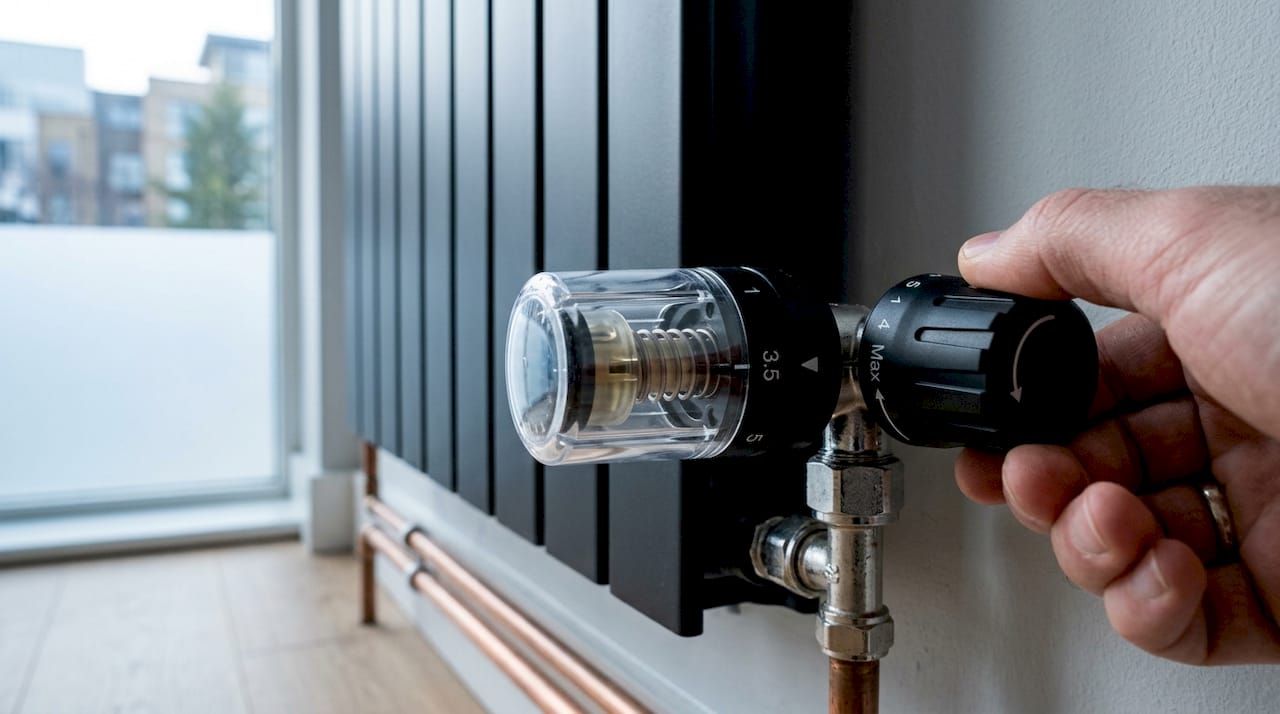
The key point most homeowners miss is this: TRVs control individual radiator output and do not regulate the boiler. The boiler fires and stops based on signals from the main room thermostat and programmer. TRVs simply decide how much of that hot water reaches each radiator.
This distinction matters for placement. The room containing your main thermostat should never have a TRV fitted. If it did, both devices would compete to control the same space, causing the boiler to short-cycle and the room to heat unevenly.
TRVs also play a supporting role in system balancing alongside lockshield valves. System balancing by adjusting lockshield valves is the process of setting the correct flow rate to each radiator so the whole system heats evenly. TRVs assist this process by modulating flow in response to temperature, but they do not replace the need for proper balancing.
- The sensor element responds to ambient air temperature, not pipe temperature.
- The valve head must sit horizontally, parallel to the floor, for accurate sensing.
- TRVs work passively with no electrical connection required on standard models.
- Smart TRV heads add programmable schedules and remote control via an app.
Pro Tip: Never fit a TRV in a cupboard or behind a curtain. The sensor reads the air around it. If that air is trapped or artificially warm, the valve will close prematurely and the radiator will stay cold.
What are the common types of thermostatic radiator valves?
Choosing the right TRV type depends on how your pipework enters the radiator. Getting this wrong means a poor fit, potential leaks, or a valve that simply cannot be installed without modifying the pipework.
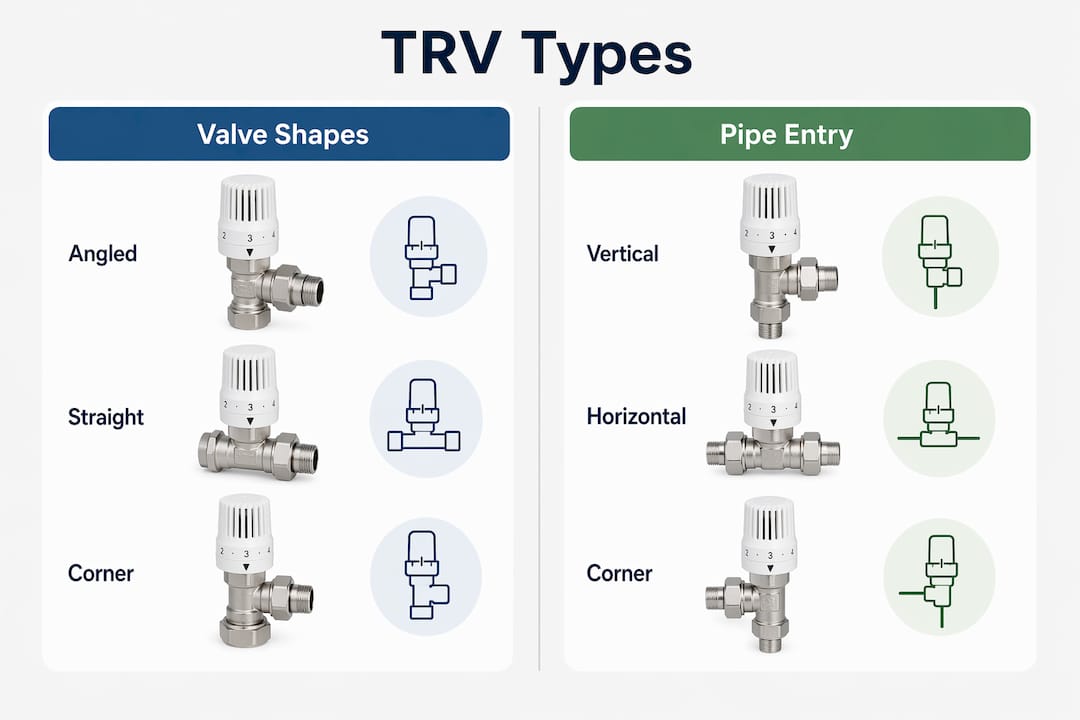
Angled, straight, and corner TRV types each suit a different pipe configuration. Angled valves are the most common in UK homes, designed for pipes that rise vertically from the floor and connect to a radiator inlet at 90 degrees. Straight valves suit pipes running horizontally along the skirting board. Corner valves handle rear-entry pipe layouts, which appear frequently in older or period properties.
Most UK radiators use 15mm copper pipe and valves with M30 x 1.5mm threaded connections. This is the near-universal standard for TRV heads, which means you can swap a standard head for a smart TRV head without replacing the valve body, provided the thread matches.
| Valve type | Pipe entry direction | Typical use case |
|---|---|---|
| Angled | Vertical from floor | Most modern UK homes |
| Straight | Horizontal along wall | Skirting-level pipework |
| Corner | Rear entry from wall | Older or period properties |
| Smart head | Any (replaces standard head) | Upgrade without full replacement |
Finishes range from chrome and brushed nickel to white and anthracite, so matching your radiator and room décor is straightforward. Smart TRV heads from well-known manufacturers are widely available and compatible with most M30-threaded valve bodies, though you should always verify compatibility before purchasing.
Pro Tip: If your TRV head is mounted vertically, pointing upward toward the ceiling, the sensor sits directly above the hot pipe and reads pipe heat rather than room air. This causes the valve to close too early. Always check the manufacturer's guidance on orientation before fitting.
How to fit thermostatic radiator valves and comply with UK building regulations
Fitting a TRV is a manageable DIY task for a confident homeowner, but the process requires care. A mistake at any stage can cause a leak or leave your heating system unbalanced.
The regulatory starting point is clear. Part L building regulations require TRVs on all radiators in new or replacement heating systems, except in the room where the main thermostat is located. This applies across England and Wales and is not optional for new installations.
- Turn off the heating system and allow the radiator to cool completely before starting work.
- Isolate the radiator by closing the lockshield valve and the existing manual valve. Count the turns on the lockshield valve and note the number. You will need to return it to the same position after the work is done.
- Drain the radiator by placing a towel and bowl beneath the valve, then carefully loosen the union nut connecting the valve to the radiator. Have a jug ready for residual water.
- Remove the old valve by unscrewing the union nut and the compression fitting from the pipework.
- Fit the new TRV body using new olives and compression fittings. Tighten to hand-tight, then add a half-turn with a spanner. Over-tightening compression nuts damages the olive and causes leaks.
- Attach the TRV head and orient it horizontally so the sensor reads room air accurately.
- Reopen the lockshield valve to the same number of turns you recorded in step 2.
- Restore the system, check for leaks, and set the TRV to position 3 (approximately 20°C) as a starting point.
One common mistake is ignoring the lockshield valve setting after a replacement. Restoring it to its original position maintains the system balance you had before. Changing it without recalibrating the whole system can leave some radiators cold and others overheating.
You can replace a faulty TRV body without draining the entire system if the radiator is properly isolated. For older systems without reliable isolation valves, a pipe freezing kit provides a temporary seal while you work.
Pro Tip: Before buying a replacement valve, measure the pipe diameter and check the existing valve's thread size. Most UK systems use 15mm pipe with M30 x 1.5mm threads, but some older properties use imperial sizing. Fitting the wrong valve means a return trip to the merchant.
What are the benefits of using thermostatic radiator valves?
The practical advantages of TRVs are concrete and measurable. The headline benefit is individual room temperature control, which lets you keep bedrooms cooler than living spaces and avoid heating rooms that are unoccupied.
TRVs contribute significantly to energy savings by preventing overheating in rooms you are not using. A spare bedroom set to position 1 or 2 uses far less energy than one running at full output. Multiplied across several rooms over a heating season, the savings are meaningful.
- Room-by-room comfort: Set the living room warmer and bedrooms cooler without touching the boiler controls.
- Reduced boiler wear: When TRVs close across multiple rooms, the system demand drops and the boiler cycles less aggressively.
- Regulatory compliance: Fitting TRVs satisfies Part L requirements and supports your home's energy performance certificate rating.
- Carbon reduction: Lower energy consumption directly reduces your household's carbon footprint, contributing to UK net-zero targets.
- Auto-balancing technology: Auto-balancing TRVs continuously regulate water flow to each radiator, maintaining system balance without manual adjustment. This is particularly useful in larger homes where traditional balancing is time-consuming.
For homeowners interested in going further, smart heating controls combined with smart TRV heads allow room-by-room scheduling from a smartphone, adding another layer of efficiency on top of the mechanical benefits.
How to maintain, troubleshoot, and replace TRVs effectively
TRVs are reliable, but they do fail. Knowing the warning signs saves you from a cold room or an unexpected repair bill.
The most common fault is a stuck pin. The pin inside the valve body can seize in the closed position, usually after a long summer when the heating has been off. The symptom is a radiator that stays cold even when the TRV is set to maximum. The fix is often straightforward: remove the valve head, expose the pin, and gently press it in and out several times with a cloth to free it.
- Leaking from the valve body: Usually caused by a worn olive or over-tightened compression fitting. Replace the olive and refit carefully.
- Radiator cold at all settings: Check whether the pin is stuck. If freeing the pin does not help, the valve body may need replacing.
- Radiator always hot regardless of setting: The valve is stuck open. Replace the valve head first, then the body if the problem persists.
- Inconsistent heating across the system: Often a balancing issue rather than a TRV fault. Check lockshield valve settings before replacing any TRVs.
- Magnetite sludge: Systems with sludge accumulation commonly cause TRV failure. Powerflushing and chemical cleaning improve valve longevity and restore system performance.
When replacing a valve head, you rarely need to drain the system. Swap the head only, keeping the valve body in place. When replacing the full valve body, isolate the radiator as described in the installation steps and record your lockshield turns before you start.
For advice on avoiding the most common errors, the guide on DIY plumbing mistakes covers TRV pitfalls alongside other frequent homeowner errors. If you are unsure at any stage, a qualified engineer can diagnose and fix a faulty TRV quickly and without disrupting the rest of your system.
Key takeaways
TRVs are the most cost-effective way to control room-by-room heating, but they only deliver their full benefit when correctly installed, oriented, and balanced alongside lockshield valves.
| Point | Details |
|---|---|
| TRVs do not control the boiler | They regulate individual radiator output only; the main thermostat controls boiler firing. |
| Part L compliance is mandatory | Fit TRVs on all radiators except in the main thermostat room for new or replacement systems. |
| Orientation determines accuracy | Mount the TRV head horizontally so the sensor reads ambient room air, not pipe heat. |
| Balancing is still required | Adjusting lockshield valves after fitting TRVs is the only way to achieve even heat distribution. |
| Stuck pins are the most common fault | Free a seized pin manually before replacing the valve body to avoid unnecessary cost. |
TRVs are more useful than most homeowners realise
Most homeowners I speak to treat TRVs as a simple on/off switch. They crank them to maximum in winter and forget about them. That approach wastes money and misses the point entirely.
The biggest misconception I encounter is the belief that turning a TRV to its highest setting heats a room faster. It does not. The valve is either open or closed. Setting it to 5 does not increase the water flow beyond what the system delivers. It simply raises the temperature threshold at which the valve closes. If you want a room to reach 22°C, set the TRV to the position that corresponds to 22°C and leave it there.
The second thing most homeowners overlook is system balancing. Fitting TRVs without adjusting the lockshield valves is like fitting new tyres on a car with misaligned wheels. The components are correct, but the system still does not perform as it should. I have seen homes where the radiators nearest the boiler run too hot and those furthest away barely warm up, simply because nobody balanced the system after fitting new valves.
Smart TRV heads are genuinely worth considering if you have a busy household with varied room usage. The ability to set different schedules for different rooms, and to adjust them remotely, adds real practical value. Pair them with a good room thermostat and you have a heating system that responds to how you actually live, not just a fixed programme. For a deeper look at how these technologies fit together, the guide on plumbing valves for homeowners is worth reading alongside this one.
— Michael
Your-local-plumber can handle your TRV installation
Fitting TRVs correctly requires the right valve type, accurate orientation, and proper system balancing afterwards. Get any of those wrong and you end up with cold rooms, leaks, or a boiler that works harder than it needs to.

Your-local-plumber's engineers fit and replace thermostatic radiator valves in full compliance with Part L building regulations. They balance your system after every installation, so every radiator performs as it should. Whether you need a single valve replaced or a full set fitted across the house, the team provides transparent pricing and fast local service. Visit Your-local-plumber to book an engineer or get a quote today.
FAQ
What does a thermostatic radiator valve actually do?
A TRV automatically adjusts the flow of hot water into a radiator based on the room's air temperature, maintaining a consistent level of warmth without manual intervention.
Do thermostatic radiator valves save energy?
Yes. TRVs prevent overheating in unoccupied rooms by reducing or cutting water flow when the target temperature is reached, which lowers overall energy consumption.
What setting should I use on my TRV?
Set TRVs to position 3 as a starting point, which corresponds to approximately 20°C. Adjust up or down by one position to fine-tune individual room comfort.
Can I fit a TRV myself?
A confident DIY homeowner can replace a TRV head without professional help. Replacing the full valve body requires isolating the radiator and is more involved, but remains achievable with the right tools and care.
Why is one radiator cold when the TRV is on maximum?
The most likely cause is a stuck pin inside the valve body. Remove the TRV head, expose the pin, and press it in and out gently to free it. If the radiator remains cold, the valve body may need replacing.