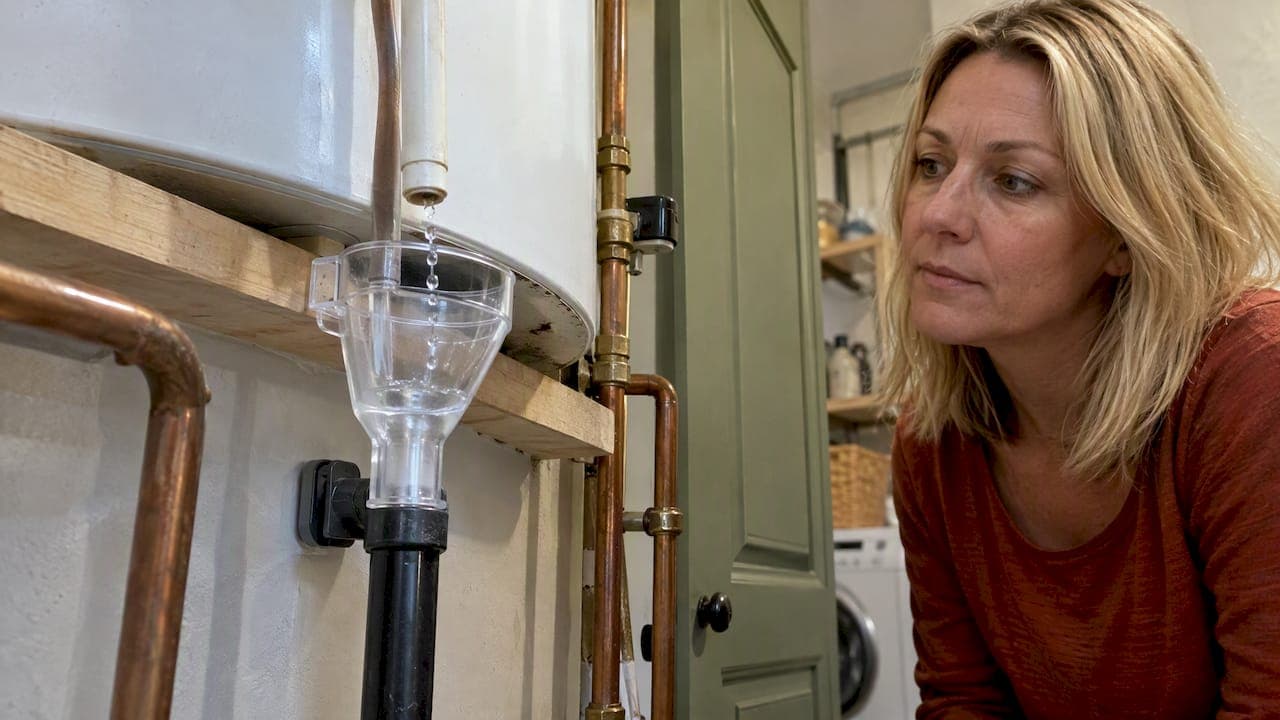
If water is dripping or running through the tundish beside your unvented cylinder, a relief valve has opened or is letting water past its seat. That should not happen in a healthy system, so treat it as a fault that needs a qualified engineer, not as a quirk to live with. Most causes are simple, such as a worn expansion vessel or a failed pressure-reducing valve. They are cheap to fix early and expensive to ignore.
This guide explains what a tundish is, why it drips, what you can safely check yourself, and what an engineer will do when they arrive.
TL;DR
- A tundish is the visible break in the discharge pipe from your unvented cylinder's safety valves. Water in it means a valve has opened.
- A drip is not normal. The usual culprits are an expansion vessel that has lost its charge, high incoming pressure, a faulty pressure-reducing valve or a valve seat with debris on it.
- Do not block, cap or tamper with the tundish or its pipe. They are there to stop the cylinder over-pressurising.
- If the flow is more than a drip, the water is hot, or the drip continues after you have followed the manufacturer's recharge steps, call a qualified engineer.
- Tell the engineer it is an unvented cylinder and when the drip happens (during heating, constantly, or only at certain times of day).
Table of Contents
- What a tundish does and why it matters
- Is a dripping tundish normal?
- Common causes of a dripping tundish
- Is a dripping tundish dangerous?
- What you can safely check yourself
- What an engineer will check
- How the tundish and discharge pipe should be arranged
- Perspective: why we say fix it early
- Get an engineer to look at it
- Related problems that look similar
- FAQ
- Sources
What a tundish does and why it matters
An unvented cylinder stores hot water at mains pressure. Because the water is sealed in, it needs safety devices. Approved Document G requires one or more temperature relief or combined temperature and pressure relief valves, fitted directly on the vessel, to stop stored water passing 100°C if the electrical controls fail.
If one of those valves opens, the water has to go somewhere safe. It leaves through a discharge pipe, and the tundish is the small funnel-shaped fitting in that pipe with an air gap. It gives you a visible indication that water is discharging from the safety valves. You can see it, and the water carries on safely down the pipe.
So the tundish is not the faulty part. It is the warning light. Water appearing there is the system telling you something upstream has opened.

Is a dripping tundish normal?
No. The government's guidance treats these safety devices as a last resort under fault conditions. The Approved Document G framework is built on the idea that they should not discharge in normal, healthy operation.
A common misreading is that a little water while the cylinder heats is just "expansion". Heating water does expand, but an unvented cylinder is designed to absorb that expansion, using an expansion vessel or an internal air bubble, without discharging anything. If water is leaving through the tundish, the expansion is not being absorbed properly, or a valve is releasing when it should not.
The pattern of the drip is a useful clue:
| What you see | What it often points to |
|---|---|
| Drips start as the cylinder heats and stop when it cools | Expansion not being absorbed: expansion vessel or air gap, or the expansion relief valve |
| Constant trickle, hot or cold, all day | A relief valve not reseating, debris on a valve seat, or incoming pressure that is too high |
| Heavy flow, steaming or very hot water | Possible over-temperature or serious valve fault: act at once (see below) |
| Drips only at certain times of day | Mains pressure peaking, often overnight when demand drops |
This table is a guide to likely causes, not a diagnosis. The cylinder's own fault-finding chart decides the exact checks, and they differ between models.
Common causes of a dripping tundish
Manufacturers and installers list a similar set of causes. Nu-Heat's troubleshooting guidance names excessive pressure, a faulty expansion vessel, incorrect system pressure settings, a malfunctioning pressure-reducing valve, a faulty temperature and pressure relief valve and high mains pressure. Here is what each means in plain terms.
An expansion vessel that has lost its charge
The expansion vessel is a small tank with an air cushion behind a diaphragm. When the water heats and expands, it squeezes into the vessel. Over the years the air charge can leak away, or the diaphragm can fail. With no cushion left, the extra volume has nowhere to go and the pressure rises until a relief valve opens.

This is one of the most common reasons for a drip that starts during heating and stops afterwards. If you want to understand the component better, our guide on expansion vessel failure explains how the vessel works and what failure looks like.
A failed pressure-reducing valve
Many unvented cylinders have a pressure-reducing valve (PRV) at the cold inlet. It brings the mains pressure down to the level the cylinder is set for. If it fails or drifts, the cylinder sees a higher pressure than intended and the relief valve opens to protect it.
High mains pressure
Mains pressure in the street is not constant. It is often highest at night, when few people are drawing water. A cylinder that is coping during the day can start to drip overnight. If the drip appears and disappears with the time of day, mention this to your engineer.
Debris on a valve seat, or a worn relief valve
Small particles of scale or grit can stop a relief valve closing fully, so it weeps continuously. A worn valve can also lift too early. Either way, the result is water running through the tundish when the system is not actually in trouble.
Air gap needs recharging
Some cylinders rely on an internal air gap rather than an external expansion vessel. Baxi's Megaflo guidance says dripping through the tundish or the external safety pipe can mean the air gap needs recharging, and that if the dripping continues after the manufacturer's procedure you should contact the qualified installer. That procedure is specific to that cylinder type, so use only the instructions for your own model.
Is a dripping tundish dangerous?
A slow drip is usually a sign of a fault rather than an immediate emergency, but you should not leave it for months. Vaillant's advice is to call a qualified engineer promptly when water appears, because it points to a fault with the pressure release valve or rising system pressure.
There are two reasons not to wait:
- The safety device is already working. If the relief valve is opening, it is doing its job, but a system that regularly needs its last line of defence is one fault away from a worse problem.
- A weeping valve tends to get worse. Debris and wear do not repair themselves, and a valve that has lifted repeatedly can stop sealing.
A few signs make it urgent:
- Water pouring rather than dripping from the tundish or discharge pipe.
- Steam, or water too hot to touch at the discharge point.
- The discharge pipe terminating somewhere you cannot see, or water appearing on a wall or ground outside.
- Any sign the cylinder is overheating, such as unusually hot pipework.
In that situation, switch off the electric immersion heater and the heating at the controls. CIPHE's advice for plumbing emergencies is to turn off central heating and any electric immersion heater and call a professional plumber. It also advises against turning on hot taps if escaping water cannot be controlled. Then call an engineer. For a cylinder in a fault state, our emergency engineer service offers a 60 minute response time.
What you can safely check yourself
There is a limit to DIY on an unvented cylinder. These are pressurised, safety-critical systems, and the law says installation must be done by someone competent. The guidance note states that an unvented hot-water storage system may only be installed by a competent person. Servicing should be done by a suitably qualified person too.
What you can do is gather information, which makes the engineer's job faster:
- Note when it drips. During heating only, all the time, or at certain hours?
- Feel the water carefully. Do not hold your hand under it. Touch the pipe below the tundish briefly, or just note whether steam is visible.
- Check the pressure gauge, if you have an external expansion vessel or a pressure gauge on the system. Write down the reading when cold and when hot.
- Look at the tundish. Is it visible and unobstructed? Is there a pipe leading away from it? Do not push anything into it or cap it.
- Find the cylinder's model and the manufacturer's instructions. They are often in the airing cupboard or on the label on the cylinder.
- Take a short video of the drip while the cylinder heats. It helps an engineer see the pattern.
What not to do
- Do not plug, block or reduce the discharge pipe. The pipe is there so a relief valve can release safely.
- Do not fit a smaller pipe or add a tap or valve to the discharge line.
- Do not twist or operate the relief valve repeatedly hoping to clear it, unless the manufacturer's instructions tell you to, and then only as they describe.
- Do not turn off the water supply to stop the drip and then forget about it. Isolating things can help in an emergency, and our guide to water isolation valves shows where to find yours, but the fault still needs fixing.
What an engineer will check
A competent engineer works from the manufacturer's instructions. The Hot Water Association's servicing guide sets out the checks: the engineer should ask about tundish drips or other issues, identify and check the expansion system, test the relief valves and check that the tundish drains correctly without blockages.
In practice that means:
- Reading the symptom. Drip during heating or constantly, hot or cold.
- Checking the expansion vessel or air gap. Is the charge correct, and is the vessel taking the expansion?
- Measuring incoming pressure. Both the static pressure and how it behaves through the day.
- Testing the pressure-reducing valve, and replacing it if it is passing pressure it should not.
- Testing the relief valves, and replacing any that will not reseat.
- Checking the discharge route. The tundish should drain freely, with no blockages.
If you are paying for the time, our boiler and heating work is charged at £110 per hour. We give you a clear idea of what is involved before work starts, and you pay only after the work is done successfully.
How the tundish and discharge pipe should be arranged
If your tundish seems to be the problem, for example it overflows rather than drains, it may be the installation rather than the valves. These are the points the guidance sets out for England:
- The tundish should be within 500mm of the safety valves and in the same compartment as the vessel.
- After the tundish, the discharge pipe (called D2) needs a vertical section of at least 300mm before any bends, then a continuous fall of at least 1 in 200 towards a safe discharge point.
- Its size depends on the safety device's outlet size and the route's total hydraulic resistance, including bends, according to one manufacturer's installation manual.
These details are why a tundish that "overflows" with a modest discharge usually needs an engineer to look at the whole run, not just the fitting. Scotland has its own rules, so if you are north of the border check the Scottish building standards instead.
If your discharge pipe is not draining properly, or terminates somewhere unsafe, mention that when you book.
Perspective: why we say fix it early
We see the same pattern again and again. A homeowner notices a drip at the tundish, decides it is only a pound or two of water a month, and leaves it. A year later the expansion vessel has gone completely, the relief valve is passing constantly and the cylinder is working harder than it should.
Our view is simple. The tundish is a gift: it shows you a fault while it is still small. Treat the drip as the cheap warning it is. A quick look from an engineer who tests the pressure, the expansion vessel and the valves costs far less than waiting for the failure to arrive on its own terms.
That is why we keep it straightforward. We do not charge a call-out fee, we work on a no fix, no fee basis, and you pay only after the work has been done successfully. You speak directly to the engineer, so you can describe exactly what you have seen, and we back our work with a 12 month warranty.
If the drip is heavy or the water is hot, do not wait for an appointment slot. Ring us and say it is an unvented cylinder.
Michael
Get an engineer to look at it
If your tundish is dripping, we can send a local engineer to find the cause. Heating and boiler work is charged at £110 per hour, and we are available 24/7, including holidays. Tell us it is an unvented cylinder and describe when it drips, and the engineer will arrive prepared.

For a drip that is getting worse, book our emergency plumbing or heating engineer. For anything less urgent, you can book plumbing online. If the cylinder is old and the problems keep coming back, you can also ask for a new boiler quote, and we will look at the whole hot water and heating setup.
We cover Reading, Newbury, Oxford, Abingdon, Bracknell, Windsor, Basingstoke, Swindon, Bristol and many other towns across the area. See our home page for the full list.
Related problems that look similar
Not every drip outside your boiler or cylinder is a tundish problem. A few that get confused:
- A boiler overflow pipe dripping comes from the boiler's own pressure relief, not the cylinder. Our guide to boiler overflow pipe dripping lists the checks to do first.
- Water around the base of the cylinder is a leak, not a discharge. Follow the steps in what to do when a hot water tank is leaking.
If you cannot tell which it is, an engineer can confirm quickly.
FAQ
Why is my unvented cylinder tundish dripping only when the water is heating?
That pattern usually means the expansion from heating is not being absorbed. The likely suspects are the expansion vessel or air gap, or the expansion relief valve. It is still a fault, because a healthy system absorbs expansion without discharging. Have an engineer check the vessel charge and the valves.
Can I ignore a dripping tundish?
We would not. The water cost may be small, but the drip shows a safety valve has opened, and Approved Document G treats these devices as a last resort. The underlying fault usually gets worse. Book an inspection soon, and straight away if the flow is heavy or hot.
How much pipe is needed before the tundish?
The tundish should sit within 500mm of the safety valves, in the same compartment as the cylinder. The rule is set out in the England guidance note. The pipe after it has its own requirements for height, fall and size, so leave any changes to a competent installer.
Can I fix a dripping tundish myself?
You can note when it drips, record the pressure and find the manufacturer's instructions. The repair itself involves a pressurised system, and work on unvented cylinders must be done by a competent, suitably qualified person. Do not block or cap the discharge pipe.
What should I tell the engineer?
Say it is an unvented cylinder, give its make if you know it, and describe when the drip happens: during heating, constantly or at certain hours. A short video helps. Mention any recent work on the plumbing or any change in water pressure.
Sources
- Guidance Note No. 50: Unvented hot water storage systems
- Approved Document G: Sanitation, hot water safety and water efficiency
- Approved Document G annex, discharge pipework (Defra consultation)
- Hot Water Association Servicing Guide
- CIPHE: Plumbing Emergencies
- Baxi: How to recharge the air gap on a Megaflo unvented cylinder
- Vaillant: What is a tundish?
- Nu-Heat: Hot water cylinder troubleshooting
- World Heat: Unvented cylinders installation, commissioning and service manual