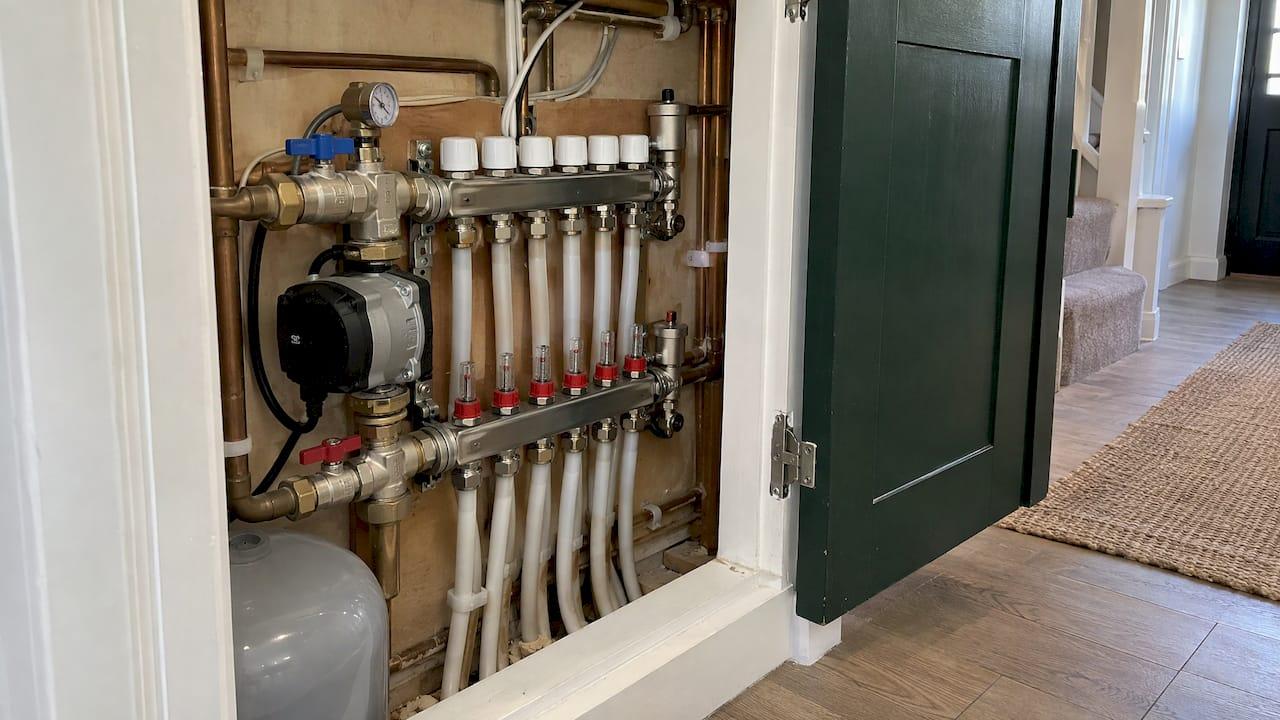
When underfloor heating stops working, the first job is to find out how far the fault reaches. If one room is cold and the rest are fine, the problem is usually at that room's thermostat, valve or actuator (the small motor that opens the water flow). If every room is cold, look at the boiler, the pump and the power supply. A few checks are safe for any homeowner. Anything involving a lifted floor, a leak, a tripping breaker or the manifold itself needs an engineer, and we cover those jobs across Reading, Newbury, Oxford, Basingstoke, Bristol and the surrounding towns.
TL;DR
- Start by deciding whether the fault is one room or the whole house: it narrows the cause quickly.
- Safe checks: thermostat batteries and settings, the timer, the boiler display and any tripped breaker (reset once only).
- Underfloor heating is slow by design, so a floor that is merely cool after a few hours may not be faulty.
- A wet patch, falling pressure, a breaker that keeps tripping or a cold loop after bleeding means stop and call an engineer.
- Our heating engineers offer 24/7 cover, no call-out fee and a no fix, no fee guarantee.
Table of Contents
- First, is it really broken?
- One room cold or the whole house?
- Safe checks you can make yourself
- Wet underfloor heating: what goes wrong at the manifold
- Pressure loss and leaks
- Electric underfloor heating: a different checklist
- When a cold floor is a heating-design issue
- A sensible order of checks
- What to tell the engineer
- Can underfloor heating be fixed?
- Perspective
- Getting it fixed
- FAQ
- Sources
First, is it really broken?
Underfloor heating behaves differently from radiators. It warms the whole floor area at once instead of a single panel, so it takes longer to bring a room up to temperature. A housebuilder's own homeowner guidance explains that this is why the system is meant to run continuously rather than in short bursts, and that the floor is there to warm the air rather than your feet, so some variation in floor temperature is normal.
So before you assume a fault, ask three questions:
- Is the room actually below the temperature set on the thermostat after several hours of running, not minutes?
- Has the heating been switched off or set back overnight, with the system now trying to recover from cold?
- Has anything changed recently: new rugs, a thicker floor covering, a power cut, a boiler service or a change of thermostat batteries?
If the answer to the first question is yes and nothing has changed, you have a genuine fault and the checks below apply.
One room cold or the whole house?
This is the most useful distinction you can make.
| What you see | Most likely area | Who usually fixes it |
|---|---|---|
| One room cold, others warm | Room thermostat, valve or actuator, air in that loop | You for the simple checks, then an engineer |
| Part of one room cold, part warm | Air in the loop, or a partly blocked loop | Engineer |
| Every room cold, radiators also cold | Boiler, pump, timer or power | Heating engineer |
| Every room cold, radiators fine | Underfloor circuit pump or mixing set, manifold controls | Heating engineer |
| Pressure dropping, damp patch | Leak in the pipework | Engineer, with floor access |
This table is written for water-based (wet) systems, where hot water from the boiler circulates through pipe loops in the floor. Electric systems, with heating cables or mats under the floor covering, follow different rules, covered further down.
Safe checks you can make yourself
These need no tools and no opening of any panel.
Thermostat and timer
Most "dead" rooms turn out to be a thermostat that is not calling for heat. Check the display is on and the batteries are fresh. Confirm it is in the right mode, the target temperature is a few degrees above the room temperature and any schedule is not holding it in an off period. Raising the target temporarily is a quick way to see whether the thermostat responds. If a thermostat is unresponsive or the boiler ignores it, our guides on a room thermostat that is not working and a boiler not responding to the thermostat take you through it step by step.

If the whole system is silent at certain times of day, the timer is the next suspect. Our page on a heating timer that is not working lists what to look at.
Boiler and hot water
Look at the boiler display. A fault code, a low-pressure reading or a boiler that has locked out will leave the underfloor circuit with nothing to distribute. Check that other heating and hot water are working. If you have heating but no hot water, or the reverse, the cause is different again, and our guide to no hot water but the heating works helps you separate the two.
Power supply
Thermostats, actuators and pumps all need power. Check that the fused spur switch (the small switched socket on the wall that feeds the controls) is on, and look at the consumer unit for a tripped breaker or RCD (the safety switch that cuts power when it senses a fault). If one has tripped, reset it once only. If it trips again, leave the system off and have the wiring inspected: repeated tripping is a sign of an electrical fault, and that is a job for a qualified electrician.
Wet underfloor heating: what goes wrong at the manifold
The manifold is the metal distribution unit, usually in a cupboard, under the stairs or in a utility room, where the floor pipes connect. Each loop (one continuous pipe circuit serving a room or zone) has a valve and, usually, an actuator on top. Manufacturer troubleshooting guidance for engineers says that when one or more loops fail to warm up while other zones work, you should check the manifold valves are open, that there is a call for heat from the thermostat, and that the actuator opens on demand.
In practice, the common causes are:
- A stuck or failed actuator. The thermostat calls, but the valve never opens. The loop stays cold while its neighbours heat normally.
- A closed or partly closed loop valve. Sometimes left that way after a previous repair or balancing job.
- Air in the loop. Air collects in the pipe and blocks circulation. The same guidance describes purging a loop by shutting the other loops so the pump pressure concentrates on the problem one.
- Poor circulation overall. The manifold's regulating valve may need adjusting, and the pump isolating valves should be fully open.
- A wiring or thermostat link fault between the room thermostat and the actuator.
Opening a manifold, purging loops and rebalancing flow rates are not tasks to improvise. Over-adjusting can leave you with a loop that is too hot, too cold or noisy, and a floor system that was balanced at installation takes patience to rebalance. This is the point where a heating engineer saves you time.
Pressure loss and leaks
A wet system that keeps losing pressure, with the boiler display showing a low reading you keep topping up, may have a leak. Where the leak is in the floor, the signs are a wet patch around the leak, and the floor will have to be raised to make the repair. Leaks at the manifold are generally at the connections, where loose nuts and unions need tightening.
Warning signs to look for:
- Repeated need to re-pressurise the boiler
- A damp or discoloured area on the floor, or a cold spot that never warms
- Stained skirting, a musty smell or a rise in your water bill
- Sounds of water in an otherwise quiet room
Our guides on signs of hidden leaks and how leak detection works explain how a leak under a floor is traced without tearing up more than necessary. Do not keep topping up the system and carry on: water escaping under a floor can damage screed, timber and the ceiling below.
Electric underfloor heating: a different checklist
Electric systems have no water, boiler or manifold. The usual order of checks is:
- Power. Check the fused spur, breaker and RCD, and whether the thermostat display is live. A blank display with the breaker on points to a supply or thermostat fault.
- Thermostat settings. Confirm mode, schedule and target temperature, and look for the heating symbol showing that it is calling.
- Floor sensor. The thermostat reads the floor temperature from a small probe. A failed or disconnected sensor can make it shut the heating off or show an error.
- The heating element itself. A damaged cable or mat, often from a fixing driven through it, is the most serious fault and typically means lifting the floor covering.
Testing voltage, resistance or insulation, and checking for an earth fault, all count as qualified-electrician work. Do not open the thermostat or touch wiring yourself. If your electric system fails, speak to a qualified electrician for the wiring and sensor tests. Our heating engineers can look at the wider heating and hot water side of your home.
When a cold floor is a heating-design issue
Sometimes nothing is broken and the system simply cannot keep up. Common reasons include:
- A thick carpet and heavy underlay or a new floor covering with higher thermal resistance, which slows the heat reaching the room
- Flow temperature set too low at the boiler or mixing set
- Furniture, built-in units or large rugs covering much of the floor
- Poor insulation, draughty windows or a recently extended room that was not included in the original heat design
- A boiler that is undersized or cycling off early
These are not quick fixes, but an engineer can check flow temperatures and loop balance and tell you whether the system is working as designed. If the floor is warm but the room is not, the cause is often heat loss rather than a fault in the heating.
A sensible order of checks
- Confirm whether one room or the whole house is affected.
- Check thermostat batteries, mode, schedule and target.
- Check the timer and the boiler display for faults or low pressure.
- Check the fused spur, breaker and RCD. Reset once at most.
- Allow several hours for the floor to respond before concluding it has failed.
- If a single loop is still cold, or the pressure keeps falling, stop and book an engineer.
Do not take apart manifold components, bleed repeatedly or isolate parts of the system without knowing what you are closing. A manifold that has been left in the wrong state is harder to diagnose than one left untouched.
What to tell the engineer
A useful description shortens the visit and the bill. Note:
- Which rooms are cold and which are warm
- When it started, and whether it followed a power cut, boiler service or other work
- What the boiler display shows, including pressure
- The thermostat make and whether it responds when you change the target
- Whether any breaker has tripped, and how often
- Whether the system is wet or electric, and roughly when it was installed
Can underfloor heating be fixed?
In most cases, yes. Thermostats, actuators, valves, pumps, air locks and boiler faults are all repairable without touching the floor. Pipe leaks and damaged electric cables are harder because access means lifting the floor covering, and in a screed floor the repair is dug out from the centre of the wet patch. Even then it is usually a localised repair, not a new system.
Perspective
Most underfloor heating callouts we hear about start the same way: one room is cold, the homeowner has changed the thermostat batteries and nudged the temperature up, and nothing has happened. That is exactly the right first step. What goes wrong next is usually over-eagerness: valves turned, manifold parts loosened, a system that was balanced once now balanced by guesswork.
Our advice is to do the checks that cost you nothing and risk nothing, then call someone. We work on heating and boilers at £110 per hour, with no call-out fee, and our no fix, no fee guarantee means you pay only after successful work. Emergency heating and hot water cover runs 24/7, including holidays, and our work carries a 12-month warranty. When you phone, you speak directly to the engineer, so you can describe the cold room, the boiler pressure and what you have already tried before anyone arrives.
A heating fault in November is not a problem to leave for the weekend. Get it looked at while the fix is a thermostat or an actuator, not a wet patch.
Michael
Getting it fixed
If your checks have not brought the heat back, our engineers cover heating and boiler faults with a 60-minute emergency response option, and we work across Reading, Newbury, Oxford, Bracknell, Basingstoke, Swindon, Bristol and the other towns we serve. Heating and boiler work is charged at £110 per hour, there is no call-out fee, and you pay only after the work is done successfully. You can book an emergency heating engineer online, or see everything we cover on our main site. More than 300 customers have reviewed us on Trustatrader.

If the underfloor system is old and the faults keep coming back, a new boiler may be part of the answer, and you can request a free on-site quote. New boilers supplied and fitted start from £1300.
FAQ
Why is only one room of my underfloor heating cold?
A single cold room usually points to that room's thermostat, its actuator, a closed loop valve or air in that loop. Check the thermostat first. If it is calling for heat and the floor stays cold, the manifold actuator or valve is the next suspect, and that is an engineer's job.
How long should underfloor heating take to warm up?
Longer than radiators, because it heats the whole floor area at once. It is designed to run continuously at a steady setting rather than switch on for an hour. If a room is still well below target after several hours of steady running, treat it as a fault.
Can I bleed or purge underfloor heating myself?
We do not recommend it. Purging a loop means closing other loops and driving pump pressure through the affected one, and getting the valves back to their balanced positions afterwards takes experience. Leave it to a heating engineer.
What should I do if the breaker keeps tripping?
Reset it once. If it trips again, leave the underfloor heating switched off and arrange an inspection by a qualified electrician. A repeat trip suggests an electrical fault, not a setting problem.
Is a wet patch on the floor an emergency?
Treat it as urgent. A wet patch over an underfloor pipe, together with falling boiler pressure, suggests a leak, and the floor will have to be raised to repair it. Turn the heating off and call an engineer the same day to limit damage.
Sources
- Grant UK: loops failing to warm up when other zones work
- Grant UK: why an underfloor heating system loses pressure
- Redrow homeowner support: underfloor heating