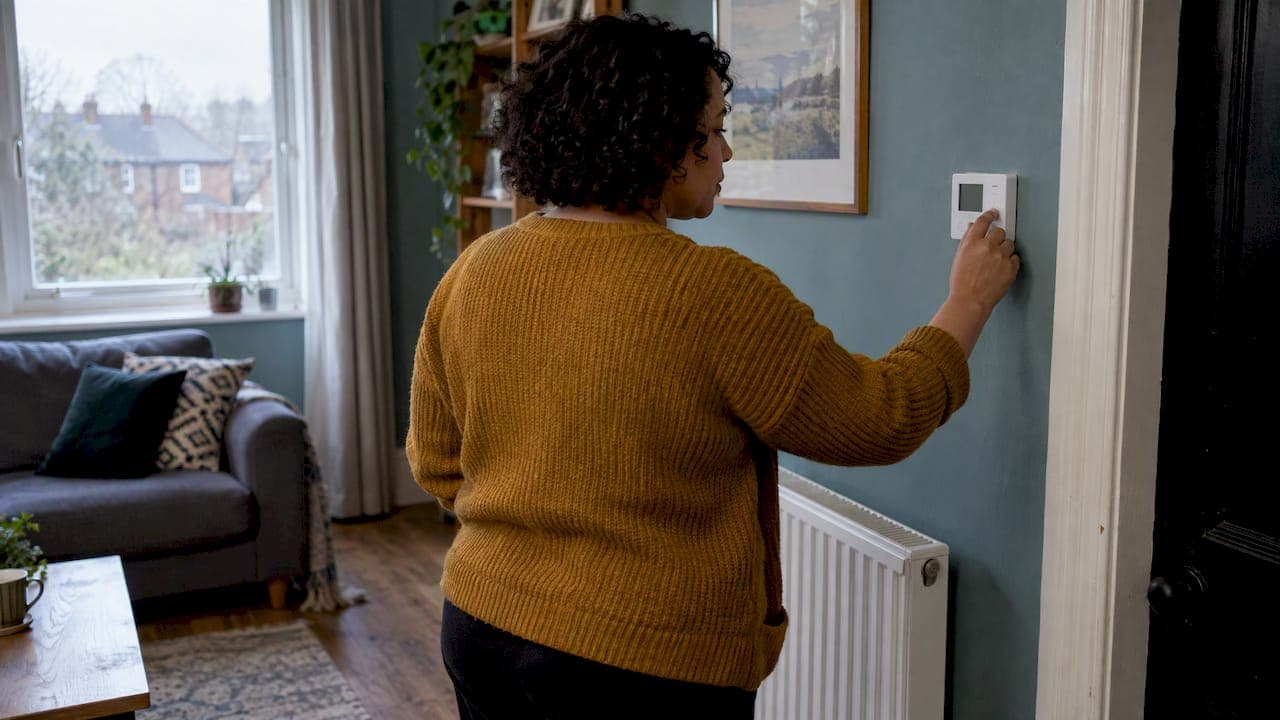
If your room thermostat is not working, the cause is usually simple: flat batteries, a setting that is too low, a programmer that is not asking for heat, or a wireless link that has dropped. Work through the checks below in order, because most of them take a few minutes and need no tools. If the heating still will not start, the fault is likely a failed thermostat, a wiring problem or the boiler itself, and that is the point to call an engineer.
TL;DR
- Turn the thermostat up well above the room temperature first. A thermostat set below the current temperature will never ask for heat.
- Replace the batteries, then check the programmer or timer and the power supply to the boiler.
- On a wireless model, check the receiver lights, the distance and any interference, then re-pair the two units following the maker's instructions.
- A basic replacement thermostat typically costs between £75 and £200 fitted, but wiring faults and boiler faults need a qualified engineer.
- If the heating is off in cold weather and the checks fail, book an engineer rather than keep resetting the boiler.
Table of Contents
- How a room thermostat works (and why it seems to fail)
- Start with the quick checks
- Thermostat not calling for heat
- Wireless thermostat not working or not communicating with the boiler
- Is it the thermostat, or something else?
- When to replace a room thermostat
- Our perspective
- When we can help
- A safe order of checks to print
- FAQ
- Sources
How a room thermostat works (and why it seems to fail)
A room thermostat does one job. It senses the air temperature where it is fitted and tells the boiler to fire up when the room is colder than the setting, and to stop when it is warmer. It does not control how hot the radiators get. That is the boiler's own flow temperature and, room by room, the radiator valves.
That is why a "faulty" thermostat is often something else. The thermostat may be working perfectly while the programmer is off, the boiler has no power, or a radiator valve is closed. It may also be fine but misleading, because it sits in a draught, in direct sun or above a heat source and reads the wrong temperature.
It helps to know which of these you are dealing with:
| What you see | Most likely cause |
|---|---|
| Blank display | Flat batteries or no power to a wired unit |
| Display works but boiler never fires | Setting too low, programmer off, wireless link lost, or boiler fault |
| Heating runs but never switches off | Thermostat in the wrong place, stuck contacts or a wiring fault |
| Heating comes on at odd times | Programmer clock wrong after a power cut |
| Some radiators cold, others hot | Radiator valve or balancing issue, not the thermostat |
Start with the quick checks
These are the same checks that consumer guidance from heating bodies and councils recommends before anyone is called out.
1. Turn the thermostat up
OFTEC's consumer advice says to turn the room thermostat temporarily to its maximum setting to see whether the heating starts. Do this before anything else. Citizens Advice likewise says to make sure the thermostat is set above the current room temperature.
If you hear a click and the boiler starts within a minute or two, the thermostat was simply set too low. Turn it back to a sensible temperature afterwards so you are not paying to overheat the house.
2. Change the batteries
Batteries are the commonest cause of a dead digital or wireless thermostat. Fit fresh alkaline batteries of the right type, even if the display still shows something. A weak battery can run the screen but not transmit a signal to the boiler.
3. Check the programmer or timer
The thermostat only matters when the programmer is calling for heating. Check that the time and day are right, which is easy to get wrong after a power cut, and that the heating is set to on, not off. OFTEC suggests setting heating and hot water to permanently on while you test.
Citizens Advice also points to summer or off modes on the boiler or programmer, and to the clock and schedule.
4. Check power and credit
Even a gas boiler needs electricity. City of York Council's heating advice notes that central heating still needs power when the fuel is gas, and tells tenants to check any meter credit. If you are on a prepayment meter, check you have credit for both gas and electricity. Look at the fused spur next to the boiler and at your consumer unit too, in case a trip switch has dropped.
5. Look at the boiler
Check the boiler display for a fault code or lock-out, and check the pressure gauge. Most combi boilers need roughly 1 to 1.5 bar when cold, but follow your own manual. If your boiler is showing a fault code, our guide to what to check when a boiler is not responding to the thermostat walks through the next steps. If the burner tries to light but fails, see causes of a boiler not igniting.
Never remove the boiler casing or touch gas components yourself. That is work for a Gas Safe registered engineer.
Thermostat not calling for heat
When readers search for a thermostat "not calling for heat", they mean the thermostat looks fine but the boiler stays off. Here is a simple test that separates the two halves of the problem.
- Set the programmer to continuous on.
- Turn the thermostat to maximum.
- Listen at the boiler, or ask someone to watch it while you adjust the thermostat.
- Turn the thermostat to minimum and see if the boiler stops.
If the boiler responds to the thermostat, the control is working and your real problem is the setting, the position or the schedule. If the boiler never reacts, the fault is in the thermostat, its wiring or its receiver, or the boiler is not accepting the call for heat.
A wired thermostat that is dead with good power often has a failed switch or a loose connection at the back plate. Both are jobs for someone competent to isolate the circuit and test it. Do not poke at terminals with the heating circuit live.
Wireless thermostat not working or not communicating with the boiler
A wireless thermostat has two parts: the unit on the wall and a receiver wired to the boiler. Most communication faults sit between them.
Check the batteries and the distance
Fresh batteries come first. Then think about what has changed. Has the thermostat moved? Has a large metal object, a new router or another wireless device been put near the receiver? Manufacturer fault-finding guidance, such as this wireless room thermostat fault-finding sheet, advises fresh batteries, keeping the unit away from large metal objects and other wireless devices, and checking the status lights on the receiver.
Read the receiver lights
Most receivers have lights that show power, a call for heat and signal status. If they indicate a lost connection, the maker's instructions will describe how to link the thermostat and receiver again. Every brand differs, so use your model's own instructions rather than a generic guide.

Re-pair the two units
Drayton Controls lists troubleshooting steps for its Digistat RF: when the thermostat is not communicating with its receiver, replace the batteries and recommission the two units. The principle is the same for other brands. Fit new batteries, put the receiver into its learn or link mode, then send a signal from the thermostat.
Move it closer as a test
If pairing works only when the thermostat is held next to the receiver, you have a range or interference problem. Moving the receiver to a better spot, or the thermostat nearer to it, may solve it. If the receiver is fixed inside the boiler or a cupboard, an engineer can usually relocate it.
Smart thermostats
Smart models add Wi-Fi, an app and often a hub. If the app shows the thermostat offline, restart the router and hub, then check the thermostat's own display. Remember that an internet fault does not usually stop the thermostat controlling the boiler through its own receiver, but it can stop schedules and remote control from working.
Is it the thermostat, or something else?
Before you buy a new thermostat, rule out the neighbours.
- Thermostatic radiator valves (TRVs). If rooms are cold but the boiler runs, a stuck valve pin may be the cause. Our piece on why thermostatic valves matter for home heating explains what they do. City of York Council also lists the radiator valve among the checks.
- Radiators that stay cold. Cold spots at the bottom or top are a circulation or air problem. Start with common radiator problems and quick fixes or the radiator cold at the bottom checks.
- No heating at all. If the checks above fail and the whole system is dead, read central heating does not work: fix it fast.
- Thermostat position. A thermostat in direct sun, a draught, above a radiator or on a cold external wall reads the wrong temperature. The heating then cuts out early or runs too long. It is not broken, just badly sited. A hallway or main living space, away from heat sources and out of draughts, is the usual choice.
When to replace a room thermostat
Replace the thermostat when you have confirmed that the programmer is calling for heat, the boiler has power and no fault, the batteries are new, and the thermostat still does nothing or behaves erratically. Other signs are a cracked or unresponsive display, a unit that feels hot or smells burnt, or a clicking relay that does not match the boiler's behaviour.
Old wireless thermostats and receivers are often replaced as a pair, since parts of different makes rarely pair together. Compatibility with the boiler matters too, so check the boiler's control inputs before you buy.
Who should fit it
Swapping like-for-like on a low-voltage, battery-powered thermostat is simple. Anything involving mains wiring is different. Under Part P of the Building Regulations, certain electrical work in a dwelling must be notified or done by a registered competent person. Work at the boiler's terminals touches a gas appliance and needs a Gas Safe registered engineer. If you are unsure, do not open anything. OFTEC likewise suggests calling a registered technician if you are unsure about any check. That applies to oil systems, but the principle holds for any heating.
How much does it cost?
MyBuilder's price guide says replacing a thermostat in the UK typically costs between £75 and £300, and £75 to £200 for the unit plus professional fitting on a standard job. The same guide puts the unit itself at roughly £15 to £30 for a standard thermostat, £50 to £150 for a programmable one and £130 to £250 for a smart model.
The spread comes from the type of thermostat, how easy the wiring is, and whether the receiver or programmer also needs to change. Ask for a fixed price before work starts.
Our perspective
Most thermostat call-outs we hear about end up being something small: a battery, a programmer set wrong after a power cut, or a receiver that lost its link. We would rather you fix those yourself in ten minutes than pay anyone. That is why we put the free checks first.

Where people lose money is replacing a working thermostat because the boiler was the real fault, or paying a premium because the heating went off on a cold night. A good engineer tests the control before condemning it. They check whether the thermostat is sending a call for heat, whether the boiler is receiving it, and only then decide what to replace.
We charge no call-out fee and work on a no fix, no fee basis, with payment only after the work is done successfully and a 12-month warranty on our work. You speak directly to the engineer. Our published rate for heating and boiler work is £110 per hour. If the cause turns out to be the boiler and not the thermostat, we say so, and a new boiler is quoted free on site. For a broader look at pricing, see our guide to avoiding emergency markups on central heating repairs.
— Michael
When we can help
If your thermostat checks have failed, or the heating is off in cold weather, we can help. Our emergency heating engineer service offers a 60 minute response time, available 24/7 including holidays, with no call-out fee. Heating and boiler work is charged at £110 per hour, and you pay only after the job is completed successfully.
If the thermostat is fine and the boiler is beyond economic repair, new boilers supplied and fitted start from £1,300, and you can request a free new boiler quote. For other jobs, see everything we cover on our main site.
A safe order of checks to print
- Thermostat turned up above room temperature.
- Batteries replaced.
- Programmer time, day and mode correct, heating on.
- Power to the boiler, spur switched on, meter credit available.
- Boiler shows no fault code and pressure is in the range in the manual.
- Wireless: receiver lights checked, units re-paired, nothing metal or electrical in between.
- Radiator valves open.
- Still nothing: stop, and call a registered engineer.
If you smell gas or suspect carbon monoxide, turn off the appliance, open windows and call the National Gas Emergency Service on 0800 111 999. Do not wait for a thermostat appointment.
FAQ
Why is my thermostat on but my boiler will not fire up?
Start by turning the thermostat to its maximum and checking that the programmer is set to on. Then check that the boiler has power, no fault code and enough pressure. If all of those are fine, the thermostat's switch, its wiring or the wireless receiver is the likely fault, and an engineer should test it.
How long does a room thermostat last?
There is no fixed life span. A simple wired thermostat can run for many years, while electronic and wireless units age faster because of batteries and radio components. Replace one when it becomes unreliable and basic checks do not fix it, rather than on a set date.
Can I replace a room thermostat myself?
A like-for-like battery-powered unit is a reasonable job if you are confident and follow the manufacturer's instructions. Mains-wired replacements are covered by Part P rules, and anything at the boiler's terminals should be left to a Gas Safe registered engineer. When in doubt, ask someone qualified.
Where should a room thermostat go?
Fit it in a main living space or hallway, away from direct sun, draughts, radiators and cold external walls. A badly placed thermostat can make the heating cut out too early or run too long even when the unit itself works perfectly.
How do I know if the fault is the thermostat or the boiler?
If the boiler fires when you turn the thermostat to maximum, the boiler works and the thermostat or its settings need attention. If it does not react at all and the programmer is calling for heat, the boiler or the wiring between them is more likely at fault.
Sources
- Trouble shooting tips, OFTEC consumer advice
- Heating and hot water advice, City of York Council
- Getting your broken boiler repaired or replaced, Citizens Advice
- Wireless Room Thermostat Fault Finding
- Frequently Asked Questions, Drayton Controls
- Electrical Safety, Milton Keynes Council
- Thermostat Replacement Costs, MyBuilder