TL;DR:
- Plumbing certification recognizes a tradesperson's competency through training, experience, and examinations. It determines legal practice scope, employment opportunities, and professional credibility across different countries. Ongoing documentation and understanding jurisdiction-specific requirements are crucial for career advancement and compliance.
Plumbing certification is the formal credential granted to individuals who have fulfilled designated training, experience, and examination requirements to work professionally and legally in the plumbing trade. In the UK, this is most commonly understood through qualifications such as City & Guilds Level 2 and Level 3 Diplomas, while internationally the term covers everything from journeyman licences in US states to competency-based registration frameworks in Australia. Understanding plumbing certifications matters because the credential you hold determines what work you can legally carry out, who will employ you, and how much professional credibility you carry with clients. The distinction between a certificate, a licence, and a specialty credential is not merely administrative. It shapes your entire career trajectory.
What is plumbing certification and what does it actually mean?
Plumbing certification is defined as official recognition that a tradesperson has met a prescribed set of competency standards, typically covering technical skills, safety knowledge, and regulatory awareness. The industry term most commonly used alongside "certification" is licensure, and the two are not interchangeable. A certificate confirms you have completed a training programme. A licence, issued by a regulatory body, is the legal permission to practise.

In the UK, the recognised route runs through City & Guilds or BTEC qualifications, followed by registration with bodies such as CIPHE (Chartered Institute of Plumbing and Heating Engineering) or WaterSafe. In the United States, certification requirements vary by state, with West Virginia requiring applicants to certify their experience and pass a written exam before any licence is issued. Australia operates through state-level bodies such as Victoria's Victorian Building Authority (VBA), which links formal training qualifications directly to licensing class. What plumber accreditation means in one country can differ substantially from what it means in another, which is why understanding the local framework is the first step for any aspiring plumber.
What are the typical requirements to obtain plumbing certification?
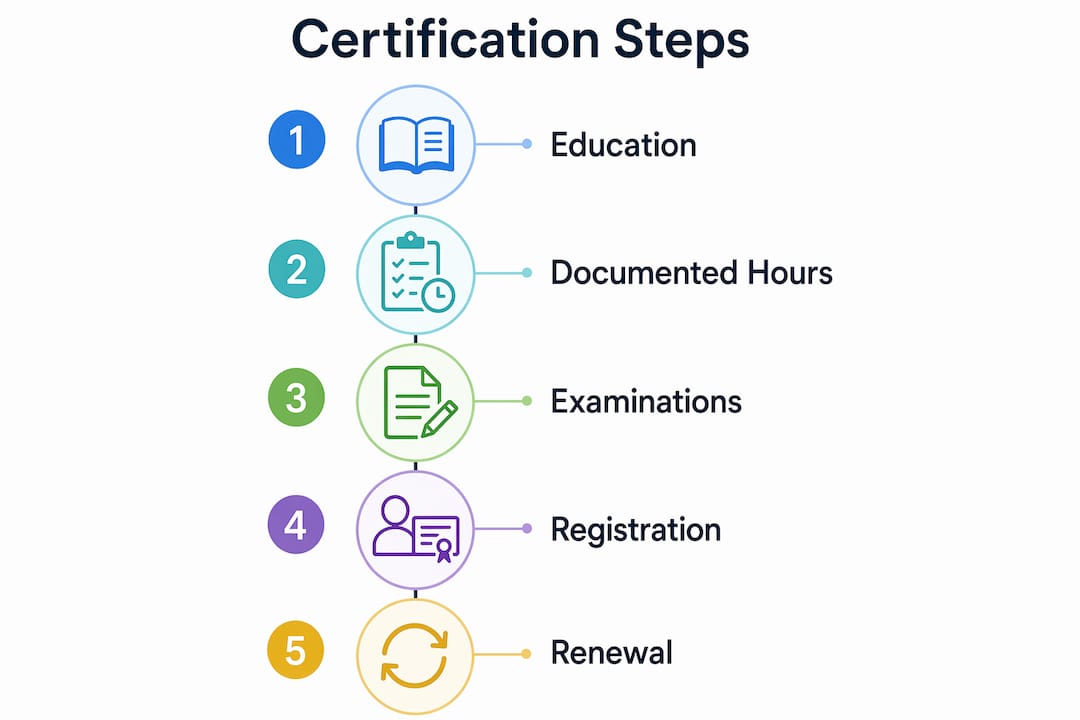
Plumbing certification requirements follow a broadly consistent pattern across most jurisdictions: formal education, documented supervised work experience, and a written or practical examination. The exact figures, however, vary considerably.
Utah provides one of the most detailed published frameworks. The state's journeyman plumber licence requires 576 classroom hours, 8,000 supervised experience hours, and passing both theory and practical exams. An alternative pathway demands 16,000 hours of supervised experience in lieu of classroom study. This illustrates a principle that applies globally: regulators accept different combinations of education and experience, but they rarely accept one without the other.
Victoria's VBA takes a competency-based approach. The authority prescribes five mandatory licence units for plumbers, covering plan-reading, regulatory interpretation, risk management, and costing. These units are tied to the Certificate IV in Plumbing Services, meaning formal training and licensing are structurally linked rather than treated as separate tracks.
The typical plumbing certification process involves:
- Apprenticeship enrolment: Registering with a recognised training provider or employer-led apprenticeship scheme
- Classroom study: Completing the required theory hours covering building regulations, materials science, and health and safety
- Supervised on-site hours: Accumulating documented work experience under a qualified plumber, with records signed off by a supervisor
- Written examination: Passing a theory test covering codes, regulations, and technical knowledge
- Practical assessment: Demonstrating hands-on competency in tasks such as pipework installation, jointing, and fault diagnosis
- Licence application: Submitting evidence of all the above to the relevant regulatory body
Pro Tip: Keep a detailed logbook of every supervised work hour from day one. Regulators require documented evidence of apprenticeship hours, and gaps in records are the most common reason licence applications are delayed.
How do plumbing certification types and legal scopes vary internationally?
The plumbing certification process is not uniform. Regulatory frameworks differ by country, by state or region within a country, and sometimes by the type of work being performed. The table below compares key jurisdictions.
| Jurisdiction | Regulatory body | Certification type | Legal scope |
|---|---|---|---|
| United Kingdom | WaterSafe, CIPHE, Gas Safe Register | City & Guilds / BTEC Diploma | Required for notifiable plumbing work and gas work |
| United States (Utah) | Utah Division of Occupational and Professional Licensing | Journeyman / Master Plumber Licence | State-specific; must pass theory and practical exams |
| United States (West Virginia) | WV Division of Labor | Plumber Certification | No plumbing work permitted without a Division-issued licence since 2009 |
| Australia (Victoria) | Victorian Building Authority | Certificate IV linked licence units | Five prescribed units mandatory for registration |
| United States (California) | State Water Resources Control Board | ASSE 5110 Specialty Certification | Backflow prevention testers only; separate from general licensure |
Specialty certifications occupy a distinct category. California officially recognises ASSE 5110 certification for backflow prevention assembly testers, meeting requirements under the state's Cross-Connection Control Policy. This credential is legally recognised but applies only to that specific function. It does not grant the holder permission to carry out general plumbing work.
This distinction matters for anyone planning a career. Specialty certifications complement general licensure rather than replacing it. A plumber who holds an ASSE 5110 credential alongside a full journeyman licence can offer a broader range of services and command higher fees. One who holds only the specialty credential cannot legally perform standard plumbing installations. Understanding UK plumbing regulations and their equivalents in your target jurisdiction is therefore not optional. It is the foundation of a compliant practice.
Why does plumbing certification matter for your career?
Plumbing certification is the primary mechanism through which the trade distinguishes competent, legally authorised practitioners from unqualified workers. For anyone considering the profession, the credential is not a bureaucratic hurdle. It is the asset that unlocks career progression.
The role of plumbing certifications in career development operates on several levels:
- Legal authorisation: Without the appropriate licence, performing notifiable plumbing work exposes you and your client to legal liability. Certification removes that risk.
- Employability: Contractors, local authorities, and housing associations require proof of qualification before engaging tradespeople. A City & Guilds Level 3 or equivalent is the baseline expectation for most commercial roles.
- Progression to master level: In jurisdictions that recognise a master plumber classification, such as many US states, candidates must first hold a journeyman licence for a specified period before applying. Certification is the ladder, not just the door.
- Access to specialisations: Credentials in areas such as gas safety (Gas Safe Register in the UK), underfloor heating, or backflow prevention allow plumbers to enter higher-value markets.
- Client confidence: Homeowners and businesses are increasingly aware of rogue traders. Displaying recognised credentials, whether WaterSafe approval or a City & Guilds certificate, directly influences hiring decisions.
Pro Tip: If you are targeting commercial contracts in the UK, registration with CIPHE or membership of the Association of Plumbing and Heating Contractors (APHC) carries significant weight with procurement teams. These bodies signal professional accountability beyond the minimum licence requirement.
Auburn University's Plumbing Technician programme illustrates a common scenario: the programme includes OSHA 10-hour certification as part of its national credential package, yet completion does not guarantee full state plumbing licensure in every US state. This gap between a training certificate and a legal licence is one that catches many new entrants off guard.
What are common misconceptions about the plumbing certification process?
Several misunderstandings consistently trip up people entering the trade. Addressing them early saves significant time and money.
-
"Completing a course means I am certified." A training certificate confirms you have studied a subject. Licensure requires documented supervised work hours on top of that study. Documented apprenticeship hours are a non-negotiable component of most licence applications, not an optional extra.
-
"One certification covers all plumbing work." Different licence classes cover different scopes of work. In Victoria, the prescribed units required vary by licensing class, meaning a plumber licensed for drainage work is not automatically authorised to carry out gasfitting. Always check the scope attached to your specific credential.
-
"A specialty certification replaces a general licence." Specialist credentials such as ASSE 5110 for backflow prevention are regulatory compliance specific and legally separate from general licensure. Holding one does not grant permission to perform work outside its defined scope.
-
"Once certified, no further action is needed." Most jurisdictions require periodic licence renewal, and many now mandate continuing professional development (CPD) hours as a condition of renewal. In the UK, Gas Safe registration must be renewed annually.
-
"The cheapest or fastest course is equivalent to a full qualification." Short online programmes may provide useful knowledge, but they rarely satisfy the supervised experience and examination requirements that licensing boards demand. Choosing the right qualification for your target licence class from the outset avoids costly repetition.
Key takeaways
Plumbing certification is a multidimensional credential that combines formal education, documented experience, and examination to grant legal authorisation to practise, with requirements and scope varying significantly by jurisdiction.
| Point | Details |
|---|---|
| Certification versus licence | A certificate confirms training completion; a licence grants legal permission to practise plumbing work. |
| Experience hours are mandatory | Documented supervised hours are required alongside coursework; course completion alone is insufficient for licensure. |
| Scope varies by credential | Different licence classes and specialty certifications cover distinct scopes of work and cannot substitute for one another. |
| Jurisdiction shapes requirements | Utah, West Virginia, Victoria, and the UK each operate distinct frameworks with different hour and exam requirements. |
| Ongoing compliance is required | Most licences require periodic renewal and continuing professional development to remain valid. |
My view on navigating plumbing certification pathways
Working alongside certified plumbers and engineers for years, the single most consistent observation I have is this: the people who struggle with certification are almost never short on skill. They are short on paperwork. Supervised hours that were never logged, supervisors who have moved on and cannot sign off records, training certificates that do not align with the licence class being applied for. These are avoidable problems that delay careers by months.
My advice is to treat documentation as part of the job from your first day on site. Keep a dedicated folder, physical or digital, with every hour logged, every supervisor's contact details, and every course certificate. When you reach the application stage, you want to be assembling evidence, not hunting for it.
The other point worth making is about specialty credentials. Many plumbers treat them as an afterthought, something to pursue once the main licence is secured. I think that is the wrong order of thinking. Identifying which specialisations align with your target market, whether that is commercial gas work, water treatment, or underfloor heating, and planning your certification pathway around those goals from the start produces a far more coherent career trajectory. The role of plumbing certifications in legal compliance is well documented. Their role in shaping a genuinely differentiated career is underappreciated.
— Michael
See professional plumbing standards in practice
Understanding what plumbing certification requires is one thing. Seeing what certified, experienced engineers actually deliver is another.

Your-local-plumber works with fully qualified engineers who meet UK regulatory standards across a full range of services, from emergency repairs to complete installations. If you are considering a career in plumbing and want to understand the standard of workmanship that certification enables, the Your-local-plumber gallery showcases completed projects that reflect what professional, compliant plumbing looks like in practice. For anyone already working in the trade or looking to hire a certified professional, Your-local-plumber provides transparent pricing and fast local response across its service area.
FAQ
What is the difference between a plumbing certificate and a plumbing licence?
A plumbing certificate confirms that an individual has completed a training programme covering technical and regulatory knowledge. A licence, issued by a regulatory body such as the WV Division of Labor or Utah's DOPL, is the legal authorisation to perform plumbing work and requires documented supervised experience and examination in addition to any certificate.
How many hours of experience are needed for plumbing certification?
Requirements vary by jurisdiction. Utah's journeyman plumber licence requires 8,000 supervised hours alongside 576 classroom hours, with an alternative pathway requiring 16,000 supervised hours. UK apprenticeships typically run three to four years and combine on-site experience with college attendance.
Do specialty plumbing certifications replace a general licence?
No. Specialty certifications such as ASSE 5110 for backflow prevention testers are legally recognised for their specific scope only and do not substitute for a general plumbing licence. Plumbers typically hold both a general licence and one or more specialty credentials to expand their service offering.
Does a plumbing certificate guarantee a licence in every region?
No. Auburn University's Plumbing Technician programme, for example, includes national certification but does not guarantee full state licensure in every US state. Each jurisdiction sets its own requirements, and a certificate from one region may not satisfy the conditions of another.
How often does a plumbing licence need to be renewed?
Renewal periods vary. In the UK, Gas Safe registration requires annual renewal. Many US states require licence renewal every one to three years, often with continuing professional development hours as a condition. Checking the specific renewal schedule for your jurisdiction is the only reliable way to stay compliant.