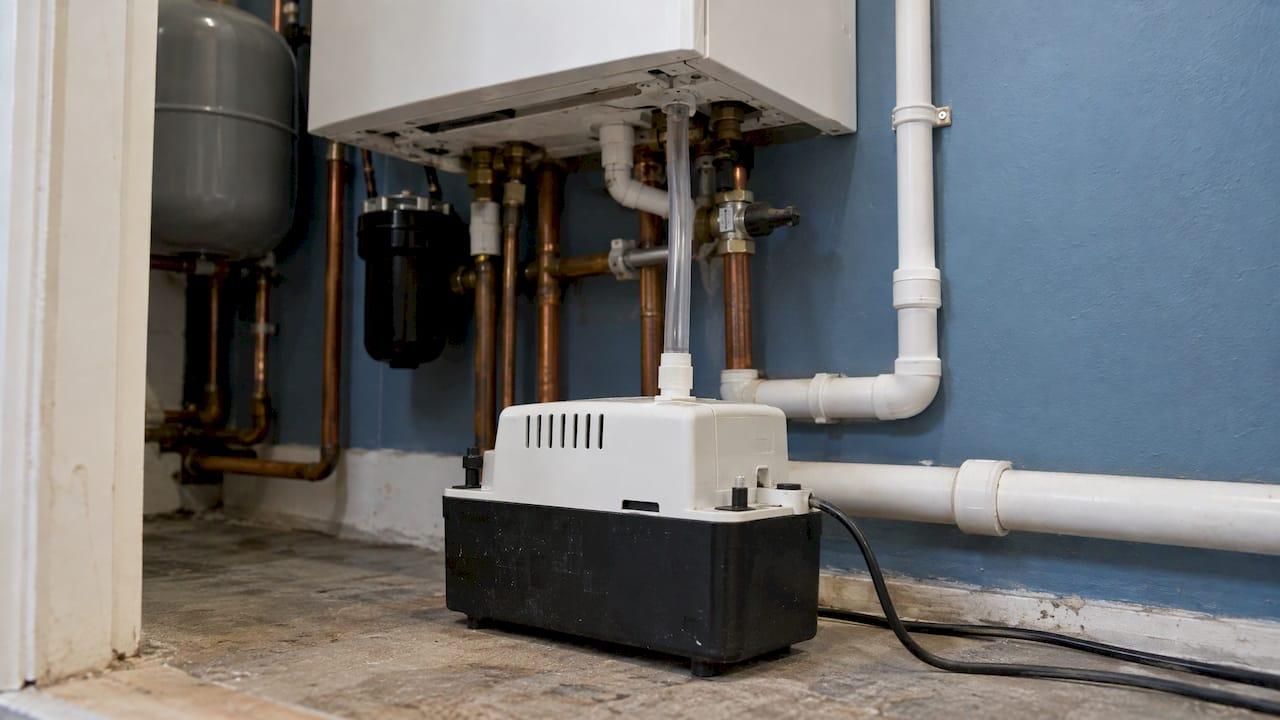
A condensate pump running for a short burst every so often is normal. One that runs non-stop, or keeps starting and stopping with nothing coming in, is telling you that water is not leaving the tank properly or is coming back into it. The usual culprits are a kinked or blocked discharge hose, a stuck float, a leaking check valve or a build-up of sludge. This guide explains how to tell which one you have, which checks are safe for a homeowner, and when to stop and call an engineer.
TL;DR
- A short, smooth run each time the tank fills is normal. A pump that never stops, or restarts every few seconds, needs looking at.
- Most causes are about the water path: a kinked or blocked hose, too much lift, a stuck float, dirt around the level sensor or a leaking check valve.
- Switch off and isolate the power before you touch anything. Never open the pump casing or a boiler casing, and never bypass a safety switch.
- A red warning light that stays on, or a boiler that shuts down, means call a qualified engineer.
- We are available 24/7 for heating and boiler emergencies, with no call-out fee.
Table of Contents
- What a condensate pump does and why it runs
- Why the pump runs constantly
- Why a condensate pump keeps cycling
- Gurgling and other noises
- Safe checks you can make at home
- When to switch off and call an engineer
- Keeping the pump trouble-free
- Our view: fix the cause, not the symptom
- Need a hand with a pump that will not stop?
- FAQ
- Sources
What a condensate pump does and why it runs
A modern condensing boiler produces acidic water as a by-product of burning gas efficiently. This is normally carried away by a plastic condensate pipe that falls to a drain. Where there is no suitable fall to a drain, for example a boiler in a utility room, basement or internal kitchen, a small pump is fitted to lift the water away. The same type of pump is used with air conditioning units.
The pump has a small tank. Condensate collects until a float reaches its operating level, then the pump starts and pushes the water out through a small-bore discharge pipe. According to a UK pump supplier's guide, a tank pump collects condensate in a reservoir and starts when the water reaches its operating level. That is why you hear it come on every now and then while the heating or hot water is in use.
So "running" on its own is not the fault. What matters is the pattern:
- Normal: a short, smooth whirr that clears the tank, then silence for minutes. The boiler is working harder in cold weather, so you will hear it more often in winter.
- Suspicious: it runs for a long time without the tank emptying, or runs continuously even when the boiler is off.
- Suspicious: it stops for a second or two, then starts again with nothing new coming in.
- Suspicious: gurgling, grinding or rapid clicking, or any sign of water around the unit.
Why the pump runs constantly
A pump that never switches off is in one of two situations. Either water keeps arriving, or the pump cannot empty its tank. Working out which one applies stops you blaming a perfectly good pump. Here are the common causes in rough order of how often they turn up.
A kinked or blocked discharge hose
The small outlet pipe is easy to squash behind a boiler, or to trap when a cupboard door or boxed-in pipe is moved. Pump manufacturer Hartell notes that a kinked or blocked discharge hose can restrict flow enough to stop the reservoir emptying, which keeps the pump running. If the pump hums and runs but the water level in the tank never drops, this is the first place to look.
Too much lift, or a poorly routed pipe
Every pump has a maximum vertical lift. If the discharge pipe climbs higher than the pump can manage, it cannot clear the tank. Hartell also lists excessive vertical lift as a reason the reservoir will not empty. Routing matters as well: a pipe that dips and sags creates low points that hold water, and a line that is not properly sloped or vented can trap air.
This is most often a problem after a boiler swap, a kitchen refit or a pipe move, when the discharge route has changed since the pump was last behaving well.
Water flowing back down the pipe
A check valve sits in the outlet to stop water draining back into the tank once the pump stops. If it is leaking or failing, the water returns, the float rises again and the pump restarts. That produces the classic pattern: the pump stops for a second or two, then restarts with nothing coming in. Hartell says a failing or leaking check valve can cause frequent start-stop cycling, and the same pattern is described in this pump troubleshooting guide.

A stuck float or dirty level sensor
A float that sticks in the "up" position tells the pump the tank is permanently full. Sludge, algae and mineral deposits can cause this, or false triggers where the float registers a level that is not there. Hartell lists sludge or algae as a cause of false float triggers. Contamination around the level control is also named as a cause of repeated cycling in BHL's guide.
A partly blocked drain line
Algae, mould, sludge and mineral deposits can build up in the condensate drain line, restricting flow so that the reservoir overflows or the pump keeps running, as a heating and cooling supplier explains. Where the pump is part of a boiler installation, a partial blockage can also appear in winter as an iced-up external section, which we cover below.
Plenty of water coming in
Sometimes the pump is fine. If the source appliance is working hard, if another appliance shares the same drain, or if a sagging pipe suddenly releases standing water, the pump will legitimately run for longer. With an air conditioner running all day in hot weather, this is normal. Check whether the run time drops once the source has been off for a few minutes.
A failing motor or seized impeller
If the pump hums but does not move water, the discharge line may be blocked, the check valve may be obstructed or the impeller may be seized. A pump that hums and warms up without spinning has a failing motor. In that case the practical fix is replacement, and the pump should be fitted by a heating engineer.
Why a condensate pump keeps cycling
Rapid on-off cycling is not the same as constant running, though the causes overlap. If the pump runs for a couple of seconds, stops and runs again, think backflow first. Hartell points to a failing or leaking check valve, air trapped in the discharge line, or a line that is not properly sloped or vented. Sludge or algae causing false float triggers is the other usual suspect.
A quick way to tell the difference:
| What you notice | Likely cause | What it points to |
|---|---|---|
| Runs continuously, tank stays full | Kinked or blocked hose, too much lift | Water path problem |
| Runs continuously, tank is nearly empty | Stuck float or dirty sensor | Level control problem |
| Stops for a second or two, then restarts | Leaking check valve, backflow | Valve problem |
| Runs then stops, returns every few minutes | Normal operation | Nothing to fix |
| Hums but no water moves | Blocked line, seized impeller, failing motor | Engineer visit |
Treat the table as a guide to what to look at first, not a diagnosis. The tank, outlet and level control all work together.
Gurgling and other noises
A brief, smooth cycle is normal. Gurgling can suggest trapped air, a partial blockage in the discharge or irregular flow into the reservoir. Grinding can mean debris or worn bearings, and rapid clicking can point to float switch or relay trouble. That summary comes from a US inspection company's guide, and the general point stands: persistent abnormal noise, overflow or no discharge deserves inspection.
On a boiler, gurgling has another common source. A blocked condensate pipe can cause gurgling before the boiler locks out, and Ideal's user guide says a frozen blockage is likely at an exposed external section, a bend, an elbow or a dip. It also notes that accessible pipework at ground level can be thawed with a hot-water bottle, heat pack, warm cloth or warm, not boiling, water. Noise also travels through a heating system, so work out whether it is coming from the pump, the boiler, a radiator or the pipework. Viessmann's advice lists trapped air, low water pressure and a frozen condensate pipe among the causes of boiler gurgling.
If the noise seems to be the boiler rather than the pump, our guide to a boiler gurgling noise goes through it in more detail. If it is a circulating pump you can hear instead, see our central heating pump noise guide.
Safe checks you can make at home
These are checks that do not need tools and do not involve opening anything. Stop at any point where you would have to take a cover off.
- Switch off and isolate. Turn the boiler off at its switch, and switch off the pump at its plug or fused spur before you touch anything near it. The manufacturer's installation manual says to switch off and secure the power before maintenance. Beckett's guidance is to disconnect the pump from the electrical supply before servicing.
- Look for water. If there is a puddle or the tank is overflowing, contain it with towels or a shallow tray. If it is a leaking air conditioner, do not keep running it.
- Trace the discharge hose. Follow it from the pump to where it ends. Look for kinks, squashed sections, sagging runs where water sits and anything that has been moved or boxed in.
- Check the power. If the pump is not behaving at all, confirm it has power. Hartell and Beckett both list this as an early check.
- Look at the outside run. In frosty weather, check any external condensate pipe for ice, and use only the warm-water method above on accessible ground-level sections.
- Note the pattern. Time how long it runs and whether it stops when the boiler is off. Write down what the warning light is doing. This information is exactly what an engineer wants.
What not to do
- Do not open the pump casing. The manufacturer's manual says live voltage is present and that only a heating engineer may install or open the pump.
- Do not remove a boiler casing or touch gas components. Work on gas appliances in the UK must be carried out by a Gas Safe registered engineer.
- Do not bypass or disconnect an overflow or safety switch. When connected, that switch shuts off the boiler to prevent further condensate building up if the pump malfunctions. If a pump is wired only to power with no correctly connected high-water safety link, a failure or blocked outlet could let the source appliance carry on producing condensate and overflow, as this guide to condensate pumps points out.
- Do not keep pressing reset. Repeated alarms, odd noises, cycling or overflow should be investigated, not reset again and again.
Any new fixed wiring for a pump or any mains investigation should be done by a competent person working to BS 7671.
When to switch off and call an engineer
Call a qualified engineer if any of these apply:
- The red warning light on the pump lights or flashes for a long time. The Glow-worm installation manual tells the user to contact a qualified installer in that case, as it indicates a fault or defect.
- The boiler has shut down or locked out and will not restart. A connected high-level switch may be doing exactly what it is designed to do.
- The pump hums but moves no water, or hums and gets hot.
- Water is escaping from the tank, the pipework or the boiler.
- The pump runs continuously after you have checked the hose and the water path.
- You can smell burning or see scorching around the pump or its plug.
Water around a boiler is a separate worry in its own right, so if you find any, our guide on a boiler leaking water covers the safe first steps. If the boiler is showing a code, common boiler fault codes may help you read it before you call. If your radiators or circulation are the problem instead of the condensate, see heating pump not working.
Keeping the pump trouble-free
A little regular attention goes a long way, because most of the faults above come from dirt, kinks and low points rather than worn-out parts.
- Keep the area clear. Do not stack things against the pump or squash the outlet pipe.
- Listen to it. Once you know what normal sounds like, a change in pattern is easy to spot.
- Have it cleaned at the boiler service. The tank, float and check valve are worth checking at the same visit as the annual boiler service, and an engineer can clear sludge before it makes the float stick.
- Protect the outside run in winter. Keep any external condensate pipe as short and as well insulated as the installation allows, and have an engineer reroute a run that repeatedly freezes.
- Act early on changes. A pump that begins running more than usual after a pipe move, a new appliance or a spell of cold weather is easier and cheaper to put right early.
Our view: fix the cause, not the symptom
We see condensate pump complaints most often in winter, and the story is usually the same: someone has reset the boiler three or four times because the pump keeps running, and by the time we arrive the tank has overflowed or the boiler has locked out.
Our advice is simple. Treat a pump that will not stop as information. It is telling you that water cannot leave, or is coming back. Check the hose, switch off, and then call someone to look at the whole path from boiler to drain, because a new pump on a kinked, sagging or frozen pipe will run just as badly as the old one.
When we attend, we work directly with you rather than through a call centre, and we explain what we found before we start. We do not charge a call-out fee, our no fix no fee guarantee means you pay only after the work is done successfully, and our work carries a 12-month warranty. For heating and boiler repairs our rate is £110 per hour.
If it turns out the boiler itself is the problem, or it is time for a replacement, we can quote for that too, free on site.
Michael
Need a hand with a pump that will not stop?
If you have worked through the checks and the pump is still running, or the boiler has shut down, book our emergency heating engineer. We offer a 60 minute response time and 24/7 availability including holidays, and boiler and heating work is charged at £110 per hour with no call-out fee.

If the pump trouble is a sign the boiler is reaching the end of its life, we supply and fit new boilers from £1,300, and you can request a new boiler quote with a free on-site visit. Over 300 Trustatrader reviews are there if you want to see what other customers say about us.
FAQ
Is it normal for a condensate pump to run?
Yes. The pump is designed to run intermittently: water collects in the tank, the float rises and the pump clears it in a short burst. You will hear it more often when the boiler is working hard, for example on a cold morning. It only becomes a concern if it runs non-stop, restarts every second or two, or makes grinding or rattling sounds.
Why does my condensate pump keep switching on and off?
The most likely reason is water running back into the tank through a leaking check valve, so the float rises again straight after the pump stops. Trapped air in the discharge line, a sagging pipe or sludge around the float can do the same. Because the check valve is part of the pump, an engineer should deal with it rather than you opening the unit.
Can I turn off a condensate pump that will not stop?
Yes, you can switch it off at its plug or fused spur, and you should also turn the boiler off. Do not do this to hide a problem, though, as the boiler cannot safely get rid of its condensate without the pump. Leave the system off and call an engineer, especially if water is escaping.
Why is my condensate pump gurgling?
Gurgling usually means air or a partial blockage in the discharge pipe, or irregular flow into the tank. On a boiler, a blocked or frozen condensate pipe can also gurgle before the boiler locks out. In freezing weather you can safely thaw accessible ground-level pipework with warm, not boiling, water. If the noise returns, have an engineer look at it.
Sources
- Condensate Pumps for Air Conditioning and Boilers, BHL
- Condensate pumps explained, Trust AC
- Residential AC Condensate Pump Troubleshooting, Hartell
- Condensate Pump Won't Shut Off? Disconnect the Inlet, EveryPump
- Condensate Pump Not Draining: A Comprehensive HVAC Guide
- Condensate Pumps 101: Why Your Mechanical Room Is Making That Gurgling Noise
- Ideal Logic Combi ESP1 User Guide
- Why is my boiler making noises? Viessmann UK
- Basic Condensate Pump Maintenance and Troubleshooting, Beckett